

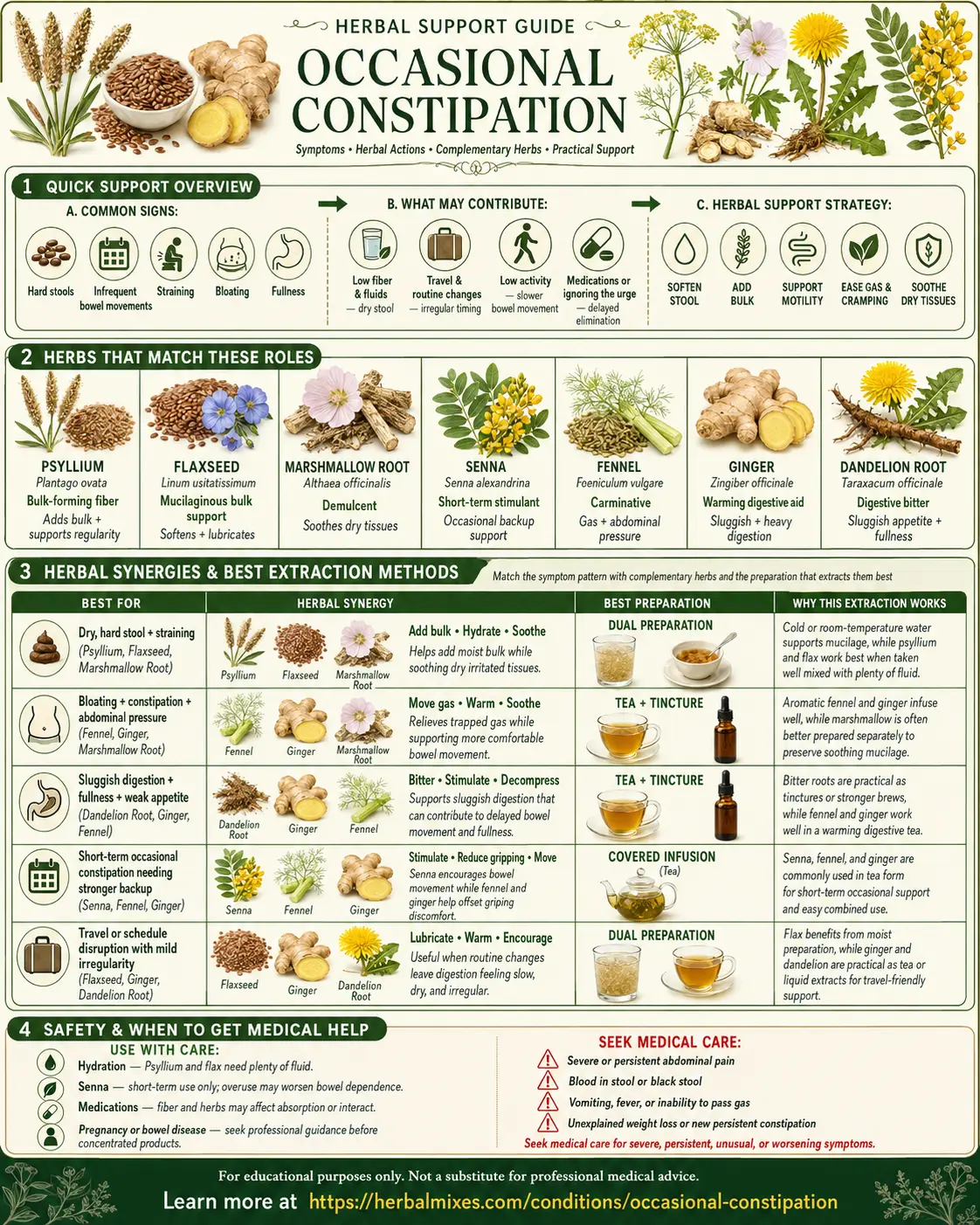
Occasional constipation shows up as infrequent bowel movements, straining, hard or lumpy stool, bloating, and a general feeling of sluggishness. It’s often linked to low fiber intake, dehydration, reduced movement, travel, stress, or a temporary change in routine. Because the underlying pattern varies — a stubborn “stuck” feeling versus stool that’s simply too dry and hard — different herbal approaches tend to work better for different situations.
Herbal Support Strategy
Herbal support for occasional constipation generally combines gentle bulking or bile-supportive herbs for everyday regularity with short-term stimulant herbs reserved for more stubborn episodes. Which herb leads the approach depends on whether the goal is gentle daily support or faster overnight relief.
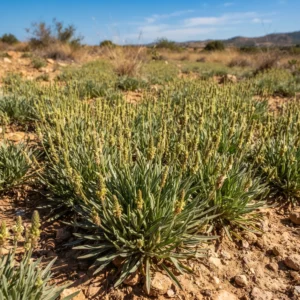




Psyllium (Plantago ovata) — Bulking + demulcent fiber. Absorbs water to form a gel-like bulk that softens and adds volume to stool; best taken with plenty of fluid.
Senna (Senna alexandrina) — Stimulant laxative. Contains sennosides that stimulate bowel muscle contractions; effective for short-term, occasional use rather than daily reliance.
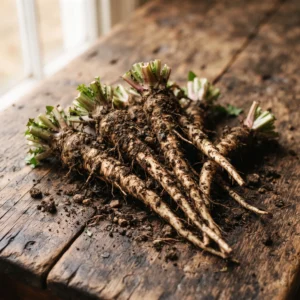
Dandelion Root (Taraxacum officinale) — Bile-supportive digestive tonic. Traditionally used to stimulate bile production, supporting digestion and mild bowel regularity.
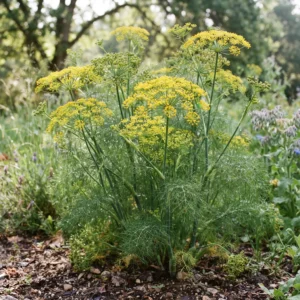
Fennel (Foeniculum vulgare) — Carminative. Traditionally used to ease the gas and bloating that often accompanies constipation.
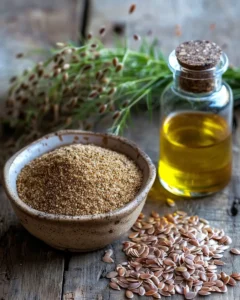
Flaxseed (Linum usitatissimum) — Bulking + demulcent fiber. A gentle source of soluble and insoluble fiber that adds bulk and moisture to stool.
Licorice Root (Glycyrrhiza glabra) — Mild digestive-soothing support. Traditionally used to support healthy mucus production in the digestive tract, which may help ease stool passage.
Herbal Synergies & Best Extraction Methods
Psyllium + Flaxseed Best for: Gentle, everyday regularity support, especially when constipation is linked to low fiber intake. Both are bulking fibers that absorb water to soften stool and add volume; taken together with adequate fluid, they support consistent, comfortable elimination. Best Preparation: Powder/Capsule. Mixed with a full glass of water or added to food; not suited to tea, since fiber needs to be consumed directly.
Senna + Fennel Best for: Occasional, stubborn constipation needing a stronger overnight nudge. Senna stimulates the bowel directly while fennel helps offset any accompanying cramping or gas. Best Preparation: Covered Infusion (Tea), taken before bedtime. A single cup is typically enough; this pairing is intended for short-term, occasional use only.
Dandelion Root + Fennel Best for: Sluggish digestion without urgency, especially after heavy meals or a period of low activity. Dandelion supports bile flow and digestive movement from the top down, while fennel eases bloating along the way. Best Preparation: Decoction. Dandelion root benefits from a longer simmer to draw out its bitter, bile-supportive compounds.
Senna + Licorice Root Best for: Occasional constipation with a harder, drier stool pattern. Senna stimulates bowel movement while licorice traditionally supports mucus production, helping stool pass more comfortably. Best Preparation: Tea + Tincture. A tea works well before bed, with a tincture as a faster-acting alternative when needed.
Psyllium + Dandelion Root Best for: A gentler, longer-term-friendly combination for people who experience occasional constipation regularly. Psyllium adds bulk while dandelion supports the digestive process that moves that bulk along. Best Preparation: Powder/Capsule + Decoction. The psyllium is taken as a powder with water; the dandelion is prepared separately as a decoction or tea.
Available Ready-to-Use Products
If you prefer a ready-made option, these commercially available products contain herbs relevant to the approaches discussed above.
Overnight Occasional Relief — A senna-based tea for stubborn, occasional constipation. Traditional Medicinals — Smooth Move Tea — Built around senna leaf with fennel and licorice, this closely matches the stimulant-laxative strategy for short-term, occasional use.
Gentle Everyday Fiber Support — A daily psyllium husk capsule for ongoing bulk and regularity support. Yerba Prima — Psyllium Husks Caps — Pure psyllium husk aligns with the bulking-fiber strategy for gentle, everyday support when taken with enough water.
Calming Overnight Blend — A senna tea with added chamomile for a gentler, more soothing overnight option. Traditional Medicinals — Smooth Move Chamomile Tea — Combines the same senna dose with a calming addition, useful for those who also experience some digestive tension.
Herbal Properties Required
For occasional constipation, the most useful herbal properties are typically bulking/demulcent, mild stimulant laxative, bile-supportive (cholagogue), and carminative. Bulking herbs add volume and moisture to stool, while stimulant herbs encourage the bowel muscles to move things along when a stronger nudge is needed. Bile-supportive herbs help stimulate digestion from the top down, and carminatives ease any accompanying gas or bloating.





Use With Care
Senna and other stimulant herbs are intended for short-term, occasional use — generally less than one week at a time — since regular use can lead to dependency and reduced bowel responsiveness. Do not use senna if you have diarrhea, loose stools, or unexplained abdominal pain, as it may worsen these conditions. Psyllium and flaxseed must be taken with plenty of water; without enough fluid, they can worsen constipation or cause choking. Bulking fibers can interfere with the absorption of some medications — take them at least 1–2 hours apart from prescription drugs. Consult a healthcare provider before using stimulant laxatives during pregnancy, while breastfeeding, or if you have inflammatory bowel disease.
If you take prescription medication, are pregnant or breastfeeding, or have a medical condition, check with a qualified healthcare professional before using concentrated herbal products.
When to Get Medical Help
Seek medical evaluation if you experience:
- No bowel movement for more than a week, or constipation that doesn’t respond to home care
- Severe abdominal pain, bloating, or a hard, distended abdomen
- Blood in the stool or on toilet paper, or black, tarry stools
- Unexplained weight loss alongside changes in bowel habits
- Alternating constipation and diarrhea, or symptoms that persist for several weeks
Persistent, severe, unusual, or worsening symptoms should be evaluated by a healthcare professional.
Frequently Asked Questions
What’s the best herb for occasional constipation? Senna has the strongest evidence for short-term, occasional relief, while psyllium is better suited to gentle, ongoing regularity support.
Can I use senna every day? No — senna and other stimulant laxatives are meant for occasional, short-term use. Regular reliance can lead to dependency; daily support is better handled with fiber like psyllium or flaxseed.
Which preparation works fastest? Senna tea or tincture typically produces a bowel movement within 6–12 hours, making it the fastest-acting option among these herbs.
Do I need to drink more water with these herbs? Yes, especially with psyllium and flaxseed — adequate fluid is essential for bulking fibers to work properly and comfortably.
Should I see a doctor for occasional constipation? Mild, infrequent constipation can usually be managed at home, but if it becomes frequent, severe, or doesn’t improve, a healthcare provider should evaluate the underlying cause.
References
Alsalimy, N., Madi, L., & Awaisu, A. — Efficacy and Safety of Laxatives for Chronic Constipation in Long-Term Care Settings: A Systematic Review (Journal of Clinical Pharmacy and Therapeutics) https://onlinelibrary.wiley.com/doi/10.1111/jcpt.12721
Senna — LiverTox, NCBI Bookshelf, National Institutes of Health https://www.ncbi.nlm.nih.gov/books/NBK547922/
Gordon, M. et al. — Cochrane Review: Osmotic and Stimulant Laxatives for the Management of Childhood Constipation (Evidence-Based Child Health, cited via NCBI Bookshelf) https://www.ncbi.nlm.nih.gov/books/NBK547922/
Is Senna Laxative Use Associated to Cathartic Colon, Genotoxicity, or Carcinogenicity? (PMC) https://www.ncbi.nlm.nih.gov/pmc/articles/PMC2809429/
Effect of an Herbal Capsule on Chronic Constipation Among Menopausal Women: A Randomized Controlled Clinical Trial (PMC) https://www.ncbi.nlm.nih.gov/pmc/articles/PMC6823525/
Laxatives or Methylnaltrexone for the Management of Constipation in Palliative Care Patients — Cochrane Review Update (PMC) https://www.ncbi.nlm.nih.gov/pmc/articles/PMC10896017/
Disclaimer
For educational purposes only. This information is not intended to diagnose, treat, cure, or prevent disease. Herbal products may cause side effects or interact with medications. Consult an appropriate healthcare professional if you have a medical condition, take medication, are pregnant or breastfeeding, or have persistent or concerning symptoms.