

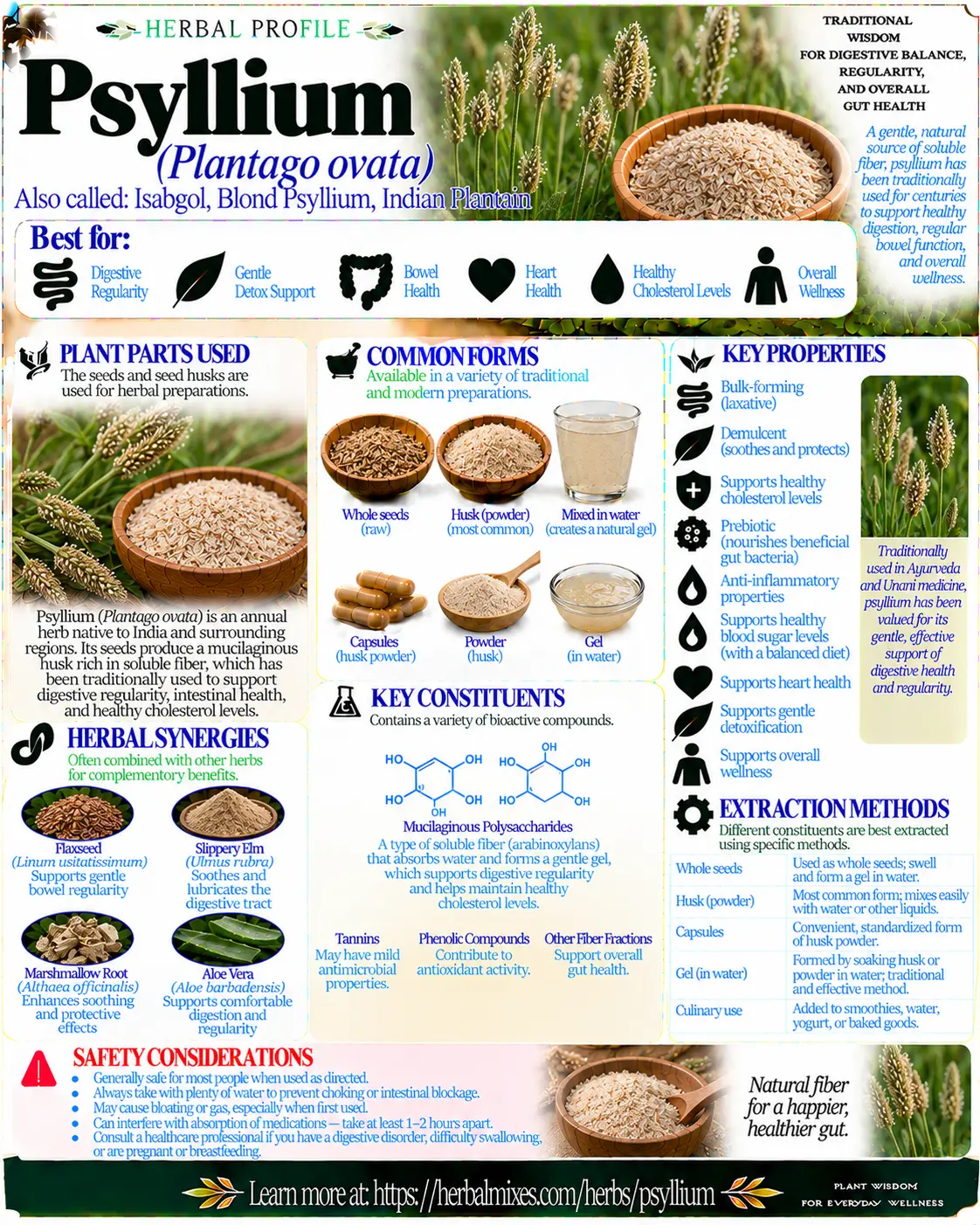
What Psyllium Is Good For
Constipation — Psyllium is one of the best-supported herbal fiber treatments for occasional constipation. Its husk absorbs water and forms a soft gel that increases stool bulk and helps promote regular bowel movements. The European Medicines Agency recognizes Plantago ovata husk for constipation.
Stool normalization — Psyllium is unusual because it can help regulate stool consistency rather than simply act as a stimulant laxative. Its water-holding gel can soften hard stools while also adding structure to loose stools.
IBS-related bowel regularity — Psyllium is commonly used as soluble fiber in people with irritable bowel syndrome, especially when constipation or irregular stool consistency is prominent. It is generally better tolerated than coarse insoluble fibers such as wheat bran.
Cholesterol support — Psyllium’s viscous soluble fiber can reduce intestinal reabsorption of bile acids and modestly lower LDL cholesterol. A meta-analysis of 28 randomized trials involving 1,924 participants found significant reductions in LDL, non-HDL cholesterol, and apoB with psyllium supplementation.
Blood sugar support — The gel slows digestion and nutrient absorption, which can reduce post-meal glucose spikes. Meta-analyses suggest the greatest glucose-lowering effect occurs in people with impaired glucose control or type 2 diabetes rather than in people with normal glucose levels.
Daily fiber support — Psyllium is an efficient way to increase soluble fiber intake when diet alone does not consistently provide enough fiber.
Available Herbal Products
Buying Guides for Available Psyllium Products
Organic Psyllium Husks, Whole – Pure whole seed husk. Provides approximately 6 g of soluble fiber per serving and is currently available directly from the manufacturer. Seller: NOW Foods – View NOW Organic Whole Psyllium Husks →
Psyllium Husks, Whole – Single-ingredient whole husk. A simple unflavored option currently available in several package sizes. Seller: NOW Foods – View NOW Whole Psyllium Husks →
Psyllium Husk Fiber Capsules – Capsule form. Provides psyllium fiber in a portable format for people who dislike mixing loose husk into liquids. Seller: Metamucil – View Metamucil Psyllium Fiber Capsules →
Organic Psyllium Whole Husk Fiber – Certified-organic whole husk. A simple plant-based soluble-fiber product currently available from the U.S. manufacturer site. Seller: Organic India USA – View Organic India Psyllium Husk →
Whole husk and powder work similarly, but powder thickens much faster and needs to be mixed and swallowed promptly. Capsules are convenient but often require multiple capsules to provide an amount comparable with a spoonful of loose husk.
Herbal Synergies
Psyllium pairs especially well with flaxseed, marshmallow root, fennel, ginger, and oats depending on whether the goal is bowel regularity, digestive soothing, or metabolic support.
Psyllium + Flaxseed
Best for: Constipation and daily soluble-fiber support
Both form water-binding gels, but psyllium provides stronger bulk-forming fiber, while flaxseed contributes additional mucilage, lignans, and alpha-linolenic acid.
Best extraction: No traditional extraction is needed. Mix freshly with abundant water or incorporate into moist foods.
Psyllium + Marshmallow Root
Best for: Constipation with digestive irritation
Psyllium adds bulk and water retention, while marshmallow root contributes soothing mucilage.
Best extraction: Psyllium mixed fresh with liquid; marshmallow root prepared separately as a cold infusion.
Psyllium + Fennel
Best for: Fiber supplementation with bloating or gas
Increasing fiber can temporarily increase bloating. Fennel adds carminative and antispasmodic support that may improve digestive comfort.
Best extraction: Psyllium mixed in water and fennel prepared as a covered hot infusion.
Psyllium + Ginger
Best for: Sluggish digestion with constipation
Psyllium provides mechanical stool-bulking action, while ginger adds warming digestive and motility support.
Best extraction: Psyllium in water plus ginger tea or powder.
Psyllium + Oat Beta-Glucan
Best for: Cholesterol and metabolic support
Both are viscous soluble fibers associated with cholesterol-lowering effects. Using different fiber sources can broaden overall dietary fiber intake.
Best extraction: No extraction needed; consume as foods or fiber preparations with adequate fluid.
Key Herbal Properties
Bulk-forming laxative — Psyllium absorbs substantial amounts of water, increases stool mass, and helps stimulate normal bowel movement.
Demulcent — Its hydrated mucilage forms a soothing gel that can reduce mechanical irritation within the gastrointestinal tract.
Stool normalizer — Psyllium can soften dry stool while also absorbing excess water in loose stool.
Hypocholesterolemic — Regular intake can modestly lower LDL cholesterol through its viscous soluble-fiber effects.
Glycemic-modulating — Psyllium slows carbohydrate absorption and can reduce post-meal glucose excursions.
Prebiotic-like fiber — Psyllium is only partially fermented compared with many other soluble fibers, which may explain why it is often better tolerated and less gas-producing.
Satiety supportive — Its expanding gel can increase fullness, although psyllium should not be viewed as a stand-alone weight-loss treatment.


Active Compounds
Psyllium husk differs dramatically from most medicinal herbs because its therapeutic activity comes primarily from complex gel-forming polysaccharides rather than alkaloids or essential oils.
Arabinoxylans
Found mainly in: Seed husk
Arabinoxylans are the major structural polysaccharides responsible for psyllium’s remarkable water-binding and gel-forming ability.
Their highly branched structure creates a viscous matrix that resists complete digestion.
Best extraction: Water hydration rather than conventional herbal extraction.
Heteroxylan Polysaccharides
Found mainly in: Husk
Psyllium mucilage contains complex heteroxylans composed largely of xylose and arabinose, along with smaller quantities of other sugars.
These compounds form the physical gel responsible for most of psyllium’s clinical effects.
Best extraction: Mix directly with water and consume while hydrated.
Soluble Gel-Forming Fiber
Found mainly in: Husk
Psyllium contains a large fraction of viscous soluble fiber that remains relatively intact throughout much of the gastrointestinal tract.
This viscosity contributes to cholesterol reduction, glycemic moderation, and stool normalization.
Best extraction: No extraction is necessary; hydration is essential.
Insoluble Fiber
Found mainly in: Husk and seed structures
A smaller proportion of psyllium fiber is insoluble and contributes additional stool bulk.
Best extraction: Whole-husk consumption.
Phenolic Compounds
Found mainly in: Seed and husk in much smaller amounts
Psyllium contains small quantities of phenolic constituents, but these are not considered the primary drivers of its clinical effects.
Best extraction: Water or hydroalcoholic extraction, although medicinal use generally focuses on the intact fiber.
Plant Sterols
Found mainly in: Seed rather than purified husk
Whole psyllium seed contains small quantities of phytosterols and lipids.
Best extraction: Lipid-compatible extraction, but these are not the main therapeutic targets of psyllium husk.
FAQ
What is psyllium best used for?
Psyllium is best supported for constipation, improving stool consistency, increasing soluble fiber intake, and modestly lowering LDL cholesterol.
It also has useful evidence for improving glycemic control in people with impaired glucose regulation.
How does psyllium work?
Psyllium absorbs water and forms a thick, viscous gel.
That gel increases stool bulk, keeps stool hydrated, slows nutrient absorption, and binds bile acids in the intestine.
Can psyllium help diarrhea as well as constipation?
Yes.
Because it binds water rather than simply stimulating bowel contractions, psyllium can sometimes firm loose stool while softening hard stool, making it useful as a stool-normalizing fiber.
Should psyllium be taken before or after meals?
For constipation, timing is usually less important than taking it consistently with enough fluid.
For post-meal glucose control or cholesterol support, studies often use psyllium shortly before or with meals.
Is psyllium the same as plantain leaf?
No.
Both come from the genus Plantago, but psyllium usually means the seed husk of Plantago ovata.
Medicinal plantain leaf generally refers to Plantago major or Plantago lanceolata and has very different uses and chemistry.
Safety & Precautions
The most important rule with psyllium is simple:
Always take it with plenty of liquid.
Psyllium expands rapidly when hydrated. Taking dry or inadequately hydrated husk can cause choking or obstruction of the throat or esophagus.
NOW Foods specifically warns that psyllium should be taken with at least a full glass of liquid and should not be used by people with difficulty swallowing.
EMA likewise recognizes ispaghula husk as a bulk-forming laxative that must be accompanied by adequate fluid intake.
Do not take psyllium if you have difficulty swallowing, narrowing of the gastrointestinal tract, intestinal obstruction, severe unexplained abdominal pain, or sudden changes in bowel habits lasting more than about two weeks without medical evaluation.
Common side effects include gas, bloating, abdominal fullness, and mild cramping, especially when starting with a large amount.
Begin with a smaller quantity and increase gradually while maintaining adequate fluid intake.
Psyllium can affect the absorption of some medications and supplements because its viscous gel can delay or reduce contact with the intestinal surface.
As a general precaution, take prescription medicines at least 2 hours before or after psyllium, unless a healthcare professional gives different instructions.
MedlinePlus specifically advises discussing psyllium use with a clinician when taking medications and notes potential interactions including aspirin.
People using diabetes medication should monitor glucose carefully because psyllium can improve glycemic control and may alter medication requirements.
Psyllium powder can rarely trigger allergic reactions, particularly after occupational or repeated inhalation exposure. Avoid inhaling airborne powder while mixing it.
Seek urgent care if psyllium causes difficulty swallowing, chest pain, vomiting, difficulty breathing, severe abdominal distension, or inability to pass stool or gas.
Pregnancy and breastfeeding are generally considered compatible with appropriately hydrated bulk-forming fiber because psyllium is not significantly systemically absorbed, but medicinal use should still be discussed with a healthcare professional when constipation is persistent or severe.
Anyone with swallowing problems, bowel obstruction, unexplained rectal bleeding, diabetes, chronic gastrointestinal disease, or regular prescription medication use should discuss therapeutic psyllium use with an appropriate healthcare professional.
References
- Kew Medicinal Plant Names Services — Plantago ovata Forssk.
- European Medicines Agency — Ispaghula Husk (Plantago ovata)
- MedlinePlus — Psyllium
- PubMed — Psyllium and LDL Cholesterol: Systematic Review and Meta-Analysis
- PubMed — Psyllium and Serum Lipids: Meta-Analysis
- PubMed — Psyllium and Glycemic Control: Meta-Analysis
- PubMed — Psyllium and Blood Sugar: 2024 Systematic Review
- NOW Foods — Organic Whole Psyllium Husks
- NOW Foods — Whole Psyllium Husks
- Metamucil — Psyllium Fiber Capsules
- Organic India USA — Organic Psyllium Whole Husk
Disclaimer
Disclaimer: This article is for educational purposes only and is not intended to diagnose, treat, cure, or prevent any disease. Herbal products can cause side effects and interact with medications. Consult a qualified healthcare professional before using herbs therapeutically, especially if you are pregnant, breastfeeding, taking prescription medications, or managing a medical condition.