

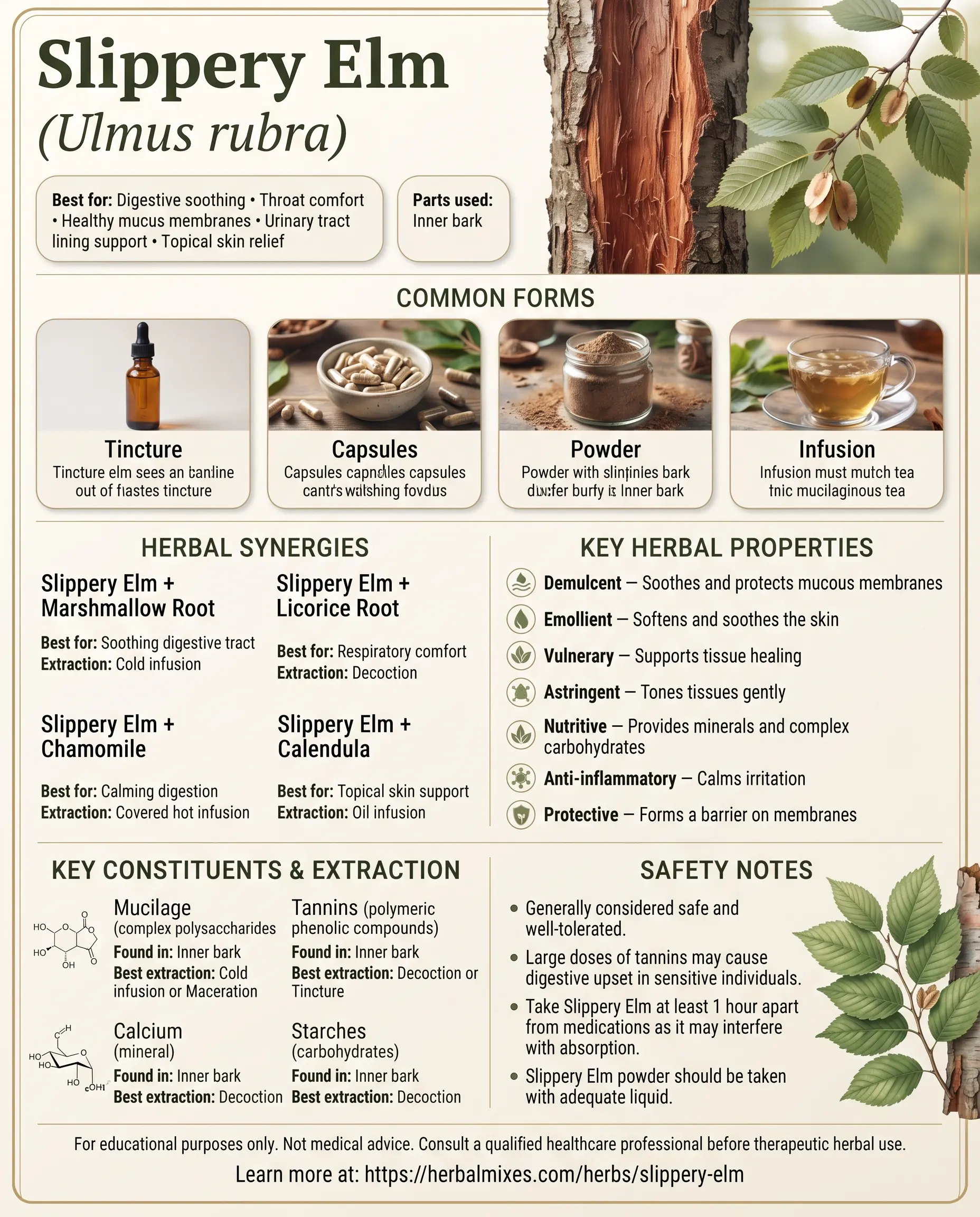
What Slippery Elm Is Good For
Sore or irritated throat — Slippery elm inner bark is rich in mucilage that becomes slippery when hydrated and can temporarily coat and soothe dry or irritated throat tissues.
Digestive irritation — The mucilage forms a gel-like layer that may soothe irritated tissues of the esophagus, stomach, and gastrointestinal tract. This is a traditional demulcent use rather than a treatment for ulcers, gastritis, or reflux disease.
Dry cough comfort — By moistening and coating throat tissues, slippery elm can help reduce irritation associated with a dry, scratchy cough.
Sensitive stomach — Slippery elm is commonly used when digestive discomfort is associated with irritation rather than sluggish digestion. Its action is primarily soothing rather than strongly stimulating.
Bowel comfort — Slippery elm has been included in herbal formulas for irritable bowel symptoms. One small uncontrolled pilot study reported improvements in several IBS symptoms, but because the formulas contained multiple ingredients, the effects cannot be attributed specifically to slippery elm.
Mucosal support — Its strongest herbal property is demulcent action: hydrated polysaccharides physically coat moist tissues rather than acting primarily through a drug-like receptor mechanism.
Available Herbal Products
Buying Guides for Available Slippery Elm Products
Organic Slippery Elm Bark Powder – Finely powdered Ulmus rubra inner bark. Currently listed in stock and particularly useful for making mucilage-rich drinks, gruels, or throat preparations. Seller: Starwest Botanicals – View Organic Slippery Elm Bark Powder →
Slippery Elm Powder – Single-ingredient powdered bark providing 1.5 g per teaspoon. Currently available and well suited to preparations where direct contact between hydrated mucilage and the throat or digestive tract is desired. Seller: NOW Foods / iHerb – View NOW Slippery Elm Powder →
Slippery Elm 400 mg – Inner-bark capsules providing 800 mg per two-capsule serving. Currently listed in stock. Seller: NOW Foods / iHerb – View NOW Slippery Elm Capsules →
Slippery Elm Bark 400 mg – Vegan whole-bark capsules providing 1.6 g per four-capsule serving. Currently listed in stock. Seller: Nature’s Way / iHerb – View Nature’s Way Slippery Elm Bark →
Slippery Elm Extract – Liquid inner-bark extract providing a 2,000 mg dry-herb equivalent per serving. Currently listed in stock. Seller: Nature’s Answer / iHerb – View Nature’s Answer Slippery Elm Extract →
For throat or gastrointestinal soothing, powder mixed directly with water often makes the most sense because it allows the mucilage to hydrate and contact irritated tissues.
Herbal Synergies
Slippery elm pairs especially well with marshmallow root, licorice root, chamomile, plantain leaf, and psyllium depending on whether the goal is throat soothing, digestive comfort, or bowel support.
Slippery Elm + Marshmallow Root
Best for: Dry throat, irritated stomach, and sensitive digestive tissues
Both herbs are rich in soothing polysaccharides, but marshmallow root is especially mucilage-rich while slippery elm forms a thick nutritive gel.
Best extraction: Cold or warm water. Avoid relying on high-alcohol tinctures when mucilage is the main goal.
Slippery Elm + Licorice Root
Best for: Upper digestive irritation and throat discomfort
Slippery elm provides physical coating action, while licorice root adds demulcent and inflammatory-modulating constituents.
Best extraction: Slippery elm powder or water preparation combined with licorice tea or DGL when appropriate.
Whole licorice is not suitable for everyone because of blood-pressure and potassium-related risks.
Slippery Elm + Chamomile
Best for: Digestive irritation with cramping or nervous tension
Slippery elm coats irritated tissues while chamomile contributes antispasmodic and calming activity.
Best extraction: Prepare chamomile as a covered infusion and stir slippery-elm powder into the cooled or warm tea.
Slippery Elm + Plantain Leaf
Best for: Dry throat and irritated mucous membranes
Both have traditional demulcent applications. Plantain adds mild astringent and inflammatory-modulating activity.
Best extraction: Warm infusion or combined tea.
Slippery Elm + Psyllium
Best for: Stool normalization and bowel regularity
Slippery elm contributes soothing mucilage, while psyllium forms a much larger water-holding gel that increases stool bulk.
Best extraction: Neither requires alcohol. Both depend on adequate water.
Take psyllium with plenty of fluid and separate both herbs from medications.
Key Herbal Properties
Demulcent — Slippery elm’s defining property. Its mucilage coats and moistens irritated mucous membranes.
Mucilaginous — Water transforms the powdered inner bark into a thick gel.
Digestive soothing — Traditionally used for upper and lower gastrointestinal irritation.
Throat soothing — Commonly used in powders and lozenges for dry or irritated throat tissues.
Mild nutritive — The inner bark contains carbohydrates and historically served as an emergency food.
Mild astringent — Tannins complement the mucilage with modest tissue-toning activity.
Prebiotic potential — Its complex polysaccharides may be fermented by gut microorganisms, although specific human microbiome research on slippery elm remains limited.




Active Compounds
Slippery elm chemistry is dominated by mucilage polysaccharides, with smaller amounts of tannins, phenolic compounds, phytosterols, starches, minerals, and resins.
Unlike many aromatic herbs, its therapeutic value does not depend on essential oils or highly concentrated alkaloids.
Mucilage Polysaccharides
Found mainly in: Inner bark
These water-binding carbohydrates are responsible for slippery elm’s characteristic slick texture.
When hydrated, they form a viscous gel that coats the mouth, throat, esophagus, and gastrointestinal lining.
Best extraction: Cold, warm, or hot water. Direct hydration of powdered bark is particularly effective.
Arabinogalactan-Type Polysaccharides
Found mainly in: Inner bark mucilage
Complex sugars containing arabinose and galactose-related structures contribute to the gel-forming polysaccharide fraction.
Best extraction: Water.
Galacturonic Acid-Rich Polysaccharides
Found mainly in: Mucilage
Uronic-acid-containing polysaccharides help create the water-retaining, viscous properties characteristic of slippery elm bark.
Best extraction: Water.
Tannins
Found mainly in: Inner bark
Tannins contribute mild astringent activity, complementing the otherwise soothing mucilage.
Best extraction: Hot water or hydroalcoholic preparations.
Phytosterols
Found mainly in: Bark
Plant sterols occur in smaller amounts and contribute to the broader chemical profile rather than slippery elm’s primary demulcent action.
Best extraction: Alcohol-rich or lipid-compatible extraction.
Starches and Complex Carbohydrates
Found mainly in: Inner bark
These add nutritive value and help explain the bark’s historical use as a food-like preparation.
Best extraction: Water and cooking.
Phenolic Compounds
Found mainly in: Bark
Phenolics contribute modest antioxidant and astringent activity.
Best extraction: Water or hydroalcoholic extraction.
FAQ
What is slippery elm best used for?
Slippery elm is best suited to dry throat, irritated gastrointestinal tissues, sensitive digestion, and general mucosal soothing.
Its strongest action comes from physical mucilage rather than a powerful pharmacological stimulant.
Is slippery elm good for acid reflux?
It may temporarily soothe irritation associated with reflux because its mucilage coats the esophagus.
However, it does not stop acid production or correct the underlying cause of GERD, and persistent reflux requires proper evaluation.
Should slippery elm be taken with hot or cold water?
Either can work.
Cool or warm water preserves the thick mucilage particularly well, while gentle simmering can also create a soothing drink.
For demulcent use, the key is allowing the powder to hydrate thoroughly.
Is powder better than capsules?
For throat or upper-digestive soothing, powder often has an advantage because the mucilage is already hydrated before swallowing and contacts the tissues directly.
Capsules are more convenient but may provide less immediate coating action.
Can slippery elm be taken with medications?
It is better to separate them.
The thick mucilage may theoretically slow or reduce absorption of oral medicines, so leaving approximately 2 hours between slippery elm and medications is a sensible precaution.
Safety & Precautions
Slippery elm is generally considered a gentle herb with a favorable safety profile.
NCBI LiverTox reports no published evidence linking slippery elm to liver-enzyme elevations or clinically apparent liver injury.
Possible adverse effects are uncommon but may include allergic skin reactions, stomach discomfort, or intolerance to the thick texture.
Always take powdered slippery elm with adequate liquid.
Starwest Botanicals specifically advises taking its powder with at least 8 oz / 250 mL of liquid.
Medication Absorption
The most practical interaction concern is its mucilage.
Because slippery elm creates a thick gel, it may theoretically interfere with or delay absorption of oral medications and supplements.
As a precaution, separate slippery elm from prescription medicines by about 2 hours, unless a pharmacist or healthcare professional recommends otherwise.
This is particularly important for medications requiring precise absorption.
Pregnancy & Breastfeeding
Ordinary food-like preparations are generally considered mild, but high-quality pregnancy and breastfeeding studies are lacking.
Several commercial slippery-elm products advise pregnant or breastfeeding users to consult a physician before use, and Nature’s Answer specifically advises against its concentrated extract during pregnancy or nursing.
Use medicinal preparations during pregnancy or breastfeeding only with appropriate professional guidance.
Persistent Digestive Symptoms
Do not use slippery elm to repeatedly mask symptoms that require investigation.
Seek medical evaluation for:
- difficulty or pain when swallowing;
- persistent reflux;
- unexplained weight loss;
- vomiting;
- black or bloody stool;
- severe abdominal pain;
- persistent diarrhea;
- ongoing constipation;
- anemia;
- progressive change in bowel habits.
Slippery elm may soothe symptoms but does not treat causes such as peptic ulcer disease, inflammatory bowel disease, celiac disease, cancer, gastrointestinal bleeding, or severe GERD.
Sustainability
The medicinal material is inner bark, and removing bark can seriously damage or kill a tree when harvesting is poorly managed.
Kew currently lists Ulmus rubra as an accepted species and reports its IUCN conservation category as Least Concern, but responsible sourcing still matters because bark harvesting is inherently more destructive than harvesting leaves or fruit.
Prefer companies that identify Ulmus rubra clearly and provide responsible sourcing and quality-testing information.
Anyone who is pregnant, breastfeeding, taking prescription medications, or managing significant gastrointestinal disease should discuss regular therapeutic slippery-elm use with an appropriate healthcare professional.
References
- Kew Plants of the World Online — Ulmus rubra
- NCBI LiverTox — Slippery Elm
- PubMed — Herbal Formulas Containing Slippery Elm for IBS: Pilot Study
- Starwest Botanicals — Organic Slippery Elm Bark Powder
- NOW Foods / iHerb — Slippery Elm Powder
- NOW Foods / iHerb — Slippery Elm Capsules
- Nature’s Way / iHerb — Slippery Elm Bark
- Nature’s Answer / iHerb — Slippery Elm Extract
Disclaimer
Disclaimer: This article is for educational purposes only and is not intended to diagnose, treat, cure, or prevent any disease. Herbal products can cause side effects and interact with medications. Consult a qualified healthcare professional before using herbs therapeutically, especially if you are pregnant, breastfeeding, taking prescription medications, or managing a medical condition.