

What Licorice Root Is Good For
Throat soothing — Licorice is traditionally used as a demulcent and expectorant for irritated throats and coughs associated with colds. The European Medicines Agency includes licorice root within the therapeutic areas of cough/cold and gastrointestinal disorders.
Productive coughs — Licorice combines soothing qualities with traditional expectorant activity, making it especially useful when coughing involves both mucus and throat irritation.
Digestive irritation — Licorice has a longstanding reputation for soothing the upper digestive tract. Its saponins and flavonoids contribute anti-inflammatory and mucosal-supportive effects, although it should not replace evaluation of persistent abdominal symptoms.
Occasional indigestion — EMA recognizes gastrointestinal disorders among the traditional medicinal uses of licorice root. It is often incorporated into formulas for mild dyspepsia and digestive discomfort.
Gastric mucosal support — For people primarily seeking digestive soothing without glycyrrhizin’s blood-pressure effects, deglycyrrhizinated licorice (DGL) is often preferred. DGL removes most glycyrrhizin while retaining other licorice constituents.
Respiratory comfort — Licorice is frequently combined with herbs such as marshmallow, thyme, horehound, or mullein because it can simultaneously soothe irritated tissues and complement mucus-clearing herbs.
Available Herbal Products
Buying Guides for Available Licorice Root Products
Licorice Root – Whole-root capsules. Provides 900 mg of Glycyrrhiza glabra root per two-capsule serving for traditional digestive support. It is currently listed as backordered, so availability may vary. Seller: Nature’s Way – View Nature’s Way Licorice Root →
DGL – Deglycyrrhizinated licorice chewables. Uses GutGard® DGL specifically for digestive support while substantially reducing exposure to glycyrrhizin. It is currently listed as backordered on the manufacturer’s site. Seller: Nature’s Way – View Nature’s Way DGL →
Licorice Liquid Herbal Extract – Root and stolon tincture. A concentrated 1:2 hydroalcoholic extract of certified organic Glycyrrhiza glabra. It was listed as out of stock when checked, but remains a useful example of a traditional whole-root extract. Seller: Herb Pharm – View Herb Pharm Licorice →
Adrenal Support – Combination tincture. Currently available and combines licorice root with eleuthero, milky oats, sarsaparilla, and prickly ash. Best suited to people specifically seeking a multi-herb formula rather than licorice alone. Seller: Herb Pharm – View Herb Pharm Adrenal Support →
Throat Coat Original – Herbal tea blend. Combines licorice with slippery elm and other soothing herbs for throat and respiratory comfort. Seller: Traditional Medicinals – View Traditional Medicinals Throat Coat →
Licorice products are not interchangeable. Whole-root licorice contains glycyrrhizin and carries important cardiovascular precautions, while DGL has most glycyrrhizin removed and is generally chosen specifically for digestive applications. NCCIH notes that DGL products may be safer for longer use than glycyrrhizin-containing licorice.
Herbal Synergies
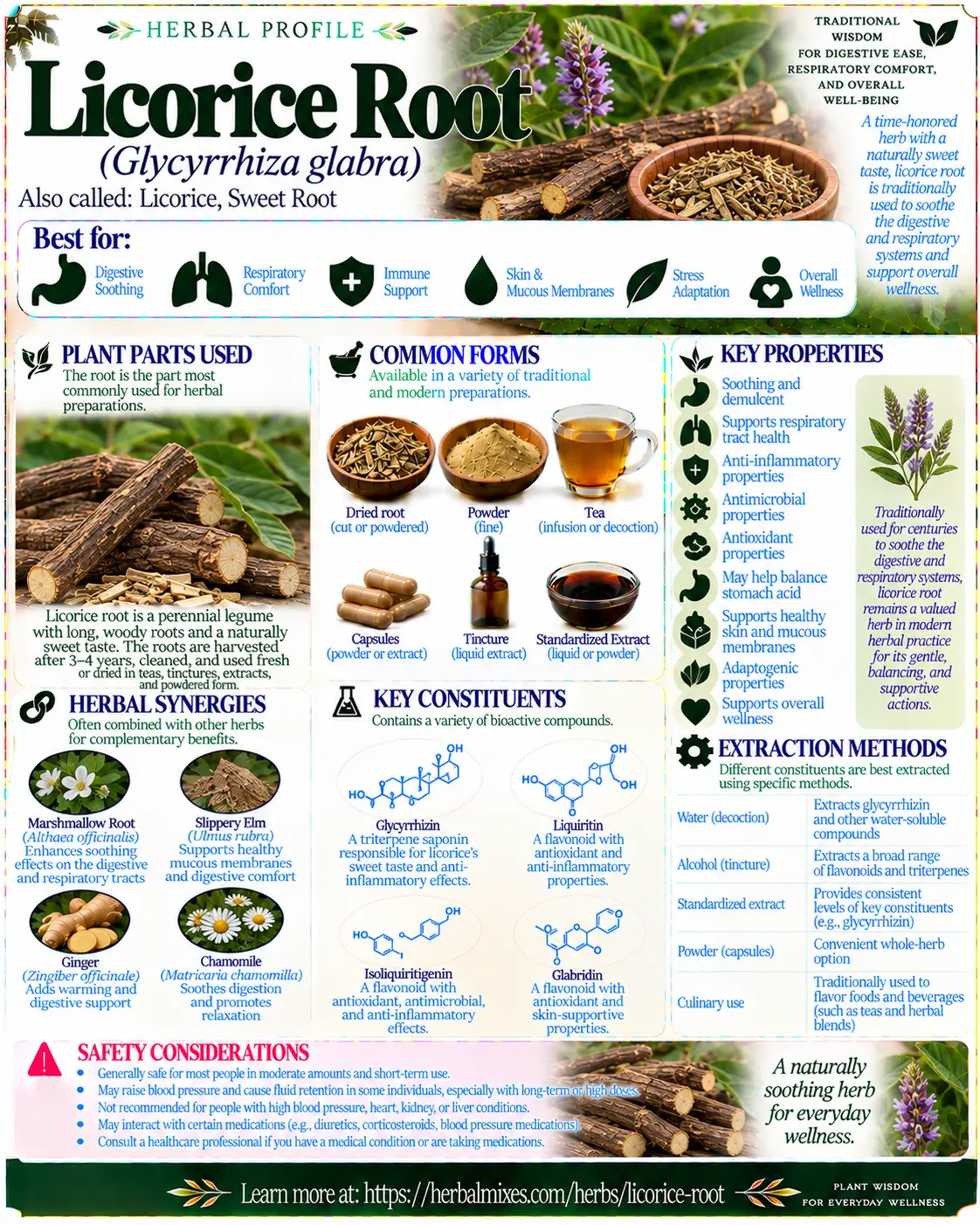
Licorice root pairs especially well with marshmallow root, thyme, horehound, ginger, and chamomile depending on whether the goal is throat soothing, productive coughs, or digestive comfort.
Licorice Root + Marshmallow Root
Best for: Dry or irritated throat and digestive mucosa
Licorice provides soothing saponins and flavonoids, while marshmallow root contributes abundant mucilage that coats irritated tissues.
This is one of the gentlest combinations when throat or digestive irritation is more prominent than congestion.
Best extraction: Licorice decoction combined with marshmallow cold infusion. Longer heating works well for licorice root, while cool water preserves marshmallow’s mucilage.
Licorice Root + Thyme
Best for: Productive coughs with throat irritation
Licorice contributes soothing and traditional expectorant actions, while thyme adds aromatic respiratory compounds such as thymol and carvacrol.
Best extraction: Licorice decoction with thyme added near the end as a covered infusion. This extracts licorice root while minimizing loss of thyme’s volatile oils.
Licorice Root + Horehound
Best for: Thick mucus and irritated throat
Horehound provides stronger bitter expectorant stimulation, while licorice softens the formula with demulcent and soothing qualities.
Best extraction: Decoction or tincture. Licorice tolerates prolonged heating, while horehound can be added later to a tea or extracted together in alcohol.
Licorice Root + Ginger
Best for: Digestive discomfort with nausea or sluggish digestion
Licorice provides mucosal soothing, while ginger contributes warming, carminative, anti-nausea, and motility-supportive actions.
Best extraction: Decoction or tincture. Both roots tolerate hot-water extraction well.
Licorice Root + Chamomile
Best for: Digestive irritation with nervous tension
Licorice supports irritated digestive tissues while chamomile contributes gentle antispasmodic, nervine, and carminative activity.
Best extraction: Simmer licorice first, remove from heat, then add chamomile and steep covered to preserve its volatile oils.
Key Herbal Properties
Demulcent — Licorice is traditionally used to soothe irritated mucous membranes of the throat and digestive tract.
Expectorant — It has longstanding use in cough formulas to help loosen respiratory secretions while simultaneously soothing irritated tissues.
Anti-inflammatory — Glycyrrhizin, glycyrrhetinic acid, liquiritigenin, isoliquiritigenin, and other constituents influence inflammatory pathways experimentally.
Gastroprotective — Licorice flavonoids and saponins have been investigated for effects on mucosal defenses and digestive inflammation.
Antioxidant — Flavonoids including glabridin, liquiritigenin, and isoliquiritigenin contribute substantial antioxidant activity.
Antiviral — Glycyrrhizin has demonstrated antiviral activity in laboratory and pharmacological research, but this does not mean ordinary licorice tea treats viral infections.
Sweetening — Glycyrrhizin is intensely sweet and explains why licorice root can sweeten herbal formulas without ordinary sugar.





Active Compounds
Licorice contains a distinctive mixture of triterpenoid saponins and flavonoids. Major constituents include glycyrrhizin, glycyrrhetinic acid, liquiritin, liquiritigenin, isoliquiritigenin, and glabridin.
Glycyrrhizin
Found mainly in: Root and rhizome
Glycyrrhizin, also called glycyrrhizic acid, is licorice’s signature triterpenoid saponin and a major contributor to its intense sweetness.
It is also responsible for many of licorice’s most important safety concerns. Excessive exposure can cause sodium retention, potassium loss, increased blood pressure, edema, and dangerous cardiac effects.
Best extraction: Hot-water decoction or hydroalcoholic tincture. Glycyrrhizin is a polar glycoside and extracts effectively into water.
Glycyrrhetinic Acid
Found mainly in: Produced largely after intestinal metabolism of glycyrrhizin
Gut microorganisms convert glycyrrhizin into glycyrrhetinic acid, a pharmacologically active metabolite.
It inhibits 11β-hydroxysteroid dehydrogenase type 2, increasing cortisol’s activity at mineralocorticoid receptors. This mechanism explains licorice-induced hypertension, potassium loss, and fluid retention.
Best extraction: It is primarily generated metabolically after ingestion rather than being the main target of ordinary herbal extraction.
Liquiritin
Found mainly in: Root and rhizome
Liquiritin is a flavonoid glycoside that contributes antioxidant and anti-inflammatory activity and forms part of licorice’s characteristic flavonoid profile.
Best extraction: Hot-water decoction or hydroalcoholic extract. Its glycosylated structure gives it useful water solubility.
Liquiritigenin
Found mainly in: Root
Liquiritigenin is a flavanone associated experimentally with antioxidant, inflammatory, and estrogen-receptor-related activity.
Best extraction: Hydroalcoholic extract. Alcohol improves recovery of the less-polar aglycone.
Isoliquiritigenin
Found mainly in: Root and rhizome
Isoliquiritigenin is a chalcone extensively studied for antioxidant, anti-inflammatory, and cellular signaling effects.
Best extraction: Hydroalcoholic tincture or concentrated extract. It is less water soluble than glycosylated flavonoids.
Glabridin
Found mainly in: Glycyrrhiza glabra root
Glabridin is an isoflavan particularly associated with G. glabra. It contributes antioxidant and antimicrobial activity and is frequently studied in dermatological and metabolic research.
Best extraction: Alcohol-rich or specialized extract. Glabridin is relatively lipophilic and is poorly represented in simple tea.
Polysaccharides
Found mainly in: Root
Licorice contains water-soluble polysaccharides that may complement its traditional soothing and immunological properties.
Best extraction: Decoction. Hot water is particularly effective for extracting polysaccharides.
FAQ
What is licorice root best used for?
Licorice root is traditionally used for coughs, throat irritation, respiratory comfort, and mild gastrointestinal complaints. EMA’s current 2026 monograph covers both cough/cold and gastrointestinal uses.
What is the difference between licorice root and DGL?
Whole licorice root contains glycyrrhizin. DGL—deglycyrrhizinated licorice—has most of this compound removed.
DGL is primarily chosen for digestive support when the goal is to minimize glycyrrhizin-related blood-pressure and potassium effects. NCCIH reports that oral DGL products might be safe for up to four months, although individual circumstances still matter.
Can licorice root raise blood pressure?
Yes.
Glycyrrhizin can cause the body to retain sodium and lose potassium, potentially resulting in high blood pressure, edema, abnormal heart rhythms, and—in severe cases—cardiac arrest.
Is licorice tea good for the throat?
Traditionally, yes. Licorice’s sweetness and demulcent qualities make it common in throat and respiratory teas, particularly when combined with slippery elm or marshmallow.
Can licorice root be taken every day?
Glycyrrhizin-containing licorice is not an ideal indefinite daily supplement.
Risk depends on dose, duration, individual sensitivity, sodium intake, medical conditions, and medications. People seeking longer-term digestive support often choose DGL instead.
Safety & Precautions
The most important safety issue with licorice root is glycyrrhizin.
NCCIH warns that glycyrrhizin can cause serious adverse effects including irregular heartbeat and cardiac arrest, especially with large amounts or prolonged use. Severe effects can occur at lower exposure in people with hypertension, high salt intake, or heart or kidney disease.
Whole licorice root may cause high blood pressure, sodium and fluid retention, low potassium, edema, muscle weakness, and abnormal heart rhythms.
People with hypertension, heart disease, kidney disease, edema, or low potassium should generally avoid glycyrrhizin-containing licorice unless specifically supervised by a healthcare professional. Herb Pharm places these same cautions on its current licorice extract.
Licorice may interact with diuretics, corticosteroids, digoxin and other cardiac glycosides, blood-pressure medicines, and potassium-depleting drugs. NCCIH specifically reports interactions with corticosteroids.
Combining licorice with potassium-depleting diuretics can increase the risk of hypokalemia and cardiac arrhythmia.
Pregnancy requires particular caution. NCCIH reports that high oral licorice exposure during pregnancy is unsafe and has been associated with increased risk of early delivery.
Safety of concentrated medicinal licorice during breastfeeding has not been adequately established.
DGL removes most glycyrrhizin and therefore carries much less risk of hypertension and potassium depletion, but it should not automatically be assumed safe for every person or every medication combination.
Do not confuse genuine licorice root with many commercial “licorice candies,” which may be flavored predominantly with anise rather than Glycyrrhiza.
Seek urgent medical care for severe weakness, fainting, marked swelling, chest symptoms, or an irregular heartbeat occurring during substantial licorice use.
Anyone with hypertension, heart disease, kidney disease, electrolyte abnormalities, pregnancy, breastfeeding, or prescription medications should discuss therapeutic licorice root use with an appropriate healthcare professional.
References
- NCCIH — Licorice Root: Usefulness and Safety View source
- European Medicines Agency — Liquiritiae Radix View source
- Kew Plants of the World Online — Glycyrrhiza glabra L. View source
- PubMed — Glycyrrhiza glabra: Phytochemical and Pharmacological Review View source
- PubMed — Comprehensive Review of Licorice Phytochemistry and Toxicology View source
- PubMed — Pharmacological Efficacy and Safety of Licorice Root View source
- PubMed — Glycyrrhizin Metabolism, Effects, and Safety View source
- Herb Pharm — Licorice Liquid Herbal Extract View source
- Nature’s Way — Licorice Root View source
- Nature’s Way — DGL View source
Disclaimer
Disclaimer: This article is for educational purposes only and is not intended to diagnose, treat, cure, or prevent any disease. Herbal products can cause side effects and interact with medications. Consult a qualified healthcare professional before using herbs therapeutically, especially if you are pregnant, breastfeeding, taking prescription medications, or managing a medical condition.