

A sore throat often needs something simple: moisture, soothing contact and time. Mucilage-rich herbs such as marshmallow root can coat irritated tissues, while sage is better suited to gargles and throat sprays.
Below you’ll find which herbs fit different throat patterns, the preparations that make the most sense, useful combinations, evidence limitations, and signs that a sore throat needs medical attention.
Best herbs: Marshmallow Root • Sage • Iceland Moss • Licorice Root • Slippery Elm

Available Ready-to-Use Products
Herbal Throat Lozenges
Best for: Dryness + scratchiness + on-the-go comfort
Lozenges keep soothing ingredients in contact with the throat longer than quickly swallowed preparations. Demulcent herbs such as marshmallow root, slippery elm or Iceland moss are particularly logical ingredients.
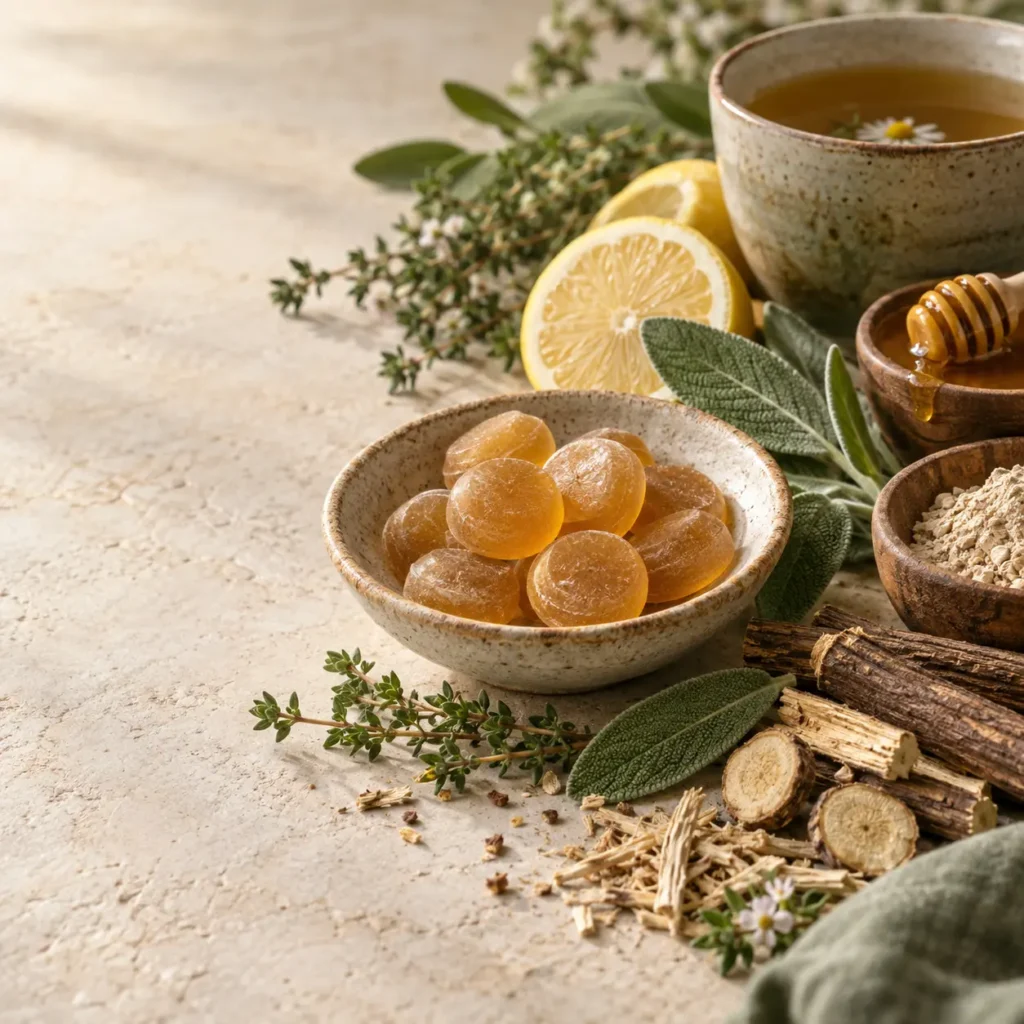
Marshmallow Root Tea
Best for: Dry + irritated throat
Marshmallow root is rich in mucilage. When hydrated, these polysaccharides produce a slippery texture that makes the herb especially suitable for dry or scratchy throat discomfort.
Herbal Throat Spray
Best for: Localized throat discomfort
Sage and Echinacea are traditionally used for mouth and throat complaints, and a small randomized placebo-controlled trial found that a particular sage spray reduced pain from acute viral pharyngitis. That evidence applies to the studied preparation rather than every sage product.
Herbal Throat Tea
Best for: Warm hydration + generalized throat comfort
A throat tea may combine soothing herbs such as marshmallow or slippery elm with warming or aromatic ingredients such as ginger, sage or thyme.

Iceland Moss Tincture
Best for: Dry throat + associated dry cough
Iceland moss contains mucilage-like polysaccharides and has a long European tradition as a demulcent for mouth and throat irritation.
[NEW BUYING GUIDE OPPORTUNITY → Iceland Moss]
Herbal Gargle
Best for: Local throat contact
A warm sage preparation can be used as a gargle rather than swallowed. Gargling provides direct contact with the irritated area and can complement soothing teas or lozenges.
What Is a Sore Throat?
A sore throat describes pain, scratchiness, dryness or irritation in the throat, often made more noticeable when swallowing.
Most sore throats are caused by viruses, including viruses responsible for common respiratory infections. Other possible contributors include allergies, postnasal drip, smoke and other irritants.
Most uncomplicated sore throats improve on their own within about a week.
However, sore throat can also result from group A Streptococcus, the bacterium responsible for strep throat.
Strep throat cannot reliably be diagnosed simply by looking at the throat at home. Healthcare professionals can use a rapid test and, when appropriate, a throat culture.
Symptoms such as cough, runny nose, hoarseness and conjunctivitis are more suggestive of a viral infection than strep throat.
Herbs may provide symptom comfort, but they should not be presented as substitutes for appropriate testing or antibiotic treatment when strep throat is confirmed.
What Should Herbal Support Focus On?
Demulcent Support
Demulcent herbs become slippery when mixed with water.
This makes them particularly well matched to:
dryness • scratchiness • raw-feeling irritation • irritation from repeated coughing
Marshmallow root, slippery elm and Iceland moss fit this category.
Their role is primarily local soothing, not killing an infection.
Local Gargle or Spray Support
Some herbs make more sense as a gargle or throat spray than as a general systemic remedy.
Sage is a good example.
The preparation comes into direct contact with the irritated tissues, which is one reason throat sprays and gargles deserve separate consideration from capsules.
Moisture and Hydration
Warm liquids can provide immediate comfort while helping maintain hydration.
Tea also creates an effective delivery method for many soothing herbs.
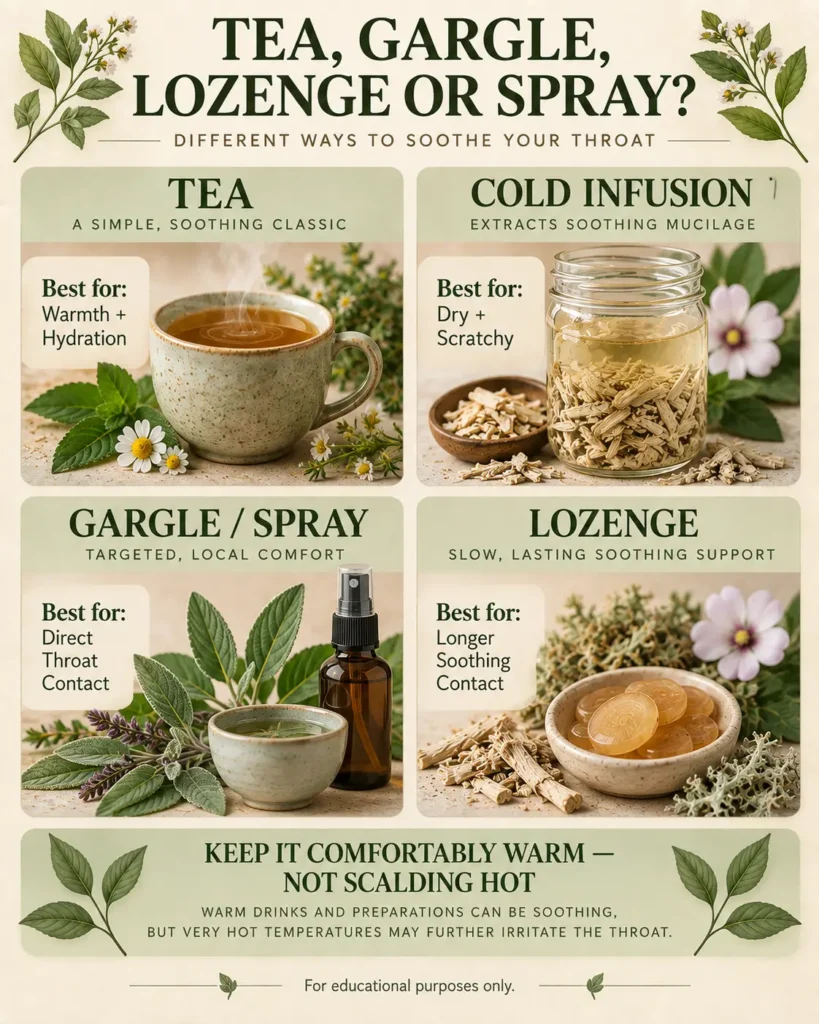
Very hot liquids are unnecessary and may further irritate sensitive tissues. Warm or comfortably hot preparations are preferable.
Gentle Aromatic Support
Ginger, thyme and similar aromatic herbs can add warmth and flavor to throat preparations.
They may be especially appropriate when sore throat occurs together with cough or other seasonal respiratory symptoms.
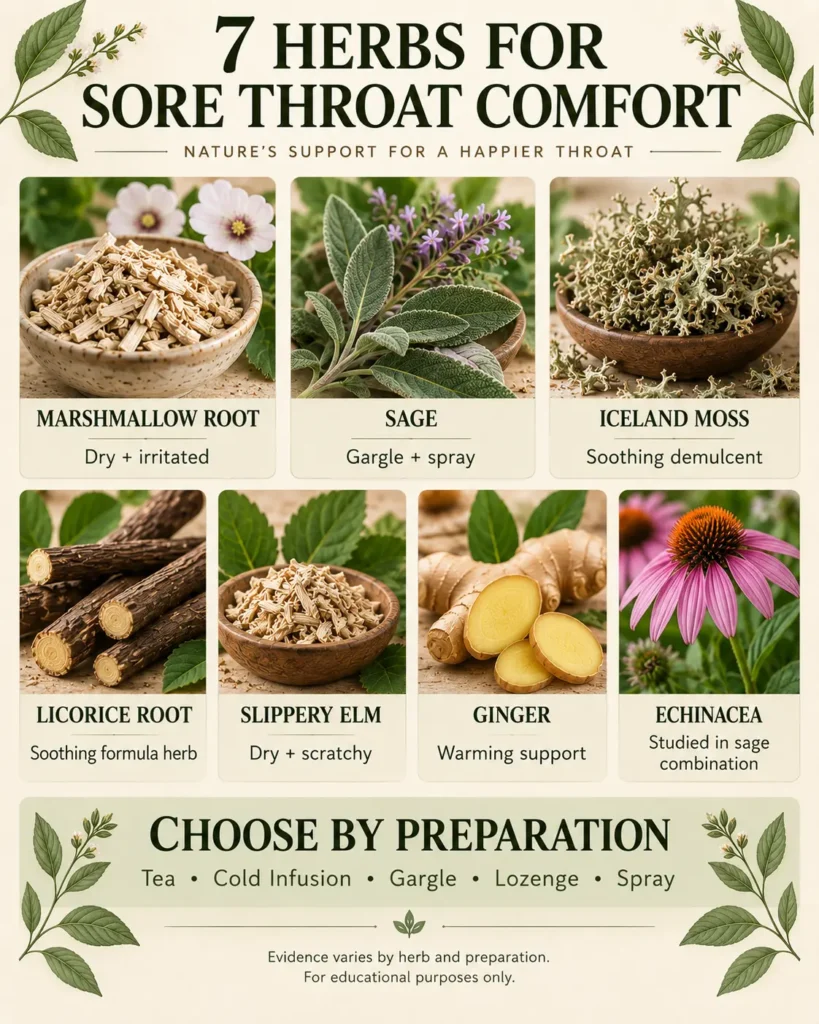
7 Best Herbs for Sore Throat Comfort
1. Marshmallow Root (Althaea officinalis)
Best role: Dry, scratchy + irritated throat

Marshmallow root is one of the clearest herbal matches for a dry, irritated throat because of its high mucilage content.
When the root is exposed to water, its polysaccharides create a slippery preparation that can provide soothing contact with irritated tissues.
European regulators recognize marshmallow root’s traditional use for irritation of the mouth or throat with an associated dry cough. This recognition is based primarily on long-standing use rather than strong modern clinical trials.
Best preparation: Cold infusion • Tea • Syrup • Lozenge
Pairs well with: Licorice Root • Mullein • Honey
Use with care: Consider separating mucilage-rich preparations from oral medicines because they could theoretically alter medication absorption.
2. Sage (Salvia officinalis)
Best role: Gargle or spray for localized throat discomfort
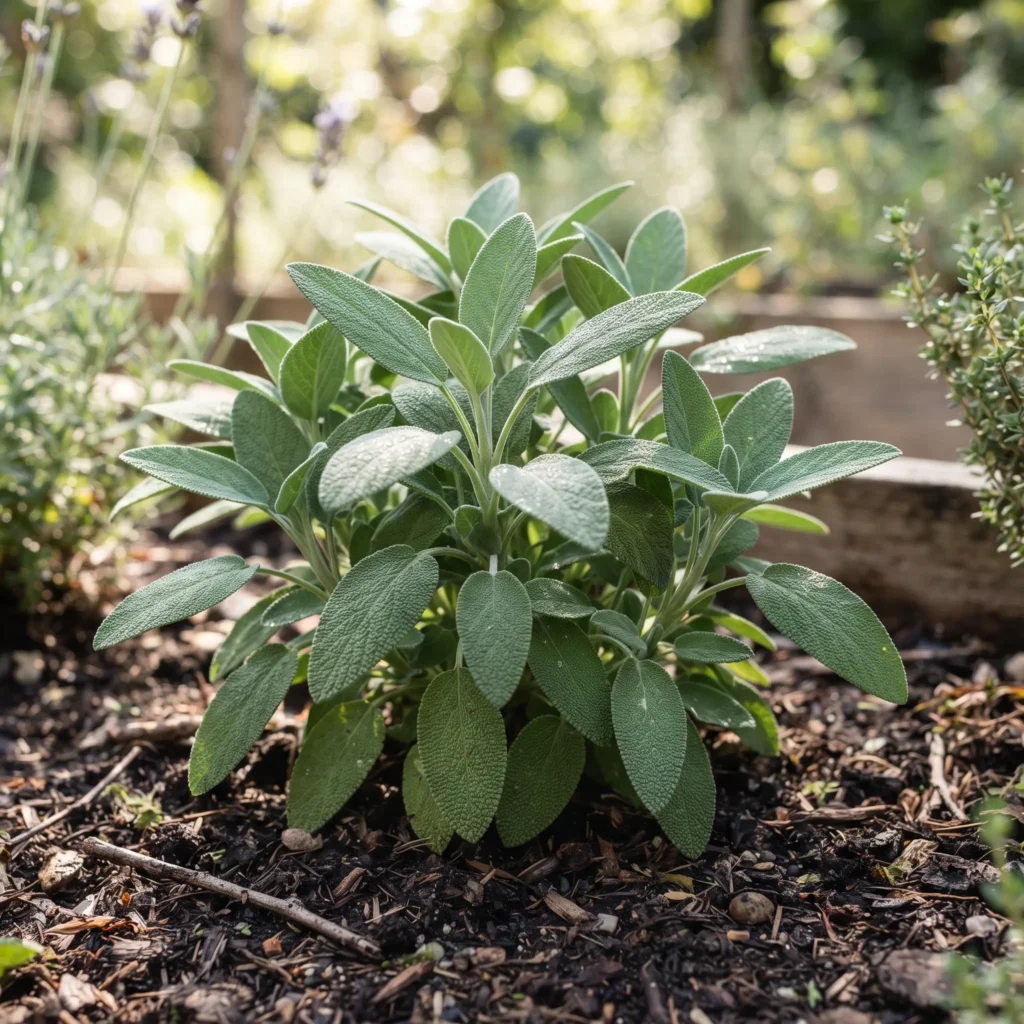
Sage has a long history of use for mouth and throat complaints.
A randomized, double-blind, placebo-controlled study involving people with acute viral pharyngitis found that a particular 15% sage spray produced greater short-term throat-pain reduction than placebo.
Another randomized trial found a specific echinacea-and-sage spray performed similarly to a chlorhexidine/lidocaine spray for acute sore-throat symptoms.
These findings are interesting but should not be generalized to every sage tea, spray or homemade preparation.
Best preparation: Gargle • Throat spray • Tea
Pairs well with: Thyme • Ginger • Echinacea
Use with care: Concentrated sage essential oil is not equivalent to culinary sage or tea. Common sage contains thujone, making casual high-dose or essential-oil ingestion inappropriate.
3. Iceland Moss (Cetraria islandica)
Best role: Dryness + throat irritation
Despite its name, Iceland moss is actually a lichen.
It contains polysaccharides that contribute to its soothing, coating character.
The European Medicines Agency recognizes its traditional use as a demulcent for mouth and throat irritation and associated dry cough.
Clinical evidence is limited, so this remains primarily a traditional-use recommendation rather than a proven treatment.
Best preparation: Lozenge • Syrup • Tea
Pairs well with: Marshmallow Root • Honey
Use with care: Follow age guidance on the specific preparation.
4. Licorice Root (Glycyrrhiza glabra)
Best role: Soothing throat-formula component

Licorice’s naturally sweet taste and traditional demulcent-style use make it a common ingredient in throat teas and lozenges.
There is some preliminary human research involving licorice gargles or lozenges in specific throat-related settings, but there isn’t enough high-quality evidence to establish licorice as a treatment for ordinary sore throat.
Its safety profile matters considerably.
The constituent glycyrrhizin can cause potassium loss, increased blood pressure and potentially serious cardiovascular effects when excessive amounts are consumed or use is prolonged.
Best preparation: Tea blend • Gargle • Lozenge
Pairs well with: Marshmallow Root • Slippery Elm • Ginger
Use with care: High blood pressure • Heart disease • Kidney disease • Pregnancy • medication interactions • prolonged/high-dose use
5. Slippery Elm (Ulmus rubra)
Best role: Dry + scratchy throat

Slippery elm inner bark becomes mucilaginous when mixed with water and has a long history in North American herbal practice.
Its practical role is similar to marshmallow root: soothing irritated tissue rather than treating the underlying infection.
High-quality modern clinical evidence specifically for acute sore throat is limited.
Best preparation: Lozenge • Gruel • Tea-style preparation
Pairs well with: Marshmallow Root • Licorice Root • Honey
Use with care: Consider separating mucilage-rich preparations from oral medications.
6. Ginger (Zingiber officinale)
Best role: Warming supporting herb

Fresh ginger makes a useful supporting ingredient when throat discomfort occurs with a cold or cough.
Its pungent flavor works well in warm tea with honey or lemon, but evidence specifically demonstrating that ginger treats acute sore throat is limited.
Think of ginger primarily as a warming supporting ingredient, not the principal demulcent.
Best preparation: Fresh tea • Decoction • Food
Pairs well with: Honey • Sage • Marshmallow Root
Use with care: Concentrated preparations deserve additional caution in people using medications that affect bleeding.
[INTERNAL LINK → Herb Profile: Ginger]
7. Echinacea (Echinacea purpurea and related species)
Best role: Supporting ingredient in certain throat formulations

Echinacea is commonly marketed for colds and respiratory complaints.
One clinical trial of a specific echinacea + sage throat spray found symptom improvement comparable to a chlorhexidine/lidocaine spray.
That does not establish echinacea alone as an effective sore-throat treatment.
NCCIH notes that echinacea research for respiratory infections remains mixed and product composition varies considerably.
Best preparation: Standardized throat spray when appropriate
Pairs well with: Sage
Use with care: Allergic reactions are possible, particularly in people sensitive to plants in the daisy family.
Best Herbal Combinations for Sore Throat
Marshmallow Root + Honey + Ginger
Best for: Dryness + scratchiness + warming comfort
Marshmallow provides mucilage-rich soothing support, honey adds a coating texture, and ginger contributes warmth and flavor.
Best preparation: Prepare marshmallow as a cool infusion and ginger separately as a warm tea, then combine and add honey.
Marshmallow Root + Slippery Elm
Best for: Very dry + irritated throat
This pairing emphasizes mucilage rather than aromatic stimulation.
Both herbs are traditionally used for their slippery, soothing qualities.
Best preparation: Tea-style preparation • Lozenge • Syrup
Sage + Thyme
Best for: Gargling + throat discomfort accompanied by cough
Sage provides the stronger throat-specific rationale, while thyme makes the combination particularly logical when cough accompanies throat irritation.
Best preparation: Covered infusion used warm as a gargle or tea.
Sage + Echinacea
Best for: Acute throat discomfort in a standardized spray
This combination is notable because a specific echinacea/sage spray has been studied clinically for acute sore throat.
The results should not be generalized to arbitrary homemade concentrations.
Best preparation: Standardized throat spray.
Licorice Root + Marshmallow Root
Best for: Soothing + coating throat preparations
Both herbs fit soothing throat formulas, although licorice introduces significantly more safety considerations.
Best preparation: Tea or professionally formulated lozenge.
Important: Medicinal licorice isn’t appropriate for everyone, particularly people with hypertension, cardiovascular or kidney disease.
Iceland Moss + Marshmallow Root
Best for: Dry throat + dry cough
This pairing emphasizes demulcent support and is particularly logical when throat dryness occurs together with a dry cough.
Best preparation: Lozenge • Syrup • Tea
Choosing the Right Preparation
For a Dry, Scratchy Throat
Favor preparations that maximize soothing contact:
Marshmallow cold infusion
Slippery elm lozenge
Iceland moss lozenge or syrup
Honey-containing warm tea
The objective is moisture and soothing contact.
For Localized Throat Pain
A gargle or spray may make more sense than swallowing a capsule because it places the preparation directly against the throat.
Sage is particularly appropriate for this format.
For Sore Throat + Dry Cough
Emphasize demulcent preparations:
Marshmallow root
Iceland moss
Slippery elm
These naturally complement the approach described in our Cough & Chest Comfort guide.
[INTERNAL LINK → Condition: Cough & Chest Comfort]
For Sore Throat + Productive Cough
Consider combining throat-soothing herbs with respiratory herbs such as thyme rather than trying to make one herb perform every role.
[INTERNAL LINK → Condition: Cough & Chest Comfort]
Tea, Gargle, Lozenge, Syrup or Spray?
Tea: Best for hydration, warmth and repeated gentle use.
Cold infusion: Particularly useful for extracting the mucilage from marshmallow root.
Gargle: Provides direct throat contact and works especially well with sage preparations.
Lozenge: Keeps soothing ingredients against throat tissues for longer periods.
Syrup: Provides coating texture and can combine honey with botanical preparations.
Throat spray: Provides targeted application; standardized sage-containing preparations have some clinical research.
Capsules: Usually less intuitively useful when the desired action is direct soothing contact with the throat.
What About Honey?
Honey isn’t an herb, but it fits naturally into sore-throat preparations.
Its thick texture can coat the throat, and NCCIH notes some evidence that honey may reduce nighttime coughing in children with colds.
Honey can be added to comfortably warm—not boiling—herbal tea.
Never give honey to a child younger than 12 months because of the risk of infant botulism.
What About Salt-Water Gargles?
Not every useful sore-throat measure needs to be herbal.
A warm salt-water gargle is inexpensive and can be used alongside an herbal tea or lozenge.
Don’t swallow large amounts of salt water, and gargling is unsuitable for young children who cannot reliably spit it out.
Could It Be Strep Throat?
This distinction is extremely important.
Most sore throats are viral. However, group A Streptococcus causes strep throat, which is a bacterial infection.
Features associated with strep throat can include:
- a sore throat that begins quickly;
- fever;
- painful swallowing;
- red or swollen tonsils;
- swollen lymph nodes toward the front of the neck;
- tiny red spots on the roof of the mouth;
- white patches or pus on the tonsils.
By contrast, cough, runny nose, hoarseness and pink eye are more suggestive of a viral illness.
Symptoms alone aren’t always enough to make the distinction.
Healthcare providers can perform a rapid strep test and, when appropriate, a throat culture.
Confirmed strep throat is treated with antibiotics. Herbal tea, gargles or lozenges may provide comfort, but they do not replace appropriate antibiotic treatment for confirmed strep throat.
What the Evidence Actually Says
The evidence differs substantially among herbs.
Marshmallow Root: European recognition for throat irritation and associated dry cough is based mainly on long-standing traditional use rather than robust clinical trials.
Sage: Small human trials of particular sage-containing throat sprays have reported improvements in acute sore-throat symptoms. NCCIH nevertheless characterizes the overall sage evidence as preliminary and notes that sage hasn’t been clearly demonstrated to help any health condition.
Iceland Moss: EMA recognizes traditional demulcent use for mouth and throat irritation and associated dry cough. Clinical evidence remains insufficient for stronger claims.
Licorice: Some preliminary throat-related research exists, but high-quality evidence is insufficient and its safety profile requires caution.
Slippery Elm: Traditional demulcent use is extensive, but strong clinical evidence specifically for acute sore throat is lacking.
Ginger: Useful as a warming tea ingredient, but evidence specifically supporting ginger as a sore-throat treatment is limited.
Echinacea: A specific echinacea/sage spray has clinical evidence, but broader echinacea evidence for respiratory infections remains inconsistent.
The practical conclusion is therefore not that “herbs cure sore throat,” but that some herbs and preparations may provide temporary symptom comfort while the underlying cause resolves or receives appropriate treatment.
When to Get Medical Help
Seek medical care promptly if sore throat occurs with:
- difficulty breathing;
- difficulty swallowing;
- blood in saliva or phlegm;
- excessive drooling, particularly in a young child;
- signs of dehydration;
- rash;
- joint swelling or pain;
- severe or rapidly worsening symptoms.
A healthcare professional should also evaluate symptoms that do not improve within several days or become worse.
Very young infants require particular caution. A baby younger than 3 months with a temperature of 100.4°F (38°C) or higher needs prompt medical evaluation.
Consider evaluation for strep throat when symptoms fit the pattern, particularly when sore throat begins suddenly with fever and painful swallowing without typical viral features such as cough or runny nose.
Frequently Asked Questions
What is the best herb for a dry sore throat?
Marshmallow root is one of the strongest traditional matches because its mucilage creates a slippery preparation that can soothe dry, irritated tissues. Iceland moss and slippery elm have similar demulcent roles.
Is sage good for a sore throat?
Sage has traditional throat uses, and small clinical trials of specific sage-containing sprays have reported symptom relief. However, the overall evidence remains limited, and those findings shouldn’t be generalized to every sage product.
Is marshmallow root good for sore throat?
Marshmallow root is traditionally used for irritation of the mouth and throat. Its mucilage makes it particularly appropriate when dryness and scratchiness dominate.
Is licorice root good for a sore throat?
Licorice has a long history in soothing throat preparations, but evidence remains limited. Glycyrrhizin-containing licorice can also cause significant adverse effects, so it isn’t suitable for everyone.
Is ginger tea good for a sore throat?
Warm ginger tea may be comforting and helps provide fluid, but ginger shouldn’t be presented as a proven treatment for sore throat. Combining it with a demulcent herb may provide a more targeted preparation.
What is better for sore throat—tea or lozenges?
It depends on the goal. Tea provides hydration and warmth, while a lozenge remains in contact with throat tissues longer. Using both can be reasonable.
Can herbs treat strep throat?
Herbs should not replace appropriate diagnosis and antibiotic treatment for confirmed strep throat. A healthcare provider can test for group A strep and determine whether antibiotics are needed.
How long does a sore throat normally last?
Most uncomplicated sore throats are viral and improve on their own within about a week. Symptoms that persist, worsen or are accompanied by concerning signs warrant medical evaluation.
References
CDC — Testing for Strep Throat or Scarlet Fever
NCCIH — Colds, Flu, and Complementary Health Approaches
NCCIH — Herbs and Other Botanicals: What the Science Says
NCCIH — Licorice Root: Usefulness and Safety
NCCIH — Echinacea: Usefulness and Safety
European Medicines Agency — Iceland Moss
PubMed — Sage Spray for Acute Pharyngitis: Randomized Placebo-Controlled Trial
PubMed — Echinacea/Sage Spray for Acute Sore Throat
Disclaimer
This article is for educational purposes only and is not medical advice. Herbal preparations can provide symptom comfort but should not replace appropriate medical evaluation, testing or treatment.
Talk with a qualified healthcare professional before using concentrated herbal products if you are pregnant or breastfeeding, giving herbs to a child, taking prescription medications, or managing a chronic medical condition.