

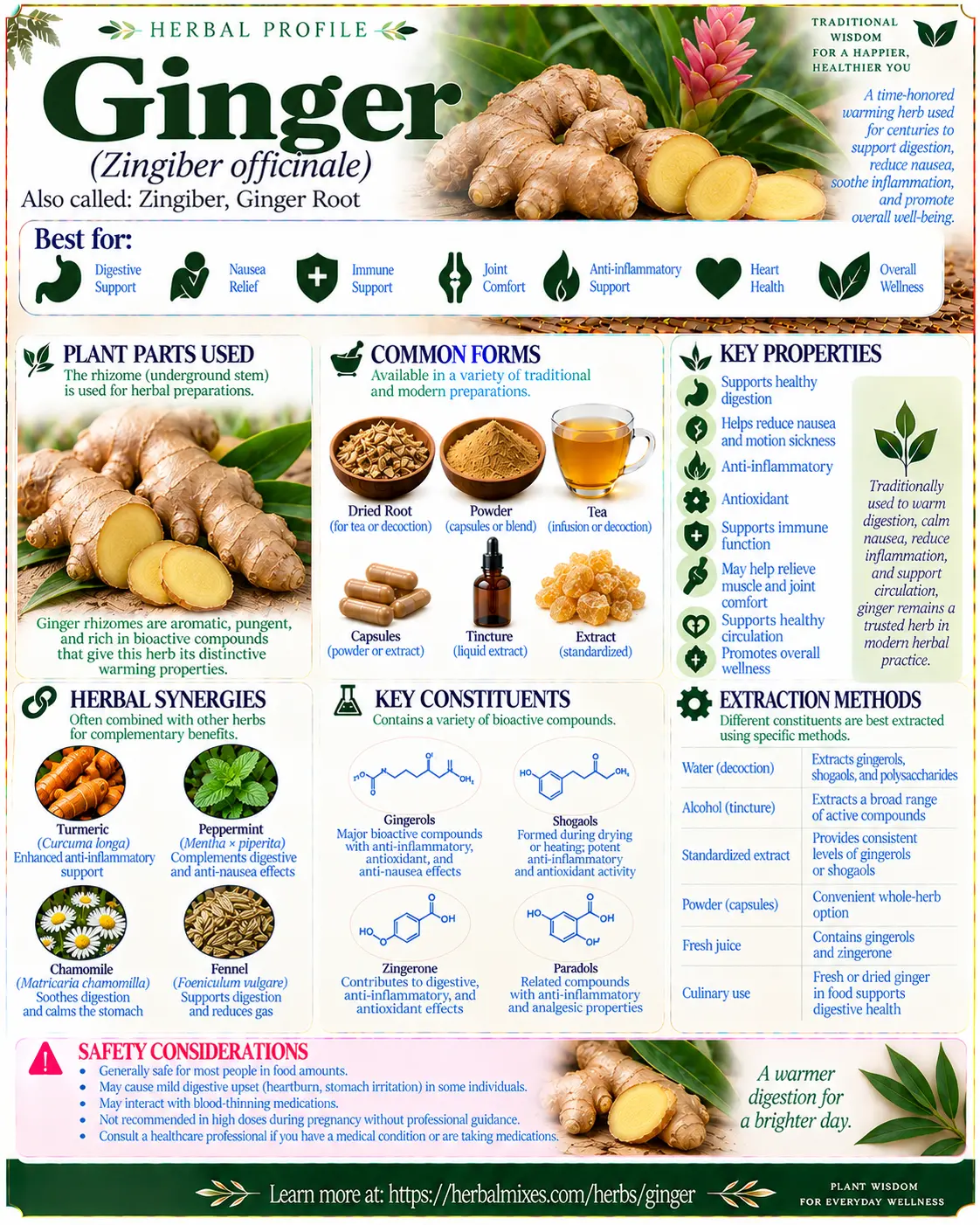
What Ginger Is Good For
Nausea & upset stomach — Ginger is one of the better-studied herbs for nausea. Research suggests it may help with pregnancy-associated nausea, while evidence for chemotherapy-related, postoperative, and motion-related nausea is less consistent.
Indigestion & sluggish digestion — Ginger is traditionally used for dyspepsia, digestive discomfort, and slow digestion. Its pungent constituents may help support gastric motility and normal digestive function.
Bloating & gas — Ginger’s warming, aromatic character makes it useful as a carminative when fullness, gas, or abdominal heaviness accompanies sluggish digestion.
Menstrual cramps — Clinical research suggests ginger supplements may help reduce the severity of menstrual cramps in some people.
Inflammatory discomfort — Gingerols and shogaols influence inflammatory pathways experimentally. Human research suggests possible benefit for osteoarthritis symptoms, although study quality and results vary.
Digestive motility — Ginger is commonly used when food seems to sit heavily in the stomach. Herb Pharm specifically formulates its ginger extract for digestive upset and healthy gastric motility.
Available Herbal Products
Buying Guides for Available Ginger Products
Organic Ginger Root Powder – Ground dried rhizome. A versatile choice for cooking, capsules, syrups, herbal blends, and warming digestive preparations. Powder provides the whole dried rhizome rather than an isolated extract. Seller: Mountain Rose Herbs – View Mountain Rose Herbs Ginger Root Powder →
Ginger Liquid Herbal Extract – Tincture. A 1:5 hydroalcoholic extract made from mature organic ginger rhizome and useful when you want a concentrated, convenient preparation for occasional digestive upset or nausea. Seller: Herb Pharm – View Herb Pharm Ginger →
Ginger Supreme – Supercritical CO₂ extract capsules. Combines concentrated ginger with turmeric and is designed for occasional nausea and digestive support. The extract emphasizes ginger’s pungent, less water-soluble constituents. Seller: Gaia Herbs – View Gaia Herbs Ginger Supreme →
Ginger Tea – Tea bags. Made with organic ginger rhizome and useful when you want a simple warming preparation for digestion without capsules or concentrated extracts. Seller: Traditional Medicinals – View Traditional Medicinals Ginger Tea →
Ginger Aid Tea – Herbal tea blend. Combines ginger with lemon myrtle, blackberry leaf, and stevia for a spicy digestive tea designed for occasional nausea and digestive support. Seller: Traditional Medicinals – View Traditional Medicinals Ginger Aid →
Herbal Synergies
Ginger pairs especially well with peppermint, chamomile, fennel, turmeric, and lemon balm depending on whether the goal is nausea, gas, digestive tension, or inflammatory support.
Ginger + Peppermint
Best for: Nausea, bloating, and digestive cramping
Ginger provides warming digestive stimulation and nausea support, while peppermint contributes cooling carminative and antispasmodic activity. Together they can be useful when nausea occurs alongside gas or abdominal tension.
Best extraction: Covered hot infusion. Ginger’s aromatic compounds and water-extractable pungents combine well with peppermint’s volatile oils when the tea is kept covered during steeping.
Ginger + Chamomile
Best for: Upset stomach with digestive or nervous tension
Ginger supports motility and nausea while chamomile adds soothing, carminative, antispasmodic, and gentle nervine properties.
This makes the combination particularly useful when digestive discomfort seems aggravated by stress or tension.
Best extraction: Covered hot infusion. Both herbs release useful aromatic compounds into hot water, while covering the cup helps retain volatile oils.
Ginger + Fennel
Best for: Bloating, gas, and sluggish digestion
Ginger provides warming digestive stimulation while fennel helps relax intestinal tension and disperse gas. The pairing works especially well after a heavy meal.
Best extraction: Covered hot infusion. Lightly crushed fennel seeds and sliced or dried ginger readily produce a practical digestive tea.
Ginger + Turmeric
Best for: Inflammatory and digestive support
Ginger supplies gingerols and shogaols, while turmeric contributes curcuminoids and aromatic turmerones. Their phytochemistry overlaps in inflammatory pathways but remains sufficiently different to make the herbs complementary.
Best extraction: Powder with food or combined concentrated extracts. The key pungent compounds of both plants are not optimally extracted by plain water alone, and turmeric’s curcuminoids are particularly poorly water soluble.
Ginger + Lemon Balm
Best for: Nervous digestion, nausea, and abdominal tension
Ginger contributes warming motility support while lemon balm offers gentle calming, carminative, and antispasmodic properties.
Best extraction: Covered hot infusion or tincture. Both preparations work well, although a tea is especially practical for occasional digestive discomfort.
Key Herbal Properties
Carminative — Ginger helps support the movement of digestive gas and is commonly used for bloating, fullness, and abdominal discomfort.
Digestive stimulant — Its pungent and aromatic constituents may stimulate digestive activity and support gastric motility.
Antiemetic — Ginger is particularly associated with nausea support. Human evidence is strongest for nausea associated with pregnancy, although results differ among other types of nausea.
Antispasmodic — Ginger may help relax gastrointestinal tension and is traditionally incorporated into formulas for cramping and digestive discomfort.
Anti-inflammatory — Gingerols and shogaols affect inflammatory signaling pathways in laboratory research and may contribute to ginger’s effects on musculoskeletal and menstrual discomfort.
Warming circulatory stimulant — Traditional herbalism classifies ginger as warming and circulatory, particularly useful when digestion or peripheral circulation feels sluggish.
Diaphoretic — Hot ginger preparations are traditionally used to encourage peripheral warmth and perspiration during mild seasonal discomfort.
Antioxidant — Ginger’s phenolic compounds, particularly gingerols and related molecules, have antioxidant activity that accompanies their broader biological effects.






Active Compounds
Ginger’s important constituents fall primarily into two groups: pungent phenolic compounds such as gingerols and shogaols, and an aromatic volatile-oil fraction rich in terpenes such as zingiberene. Processing strongly changes this chemistry: fresh, dried, heated, and extracted ginger are not chemically identical. The EMA assessment describes ginger as containing both volatile oil and a substantial gingerol fraction.
Gingerols
Found mainly in: Fresh and gently dried rhizome
Gingerols, especially 6-gingerol, are major pungent phenolic compounds responsible for much of fresh ginger’s characteristic heat. They are associated experimentally with anti-inflammatory, antioxidant, gastrointestinal, and metabolic effects.
Best extraction: Alcohol tincture, supercritical CO₂ extract, powder, or whole fresh rhizome. Gingerols have limited water solubility, so plain tea extracts only part of the available pungent fraction.
6-Gingerol
Found mainly in: Fresh rhizome
6-Gingerol is the most widely studied member of the gingerol family. It contributes significantly to ginger’s pungency and has been investigated for inflammatory, gastrointestinal, antioxidant, and vascular effects.
Best extraction: Hydroalcoholic tincture, concentrated extract, or whole ginger. Alcohol and other mixed-solvent methods recover it more efficiently than water alone.
Shogaols
Found mainly in: Dried, heated, or processed rhizome
Shogaols, particularly 6-shogaol, form largely through dehydration of gingerols during drying, heating, or storage. Dried ginger therefore contains a different pungent profile from fresh ginger.
Best extraction: Alcohol tincture, CO₂ extract, or dried powder. Shogaols are relatively lipophilic and are poorly represented in simple water infusions compared with broader extracts.
Zingerone
Found mainly in: Heated or cooked ginger
Zingerone forms as ginger undergoes heating and chemical transformation. It has a sweeter, less sharply pungent character than gingerols and contributes to the aroma of cooked ginger.
Best extraction: Cooked whole ginger, alcohol, or mixed preparations. Because it develops during heating, culinary preparations may contain more zingerone than raw ginger.
Zingiberene
Found mainly in: Volatile oil of the rhizome
α-Zingiberene is one of the dominant sesquiterpenes in ginger essential oil and contributes heavily to its characteristic aroma. The EMA assessment lists zingiberene among the principal volatile-oil constituents.
Best extraction: Steam-distilled essential oil, CO₂ extract, or alcohol tincture. Covered hot infusions capture some volatile oil but lose more through evaporation.
β-Sesquiphellandrene
Found mainly in: Volatile oil of the rhizome
β-Sesquiphellandrene is another important sesquiterpene in ginger’s aromatic fraction. It works alongside zingiberene, bisabolene, and other volatile compounds to create ginger’s characteristic aroma and biological profile.
Best extraction: Essential oil, CO₂ extraction, or hydroalcoholic tincture. Plain tea extracts some aromatic constituents, especially when covered, but is less complete.
β-Bisabolene
Found mainly in: Volatile oil
β-Bisabolene is a sesquiterpene found in ginger’s volatile fraction. Its role is less clinically defined than that of gingerols but contributes to the overall aromatic chemistry of the rhizome.
Best extraction: Steam distillation, CO₂ extraction, or alcohol tincture.
Essential Oil Complex
Found mainly in: Rhizome
Ginger contains a complex volatile oil containing zingiberene, sesquiphellandrene, bisabolene, farnesene, camphene, cineole, geraniol, citral, and numerous related terpenes. These compounds contribute its aroma, warming character, and carminative effects.
Best extraction: Steam distillation or CO₂ extraction for concentrated aromatic fractions; a covered hot infusion is more appropriate for ordinary home use.
FAQ
What is ginger best used for?
Ginger is especially useful for nausea and digestive discomfort. Research is strongest for pregnancy-associated nausea, while it is also traditionally used for indigestion, bloating, sluggish digestion, and abdominal heaviness.
Is fresh or dried ginger better?
Neither is universally better—they have different chemistry.
Fresh ginger contains more gingerols and has a brighter aromatic character. Drying and heating convert some gingerols into shogaols, making dried ginger chemically and often energetically more pungent.
Is ginger tea or tincture better?
Tea is excellent for everyday nausea, bloating, warming digestion, and combining ginger with herbs such as peppermint or chamomile.
A hydroalcoholic tincture or concentrated extract captures more of ginger’s relatively poorly water-soluble gingerols, shogaols, and aromatic compounds. Herb Pharm, for example, uses a high-alcohol extraction for its mature dried ginger rhizome.
Can ginger be taken every day?
Ginger is commonly consumed daily as food and has been used safely in many clinical studies as a supplement. Larger supplemental amounts may cause heartburn, abdominal discomfort, diarrhea, or mouth and throat irritation.
Does ginger help with motion sickness?
Ginger is commonly promoted for motion-related nausea, but evidence is inconsistent. NCCIH notes that most studies have not shown ginger to be clearly helpful for motion sickness, even though some commercial products make this traditional-use claim.
Safety & Precautions
Ginger is generally well tolerated when consumed as food or in commonly used supplemental preparations.
Possible oral side effects include heartburn, abdominal discomfort, diarrhea, and mouth or throat irritation, particularly with larger quantities or concentrated products.
Research suggests ginger supplements may be safe during pregnancy, and ginger has evidence supporting pregnancy-associated nausea. However, pregnant people considering supplemental amounts should discuss their use with an appropriate healthcare professional.
Information on concentrated ginger supplementation during breastfeeding is more limited.
Ginger is sometimes described as having antiplatelet effects. People taking anticoagulant or antiplatelet medications, those with bleeding disorders, or those preparing for surgery should discuss high-dose supplemental ginger with a healthcare professional rather than assuming culinary use and concentrated extracts carry identical risks.
People taking blood-pressure or glucose-lowering medications should also be cautious with concentrated supplementation because ginger has been investigated for effects on these systems.
Ginger may aggravate heartburn or reflux in sensitive individuals because of its pungency.
People with significant gallbladder disease or gallstones should discuss concentrated therapeutic use with a healthcare professional, particularly when using formulas intended to stimulate digestion.
Seek medical evaluation for persistent vomiting, severe abdominal pain, blood in vomit or stool, unexplained weight loss, dehydration, or nausea that is new, severe, or persistent.
Anyone with a medical condition or taking prescription medications should discuss regular therapeutic ginger supplementation with an appropriate healthcare professional.
References
- NCCIH — Ginger: Usefulness and Safety
- European Medicines Agency — Zingiberis rhizoma
- EMA — Final Assessment Report on Zingiber officinale Roscoe, Rhizoma
- PubMed — Ginger and Its Constituents: Role in Prevention and Treatment of Gastrointestinal Cancer
- PubMed — Ginger for Nausea and Vomiting Research
- PubMed — Ginger and Primary Dysmenorrhea Research
- Herb Pharm — Ginger Liquid Herbal Extract
- Gaia Herbs — Ginger Supreme
- Traditional Medicinals — Ginger Tea
- Mountain Rose Herbs — Ginger Root Powder
Disclaimer
Disclaimer: This article is for educational purposes only and is not intended to diagnose, treat, cure, or prevent any disease. Herbal products can cause side effects and interact with medications. Consult a qualified healthcare professional before using herbs therapeutically, especially if you are pregnant, breastfeeding, taking prescription medications, or managing a medical condition.