

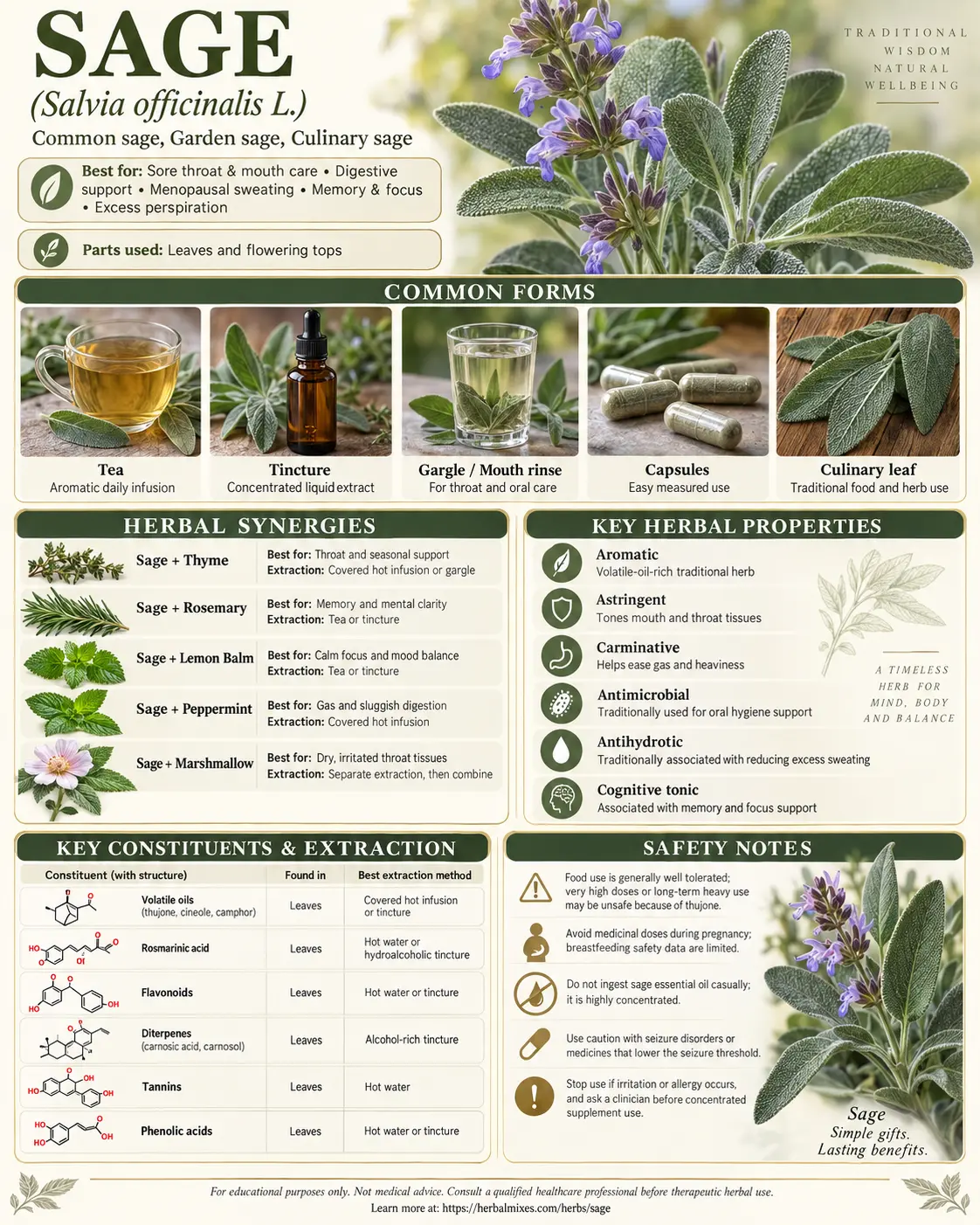
What Sage Is Good For
Digestive support — Sage has longstanding traditional use for indigestion, bloating, and mild gastrointestinal discomfort. The European Medicines Agency recognizes Salvia officinalis leaf within the therapeutic area of gastrointestinal disorders.
Hot flashes & excessive sweating — Small clinical studies suggest sage may reduce the frequency or severity of menopausal hot flashes and sweating. NCCIH considers the evidence promising but still too limited for firm conclusions.
Memory & focus — Several small human studies suggest common sage and related sage species may improve certain aspects of memory, attention, or cognitive performance in healthy adults. The evidence base remains relatively small.
Mouth & throat comfort — EMA recognizes sage leaf for traditional use in mouth and throat disorders. Strong sage infusions are commonly used as gargles for mild irritation of the mouth, gums, and throat.
Minor skin irritation — Sage also has traditional external use for mild inflammatory skin conditions and minor superficial wounds.
Antioxidant support — Sage is rich in rosmarinic acid, carnosic acid, carnosol, flavonoids, and aromatic terpenes, giving it substantial antioxidant activity.
Available Herbal Products
Buying Guides for Available Sage Products
Sage Liquid Herbal Extract – Certified-organic Salvia officinalis aerial-parts tincture. Made at a 1:5 herb-to-menstruum ratio and currently available directly from the manufacturer. Seller: Herb Pharm – View Herb Pharm Sage →
Organic Sage Leaf Cut & Sifted – Loose dried Salvia officinalis leaf. Currently listed in stock and well suited to tea, gargles, culinary use, and custom herbal blends. Seller: Starwest Botanicals – View Organic Sage Leaf →
Organic Sage Leaf Powder – Finely ground whole leaf. Currently listed in stock and suitable for capsules, culinary preparations, or custom formulations. Seller: Starwest Botanicals – View Organic Sage Leaf Powder →
Sage Extract 160 mg – Concentrated 10:1 Salvia officinalis leaf extract equivalent to 3.2 g of herb per two-capsule serving. Currently listed in stock. Seller: Swanson / iHerb – View Swanson Sage Extract →
Sage 285 mg – Whole organic Salvia officinalis leaf in capsules, providing 570 mg per two-capsule serving. Currently listed in stock. Seller: Solaray / iHerb – View Solaray Sage →
For routine digestive or throat use, sage leaf tea or tincture is generally preferable to essential oil because the oil concentrates thujone and other potent volatile compounds.
Herbal Synergies
Sage pairs especially well with rosemary, peppermint, lemon balm, chamomile, and thyme depending on whether the goal is cognition, digestion, sweating, or throat support.
Sage + Rosemary
Best for: Memory, focus, and mental alertness
Both herbs contain rosmarinic acid, carnosic acid, and aromatic monoterpenes. Sage contributes traditional cognitive support, while rosemary adds stimulating aromatic and circulatory activity.
Best extraction: Covered hot infusion or hydroalcoholic tincture.
Sage + Peppermint
Best for: Bloating, indigestion, and digestive spasms
Sage contributes bitter-aromatic digestive activity, while peppermint adds stronger carminative and smooth-muscle-relaxing effects.
Best extraction: Covered hot infusion to retain volatile oils.
Sage + Lemon Balm
Best for: Stress-related sweating and nervous digestion
Sage is traditionally used to reduce excessive perspiration, while lemon balm adds gentle calming and digestive support.
Best extraction: Covered hot infusion or tincture.
Sage + Chamomile
Best for: Mouth, throat, and digestive irritation
Sage contributes astringent and antimicrobial activity, while chamomile adds soothing and antispasmodic effects.
Best extraction: Covered hot infusion, used internally or cooled as a gargle.
Sage + Thyme
Best for: Throat and respiratory comfort
Both contain aromatic volatile oils with experimental antimicrobial activity. Thyme adds stronger expectorant and respiratory-supportive properties.
Best extraction: Covered hot infusion or tincture.
Key Herbal Properties
Carminative — Sage helps relieve gas, bloating, and mild digestive discomfort through its aromatic volatile oils.
Antihidrotic — traditional / emerging clinical evidence — Sage has longstanding use for excessive perspiration and menopausal sweating.
Nootropic supportive — Small human trials suggest possible benefits for memory and cognitive performance.
Astringent — Tannins contribute tissue-tightening effects useful in mouth and throat preparations.
Antioxidant — Rosmarinic acid, carnosic acid, carnosol, and flavonoids provide substantial antioxidant activity.
Anti-inflammatory — experimental — Sage polyphenols and terpenes modulate inflammatory pathways in laboratory and animal research.
Antimicrobial — experimental — Sage extracts and essential oil show antibacterial and antifungal activity in vitro.






Active Compounds
Sage contains two major phytochemical fractions: polyphenols and diterpenes such as rosmarinic acid and carnosic acid, and volatile essential-oil constituents such as thujone, camphor, and 1,8-cineole.
Rosmarinic Acid
Found mainly in: Leaves
Rosmarinic acid is one of sage’s major mint-family polyphenols.
It contributes antioxidant and inflammatory-modulating activity.
Best extraction: Hot water or hydroalcoholic extraction.
Carnosic Acid
Found mainly in: Leaves
Carnosic acid is a lipophilic phenolic diterpene also abundant in rosemary.
It is extensively studied for antioxidant, neuroprotective, and inflammatory-modulating effects.
Best extraction: Alcohol-rich or lipid-compatible extraction.
Carnosol
Found mainly in: Leaves
Carnosol is closely related to carnosic acid and contributes significantly to sage’s antioxidant activity.
Best extraction: Hydroalcoholic or lipid-compatible extraction.
Alpha-Thujone
Found mainly in: Essential oil
Alpha-thujone is one of sage’s most important safety-related constituents.
At high exposure it can interfere with GABA-A receptor signaling and may provoke neurological toxicity or seizures.
Best extraction: Steam distillation strongly concentrates thujone, which is why essential oil deserves much more caution than ordinary tea.
Beta-Thujone
Found mainly in: Essential oil
Beta-thujone accompanies alpha-thujone and contributes to the overall thujone content.
Best extraction: Steam distillation or alcohol-rich extraction.
Camphor
Found mainly in: Essential oil
Camphor contributes sage’s penetrating aroma and has sensory and antimicrobial effects.
High doses can be neurologically toxic.
Best extraction: Steam distillation.
1,8-Cineole
Found mainly in: Essential oil
Also called eucalyptol, this volatile compound contributes to sage’s respiratory and aromatic profile.
Best extraction: Steam distillation or hydroalcoholic tincture.
Flavonoids
Found mainly in: Leaves
Sage contains flavonoids including luteolin- and apigenin-related compounds, which contribute antioxidant activity.
Best extraction: Hot water or diluted alcohol.
FAQ
What is sage best used for?
Sage is best suited to digestive support, menopausal sweating and hot flashes, mouth and throat irritation, and mild cognitive support.
Its traditional gastrointestinal and mouth/throat uses are recognized by EMA.
Does sage really help hot flashes?
Possibly.
NCCIH notes that a few small studies suggest Salvia officinalis may reduce the frequency of menopausal hot flashes, but more research is needed before firm conclusions can be reached.
Can sage improve memory?
Small studies suggest that common sage and Spanish sage may improve certain memory or cognitive test scores in healthy adults.
The evidence is interesting but not strong enough to treat cognitive impairment or dementia.
Is sage tea the same as sage essential oil?
No.
Tea contains rosmarinic acid, tannins, flavonoids, and relatively small amounts of volatile oil.
Essential oil concentrates thujone, camphor, and 1,8-cineole and therefore carries a greater neurological safety risk.
Can sage be used as a gargle?
Yes.
Strong cooled sage infusion is a traditional preparation for mild mouth, gum, and throat irritation, and EMA includes mouth and throat disorders among sage leaf’s recognized traditional-use areas.
Safety & Precautions
Sage used in ordinary culinary amounts is generally considered safe.
NCCIH states that larger amounts have also been used safely for up to approximately 8 weeks in research studies.
The main safety concern is thujone.
Common sage contains thujone, which can be toxic in high amounts or with prolonged concentrated exposure. Excessive thujone can cause agitation, tremor, neurological symptoms, and seizures.
For this reason, do not swallow undiluted sage essential oil.
People with epilepsy or seizure disorders should be especially cautious with concentrated sage extracts and essential oil.
Solaray currently advises that its sage capsules are not for long-term use and should not exceed the recommended dose, reflecting concern about concentrated thujone exposure.
Avoid concentrated medicinal sage during pregnancy unless specifically recommended by a qualified healthcare professional. Herb Pharm advises seeking expert medical advice before pregnancy use, while several supplement manufacturers advise avoiding sage entirely during pregnancy.
Sage has historically been used to reduce milk production, so concentrated medicinal preparations may be inappropriate during breastfeeding when maintaining milk supply is important.
Normal culinary use is different from concentrated extracts or essential oil.
Sage may influence blood glucose, so people taking diabetes medications should monitor glucose carefully when using concentrated extracts.
Theoretical interactions are also possible with anticonvulsant medications because of thujone’s neurological activity.
Sage essential oil can irritate the skin and mucous membranes and should be properly diluted before topical use.
Do not use sage as a substitute for medical evaluation of persistent hot flashes, abnormal vaginal bleeding, sudden cognitive decline, persistent mouth sores, severe sore throat, or unexplained excessive sweating.
Anyone who is pregnant, breastfeeding, managing epilepsy, taking anticonvulsant or diabetes medications, or using concentrated essential oils should discuss therapeutic sage use with an appropriate healthcare professional.
References
- NCCIH — Sage: Usefulness and Safety
- European Medicines Agency — Sage Leaf
- European Medicines Agency — Sage Oil
- Herb Pharm — Sage Liquid Herbal Extract
- Starwest Botanicals — Organic Sage Leaf Cut & Sifted
- Starwest Botanicals — Organic Sage Leaf Powder
- Swanson / iHerb — Sage Extract 160 mg
- Solaray / iHerb — Sage 285 mg
Disclaimer
Disclaimer: This article is for educational purposes only and is not intended to diagnose, treat, cure, or prevent any disease. Herbal products can cause side effects and interact with medications. Consult a qualified healthcare professional before using herbs therapeutically, especially if you are pregnant, breastfeeding, taking prescription medications, or managing a medical condition.