

What Echinacea Is Good For
Immune Defense & Seasonal Resilience — Echinacea is globally renowned as a premier immune stimulant traditionally used at the very first sign of seasonal challenges to mobilize white blood cells and enhance immune surveillance.
Lymphatic Drainage & Glandular Support — Acts as a gentle lymphagogue that encourages lymphatic circulation, helping clear fluid congestion and soothe swollen lymph glands.
Upper Respiratory Comfort — Supports respiratory mucous membranes, easing scratchy throats and maintaining comfort during seasonal immune stress.
Wound & Skin Healing (Topical) — Applied topically as a fresh extract or salve, it provides vulnerary and antimicrobial support for minor cuts, scrapes, and bug bites.
Phagocytosis Activation — Stimulates the body’s natural phagocytes—immune cells that engulf and destroy foreign particles and pathogens.
Available Herbal Products
Buying Guides for Available Echinacea Products
Organic Echinacea Purpurea Root & Herb Liquid Extract – Fresh-plant hydroalcoholic tincture. The gold standard for capturing active alkylamides and polysaccharides right after harvest. Seller: Herb Pharm – View Herb Pharm Echinacea Extract →
Organic Whole Echinacea Root Cut – Dried root pieces. An authentic, traditional choice for simmering into a rich, tingling immune-supportive decoction. Seller: Mountain Rose Herbs – View Mountain Rose Herbs Echinacea Root →
Standardized Echinacea Purpurea Extract Capsules – Concentrated capsules. Formulated with guaranteed levels of active alkylamides to provide reliable daily immune support. Seller: Gaia Herbs – View Gaia Herbs Echinacea →
Immune Defense Herbal Syrup – Alcohol-free liquid formula combining echinacea root with elderberry and propolis. Designed to provide palatable, comprehensive immune support for the whole family. Seller: Traditional Medicinals – View Traditional Medicinals Formulas →
Herbal Synergies
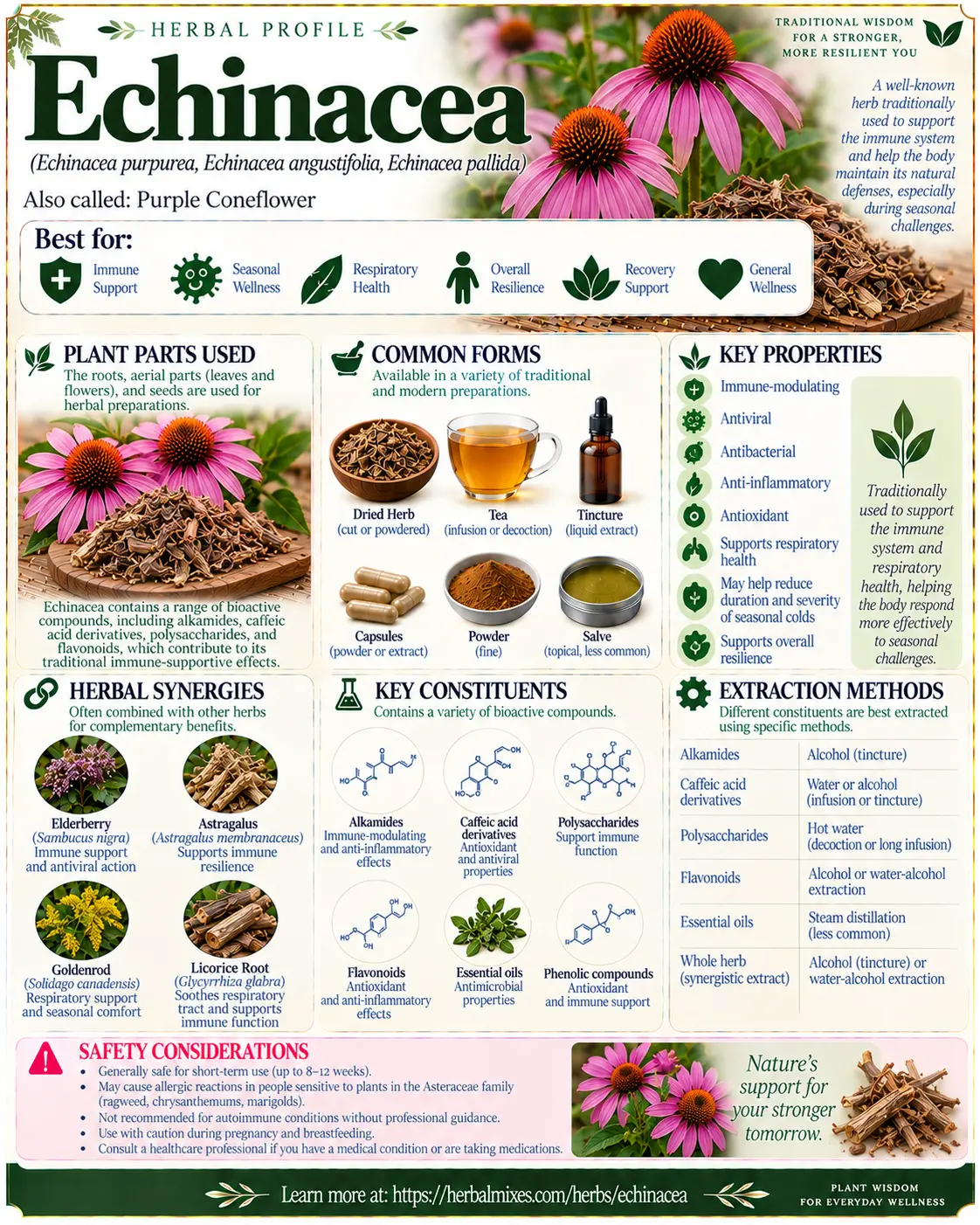
Echinacea pairs especially well with Elderberry, Andrographis, and Astragalus Root, depending on the goal of the formula.
Echinacea Root + Elderberry Fruit – Best for: Comprehensive immune defense, shortening seasonal challenges, and supporting upper respiratory health Echinacea stimulates active white blood cell phagocytosis and lymphatic drainage, while elderberry delivers rich anthocyanins that block viral attachment to host cells. Together, they form the premier immune-defense duo. Best extraction: Liquid extract tincture or immune syrup. Combines fast-acting alkylamides with rich fruit bioflavonoids.
Echinacea Root + Astragalus Root Best for: Deep immune building, long-term resilience, and preventing seasonal susceptibility Echinacea acts as an acute immune mobilizer for immediate defense, whereas astragalus provides deep adaptogenic polysaccharides that build foundational immune strength over time. Best extraction: Decoction or dual-extract capsules. Blends acute action with deep tonic restoration.
Echinacea Root + Andrographis Leaf – Best for: Intensive immune support during acute seasonal challenges and throat comfort Echinacea mobilizes immune defenses and drains lymphatic stagnation, while andrographis provides intense bitter antimicrobial support. Best extraction: Tincture combination. Delivers rapid, potent herbal action.
Key Herbal Properties
Immunostimulant — Mobilizes and activates immune cells (including macrophages and natural killer cells) to strengthen acute defense.
Lymphagogue — Encourages fluid movement through the lymphatic system, easing swollen glands and congestion.
Antimicrobial (Mild) — Helps inhibit the proliferation of surface bacteria and pathogens.
Vulnerary (Topical) — Promotes the rapid healing and soothing of minor skin wounds and abrasions.
Alterative — Supports metabolic clearance and tissue health during immune challenges.




Active Compounds
Alkylamides (isobutylamides) Found mainly in: Roots of Echinacea angustifolia and Echinacea purpurea The primary bioactive compounds responsible for the characteristic tingling sensation on the tongue when high-quality echinacea is tasted; they stimulate white blood cell activity and immune responsiveness. Best extraction: High-proof alcohol tincture. Alkylamides are fat-soluble and dissolve efficiently in alcohol.
Polysaccharides (High-Molecular-Weight) Found mainly in: Roots and aerial parts Complex carbohydrates that stimulate phagocytosis and enhance immune surveillance. Best extraction: Water decoction or alcohol-water extract. Soluble in warm water and hydroalcoholic solutions.
Caffeic Acid Derivatives (including Cichoric Acid) Found mainly in: Leaves, stems, and roots Potent antioxidant compounds that protect cellular tissues and support anti-inflammatory pathways. Best extraction: Alcohol-water extract or fresh plant juice. Soluble in hydroalcoholic solvents.
FAQ
What is echinacea best used for? Echinacea is primarily used as an acute immune stimulant to support the body’s natural defense against seasonal challenges and clear lymphatic congestion.
Why does good echinacea tincture make your tongue tingle? The tingling sensation is caused by active alkylamides, which confirm the presence and potency of the plant’s active immune-stimulating compounds.
Should echinacea be taken continuously every day? Traditional herbalism often recommends taking echinacea intermittently or acutely (such as at the onset of immune stress for 7 to 14 days) rather than indefinitely, allowing the immune system to respond dynamically.
Which species of echinacea is best (E. purpurea vs. E. angustifolia)? Both are wonderful; Echinacea purpurea is easier to cultivate and provides rich polysaccharides and alkylamides (especially in the root), while Echinacea angustifolia roots are traditionally prized for their exceptionally high, tingling alkylamide concentrations.
Can echinacea be taken safely by children? Yes, alcohol-free echinacea glycerites or weak teas are commonly used to support children’s immune health during seasonal challenges under professional guidance.
Safety & Precautions
Autoimmune Conditions: Individuals with certain progressive or autoimmune disorders (such as multiple sclerosis, lupus, or rheumatoid arthritis) or those taking immunosuppressant drugs should consult a physician before using potent immunostimulants.
Asteraceae Allergy: Individuals with known severe allergies to plants in the Asteraceae (daisy/ragweed) family—such as ragweed, marigolds, or daisies—should exercise caution.
Short-Term Acute Use: Echinacea is most effective when deployed as an acute, short-term herbal ally at the onset of immune stress rather than a continuous lifelong daily supplement.
Pregnancy & Breastfeeding: Culinary amounts and mild teas are generally safe, but consult a qualified herbalist before using concentrated therapeutic extracts during pregnancy.
Consult a qualified healthcare professional before using echinacea therapeutically, especially if you manage underlying medical conditions or take prescription drugs.
References
National Center for Complementary and Integrative Health (NCCIH) – Echinacea Overview
European Medicines Agency (EMA) Monograph on Echinacea purpurea radix / herba
World Health Organization (WHO) Monographs on Selected Medicinal Plants
Mountain Rose Herbs Echinacea Root Monograph
Disclaimer
Disclaimer: This article is for educational purposes only and is not intended to diagnose, treat, cure, or prevent any disease. Herbal products can cause side effects and interact with medications. Consult a qualified healthcare professional before using herbs therapeutically, especially if you are pregnant, breastfeeding, taking prescription medications, or managing a medical condition.