
Depression can feel like low mood, low energy, lost interest, poor sleep, appetite changes, foggy thinking, or the sense that daily life takes more effort than usual.
It is not laziness, weakness, or a character flaw. It deserves care, support, and sometimes professional treatment.
Learn more about Depression
Why It Happens
Depression can develop from many overlapping factors, including genetics, stress, trauma, grief, chronic illness, hormonal changes, medication effects, poor sleep, substance use, and major life pressure. Brain chemistry, inflammation, nervous system stress, and social isolation may also play a role.
Main Types in Plain Language
Some people experience short-term depressive symptoms after loss, illness, burnout, or life changes. Others experience major depression, seasonal depression, postpartum depression, or depression linked with bipolar disorder. These patterns need different types of care, so self-diagnosis can mislead people.
Common Triggers
Common triggers include poor sleep, chronic stress, loneliness, alcohol use, nutrient gaps, pain, major transitions, and winter light changes. Sometimes depression appears without an obvious reason, which can feel especially confusing.
How It Shows Up
Depression may show up as sadness, numbness, irritability, low motivation, guilt, fatigue, body heaviness, appetite changes, or trouble concentrating. Some people keep functioning on the outside while feeling completely drained inside.
Traditional Herbal View
Traditional herbalism often looks at depression through patterns. A tense, anxious pattern may call for calming nervines. A depleted pattern may call for nourishing tonics. A sluggish, heavy pattern may call for warming and gently uplifting aromatics.
Herbalists choose herbs by the person’s pattern, medications, safety needs, and whether professional mental health care is already involved.
How Herbs Can Help Depression
Herbalism often sees depression as a mix of nervous system strain, depletion, poor sleep, grief, low vitality, or stuck emotional heaviness. Herbalists use nervines for calm, adaptogens for stress resilience, nutritive herbs for depletion, aromatics for uplift, and bitters for digestion and appetite. They choose gentle nourishing herbs when fatigue dominates, calming herbs when worry dominates, and uplifting aromatics when the mood feels heavy or flat. These are herbs traditionally used when depression happens: lemon balm, oat straw, chamomile, lavender, tulsi, rose petals, nettle, rosehips, saffron, cardamom, rosemary, ginger, passionflower, skullcap, oats, peppermint, spearmint, ashwagandha, cinnamon, hibiscus, orange peel, cacao.
“Depression can make the world feel dim, so support often starts small: warm tea, steady meals, real help, and one kind step at a time.”
Recipes & Remedies Depression
Herbal Preparations
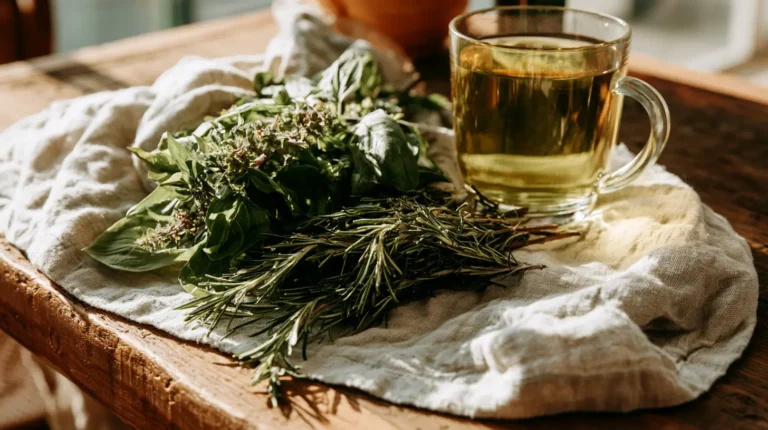
Lemon Balm, Rose, and Oat Straw Mood-Support Tea
This gentle tea supports the nervous system with calm, nourishment, and a soft floral lift. It is suitable for quiet afternoons, evening wind-down, or low-energy days when complicated recipes are not invited.
Ingredients
Dried lemon balm: 1 tablespoon
Dried oat straw: 1 tablespoon
Dried rose petals: 1 teaspoon
Dried chamomile: 1 teaspoon
Hot water: 1½ cups
Honey: 1 teaspoon, optional
Preparation Instructions
- Place lemon balm, oat straw, rose, and chamomile in a mug or teapot.
- Pour hot water over the herbs.
- Cover and steep for 10 to 15 minutes.
- Strain well.
- Add honey if desired.
How to Use
Drink 1 cup in the afternoon or evening.
Use this tea as a supportive ritual, not as a replacement for therapy, medication, or crisis care.
Avoid chamomile if you react to ragweed-family plants.
Food for support Depression
Omega-Rich Salmon, Walnut, and Herb Bowl
This simple meal supports steady nourishment with protein, omega-3 fats, fiber, herbs, and colorful plants. Food cannot solve depression alone, but it gives the body useful building materials.
Ingredients
Cooked salmon: 4 ounces
Cooked brown rice or quinoa: ¾ cup
Baby spinach: 1 cup
Walnuts: 2 tablespoons chopped
Fresh parsley: 2 tablespoons chopped
Fresh rosemary: ½ teaspoon finely minced
Olive oil: 1 tablespoon
Lemon juice: 1 tablespoon
Ground flaxseed: 1 tablespoon
Salt: ¼ teaspoon, or to taste
Preparation Instructions
- Add rice or quinoa to a bowl.
- Top with spinach and cooked salmon.
- Sprinkle walnuts, parsley, rosemary, and ground flaxseed over the bowl.
- Whisk olive oil, lemon juice, and salt.
- Drizzle the dressing over the bowl.
- Serve warm or room temperature.
How to Use
Enjoy as lunch or dinner when you need a steady, nourishing meal.
Use canned salmon if you need an easier option.
Avoid salmon or walnuts if you have allergies, and check with your clinician if you take blood-thinning medication.
What Herbs You Need
For depression support, herbalists often discuss lemon balm, oat straw, rose, chamomile, tulsi, lavender, rosemary, ginger, St. John’s wort, saffron, rhodiola, ashwagandha, nettle, milky oat, parsley, flaxseed, and walnut. These plants do not replace professional mental health care, and several require careful medication review.
Lemon Balm
Latin name: Melissa officinalis
Key herbal actions: Nervine, meaning it supports the nervous system. Carminative, meaning it eases digestive tension. Mild uplifting herb, meaning herbalists use it for low, tense moods.
Key active compounds: Rosmarinic acid, citral, citronellal, flavonoids.
Oat Straw
Latin name: Avena sativa
Key herbal actions: Nervine tonic, meaning it nourishes nervous system resilience. Nutritive, meaning it provides minerals. Gentle restorative, meaning herbalists use it for long-term stress patterns.
Key active compounds: Avenanthramides, silicic acid, flavonoids, minerals.
Rose
Latin name: Rosa damascena or Rosa centifolia
Key herbal actions: Emotional comfort herb, meaning herbalists use it for grief and tenderness. Mild astringent, meaning it tones tissues. Aromatic, meaning it offers sensory support.
Key active compounds: Geraniol, citronellol, flavonoids, anthocyanins.
Chamomile
Latin name: Matricaria chamomilla
Key herbal actions: Nervine, meaning it supports relaxation. Carminative, meaning it supports digestion. Anti-inflammatory, meaning it may calm irritation.
Key active compounds: Apigenin, bisabolol, chamazulene, flavonoids.
Tulsi
Latin name: Ocimum tenuiflorum
Key herbal actions: Adaptogen, meaning herbalists use it for stress resilience. Nervine, meaning it supports calm alertness. Aromatic, meaning it offers a bright, uplifting quality.
Key active compounds: Eugenol, ursolic acid, rosmarinic acid, flavonoids.
Lavender
Latin name: Lavandula angustifolia
Key herbal actions: Nervine, meaning it supports relaxation. Aromatic, meaning it contains fragrant volatile oils. Sleep-supportive, meaning herbalists use it in evening routines.
Key active compounds: Linalool, linalyl acetate, rosmarinic acid, flavonoids.
Rosemary
Latin name: Salvia rosmarinus
Key herbal actions: Aromatic, meaning it carries fragrant volatile compounds. Circulatory stimulant, meaning herbalists use it for warmth and movement. Uplifting herb, meaning it supports heavy, sluggish patterns.
Key active compounds: Rosmarinic acid, carnosic acid, carnosol, essential oil compounds.
Ginger
Latin name: Zingiber officinale
Key herbal actions: Warming, meaning it supports cold, sluggish patterns. Carminative, meaning it supports digestion. Circulatory stimulant, meaning herbalists use it for movement and warmth.
Key active compounds: Gingerols, shogaols, zingerone, volatile oils.
St. John’s Wort
Latin name: Hypericum perforatum
Key herbal actions: Nervine, meaning herbalists use it for mood support. Uplifting herb, meaning it has traditional use for mild low mood. Vulnerary, meaning it also has topical traditional use.
Key active compounds: Hypericin, hyperforin, flavonoids, phloroglucinols.
Important safety note: St. John’s wort has major drug interaction concerns and can interact dangerously with antidepressants, birth control pills, blood thinners, HIV medications, transplant medications, cancer medications, and many others.
Saffron
Latin name: Crocus sativus
Key herbal actions: Uplifting herb, meaning it has traditional use for mood support. Antioxidant, meaning it helps protect against oxidative stress. Digestive aromatic, meaning it supports appetite and flavor.
Key active compounds: Crocin, crocetin, safranal, picrocrocin.
Rhodiola
Latin name: Rhodiola rosea
Key herbal actions: Adaptogen, meaning herbalists use it for stress resilience. Stimulating tonic, meaning it may support fatigue patterns. Uplifting herb, meaning it suits some low-energy patterns.
Key active compounds: Rosavins, salidroside, tyrosol, flavonoids.
Ashwagandha
Latin name: Withania somnifera
Key herbal actions: Adaptogen, meaning herbalists use it for stress resilience. Nervine tonic, meaning it supports calm restoration. Sleep-supportive herb, meaning it may suit exhausted, wired patterns.
Key active compounds: Withanolides, alkaloids, sitoindosides, flavonoids.
Nettle
Latin name: Urtica dioica
Key herbal actions: Nutritive, meaning it provides minerals. Tonic, meaning herbalists use it for long-term vitality. Alterative, meaning it supports broad wellness routines.
Key active compounds: Minerals, chlorophyll, flavonoids, phenolic acids.
Milky Oat
Latin name: Avena sativa
Key herbal actions: Nervine tonic, meaning it supports depleted nervous systems. Restorative, meaning it suits burnout patterns. Nutritive, meaning it provides gentle plant nourishment.
Key active compounds: Avenanthramides, flavonoids, minerals, polysaccharides.
Parsley
Latin name: Petroselinum crispum
Key herbal actions: Nutritive, meaning it adds plant nutrients. Digestive, meaning it supports meal enjoyment. Antioxidant, meaning it contains protective plant compounds.
Key active compounds: Apigenin, vitamin C, vitamin K, flavonoids.
Flaxseed
Latin name: Linum usitatissimum
Key herbal actions: Nutritive, meaning it provides fiber and fatty acids. Demulcent, meaning it moistens tissues. Digestive supportive, meaning it supports regularity.
Key active compounds: Alpha-linolenic acid, lignans, mucilage, fiber.
Walnut
Latin name: Juglans regia
Key herbal actions: Nutritive, meaning it provides healthy fats and minerals. Cardiometabolic supportive, meaning it supports broader nourishment. Food-based tonic, meaning it fits everyday meals.
Key active compounds: Alpha-linolenic acid, polyphenols, tocopherols, minerals.
Key Herbal Products for Depression
St. John’s Wort Capsules
St. John’s wort capsules contain Hypericum perforatum extract. People commonly use them for mild to moderate depressive symptoms, but safety concerns limit their use.
Pros: Research has studied it more than many mood herbs.
Cons: It has serious medication interactions and can cause dangerous effects with antidepressants.
Choose this only with clinician guidance, especially if you take any medication.
Saffron Extract Capsules
Saffron supplements contain concentrated Crocus sativus extract. People commonly use them for mood support in capsule form.
Pros: Some clinical studies have examined saffron for depressive symptoms.
Cons: Quality, dose, and extract type vary widely.
Choose this when someone wants a non-sedating supplement and has checked safety.
Lemon Balm Tea or Tincture
Lemon balm products come as loose tea, tea bags, tinctures, or glycerites. People commonly use them for stress, tension, and low mood with anxiety.
Pros: It tastes pleasant and feels gentle for many people.
Cons: It may not feel strong enough for significant depression.
Choose tea for a gentle ritual or tincture when convenience matters.
Ashwagandha Capsules
Ashwagandha capsules contain Withania somnifera root extract. People commonly use them for stress-related fatigue, poor sleep, and burnout patterns.
Pros: It may suit depleted, stressed, overworked patterns.
Cons: It does not suit everyone and raises safety concerns with pregnancy, thyroid issues, autoimmune conditions, liver concerns, and some medications.
Choose this only after reviewing personal safety factors.
Omega-3 Supplements
Omega-3 supplements are not herbs, but many people use them for mood-support routines. They usually contain EPA and DHA from fish oil or algae.
Pros: Research has studied omega-3 fatty acids in depression, often as an add-on support.
Cons: Effects vary, and high doses may interact with blood-thinning medications.
Choose this when diet lacks oily fish and a clinician approves supplement use.
FAQ
Can herbs replace antidepressants or therapy?
No. Herbs should not replace antidepressants, therapy, crisis support, or professional mental health care. Depression can become serious, and support works best when it matches the person’s needs.
Is St. John’s wort safe for depression?
St. John’s wort is not safe for everyone. It can interact with many medications, including antidepressants and birth control pills. Always ask a qualified clinician before using it.
What if depression feels severe or scary?
Get immediate help if you feel at risk of harming yourself or someone else. In the United States, call or text 988 for the Suicide and Crisis Lifeline. You can also call emergency services or go to the nearest emergency room.
Can I drink mood-support tea every day?
Gentle teas like lemon balm, oat straw, rose, and chamomile may suit daily use for many people. However, herbs still affect the body. Start with one cup and stop if you notice unwanted effects.
Fresh herbs or dried herbs: which works better?
Both can work well. Fresh lemon balm and rosemary taste bright, while dried herbs offer convenience and stronger shelf stability. Use clean, correctly identified herbs from a trusted source.
How should I store mood-support herbs?
Store dried herbs in airtight containers away from heat, light, and moisture. Most leafy herbs taste best within one year. Discard herbs that smell dusty, moldy, or weak.
Can pets use these herbs?
Do not give mood-support herbs to pets unless a veterinarian approves. St. John’s wort, essential oils, and concentrated extracts may harm animals. Keep tinctures, capsules, and teas out of reach.
References
NCCIH: Depression and Complementary Health Approaches
NCCIH: 8 Things To Know About Depression and Complementary Health Approaches
NCCIH: St. John’s Wort and Depression
NCCIH: St. John’s Wort Usefulness and Safety
NCCIH: 5 Things To Know About St. John’s Wort and Depression
NIMH: Help for Mental Illnesses
988 Suicide and Crisis Lifeline
PubMed: Efficacy of Omega-3 PUFAs in Depression: A Meta-Analysis
PubMed Central: Omega-3 Polyunsaturated Fatty Acids in Depression
PubMed Central: Advantages and Disadvantages of St. John’s Wort as a Treatment for Depression
PubMed: The Effects of Lemon Balm on Depression and Anxiety
Disclaimer
This article offers educational information only. It does not provide medical advice, diagnosis, or treatment.
Depression can become serious and may require therapy, medication, crisis support, or urgent care. If you feel unsafe, at risk of self-harm, or unable to cope, call or text 988 in the United States or contact emergency services.
Herbs may interact with antidepressants, anxiety medications, birth control pills, blood thinners, sedatives, alcohol, surgery, pregnancy, breastfeeding, bipolar disorder, liver conditions, and chronic health issues. Always review herbal supplements with a qualified healthcare professional.