

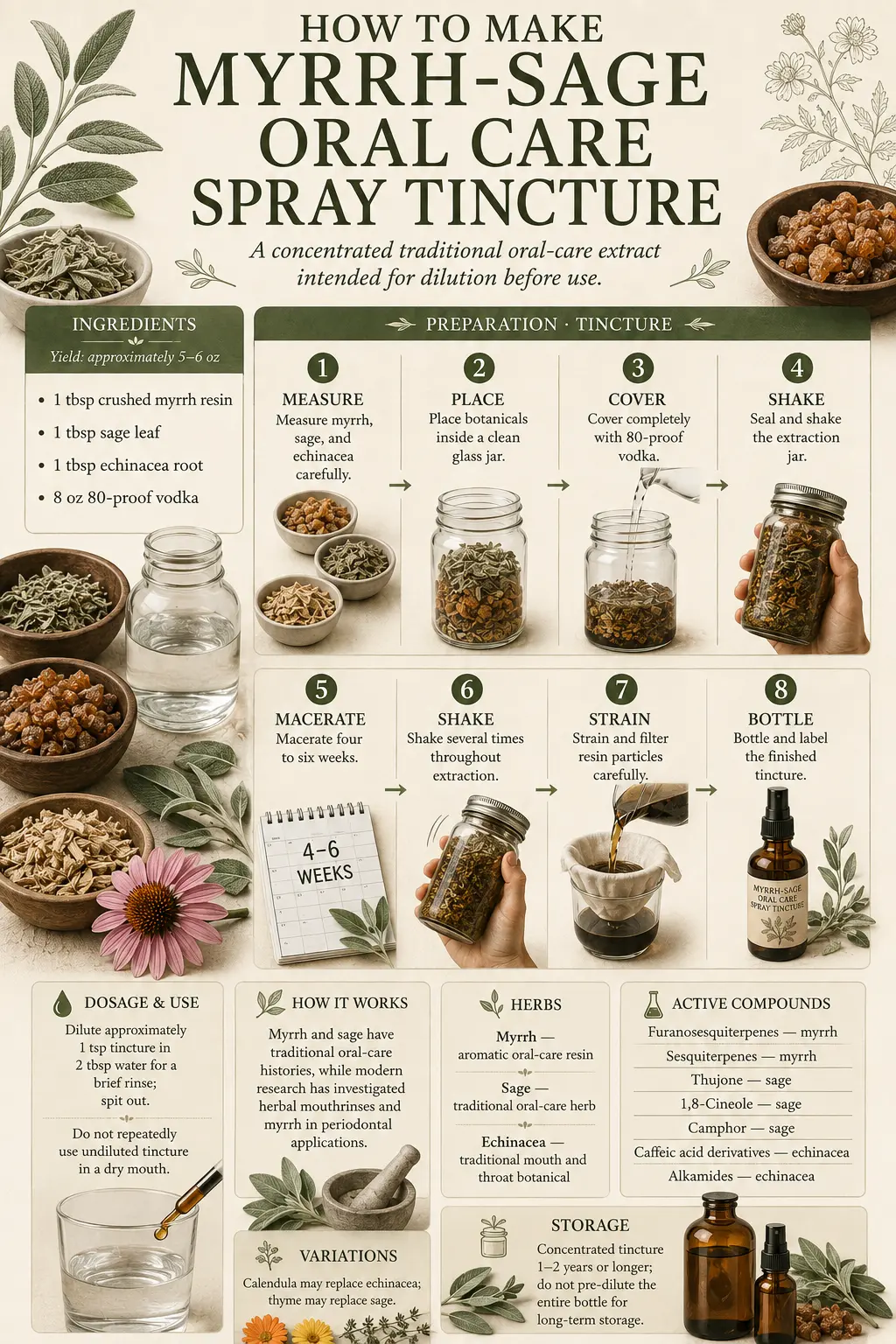
Recipe Details
Preparation Type: Tincture
Ingredients
Myrrh resin — 1 tablespoon, crushed
8 oz 80-proof vodka
1 sterilized 12-oz glass jar
Preparation
- Place the crushed myrrh, sage, and echinacea root into the jar.
- Pour the vodka over the herbs.
- Seal tightly.
- Shake thoroughly.
- Store in a cool, dark place for 4–6 weeks, shaking several times per week.
- Strain through fine muslin.
- Filter again if resin particles remain.
- Store the finished tincture in amber glass.
Yield
Approximately 5–6 oz concentrated tincture.
Dosage & Usage
For oral use, do not spray the undiluted tincture repeatedly into a dry mouth.
For a rinse, dilute approximately 1 teaspoon tincture in 2 tablespoons water, swish briefly, and spit.
For a spray format, prepare only a small amount at the time of use by diluting the tincture with water rather than storing a heavily water-diluted homemade spray for extended periods.
The alcohol component is important here: NIDCR recommends avoiding alcohol-containing oral products in people with dry mouth because alcohol can contribute to oral dryness. (NIDCR)
Precautions & Contraindications
- This formula is not ideal for frequent use in significant xerostomia. The alcohol-containing tincture can work against the moisturizing goal.
- Do not use during pregnancy or breastfeeding without professional guidance. Mountain Rose Herbs specifically cautions against internal myrrh use during pregnancy without qualified supervision. (Mountain Rose Herbs)
- Avoid if allergic to any ingredient.
- Myrrh can cause nausea in sensitive individuals. (Mountain Rose Herbs)
- Stop immediately if the spray causes burning, increased dryness, swelling, or irritation.
- Do not swallow large quantities.
- This preparation does not replace brushing, flossing, fluoride care, or professional treatment of gum disease.
Health Conditions & How It Works
Myrrh and sage have longstanding traditional oral-care reputations. Contemporary research has investigated herbal mouthrinses for plaque and gingival outcomes, although evidence varies considerably between individual herbs and formulations. A randomized study of a sage-containing mouthwash found no superiority over placebo for the measured gingival and plaque outcomes, while a 2026 systematic review and meta-analysis reported that myrrh has been investigated in periodontal and gingival applications. (PubMed)
Because the preparation contains alcohol, it should be regarded primarily as a traditional concentrated oral-care rinse, not a moisturizing dry-mouth spray.

Herbs Used in This Recipe
Myrrh Resin — A bitter aromatic resin traditionally incorporated into oral-care preparations and tinctures. (Mountain Rose Herbs)
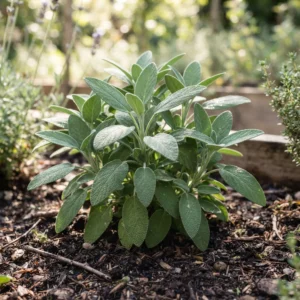
Sage — An aromatic culinary and medicinal herb with a history of traditional oral and gum use.
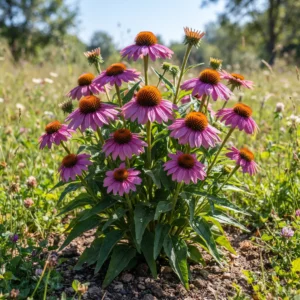
Echinacea Root — Traditionally used in botanical preparations for mouth and throat support and frequently paired with other oral-care herbs.
Active Compounds
- Furanosesquiterpenes — Myrrh — Characteristic constituents of myrrh resin contributing to its aromatic chemistry.
- Sesquiterpenes — Myrrh — Contribute to myrrh’s complex resinous volatile profile.
- Thujone — Sage — A characteristic volatile constituent of some sage species and preparations.
- 1,8-Cineole — Sage — An aromatic monoterpene found in sage volatile oil.
- Camphor — Sage — Contributes to sage’s characteristic aromatic profile.
- Caffeic acid derivatives — Echinacea — Part of the phenolic profile of echinacea roots.
- Alkamides — Echinacea — Characteristic lipophilic constituents of echinacea roots.
Ready-to-Use Product
There are unusually close commercial examples for this formula:
Herbal Relief Botanical Throat Spray — Herbalist & Alchemist — contains echinacea root, sage, licorice, myrrh, vegetable glycerin, alcohol, and essential oils. (Herbalist & Alchemist)
Botanical Throat Spray — Herbalist & Alchemist — another commercial product containing echinacea, licorice, sage, and myrrh. (Smile Herb Shop)
Herbal Throat Spray Phytosynergist — contains marshmallow, sage, echinacea, myrrh, glycerol and alcohol. (Whole Body Solutions)
Variations & Substitutions
- Echinacea root → calendula flower: provides a gentler traditional oral-care botanical, though the resulting tincture has a different phytochemical profile.
- Sage → thyme: creates a more aromatic Mediterranean profile but changes the traditional oral-care character.
Storage & Shelf Life
The concentrated tincture can generally be stored in tightly closed amber glass for 1–2 years or longer.
Do not pre-dilute the entire bottle with water for long-term storage. Prepare a small diluted portion for immediate use instead.
FAQ
Why isn’t this the best choice for severe dry mouth?
The tincture contains alcohol, and alcohol can worsen oral dryness. NIDCR specifically recommends alcohol-free oral rinses for dry mouth. (NIDCR)
Why include myrrh?
Myrrh has a long traditional history in oral-care preparations and continues to be investigated for periodontal applications. (PubMed)
Can I spray the concentrated tincture directly into my mouth?
Dilution is preferable, particularly for a dry or sensitive mouth.
Can I store diluted spray for several months?
No. A homemade water-diluted spray does not have the validated preservation system of a commercial oral spray. Make small amounts and use promptly.
References
NIDCR — Dry Mouth and Older Adults (NIDCR)
PubMed — Sage-Containing Mouthwash Randomized Clinical Trial (PubMed)
PubMed — Myrrh in Periodontal Disease and Gingival Healing (PubMed)
PubMed — Herbal Mouthrinses Systematic Review (PubMed)
Mountain Rose Herbs — Myrrh Extract (Mountain Rose Herbs)
Disclaimer
Educational purposes only. This preparation reflects traditional herbal oral-care practice and is not intended to diagnose, treat, cure, or prevent gum disease, xerostomia, infection, or other oral conditions.