

What Yarrow Is Good For
Minor bleeding & wound support — Yarrow is traditionally used externally for small superficial wounds because of its astringent and tissue-supportive properties. EMA recognizes traditional use for minor superficial wounds.
Digestive cramping — Yarrow is traditionally used for mild spasmodic gastrointestinal complaints, including bloating and digestive tension. Its bitter compounds, flavonoids, and volatile constituents contribute digestive and antispasmodic activity.
Loss of appetite — The herb’s bitter sesquiterpene lactones stimulate bitter taste receptors and help explain its traditional use when appetite is temporarily reduced.
Menstrual cramping — Yarrow has traditional use for minor spasms associated with menstruation. Human evidence remains limited, so it is best described as traditional support rather than a proven treatment.
Cold & fever comfort — Yarrow is commonly used in traditional herbal teas during colds, especially when gentle sweating is desired. This diaphoretic use is primarily traditional.
Hemorrhoid discomfort — Its astringent and anti-inflammatory properties make yarrow a traditional ingredient in external washes and compresses for irritated hemorrhoidal tissues.
Available Herbal Products
Buying Guides for Available Yarrow Products
Yarrow Liquid Herbal Extract – Flowering aerial-parts tincture made from Achillea millefolium. A convenient liquid preparation for people who prefer a concentrated extract rather than tea. Seller: Herb Pharm – View Herb Pharm Yarrow →
Organic Yarrow Flowers Cut & Sifted – Loose organic flowering herb suitable for tea, infusions, topical washes, and custom herbal blends. Seller: Starwest Botanicals – View Starwest Botanicals Yarrow Flowers →
Organic Yarrow Flower Powder – Finely powdered organic yarrow flowering herb suitable for capsules, poultices, and custom formulas. Seller: Starwest Botanicals – View Starwest Botanicals Yarrow Powder →
Yarrow Capsules – Whole-herb capsules made from Achillea millefolium. A practical option for people who dislike yarrow’s bitter aromatic flavor. Seller: Nature’s Way – View Nature’s Way Yarrow →
Yarrow Extract – Liquid yarrow preparation made from the aerial parts of Achillea millefolium. Useful for flexible liquid use in traditional digestive or menstrual-support formulas. Seller: HawaiiPharm – View HawaiiPharm Yarrow Extract →
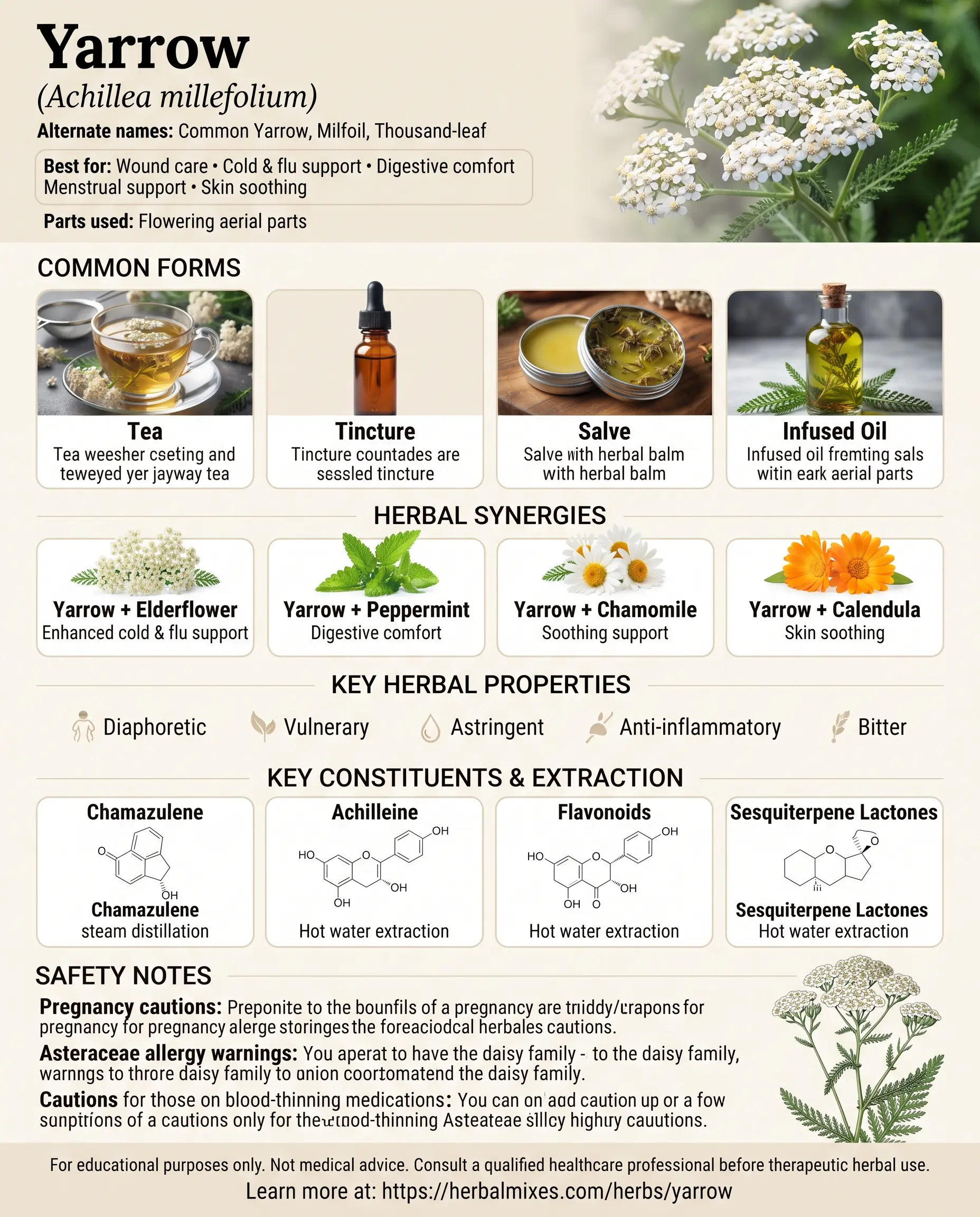
Herbal Synergies
Yarrow pairs especially well with peppermint, ginger, shepherd’s purse, chamomile, and elderflower depending on whether the goal is digestion, menstrual comfort, minor bleeding, or cold support.
Yarrow + Peppermint
Best for: Bloating and digestive cramping
Yarrow contributes bitter and antispasmodic activity, while peppermint adds stronger carminative and smooth-muscle-relaxing effects.
Best extraction: Covered hot infusion. Both herbs contain aromatic volatile constituents that extract well into hot water when the cup is covered.
Yarrow + Ginger
Best for: Sluggish digestion with cramping
Yarrow provides bitter digestive stimulation, while ginger adds warming carminative and anti-nausea activity.
Best extraction: Yarrow infusion or tincture combined with ginger tea or fresh ginger preparation.
Yarrow + Shepherd’s Purse
Best for: Traditional short-term support for excessive menstrual flow
Both herbs have traditional astringent and hemostatic reputations, though shepherd’s purse is more specifically associated with menstrual bleeding.
Best extraction: Tincture combination.
Unexpected, very heavy, prolonged, or recurrent abnormal bleeding requires medical evaluation rather than herbal self-treatment.
Yarrow + Chamomile
Best for: Menstrual cramping and digestive tension
Yarrow contributes antispasmodic and bitter activity, while chamomile adds calming, carminative, and smooth-muscle-relaxing effects.
Best extraction: Covered hot infusion.
Yarrow + Elderflower
Best for: Traditional cold and fever comfort
Both herbs are traditionally considered diaphoretic, encouraging gentle sweating during early cold symptoms.
Best extraction: Hot infusion taken warm.
Key Herbal Properties
Astringent — Tannins contribute tissue-tightening effects and help explain yarrow’s traditional topical use for minor wounds and bleeding.
Antispasmodic — EMA recognizes traditional use for mild spasmodic gastrointestinal complaints and menstrual cramping.
Bitter — Sesquiterpene lactones give yarrow a pronounced bitter quality that supports appetite and digestive activity.
Diaphoretic — traditional — Yarrow is traditionally used in warm teas to encourage sweating during feverish colds.
Vulnerary — Traditional topical preparations are used for small superficial wounds and irritated tissues.
Anti-inflammatory — Flavonoids, sesquiterpene lactones, and volatile compounds demonstrate inflammatory-modulating activity.
Carminative — Aromatic constituents complement its bitter action in digestive formulas.
Antioxidant — Flavonoids and phenolic compounds contribute antioxidant activity.







Active Compounds
Yarrow contains a complex mixture of sesquiterpene lactones, flavonoids, volatile oils, phenolic acids, tannins, coumarins, and polyacetylenes. Its chemistry can vary substantially among populations of Achillea millefolium.
Achilleine
Found mainly in: Flowering aerial parts
Achilleine is a nitrogen-containing compound historically associated with yarrow’s traditional hemostatic reputation.
Research on isolated achilleine is limited, so it should not be treated as a clinically established blood-clotting medicine.
Best extraction: Hydroalcoholic extraction.
Apigenin
Found mainly in: Flowers and aerial parts
Apigenin is a flavonoid associated with antispasmodic and anti-inflammatory activity.
It may contribute to yarrow’s traditional use for digestive and menstrual cramping.
Best extraction: Hot water or hydroalcoholic extraction.
Luteolin
Found mainly in: Flowering aerial parts
Luteolin and its glycosides contribute antioxidant and inflammatory-modulating effects.
Best extraction: Hot water or diluted alcohol.
Sesquiterpene Lactones
Found mainly in: Leaves and flowers
Yarrow contains multiple bitter sesquiterpene lactones that contribute to its digestive, bitter, and anti-inflammatory profile.
They may also contribute to contact allergy in people sensitive to Asteraceae plants.
Best extraction: Hydroalcoholic tincture.
Chamazulene
Found mainly in: Essential-oil fraction of certain chemotypes
Chamazulene can form during steam distillation from azulene precursors and contributes to the blue coloration of some yarrow essential oils.
It has experimental anti-inflammatory and antioxidant activity.
Best extraction: Steam distillation.
Not every yarrow population produces a chamazulene-rich oil.
1,8-Cineole
Found mainly in: Essential oil
1,8-Cineole contributes aromatic and experimental antimicrobial activity.
Best extraction: Steam distillation or alcohol-containing tincture.
Camphor
Found mainly in: Essential oil of some chemotypes
Camphor may occur in varying amounts depending on the yarrow chemotype and geographic source.
Best extraction: Steam distillation.
Yarrow essential oil is much more concentrated than tea or tincture and should not be casually swallowed.
Tannins
Found mainly in: Aerial parts
Tannins contribute yarrow’s astringent effect and traditional topical usefulness.
Best extraction: Hot water.
-
FAQ
What is yarrow best used for?
Yarrow is particularly useful as a traditional herb for mild digestive cramping, appetite support, menstrual discomfort, feverish colds, and minor superficial wounds.
Can yarrow help stop bleeding?
Yarrow has a strong traditional reputation for minor bleeding, particularly when applied externally to superficial cuts.
It should not be used to manage deep wounds, uncontrolled bleeding, internal bleeding, or unusually heavy menstrual bleeding without medical evaluation.
Is yarrow tea or tincture better?
Tea works well when the goal is digestive support, menstrual comfort, or traditional diaphoretic use.
A tincture provides a broader extraction of sesquiterpene lactones and aromatic compounds and is more concentrated.
Can yarrow be used on skin?
Yes.
Cooled yarrow infusion can be used traditionally as a wash or compress for minor superficial irritation. Avoid applying it to deep, severely contaminated, or infected wounds.
Is yarrow the same as Queen Anne’s lace?
No.
Yarrow is Achillea millefolium. Queen Anne’s lace is Daucus carota. They are different plants and should not be substituted for one another.
Safety & Precautions
Yarrow is generally well tolerated in ordinary short-term herbal preparations, but several precautions are important.
Asteraceae Allergy
Yarrow belongs to the Asteraceae family.
People allergic to:
- ragweed;
- chamomile;
- chrysanthemum;
- arnica;
- feverfew;
- echinacea;
may also react to yarrow.
Possible reactions include rash, contact dermatitis, itching, or more significant allergic symptoms.
Pregnancy
Medicinal yarrow is generally not recommended during pregnancy.
EMA does not recommend its use during pregnancy because adequate safety data are lacking, and traditional references associate yarrow with effects on uterine activity.
Culinary-level accidental exposure is different from concentrated tea, tincture, or extract use.
Breastfeeding
Reliable safety information during breastfeeding is insufficient.
Avoid concentrated medicinal use unless advised by an appropriate healthcare professional.
Children
EMA does not recommend several medicinal yarrow preparations for children younger than 12 years, depending on the indication and preparation.
Bleeding & Anticoagulants
Yarrow has a traditional reputation for affecting bleeding, but modern clinical interaction data are limited.
Use concentrated preparations cautiously with:
- warfarin;
- apixaban;
- rivaroxaban;
- clopidogrel;
- aspirin;
- other anticoagulant or antiplatelet drugs.
Do not rely on yarrow to manage abnormal bleeding while taking these medications.
Skin Photosensitivity & Allergy
Some members of the Asteraceae family can produce skin reactions in sensitive individuals.
Patch test topical yarrow preparations before applying them to larger areas, especially if you have eczema or known plant allergies.
Essential Oil
Yarrow essential oil is chemically concentrated and varies significantly by chemotype.
Do not swallow undiluted yarrow essential oil.
Topical essential-oil preparations should be appropriately diluted and kept away from the eyes and mucous membranes.
Abnormal Menstrual Bleeding
Seek medical evaluation for:
- very heavy bleeding;
- bleeding between periods;
- bleeding after menopause;
- dizziness or fainting;
- severe pelvic pain;
- possible pregnancy.
These symptoms can have causes that require diagnosis rather than herbal suppression.
Wound Care
Seek medical care for:
- deep cuts;
- puncture wounds;
- wounds that will not stop bleeding;
- animal or human bites;
- severe burns;
- spreading redness;
- pus;
- fever.
Anyone who is pregnant, breastfeeding, allergic to Asteraceae plants, taking anticoagulant medication, or managing abnormal bleeding should discuss therapeutic yarrow use with an appropriate healthcare professional.
References
- European Medicines Agency — Yarrow Herb
- Kew Plants of the World Online — Achillea millefolium
- PubMed — Achillea millefolium: Traditional Uses, Phytochemistry and Pharmacology
- PubMed — Achillea millefolium and Gastrointestinal Antispasmodic Activity
- PubMed — Yarrow Flavonoids and Anti-Inflammatory Activity
- Herb Pharm — Yarrow Liquid Herbal Extract
- Starwest Botanicals — Organic Yarrow Flowers
- Starwest Botanicals — Organic Yarrow Flower Powder
- Nature’s Way — Yarrow
- HawaiiPharm — Yarrow Extract
Disclaimer
Disclaimer: This article is for educational purposes only and is not intended to diagnose, treat, cure, or prevent any disease. Herbal products can cause side effects and interact with medications. Consult a qualified healthcare professional before using herbs therapeutically, especially if you are pregnant, breastfeeding, taking prescription medications, or managing a medical condition.