

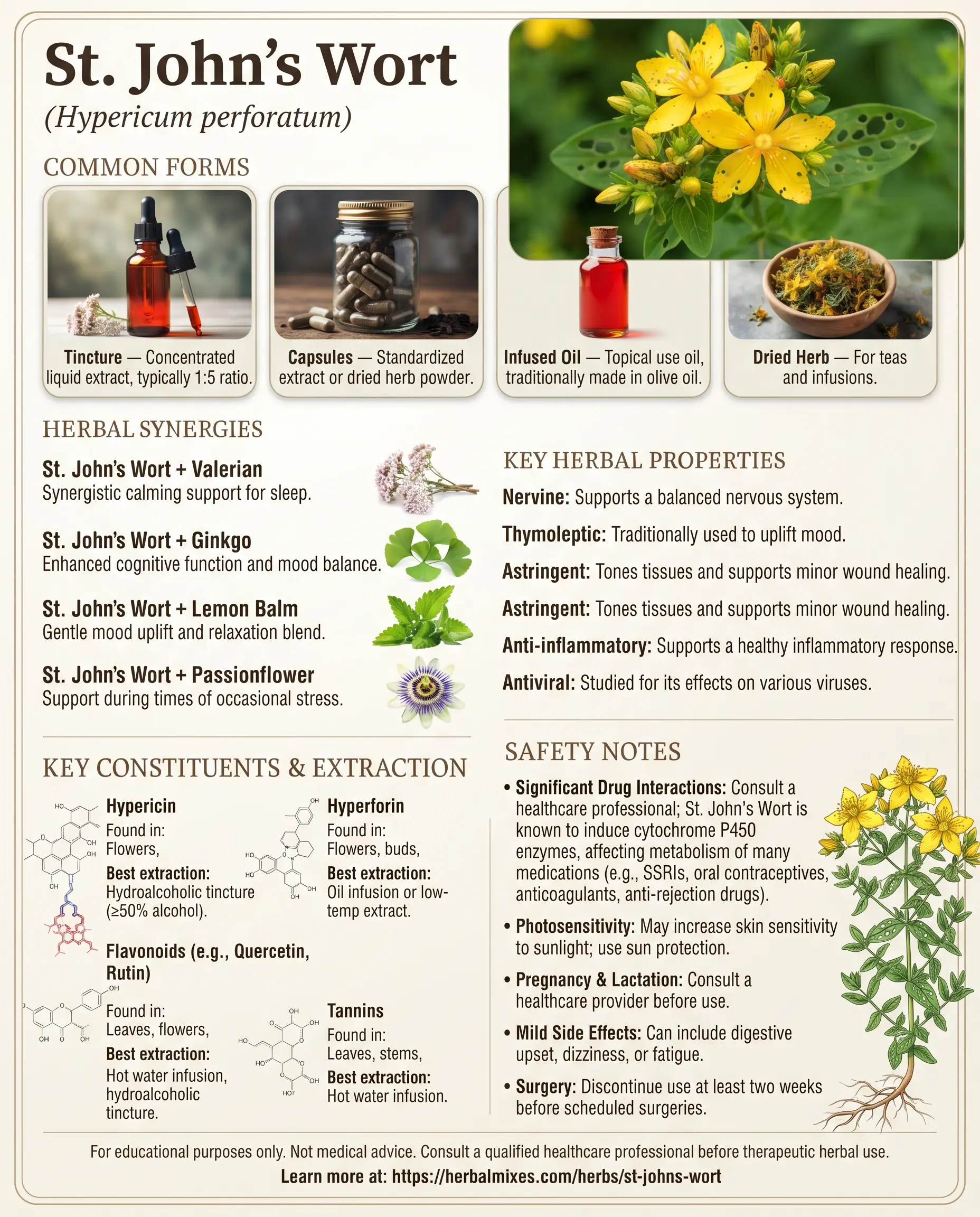
What St. John’s Wort Is Good For
Mild-to-moderate depression — This is the best-researched use of St. John’s wort. A systematic review of 35 randomized trials involving 6,993 adults found standardized extracts more effective than placebo and not significantly different from conventional antidepressants for mild-to-moderate depression, although study heterogeneity limits certainty. PubMed
Low mood & emotional well-being — NCCIH concludes that St. John’s wort appears helpful for some people with mild or moderate depression, while emphasizing that results are not consistent across all studies and evidence for severe depression is inadequate. NCCIH
Mental stress & mood disorders — The European Medicines Agency recognizes Hypericum perforatum herb within the therapeutic area of mental stress and mood disorders, with well-established and traditional-use preparations depending on extract type. EMA
Minor skin irritation & wounds — topical traditional use — St. John’s wort oils and extracts have longstanding external use for minor wounds and inflammatory skin complaints. EMA includes skin disorders and minor wounds among its recognized traditional-use areas.
Menopausal symptoms — limited evidence — Small studies have investigated St. John’s wort for menopausal symptoms, but NCCIH considers the evidence insufficient for firm conclusions.
St. John’s wort should not be used as a casual mood supplement when prescription medicines are involved. Its unusually broad interaction profile makes professional medication review particularly important.
Available Herbal Products
Buying Guides for Available St. John’s Wort Products
St. John’s Wort Liquid Herbal Extract – Fresh wildcrafted Hypericum perforatum flowering aerial-parts tincture. Currently available directly from the manufacturer. Seller: Herb Pharm – View Herb Pharm St. John’s Wort →
St. John’s Wort Extract 300 mg – Standardized aerial-parts extract containing at least 0.3% hypericins. Currently available through Vitacost. Seller: Swanson / Vitacost – View Swanson St. John’s Wort Extract →
St. John’s Wort 300 mg – Standardized Hypericum perforatum aerial extract providing 0.3% dianthrones measured as hypericin. Currently available through Vitacost. Seller: Nature’s Bounty / Vitacost – View Nature’s Bounty St. John’s Wort →
St. John’s Wort Premium Extract 300 mg – Standardized extract designed for consistent hypericin content and currently available through Vitacost. Seller: Nature’s Way / Vitacost – View Nature’s Way St. John’s Wort →
NOW Foods’ standardized St. John’s Wort 300 mg capsules are currently listed out of stock, so they are not included as a current recommendation.
When choosing a product for mood support, look for the exact species, aerial plant part, extract amount, and standardization information. Hypericin percentages alone do not fully describe pharmacological potency because hyperforin is also important.
Herbal Synergies
Because St. John’s wort has extensive medication and serotonergic interactions, combinations should be approached more carefully than ordinary calming-herb blends.
St. John’s Wort + Lemon Balm
Best for: Low mood with nervous tension
St. John’s wort provides stronger mood-directed activity, while lemon balm contributes gentle calming and digestive support.
Best extraction: Standardized St. John’s wort extract with lemon-balm tea or tincture.
Do not assume this combination makes St. John’s wort safer with medications.
St. John’s Wort + Passionflower
Best for: Low mood with restlessness or difficulty settling
Passionflower adds calming and sleep-supportive activity.
Best extraction: Standardized St. John’s wort extract with passionflower tincture or tea.
Use caution with additional sedating or psychiatric medications.
St. John’s Wort + Lavender
Best for: Mild low mood with emotional tension
Lavender provides aromatic calming support without duplicating St. John’s wort’s CYP-inducing chemistry.
Best extraction: Standardized St. John’s wort extract combined with lavender tea or aromatherapy.
St. John’s Wort + Rhodiola
Best for: Stress-related fatigue with low mood
Both herbs can affect mood and nervous-system activity.
Best extraction: Standardized extracts.
This is a more activating combination and is not appropriate for everyone, especially people with bipolar disorder, agitation, or psychiatric medication use.
St. John’s Wort + Calendula — Topical
Best for: Minor superficial skin irritation
St. John’s wort infused oil provides traditional topical soothing activity, while calendula contributes well-known skin-supportive properties.
Best extraction: Infused oils or professionally formulated topical products.
Key Herbal Properties
Antidepressant supportive — Standardized extracts have demonstrated clinically meaningful antidepressant effects in many trials involving mild-to-moderate depression.
Mood supportive — Its strongest modern herbal indication is emotional and mood support.
Serotonergic / neurotransmitter-modulating — Hyperforin-rich extracts influence several neurotransmitter systems, although St. John’s wort does not behave exactly like a conventional SSRI.
CYP enzyme inducer — Hyperforin strongly activates pathways that increase metabolism of many prescription drugs.
P-glycoprotein inducer — This contributes to decreased blood concentrations of numerous medications.
Anti-inflammatory — experimental — Hyperforin, hypericin, flavonoids, and related compounds influence inflammatory pathways.
Antiviral — experimental — Hypericin and related compounds demonstrate antiviral effects in laboratory research, but this does not make St. John’s wort a treatment for viral infections.
Vulnerary — traditional topical use — Infused oils have longstanding external use for minor wounds and irritated tissues.




Active Compounds
St. John’s wort contains several pharmacologically important groups, especially phloroglucinols, naphthodianthrones, flavonoids, biflavones, phenolic acids, and volatile compounds.
Hyperforin
Found mainly in: Flowering aerial parts, especially fresh flowering tops
Hyperforin is one of the most pharmacologically important compounds in St. John’s wort.
It contributes to antidepressant activity but is also largely responsible for the herb’s ability to induce CYP3A4 and P-glycoprotein, creating many clinically significant interactions. PubMed
Best extraction: Hydroalcoholic extraction.
Hyperforin is relatively unstable and sensitive to light, oxygen, and storage conditions, so standardized commercial extracts may differ greatly.
Adhyperforin
Found mainly in: Flowering aerial parts
Adhyperforin is structurally related to hyperforin and contributes to the phloroglucinol fraction.
Best extraction: Alcohol-rich extraction.
Hypericin
Found mainly in: Flowers and aerial tissues
Hypericin is a red naphthodianthrone and one of the traditional standardization markers for St. John’s wort products.
It contributes to photosensitizing activity at high exposure but is not considered the sole antidepressant constituent.
Best extraction: Hydroalcoholic extraction.
Pseudohypericin
Found mainly in: Flowering aerial parts
Pseudohypericin is closely related to hypericin and contributes to the plant’s characteristic red pigment chemistry.
Best extraction: Hydroalcoholic extraction.
Rutin
Found mainly in: Aerial parts
Rutin is a flavonoid glycoside contributing antioxidant activity.
Best extraction: Hot water or diluted alcohol.
Hyperoside
Found mainly in: Leaves and flowers
Hyperoside, a quercetin glycoside, contributes antioxidant and inflammatory-modulating activity.
Best extraction: Water or hydroalcoholic extraction.
Quercetin Derivatives
Found mainly in: Aerial herb
Multiple quercetin-related flavonoids contribute to the herb’s broader antioxidant profile.
Best extraction: Hot water or diluted alcohol.
Amentoflavone
Found mainly in: Aerial parts
Amentoflavone is a biflavonoid investigated for nervous-system and inflammatory activity.
Best extraction: Alcohol-containing extraction.
FAQ
What is St. John’s wort best used for?
Its strongest evidence is for mild-to-moderate depression.
It is not well established for severe depression, bipolar depression, generalized anxiety disorder, or long-term treatment beyond the periods studied in clinical trials.
Does St. John’s wort work like an antidepressant?
Standardized extracts can produce antidepressant effects, but the mechanism is complex.
A large systematic review found St. John’s wort more effective than placebo and similarly effective to conventional antidepressants in mild-to-moderate depression. PubMed
How long does St. John’s wort take to work?
Clinical studies generally evaluate effects over several weeks, not hours or a few days.
It should not be repeatedly started and stopped without considering its drug-interaction effects, which can persist after discontinuation.
Can St. John’s wort be taken with antidepressants?
Generally not without medical supervision.
Combining it with SSRIs, SNRIs, MAO inhibitors, tricyclic antidepressants, tramadol, or other serotonergic substances may increase the risk of serotonin syndrome.
Why does St. John’s wort interact with so many medications?
The key reason is hyperforin.
Hyperforin activates the pregnane X receptor and increases expression of enzymes and transporters including CYP3A4 and P-glycoprotein, which can lower blood concentrations of many drugs. PubMed
Safety & Precautions
St. John’s wort has one of the most clinically important interaction profiles of any commonly sold herb.
If you take prescription medication, do not begin St. John’s wort without reviewing your medication list with a physician or pharmacist.
Major Drug Interactions
St. John’s wort can reduce the effectiveness or blood concentration of many medicines by inducing CYP3A4, other CYP enzymes, and P-glycoprotein.
Documented or important interactions include:
- oral contraceptives — may reduce contraceptive effectiveness and cause breakthrough bleeding;
- cyclosporine and tacrolimus — may dangerously reduce immunosuppressant levels and increase transplant-rejection risk;
- warfarin and other anticoagulants — may alter anticoagulant effect;
- digoxin — may lower blood concentrations;
- certain HIV medications — including indinavir;
- some cancer medicines — including irinotecan, imatinib, and docetaxel;
- some anticonvulsants;
- certain statins, especially simvastatin;
- benzodiazepines and other CYP3A4 substrates;
- numerous other prescription medications.
NCCIH describes St. John’s wort as having an overall high risk of drug interactions.
Antidepressants & Serotonin Syndrome
Combining St. John’s wort with medications or supplements that significantly increase serotonin may cause serotonin syndrome, a potentially life-threatening reaction.
Symptoms can include:
- agitation;
- confusion;
- sweating;
- diarrhea;
- tremor;
- rapid heartbeat;
- high body temperature;
- muscle rigidity;
- hallucinations.
Do not combine it casually with SSRIs, SNRIs, MAO inhibitors, tricyclic antidepressants, tramadol, certain migraine drugs, or other strongly serotonergic products.
Bipolar Disorder & Mania
St. John’s wort may trigger mania, hypomania, agitation, or psychosis in susceptible people.
People with bipolar disorder, schizophrenia-spectrum disorders, or a history of mania should not self-treat with St. John’s wort.
Photosensitivity
Hypericin-related compounds can increase sensitivity to sunlight and ultraviolet radiation.
Possible reactions include redness, burning, or exaggerated sunburn, particularly with higher doses.
Avoid excessive sun exposure and tanning beds while using concentrated products.
Pregnancy & Breastfeeding
NCCIH states that St. John’s wort may be unsafe during pregnancy, and breastfeeding infants exposed through maternal use have reportedly experienced colic, drowsiness, or lethargy.
Concentrated medicinal use during pregnancy or breastfeeding should therefore be avoided unless specifically supervised by an appropriate healthcare professional.
Surgery
Because St. John’s wort can affect drug metabolism, anesthesia, and numerous perioperative medications, tell the surgical team if you use it.
Do not simply stop or restart it immediately around surgery without professional advice.
Depression Safety
St. John’s wort should not be used to delay medical assessment of significant depression.
Seek professional help promptly for:
- suicidal thoughts;
- self-harm thoughts;
- severe hopelessness;
- psychosis;
- mania;
- inability to function normally;
- depression lasting several weeks or worsening despite treatment.
Do not abruptly replace a prescribed antidepressant with St. John’s wort. Switching between them can require a clinician-directed washout period.
Because hyperforin-induced enzyme activity does not disappear immediately after the herb is stopped, drug interactions may persist for a period after discontinuation.
Anyone taking any prescription medication, hormonal contraception, antidepressants, transplant medication, anticoagulants, seizure medication, HIV therapy, cancer therapy, or cardiovascular medicines should discuss St. John’s wort with a pharmacist or physician before use.
References
- NCCIH — St. John’s Wort: Usefulness and Safety
- NCCIH — St. John’s Wort and Depression: In Depth
- European Medicines Agency — Hypericum perforatum Herb
- PubMed — St. John’s Wort for Major Depressive Disorder: Systematic Review
- PubMed — Systematic Review of St. John’s Wort for Major Depressive Disorder
- PubMed — Hyperforin and St. John’s Wort Drug Interactions
- PubMed — Hyperforin Content and Drug-Interaction Risk
- Herb Pharm — St. John’s Wort Liquid Herbal Extract
- Swanson / Vitacost — St. John’s Wort Extract
- Nature’s Bounty / Vitacost — St. John’s Wort
- Nature’s Way / Vitacost — St. John’s Wort
Disclaimer
Disclaimer: This article is for educational purposes only and is not intended to diagnose, treat, cure, or prevent any disease. Herbal products can cause side effects and interact with medications. Consult a qualified healthcare professional before using herbs therapeutically, especially if you are pregnant, breastfeeding, taking prescription medications, or managing a medical condition.