

What Spearmint Is Good For
Bloating & gas — Spearmint is traditionally used as a gentle carminative for gas, bloating, digestive tension, and post-meal discomfort. Kew specifically records Mentha spicata as a plant used for digestive-system disorders.
PCOS-related androgen support — Spearmint tea has unusual preliminary human evidence for lowering androgen levels. In a 30-day randomized trial involving women with PCOS-related hirsutism, drinking spearmint tea twice daily significantly reduced free and total testosterone compared with placebo.
Mild hirsutism support — In that trial, women reported improvement in perceived excess hair growth, although objective hirsutism scores did not significantly improve during the short 30-day study. Earlier five-day research also reported reduced free testosterone.
Memory & focus — A randomized placebo-controlled trial in 90 adults with age-associated memory impairment found that 900 mg/day of a polyphenol-rich spearmint extract improved working-memory measures after 90 days. This research used a specialized extract rather than ordinary tea.
Digestive freshness — Spearmint has a milder, sweeter aromatic profile than peppermint and is commonly used after meals, in oral-care products, and as a caffeine-free digestive tea.
Antioxidant support — Spearmint provides rosmarinic acid, flavonoids, phenolic compounds, and carvone-rich volatile oil, giving it antioxidant and inflammatory-modulating activity.
Available Herbal Products
Buying Guides for Available Spearmint Products
Organic Spearmint Leaf Cut & Sifted – Loose organic Mentha spicata leaf from Egypt. Currently listed in stock and well suited to the twice-daily tea format used in hormonal studies. Seller: Starwest Botanicals – View Organic Spearmint Leaf →
Spearmint Leaf Cut & Sifted – Single-ingredient Mentha spicata leaf from the United States, currently listed in stock. A straightforward choice for tea, culinary use, or custom herbal blends. Seller: Starwest Botanicals – View Spearmint Leaf →
Organic Spearmint Tea Bags – Caffeine-free tea bags containing only organic Mentha spicata leaf. Currently listed in stock and convenient for consistent daily tea preparation. Seller: Starwest Botanicals – View Organic Spearmint Tea Bags →
Organic Spearmint Leaf – Cut-and-sifted organic leaf grown in the United States and currently listed in stock. Suitable for hot tea, iced tea, culinary preparations, and herbal blends. Seller: Frontier Co-op – View Frontier Organic Spearmint Leaf →
Traditional Medicinals Organic Spearmint Tea is a well-known product but is currently marked out of stock, so it is not included as a current buying recommendation.
Herbal Synergies
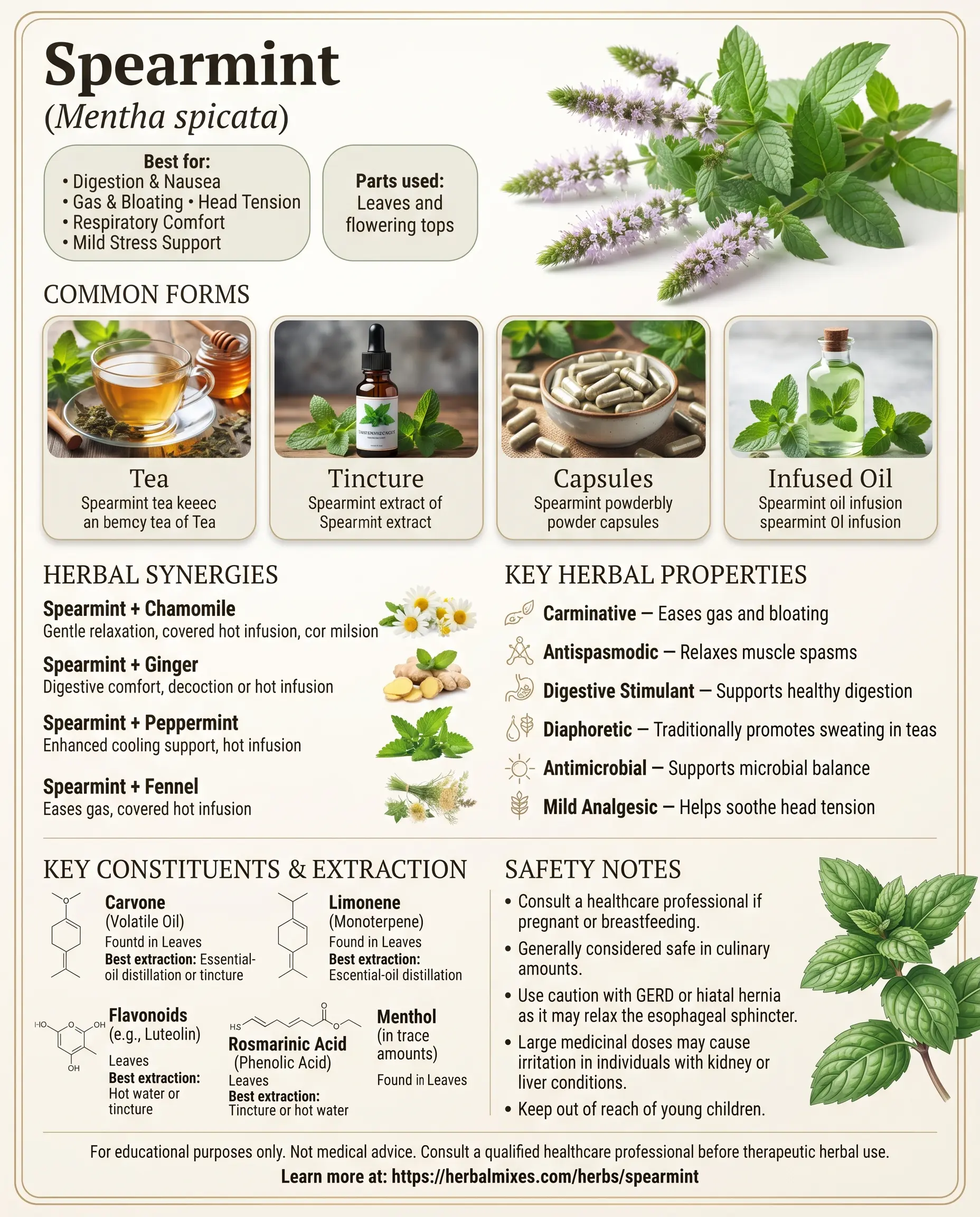
Spearmint pairs especially well with fennel, ginger, chamomile, lemon balm, and green tea depending on whether the goal is digestion, hormone-related skin concerns, or mental focus.
Spearmint + Fennel
Best for: Bloating, gas, and post-meal discomfort
Spearmint provides gentle aromatic and antispasmodic support, while fennel adds stronger carminative activity and helps reduce intestinal gas.
Best extraction: Covered hot infusion. Covering the cup helps retain volatile oils.
Spearmint + Ginger
Best for: Digestive sluggishness with nausea or bloating
Spearmint contributes cooling carminative activity, while ginger adds warming support for gastric motility and nausea.
Best extraction: Covered spearmint infusion combined with freshly prepared ginger tea.
Spearmint + Chamomile
Best for: Digestive tension with stress
Spearmint helps with gas and digestive discomfort, while chamomile contributes antispasmodic and calming activity.
Best extraction: Covered hot infusion.
Spearmint + Lemon Balm
Best for: Nervous digestion and mild stress
Both herbs belong to the mint family and provide complementary aromatic digestive effects, while lemon balm contributes stronger calming nervine activity.
Best extraction: Covered hot infusion or hydroalcoholic tincture.
Spearmint + Green Tea
Best for: Antioxidant and metabolic support
Spearmint contributes rosmarinic acid and carvone-related compounds, while green tea provides catechins such as EGCG.
This combination is sometimes used in lifestyle-oriented PCOS formulas, but spearmint’s hormone research should not be extrapolated to every blend.
Best extraction: Hot-water infusion.
Key Herbal Properties
Carminative — Spearmint’s volatile oils help relax digestive tension and support relief from gas and bloating.
Antispasmodic — traditional / experimental — Mint-family volatile constituents can influence gastrointestinal smooth muscle.
Antiandrogenic — emerging clinical evidence — Small human trials found reductions in free testosterone and, in one 30-day study, total testosterone in women with hirsutism or PCOS.
Nootropic supportive — extract-specific evidence — A high-rosmarinic-acid extract improved several working-memory measures in adults with age-associated memory impairment.
Antioxidant — Rosmarinic acid and flavonoids contribute significant antioxidant activity.
Anti-inflammatory — experimental — Spearmint polyphenols influence inflammatory signaling in laboratory and animal studies.
Antimicrobial — experimental — Spearmint essential oil demonstrates antibacterial and antifungal effects in vitro.
Breath freshening — Its carvone-rich aroma explains widespread traditional and commercial oral-care use.







Active Compounds
Spearmint differs chemically from peppermint. Its volatile oil is usually dominated by carvone rather than menthol, which gives spearmint its characteristic sweeter, softer mint aroma.
Carvone
Found mainly in: Essential oil and aromatic leaf fraction
L-carvone is spearmint’s signature volatile constituent and one of the main compounds responsible for its characteristic aroma.
It contributes to digestive, antimicrobial, and sensory effects.
Best extraction: Steam distillation for essential oil or hydroalcoholic extraction for a broader herbal preparation.
Limonene
Found mainly in: Essential oil
Limonene commonly accompanies carvone and contributes fresh citrus-mint aromatic notes.
Best extraction: Steam distillation or alcohol-rich tincture.
Rosmarinic Acid
Found mainly in: Leaves
Rosmarinic acid is an important mint-family polyphenol with antioxidant and inflammatory-modulating activity.
A specialized spearmint extract rich in rosmarinic acid was used in the clinical memory study.
Best extraction: Hot water or hydroalcoholic extraction.
Apigenin Derivatives
Found mainly in: Leaves
Spearmint contains apigenin-related flavonoids that contribute antioxidant and inflammatory-modulating activity.
Best extraction: Hot water or diluted alcohol.
Luteolin Derivatives
Found mainly in: Leaves
Luteolin glycosides form part of spearmint’s broader flavonoid profile.
Best extraction: Hot water or hydroalcoholic tincture.
Menthone and Related Monoterpenes
Found mainly in: Essential oil in smaller quantities
Spearmint can contain smaller amounts of other mint-family monoterpenes, but unlike peppermint, it generally contains relatively little menthol.
Best extraction: Steam distillation.
Phenolic Acids
Found mainly in: Leaves
Spearmint contains several phenolic acids in addition to rosmarinic acid that contribute antioxidant activity.
Best extraction: Water or water-alcohol mixtures.
-
FAQ
What is spearmint best used for?
Spearmint is particularly useful for bloating, gas, digestive comfort, and refreshing caffeine-free tea.
It also has interesting preliminary human evidence for androgen reduction in women with PCOS or hirsutism.
Does spearmint tea lower testosterone?
Small human trials suggest it can.
A 30-day randomized study found that spearmint tea taken twice daily significantly reduced free and total testosterone in women with hirsutism, while an earlier five-day study found reduced free testosterone.
Can spearmint help facial hair caused by PCOS?
Possibly, but expectations should be realistic.
In the 30-day trial, women reported less perceived hirsutism, but objective hair-growth scores did not significantly change during the study. Hair follicles respond slowly, so longer studies are needed.
Is spearmint the same as peppermint?
No.
Spearmint (Mentha spicata) is typically rich in carvone and has a sweeter, softer flavor.
Peppermint (Mentha × piperita) is a hybrid containing much more menthol and has a stronger cooling effect.
Can spearmint improve memory?
A specialized polyphenol-rich spearmint extract improved some working-memory measures in a 90-day randomized trial.
That evidence should not automatically be applied to ordinary culinary spearmint tea.
Safety & Precautions
Spearmint used in normal food and tea quantities is generally well tolerated.
Possible adverse effects include heartburn, stomach irritation, or allergic reactions, particularly in people sensitive to mint-family plants.
Hormonal Effects
Spearmint deserves more hormonal caution than its reputation as a simple culinary tea might suggest.
Human trials have demonstrated measurable changes in free testosterone, total testosterone, luteinizing hormone, follicle-stimulating hormone, and estradiol after regular spearmint-tea consumption.
This may be desirable in some women with androgen excess, but it also means concentrated or high-frequency use should be considered carefully in:
- people with diagnosed hormonal disorders;
- people undergoing fertility treatment;
- people taking antiandrogen medications;
- people using hormonal therapy;
- men intentionally trying to maintain or increase androgen levels.
Spearmint should not replace proper evaluation for PCOS, sudden facial-hair growth, infertility, irregular periods, or other signs of hormonal imbalance.
Pregnancy & Breastfeeding
Culinary spearmint is different from concentrated medicinal use.
High-quality pregnancy studies of repeated therapeutic spearmint dosing are lacking, and current commercial suppliers advise pregnant or breastfeeding users to consult a healthcare professional before medicinal use.
Because spearmint has demonstrated hormone-modulating activity in humans, avoid high-dose extracts during pregnancy unless specifically advised by a qualified healthcare professional.
Essential Oil
Do not swallow undiluted spearmint essential oil.
Essential oil concentrates carvone and other volatile compounds far beyond the levels found in ordinary tea.
Topical essential oil should be diluted appropriately and kept away from the eyes and mucous membranes.
Medication Considerations
Clinically established drug interactions are limited.
Because spearmint may affect reproductive hormones, people taking antiandrogens, fertility medications, hormonal contraceptives, estrogen therapy, or other endocrine-active medicines should discuss frequent medicinal use with their healthcare professional.
Anyone who is pregnant, breastfeeding, managing PCOS or another hormonal disorder, taking hormone-active medications, or using concentrated essential oils should discuss therapeutic spearmint use with an appropriate healthcare professional.
References
- Kew Plants of the World Online — Mentha spicata
- Kew — Spearmint Plant Profile
- PubMed — Spearmint Tea and Androgen Levels in Women With Hirsutism
- PubMed — Spearmint Tea in PCOS: Randomized Controlled Trial
- PubMed — Spearmint Extract and Working Memory
- Starwest Botanicals — Organic Spearmint Leaf
- Starwest Botanicals — Spearmint Leaf
- Starwest Botanicals — Organic Spearmint Tea Bags
- Frontier Co-op — Organic Spearmint Leaf
Disclaimer
Disclaimer: This article is for educational purposes only and is not intended to diagnose, treat, cure, or prevent any disease. Herbal products can cause side effects and interact with medications. Consult a qualified healthcare professional before using herbs therapeutically, especially if you are pregnant, breastfeeding, taking prescription medications, or managing a medical condition.