

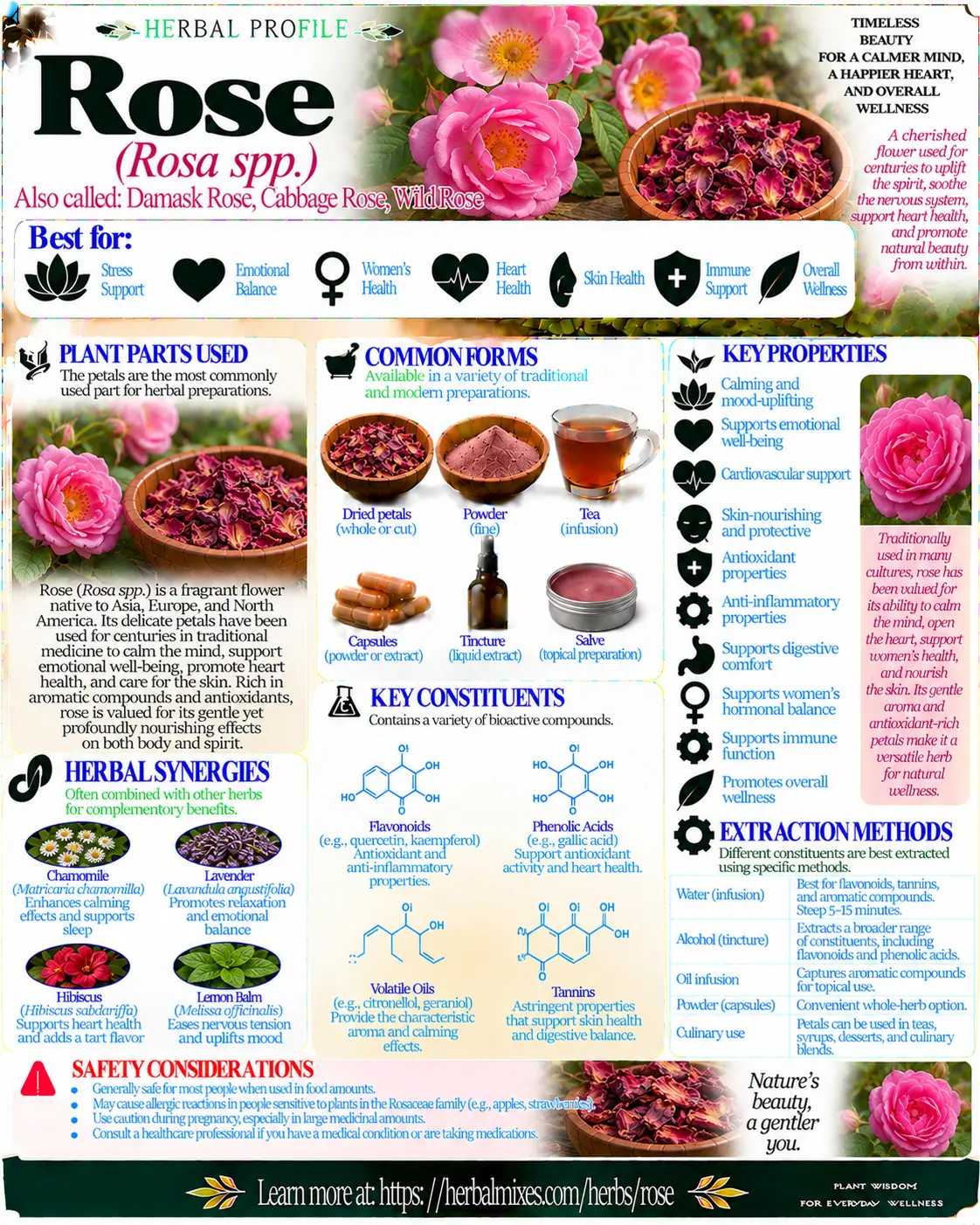
What Rose Is Good For
Stress & emotional tension — Rose is traditionally used as a gentle calming and uplifting herb. Clinical studies of Rosa damascena, especially aromatherapy preparations, suggest possible reductions in state anxiety and stress, although evidence quality ranges from very low to moderate.
Mild anxiousness — A systematic review and meta-analysis of randomized trials found that Rosa damascena preparations reduced state anxiety and stress in several studies, but results varied by preparation and study design.
Digestive comfort — Rose petals have longstanding traditional use for digestive discomfort, abdominal tension, and mild constipation. A 2025 systematic review of clinical trials found promising effects of Rosa damascena preparations on functional constipation symptoms, including bowel frequency and incomplete evacuation.
Menstrual support — Rose has traditionally been used for menstrual discomfort and emotional symptoms around menstruation. A systematic review found no significant overall reduction in menstrual pain but did report improvements in some secondary symptoms such as bloating, fatigue, and headache.
Skin soothing — Rose water, diluted rose extracts, and petal preparations are widely used for sensitive or irritated skin because of their mild astringent, antioxidant, and aromatic properties.
Antioxidant support — Rose petals are rich in polyphenols, including flavonoids, anthocyanins, tannins, and phenolic acids that contribute antioxidant activity.
Available Herbal Products
Buying Guides for Available Rose Products
Organic Red Rose Buds & Petals – Loose dried Rosa centifolia buds and petals suitable for tea, culinary preparations, bath blends, or homemade extracts. Currently listed in stock. Seller: Starwest Botanicals – View Organic Red Rose Buds & Petals →
Organic Red Rose Petals – Loose organic rose petals suitable for tea, culinary use, bath preparations, and custom herbal blends. Currently listed in stock. Seller: Frontier Co-op – View Frontier Organic Red Rose Petals →
Organic Red Rose Buds & Petals – Bulk Rosa centifolia petals and buds available as a single botanical ingredient through iHerb. Seller: Starwest Botanicals / iHerb – View Starwest Rose Buds & Petals →
Whole Pink Rosebuds & Petals – Dried Rosa centifolia buds and petals suitable for tea and culinary preparations. Currently available through iHerb. Seller: Frontier Co-op / iHerb – View Whole Pink Rosebuds & Petals →
Tulsi Sweet Rose Tea – Caffeine-free herbal tea combining cabbage rose petals with holy basil, chamomile, lemon myrtle, and other herbs. A convenient option for calming tea blends. Seller: Organic India / iHerb – View Tulsi Sweet Rose Tea →
Mountain Rose Herbs currently lists its pink and red rose petals as out of stock, so those products are not included above as current buying recommendations.
Herbal Synergies
Rose pairs especially well with lemon balm, hawthorn, chamomile, raspberry leaf, and marshmallow root depending on whether the goal is emotional support, digestive comfort, menstrual support, or tissue soothing.
Rose + Lemon Balm
Best for: Stress, emotional tension, and nervous digestion
Rose contributes gentle aromatic calming activity, while lemon balm adds stronger nervine and digestive support.
Best extraction: Covered hot infusion or hydroalcoholic tincture. Covering the tea helps preserve volatile aromatic compounds.
Rose + Hawthorn
Best for: Emotional stress with cardiovascular tension
Both herbs have traditional associations with emotional and cardiovascular support. Hawthorn adds flavonoids and procyanidins with better-established cardiovascular activity.
Best extraction: Rose petal infusion combined with hawthorn tincture or tea.
Rose + Chamomile
Best for: Mild anxiousness and digestive tension
Rose contributes aromatic and emotional support, while chamomile adds gentle antispasmodic and calming activity.
Best extraction: Covered hot infusion.
Rose + Raspberry Leaf
Best for: Menstrual support and pelvic comfort
Rose provides aromatic and mood-supportive effects, while raspberry leaf contributes astringent and traditional uterine-tonic activity.
Best extraction: Hot infusion.
Rose + Marshmallow Root
Best for: Irritated digestive or throat tissues
Rose contributes mild astringency, while marshmallow root adds stronger soothing mucilage.
Best extraction: Rose as a hot infusion and marshmallow root separately as a cold infusion, then combine.
Key Herbal Properties
Nervine — Rose is traditionally used to calm mild emotional tension and promote relaxation.
Anxiolytic supportive — Clinical research on Rosa damascena aromatherapy and other preparations suggests possible reductions in state anxiety and stress.
Antioxidant — Flavonoids, anthocyanins, phenolic acids, and tannins provide significant antioxidant activity.
Astringent — Rose petals contain tannins that contribute gentle tissue-tightening properties.
Anti-inflammatory — experimental — Rose polyphenols and volatile compounds influence inflammatory pathways experimentally.
Antimicrobial — experimental — Rose essential oil and extracts show antibacterial and antifungal activity in laboratory studies.
Digestive supportive — Traditional use includes abdominal discomfort, constipation, and digestive tension, with emerging human research supporting some gastrointestinal benefits.






Active Compounds
Rose chemistry varies considerably between petals, rose water, hydrosol, and essential oil. Petals are rich in polyphenols, while distilled oil emphasizes volatile aromatic compounds.
Citronellol
Found mainly in: Essential oil
Citronellol is one of the characteristic aromatic monoterpene alcohols in Damask rose oil.
It contributes to rose fragrance and demonstrates antimicrobial and inflammatory-modulating activity experimentally.
Best extraction: Steam distillation.
Geraniol
Found mainly in: Essential oil
Geraniol is another major aromatic alcohol contributing to the distinctive floral aroma of Rosa damascena.
Best extraction: Steam distillation or alcohol-rich extraction.
Nerol
Found mainly in: Essential oil
Nerol is closely related to geraniol and contributes a fresh floral scent to rose oil.
Best extraction: Steam distillation.
Phenylethyl Alcohol
Found mainly in: Rose water, petals, and some volatile fractions
Phenylethyl alcohol is an important contributor to the characteristic fragrance of rose petals and rose water.
Recent analyses have found it to be a major volatile component in some Rosa damascena preparations.
Best extraction: Water distillation, hydrosol production, or hydroalcoholic extraction.
Quercetin Glycosides
Found mainly in: Petals
Rose petals contain quercetin-related flavonoids that contribute antioxidant and inflammatory-modulating effects.
Best extraction: Hot water or hydroalcoholic tincture.
Kaempferol Glycosides
Found mainly in: Petals
Kaempferol derivatives form another important part of the petal flavonoid profile.
Best extraction: Water or diluted alcohol.
Anthocyanins
Found mainly in: Red and deeply colored petals
Anthocyanins provide much of the red coloration in darker rose varieties and contribute antioxidant activity.
Best extraction: Water or diluted alcohol, preferably under mildly acidic conditions.
Tannins
Found mainly in: Petals
Rose petals contain tannins that contribute mild astringent activity.
Best extraction: Hot-water infusion or hydroalcoholic tincture.
FAQ
What is rose best used for?
Rose is best suited to mild stress, emotional tension, digestive comfort, menstrual support, and gentle skin-soothing applications.
Clinical research is strongest for Rosa damascena preparations, particularly aromatherapy and some gastrointestinal applications.
Does rose really help anxiety?
Possibly.
A systematic review of randomized trials found reductions in state anxiety and stress with Rosa damascena, but study quality varied considerably and the evidence should not be treated as equivalent to established anxiety treatments.
Is rose tea the same as rose essential oil?
No.
Rose tea contains water-soluble flavonoids, tannins, and phenolic compounds, plus small amounts of volatile aromatics.
Rose essential oil is a highly concentrated volatile preparation dominated by compounds such as citronellol and geraniol.
Can rose help digestion?
Potentially.
Traditional use includes abdominal discomfort and constipation, and a recent systematic review found promising clinical effects on functional constipation symptoms.
Are rose petals and rosehips the same medicinally?
No.
Rose petals are used mainly for aromatic, calming, digestive, and astringent purposes.
Rosehips are the fruit of the rose and have a different profile rich in vitamin C-related compounds, carotenoids, polyphenols, and galactolipids.
Safety & Precautions
Rose petals used as tea or food are generally considered gentle and well tolerated.
Possible adverse effects include allergic reaction, skin irritation, nausea, or headache, particularly with concentrated aromatic preparations.
People with known allergy to roses or other Rosaceae plants should use caution.
Rose essential oil is far more concentrated than tea or rose water.
Do not swallow undiluted rose essential oil unless it is part of a properly formulated product specifically intended for internal use.
Essential oil should be diluted appropriately before topical application and kept away from the eyes and mucous membranes.
A small patch test is sensible before using concentrated rose preparations on sensitive skin.
Clinical trials of Rosa damascena have generally reported a good safety profile, but the overall evidence base is still relatively limited.
Pregnancy safety depends on the preparation.
Normal culinary amounts and occasional rose tea are quite different from concentrated essential oil, tincture, or high-dose extracts. Use concentrated medicinal products during pregnancy only with appropriate professional guidance.
Safety during breastfeeding is also insufficiently studied for concentrated extracts.
People taking sedative medications should be aware that strongly aromatic calming preparations may have additive relaxing effects, although clinically significant interactions have not been well established.
Rose should not replace treatment for persistent anxiety, major depression, severe insomnia, chronic constipation, severe menstrual pain, gastrointestinal bleeding, or significant skin infection.
Seek medical evaluation for constipation associated with blood in stool, unexplained weight loss, severe abdominal pain, vomiting, or persistent bowel changes.
Anyone who is pregnant, breastfeeding, taking prescription medication, or managing a significant chronic condition should discuss concentrated therapeutic rose preparations with an appropriate healthcare professional.
References
- PubMed — Rosa damascena: Efficacy, Safety and Pharmacology Review
- PubMed — Rosa damascena for Anxiety, Depression and Stress: Meta-Analysis
- PubMed — Rosa damascena and Gastrointestinal Disorders: Systematic Review and Meta-Analysis
- PubMed — Rose and Menstruation-Related Symptoms: Systematic Review
- PubMed — Chemical Constituents and Pharmacology of Rosa damascena
- PubMed — Rosa damascena Phytochemistry and Traditional Uses
- PubMed — Rose Aromatherapy for Anxiety and Sleep Quality
- Starwest Botanicals — Organic Red Rose Buds & Petals
- Frontier Co-op — Organic Red Rose Petals
- Organic India / iHerb — Tulsi Sweet Rose Tea
Disclaimer
Disclaimer: This article is for educational purposes only and is not intended to diagnose, treat, cure, or prevent any disease. Herbal products can cause side effects and interact with medications. Consult a qualified healthcare professional before using herbs therapeutically, especially if you are pregnant, breastfeeding, taking prescription medications, or managing a medical condition.