


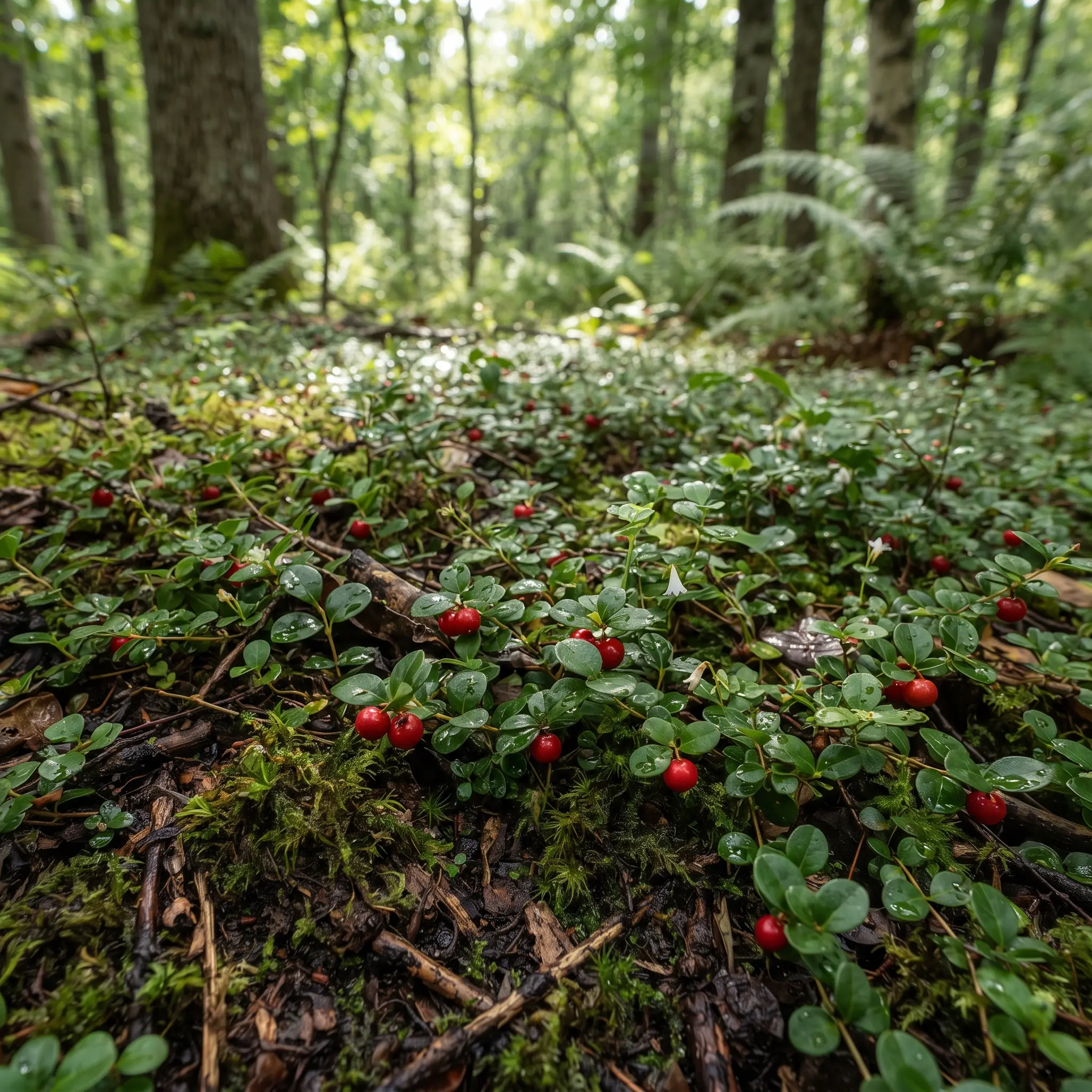
Traditionally, partridgeberry has been used primarily as a uterine tonic, especially when preparing for childbirth or easing menstrual cramps and irregularity. It is commonly prepared as a tea, decoction, or tincture.
Common Name: Partridgeberry Latin Name: Mitchella repens Alternate Names: Squaw vine, checkerberry
- Parts used: leaves and stems (also berries)
- Primary properties: uterine tonic, astringent, nervine
- Common preparations: tea, decoction, tincture
- Best known for: toning the uterus and supporting childbirth preparation
What It Helps With
Health conditions this herb is commonly used to support.
Related Buying Guides
Featured Recipes
Explore and try simple ways to prepare and use this herb at home.
Active Compounds
The tiny plant chemistry doing all the heavy lifting.
Key Herbal Properties
What this herb is known for, herbally speaking.



Herbal Synergies
Other herbs that pair especially well with this one — together, their combined properties work better than either herb does alone.
Health Conditions Partridgeberry Helps With
- Childbirth preparation — Partridgeberry has one of the longest and most specific traditional reputations of any herb as a “partus preparator,” traditionally taken in the weeks before labor to help tone and prepare the uterus.
- Menstrual cramps and irregularity — Traditionally used to ease painful menstruation and support a more regular cycle.
- Postpartum recovery — Historically used after childbirth to support uterine tone and ease postpartum discomfort.
- Sore nipples during breastfeeding (topical) — Traditionally applied topically as a wash to soothe sore, irritated nipples during nursing.
- Mild diarrhea — Its astringent, tannin-rich profile has traditionally been used to help calm loose digestion.
- Nervous exhaustion — Traditionally used as a gentle nervine tonic for irritability or debility, particularly when tied to reproductive system symptoms.
Compounds
- Tannins — Contribute partridgeberry’s astringent quality, supporting its traditional use for toning tissue and calming digestive upset.
- Saponins — Thought to contribute to partridgeberry’s traditional reputation for uterine and hormonal support.
- Mucilage — Present in smaller amounts, contributing a mild soothing quality to the plant’s overall profile.
- Flavonoids — Contribute general antioxidant activity to partridgeberry’s traditional profile.
Properties
- Uterine tonic — Partridgeberry’s defining traditional property, understood to help tone and strengthen the uterine and pelvic muscles.
- Astringent — Its tannin content lends a toning, tightening quality, supporting traditional use for tissue health and mild digestive upset.
- Nervine — Traditionally used to calm the nervous system, particularly for irritability tied to reproductive cycle changes.
- Emmenagogue — Traditionally used to support and regulate menstrual flow.
Recipes Using Partridgeberry
- Pre-birth preparation tea — Dried partridgeberry leaf steeped as a tea, traditionally taken in the final weeks of pregnancy under experienced guidance.
- Menstrual comfort tea blends — Combined with other traditionally cycle-supportive herbs into a tea for menstrual cramps and irregularity.
- Topical wash — A cooled partridgeberry infusion used traditionally as a soothing wash for sore nipples during breastfeeding.
Products Featuring Partridgeberry
- Dried leaf and stem for tea — The most traditional form, often blended with other herbs for reproductive support.
- Tincture — Offers a more concentrated, precisely dosed option, commonly used in traditional pre-birth formulas.
- Combination formulas — Frequently found blended with other traditionally pregnancy- or cycle-supportive herbs rather than used alone.
Safety & Precautions
Partridgeberry’s central traditional use is closely tied to pregnancy and labor, which means its safety picture is genuinely nuanced and deserves real care rather than casual use.
Traditional herbal sources are divided on timing: many recommend avoiding partridgeberry during the first trimester and using it only in the final weeks of pregnancy under the guidance of an experienced midwife or qualified herbal practitioner, since some research suggests it can contract uterine smooth muscle, which carries a theoretical risk of premature labor or miscarriage if used earlier or without guidance. Because of this, partridgeberry should not be self-prescribed during pregnancy, and anyone considering it for pre-birth use should work directly with a qualified midwife, doctor, or experienced herbalist rather than using it independently. There is limited modern scientific research confirming either its effectiveness or its full safety profile, so traditional use and practitioner guidance carry more weight here than for many other herbs. Safety data outside of its traditional pregnancy-related use is also limited, so anyone using it for non-pregnancy purposes, like menstrual support, should still introduce it cautiously and watch for allergic reaction. There is no well-established safety data on partridgeberry use in pets, so it’s best kept for human use only.
Q&A
Does partridgeberry taste bitter?
No, partridgeberry has a mild, slightly astringent, faintly sweet flavor rather than a strong bitterness, which is part of why it blends easily into other herbal teas.
Its taste is often described as gentle and green, similar to other mild woodland teas, making it easy to combine with more flavorful herbs in a blend.
Can partridgeberry be used daily?
Outside of its traditional pre-birth use, partridgeberry has been used consistently over shorter stretches, such as around the menstrual cycle, rather than as an indefinite daily supplement.
Given the specificity and sensitivity of its traditional reproductive uses, it’s best to follow practitioner guidance on timing and frequency rather than using it as a casual daily herb.
When in pregnancy is partridgeberry traditionally used?
Traditional practice varies, but many herbalists recommend avoiding partridgeberry in the first trimester and using it only in the final several weeks before labor, specifically as a “partus preparator” to help tone the uterus for childbirth.
Because timing matters so much with this particular herb, and sources don’t fully agree on the safest window, this is one situation where working directly with a qualified midwife or experienced herbal practitioner is especially important rather than self-dosing based on general information.
What’s the difference between partridgeberry tea and tincture?
Tea offers a gentler, more diluted traditional preparation, often taken regularly in the lead-up to labor, while tincture provides a more concentrated dose that some traditional pre-birth formulas use in combination with other herbs.
Because dosing precision matters more with this herb than many others, given its specific traditional use, it’s worth following a practitioner’s specific guidance on form and amount rather than choosing based on convenience alone.
Is partridgeberry safe to use without professional guidance?
Given its central traditional use around pregnancy and labor, and the genuine uncertainty in traditional sources about safe timing, partridgeberry is one of the herbs best used under the guidance of a qualified midwife, doctor, or experienced herbal practitioner rather than on your own.
If you’re interested in partridgeberry for reasons unrelated to pregnancy, such as general menstrual support, it’s still worth starting cautiously and discussing it with a healthcare provider, particularly if you are pregnant, trying to conceive, or have any reproductive health concerns.
References
- Plants of the World Online: Mitchella repens
- PubMed: Scientific Literature on Mitchella repens
- National Library of Medicine: Chemical Constituents from Mitchella repens
- Wikipedia: Mitchella repens
- ScienceDirect Topics: Mitchella repens Research
- Memorial Sloan Kettering Cancer Center: About Herbs — Partridgeberry
- PubMed: Mitchella repens Uterine Smooth Muscle Research
This information is for educational purposes only and is not intended as medical advice. Consult a qualified healthcare professional before using any herb, especially if pregnant, breastfeeding, taking medications, or managing a health condition.