

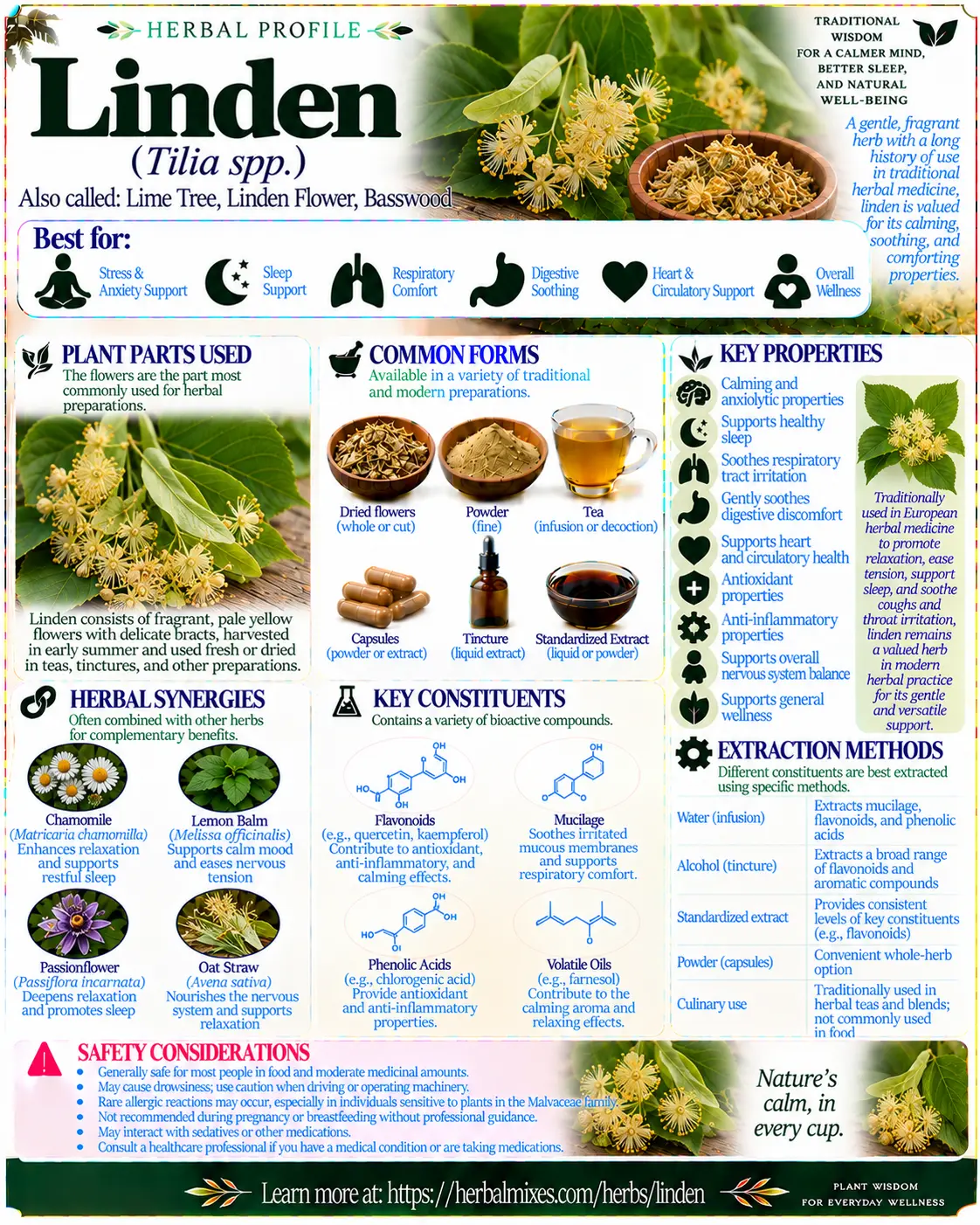
What Linden Is Good For
Stress & nervous tension — Linden flower is a gentle traditional nervine used when tension, restlessness, or emotional stress makes it difficult to relax. The European Medicines Agency recognizes linden flower for relief of mild symptoms of mental stress based on long-standing traditional use.
Sleep support — Because of its mild calming effect, linden is frequently used as an evening tea when stress or nervous tension interferes with settling down. It is considerably gentler than strongly sedating herbs such as valerian or hops.
Common cold comfort — EMA also recognizes traditional use of linden flower for relief of common-cold symptoms. Warm linden tea is particularly suited to cold-season formulas where hydration, soothing warmth, and gentle respiratory support are desired.
Irritated cough — Linden flowers contain mucilage and flavonoids and have a long history of use for cough irritation associated with upper-respiratory catarrh. EMA’s assessment documents this traditional respiratory use.
Nervous digestion — Linden is traditionally regarded as mildly antispasmodic and soothing and may be useful when digestive discomfort accompanies emotional tension.
Gentle cardiovascular relaxation — Linden has a traditional reputation for supporting circulation during nervous tension, but evidence is insufficient to treat it as a blood-pressure medication. People with diagnosed cardiovascular disease should continue conventional medical care.
Available Herbal Products
Buying Guides for Available Linden Products
Linden Liquid Herbal Extract – Flower-with-bract tincture. A certified-organic 1:4 hydroalcoholic extract of Tilia species that provides a convenient alternative to tea. Seller: Herb Pharm – View Herb Pharm Linden →
Organic Linden Leaf & Flower – Cut and sifted dried herb. Currently listed in stock and suitable for preparing linden tea, custom calming blends, or homemade extracts. Seller: Starwest Botanicals – View Starwest Organic Linden Leaf & Flower →
Linden Leaf & Flower – Cut and sifted dried herb. A non-organic bulk option currently listed in stock for tea and herbal formulations. Seller: Starwest Botanicals – View Starwest Linden Leaf & Flower →
Nighty Night Tea – Combination tea. Includes linden flower with calming herbs such as passionflower and catnip for people seeking a ready-to-use nighttime blend rather than linden alone. Seller: Traditional Medicinals – View Traditional Medicinals Nighty Night →
Cold Care P.M. Tea – Combination tea. Includes linden with meadowsweet, passionflower, and licorice in an evening cold-season formula combining respiratory comfort with relaxation. Seller: Traditional Medicinals – View Traditional Medicinals Cold Care P.M. →
Mountain Rose Herbs also carries organic linden leaf and flower, but it was listed as out of stock when this profile was prepared.
Herbal Synergies
Linden pairs especially well with lemon balm, chamomile, elderflower, passionflower, and hawthorn depending on whether the goal is relaxation, sleep, cold-season comfort, or stress-related cardiovascular support.
Linden + Lemon Balm
Best for: Stress, nervous tension, and difficulty unwinding
Linden contributes gentle calming and soothing activity, while lemon balm adds a stronger aromatic nervine and carminative effect.
This is an easy everyday combination when emotional tension also affects digestion.
Best extraction: Covered hot infusion. Both herbs contain water-soluble flavonoids, while covering the tea helps preserve aromatic constituents.
Linden + Chamomile
Best for: Mild sleep difficulty and evening relaxation
Linden provides gentle nervous-system support, while chamomile contributes additional calming, digestive, and antispasmodic properties.
Best extraction: Covered hot infusion. The flower-based combination is particularly well suited to tea.
Linden + Elderflower
Best for: Common cold comfort
Both herbs have longstanding traditional use in warm teas during colds. Elderflower adds aromatic respiratory and diaphoretic qualities, while linden contributes soothing and calming support.
Best extraction: Hot infusion, consumed warm. Both flowers release flavonoids and other polar constituents readily into water.
Linden + Passionflower
Best for: Restlessness and racing thoughts before sleep
Linden provides a soft calming base, while passionflower offers a more focused nervine action for mental restlessness.
Best extraction: Hot infusion or tincture. Traditional Medicinals currently combines the two in nighttime formulas.
Linden + Hawthorn
Best for: Nervous tension with cardiovascular awareness
Linden contributes relaxation while hawthorn adds more specific cardiovascular and circulatory support.
This combination is traditionally used when emotional tension is accompanied by awareness of heartbeat or vascular tension, after serious cardiovascular causes have been excluded.
Best extraction: Tea or tincture. Both herbs provide flavonoids in water, while hydroalcoholic extraction captures a broader spectrum.
Key Herbal Properties
Nervine — Linden is traditionally used to calm mild mental stress and nervous tension. EMA formally recognizes this traditional use.
Mild sedative — Linden can help promote relaxation before sleep without usually producing strong sedation.
Diaphoretic — Traditionally, warm linden tea is used during colds to encourage gentle perspiration and provide comfort. EMA’s assessment documents this historical use.
Demulcent — Flower mucilage contributes a soothing quality useful for irritated throat and respiratory tissues.
Antispasmodic — Linden has a traditional reputation for easing mild tension and spasmodic discomfort, particularly when stress is involved.
Antioxidant — Linden flowers contain flavonoids and phenolic acids including quercetin- and kaempferol-related compounds. Recent chemical analysis of Tilia cordata flower extracts confirms a diverse polyphenol profile.
Mild astringent — Tannins and polyphenols contribute gentle tissue-toning activity.







Active Compounds
Linden flowers contain a mixture of flavonoids, phenolic acids, mucilage polysaccharides, tannins, and small amounts of volatile compounds. Important flavonoids include tiliroside, quercetin derivatives, kaempferol derivatives, and rutin.
Tiliroside
Found mainly in: Flowers and bracts
Tiliroside is a glycosidic flavonoid found in Tilia species and is one of the better-studied compounds associated with linden chemistry.
Preclinical research has investigated its antioxidant and inflammatory signaling effects, but isolated tiliroside research should not be interpreted as evidence that linden tea treats inflammatory disease.
Best extraction: Hydroalcoholic extract or hot infusion. Laboratory studies of Tilia flowers commonly use alcohol-water mixtures to obtain a broad flavonoid spectrum.
Quercetin Derivatives
Found mainly in: Flowers and bracts
Linden contains quercetin and quercetin glycosides, which contribute antioxidant activity.
Best extraction: Hot-water infusion or hydroalcoholic tincture. Glycosylated flavonoids have useful polarity and extract readily into water.
Kaempferol Derivatives
Found mainly in: Flowers
Kaempferol and its glycosides form another important part of linden’s flavonoid fraction. Modern analyses identify kaempferol-related compounds alongside quercetin and tiliroside.
Best extraction: Hot infusion or hydroalcoholic extract.
Rutin
Found mainly in: Flowers and bracts
Rutin is a flavonoid glycoside contributing antioxidant and vascular-supportive activity.
Best extraction: Hot water or diluted alcohol. Its glycoside structure makes it suitable for aqueous extraction.
Phenolic Acids
Found mainly in: Flowers
Linden flower extracts contain phenolic acids including protocatechuic, chlorogenic, p-coumaric, and gallic acids. In a recent comparison of flower extracts, protocatechuic acid was prominent in linden preparations.
Best extraction: Hot water or hydroalcoholic extraction. These polar compounds extract efficiently into water-containing solvents.
Mucilage Polysaccharides
Found mainly in: Flowers and bracts
Linden contains mucilage, helping explain the soft, soothing character of linden tea and its traditional use for irritated coughs.
Best extraction: Hot or warm water. Polysaccharides are best extracted in aqueous preparations rather than high-proof alcohol.
Tannins
Found mainly in: Flowers and bracts
Tannins contribute mild astringency and complement linden’s broader polyphenol profile.
Best extraction: Hot-water infusion or hydroalcoholic tincture.
FAQ
What is linden best used for?
Linden is best suited to mild mental stress, nervous tension, relaxation, and common-cold comfort.
EMA recognizes traditional use for both mild mental stress and relief of common-cold symptoms.
Does linden help with sleep?
It may help when difficulty settling down is connected with mild stress or nervous tension.
Linden is generally a gentle relaxing herb rather than a powerful sedative, making it useful alone or with herbs such as lemon balm, chamomile, or passionflower.
Is linden tea or tincture better?
For most everyday uses, tea is an excellent choice.
Hot water extracts mucilage, flavonoids, phenolic acids, and other polar compounds, while a tincture provides a more concentrated preparation and broader extraction of less-polar constituents.
EMA recognizes both herbal tea and liquid/tincture preparations.
What part of the linden tree is used?
Medicinal preparations primarily use the flowers together with their thin leaf-like bracts.
EMA’s herbal drug “Tiliae flos” covers flowers from Tilia cordata, Tilia platyphyllos, Tilia × vulgaris, or mixtures of these species.
Can linden tea be used every day?
Linden tea is traditionally used as a gentle short-term herbal beverage.
For EMA’s recognized traditional indications, medical evaluation is appropriate when symptoms persist or worsen rather than continuing self-treatment indefinitely.
Safety & Precautions
Linden is generally considered a gentle herb, and EMA’s monograph reports no established major drug interactions for traditional linden-flower preparations.
Safety during pregnancy and breastfeeding has not been adequately established. Medicinal amounts are therefore best used only with professional guidance.
EMA’s traditional-use monograph does not recommend medicinal linden preparations for children under 12 years because adequate data are lacking.
Allergic reactions are possible, particularly in people sensitive to linden pollen or related botanical materials.
Linden has sometimes been described traditionally as mildly hypotensive, but evidence is insufficient to rely on it for blood-pressure treatment. People using antihypertensive medications should monitor appropriately when experimenting with concentrated preparations.
Herb Pharm currently markets a linden extract for cardiovascular and circulatory support and advises seeking expert medical advice during pregnancy, nursing, or when using medications.
Do not use linden tea as a substitute for treatment of pneumonia, influenza complications, asthma attacks, or serious cardiovascular symptoms.
Seek medical care for a cold or cough accompanied by difficulty breathing, chest pain, persistent high fever, coughing blood, confusion, dehydration, or symptoms that are severe or worsening.
Anyone pregnant, breastfeeding, taking prescription medication, or managing cardiovascular or other chronic disease should discuss regular therapeutic use of linden with an appropriate healthcare professional.
References
- European Medicines Agency — Tiliae Flos
- EMA — Community Herbal Monograph on Linden Flower
- EMA — Assessment Report on Tilia Flower
- PubMed — Tiliroside Review
- PubMed — Extraction and Determination of Tiliroside in Tilia Flowers
- PubMed — Linden Flower Ethanol-Water Extracts and Polyphenols
- Herb Pharm — Linden Liquid Herbal Extract
- Starwest Botanicals — Organic Linden Leaf & Flower
- Traditional Medicinals — Nighty Night Tea
Disclaimer
Disclaimer: This article is for educational purposes only and is not intended to diagnose, treat, cure, or prevent any disease. Herbal products can cause side effects and interact with medications. Consult a qualified healthcare professional before using herbs therapeutically, especially if you are pregnant, breastfeeding, taking prescription medications, or managing a medical condition.