

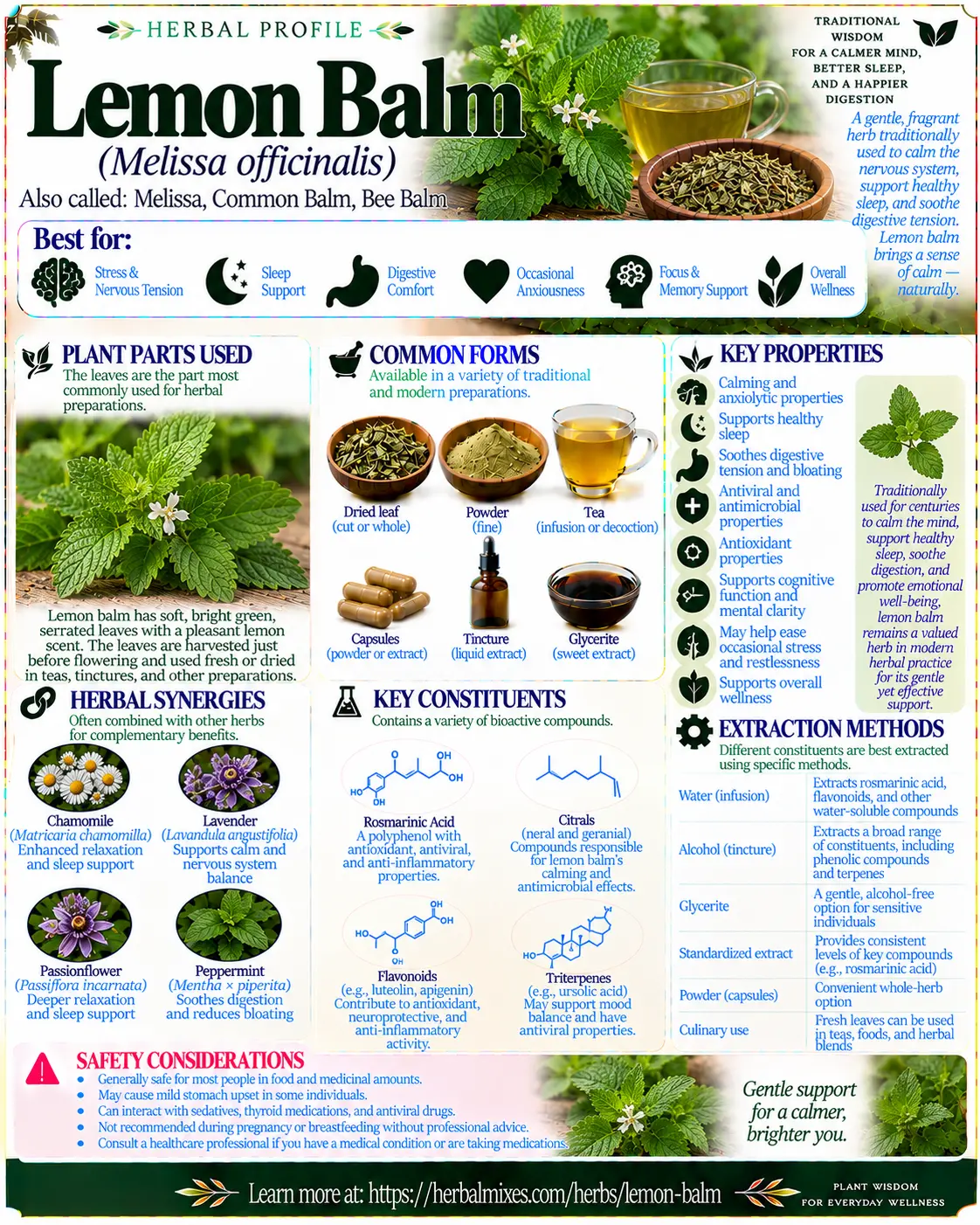
What Lemon Balm Is Good For
Stress & nervous tension — Lemon balm is one of the classic gentle nervine herbs, traditionally used to calm mental tension, restlessness, and irritability. The European Medicines Agency recognizes lemon balm leaf for traditional use in mild mental stress and as an aid to sleep.
Sleep support — Lemon balm is especially useful when difficulty sleeping is connected with tension or an overactive mind rather than severe insomnia. It is often paired with valerian, passionflower, chamomile, or lavender.
Occasional anxiousness — Human studies and recent reviews suggest lemon balm extracts may support calmer mood and reduce mild anxiety symptoms, although effects depend heavily on preparation and dose.
Bloating & gas — Lemon balm has traditional carminative and antispasmodic actions, making it useful when gas, mild cramping, or digestive tension accompany stress. EMA includes gastrointestinal complaints among its traditional therapeutic areas.
Nervous digestion — Lemon balm is particularly well suited to people whose digestion becomes unsettled during periods of worry or tension. Its calming and aromatic digestive actions address both the nervous and gastrointestinal components.
Calm focus — Lemon balm is generally relaxing without being strongly sedating, making it useful when mental tension interferes with concentration.
Available Herbal Products
Buying Guides for Available Lemon Balm Products
Lemon Balm Liquid Herbal Extract – Fresh aerial-parts tincture. A concentrated 1:1.5 extract made from fresh Regenerative Organic Certified Melissa officinalis, useful for calming support when a fast, convenient liquid preparation is preferred. Seller: Herb Pharm – View Herb Pharm Lemon Balm →
Lemon Balm Calm – Extract capsules. Certified-organic lemon balm aerial-parts extract in a melatonin-free capsule designed for mild occasional anxiety and evening relaxation. Seller: Herb Pharm – View Herb Pharm Lemon Balm Calm →
Organic Lemon Balm – Dried loose leaf. A versatile form for homemade tea, infusions, glycerites, tinctures, and calming herbal blends. Mountain Rose Herbs identifies the herb as Melissa officinalis, although this item was listed as out of stock when checked. Seller: Mountain Rose Herbs – View Mountain Rose Herbs Lemon Balm →
Organic Lemon Balm Tea – Tea bags. A simple caffeine-free single-herb tea made from organic lemon balm leaf and designed for nervous-system and digestive support. It was listed as out of stock when checked. Seller: Traditional Medicinals – View Traditional Medicinals Lemon Balm Tea →
For everyday use, loose leaf or tea bags are ideal for gentle nervous and digestive support, while tinctures and concentrated extracts are more convenient when stronger or smaller-volume preparations are desired.
Herbal Synergies
Lemon balm pairs especially well with chamomile, passionflower, lavender, peppermint, and valerian depending on whether the goal is relaxation, sleep, anxiousness, or nervous digestion.
Lemon Balm + Chamomile
Best for: Stress, digestive tension, and mild sleep difficulty
Lemon balm contributes calming and carminative activity, while chamomile adds gentle sedative, antispasmodic, and digestive-soothing properties.
This is one of the easiest everyday combinations for tension that affects both mood and digestion.
Best extraction: Covered hot infusion. Both herbs contain water-soluble polyphenols and volatile oils; covering the tea helps retain the aromatic fraction.
Lemon Balm + Passionflower
Best for: Racing thoughts and nighttime restlessness
Lemon balm helps relax nervous tension, while passionflower is particularly useful when the mind feels overactive or difficult to settle.
Best extraction: Tincture or covered infusion. A tincture provides a more concentrated combination, while tea is ideal for gentler evening support.
Lemon Balm + Lavender
Best for: Stress, mild anxiousness, and emotional tension
Both herbs are aromatic nervines, but lavender adds a more floral, relaxing essential-oil profile while lemon balm contributes stronger digestive support.
Best extraction: Covered hot infusion or tincture. Both herbs contain volatile compounds that can evaporate if the tea is left uncovered.
Lemon Balm + Peppermint
Best for: Bloating, gas, and stress-related digestive discomfort
Lemon balm provides nervous-system relaxation while peppermint adds stronger carminative and smooth-muscle-relaxing activity.
This combination works particularly well after meals when digestive tension and gas occur together.
Best extraction: Covered hot infusion. Both herbs are rich in aromatic compounds that extract quickly into hot water.
Lemon Balm + Valerian
Best for: More persistent difficulty falling asleep
Lemon balm contributes gentle calming activity, while valerian provides stronger sedative and antispasmodic effects.
This pairing is more appropriate for nighttime than daytime use.
Best extraction: Tincture or standardized extracts. Valerian’s less water-soluble constituents benefit from alcohol, while lemon balm also extracts broadly in hydroalcoholic preparations.
Key Herbal Properties
Nervine — Lemon balm gently supports relaxation and nervous-system balance without usually causing heavy sedation.
Mild sedative — Traditional use includes support for sleep when restlessness or mental tension is the main problem. EMA recognizes this traditional indication.
Carminative — Lemon balm helps ease intestinal gas and digestive tension and is particularly appropriate when stress aggravates gastrointestinal symptoms.
Antispasmodic — Its volatile oils and rosmarinic-acid-rich extracts may help relax smooth muscle experimentally, supporting traditional use for mild cramping.
Anxiolytic — Human and preclinical research suggests lemon balm can influence anxiety- and stress-related pathways, although results vary by preparation.
Antioxidant — Rosmarinic acid and other phenolic compounds contribute substantial antioxidant activity.
Anti-inflammatory — Polyphenols and volatile constituents influence inflammatory pathways experimentally, although lemon balm is not a replacement for treatment of inflammatory disease.
Antiviral — Lemon balm extracts have demonstrated antiviral activity in laboratory and topical research, especially against herpes simplex virus. These effects depend heavily on extract type and should not be generalized to all lemon balm products.








Active Compounds
Lemon balm contains two particularly important chemical fractions: polyphenols, especially rosmarinic acid, and volatile oils, including citral-related compounds such as geranial and neral. Recent reviews emphasize that lemon balm’s biological effects vary substantially depending on whether a preparation is polyphenol-rich or essential-oil-rich.
Rosmarinic Acid
Found mainly in: Leaves and aerial parts
Rosmarinic acid is one of the most important phenolic compounds in lemon balm and contributes strongly to its antioxidant and anti-inflammatory profile.
It is also frequently used as a quality marker in standardized lemon balm extracts.
Best extraction: Hot-water infusion or hydroalcoholic tincture. Rosmarinic acid is relatively polar and extracts readily into both water and diluted alcohol.
Geranial
Found mainly in: Essential oil of fresh leaves
Geranial, one component of citral, contributes strongly to lemon balm’s lemon-like aroma and antimicrobial activity.
Best extraction: Essential oil, fresh tincture, or covered infusion. Because geranial is volatile, prolonged boiling causes substantial loss.
Neral
Found mainly in: Essential oil
Neral is the second major citral isomer and complements geranial in creating lemon balm’s characteristic citrus aroma.
Best extraction: Essential oil or hydroalcoholic tincture. Covered tea retains some neral but extracts less than concentrated aromatic preparations.
Citronellal
Found mainly in: Essential oil of leaves
Citronellal contributes lemony fragrance and has been studied experimentally for antimicrobial, calming, and smooth-muscle effects.
Best extraction: Steam-distilled essential oil or alcohol tincture.
Geraniol
Found mainly in: Essential oil
Geraniol is a fragrant monoterpene alcohol found in smaller quantities and contributes to lemon balm’s aromatic and antimicrobial profile.
Best extraction: Essential oil or hydroalcoholic tincture.
Flavonoids
Found mainly in: Leaves
Lemon balm contains flavonoids such as luteolin- and apigenin-related compounds, which contribute antioxidant and nervous-system effects.
Best extraction: Hot infusion or hydroalcoholic tincture. Many flavonoid glycosides extract readily in water.
Phenolic Acids
Found mainly in: Leaves and aerial herb
In addition to rosmarinic acid, lemon balm contains other caffeic-acid-related phenolics that contribute antioxidant activity.
Best extraction: Hot-water infusion or diluted alcohol.
Tannins
Found mainly in: Leaves
Tannins contribute mild astringency and add to the herb’s broader antioxidant profile.
Best extraction: Hot-water infusion or hydroalcoholic tincture.
FAQ
What is lemon balm best used for?
Lemon balm is especially useful for stress, nervous tension, mild sleep difficulty, bloating, gas, and nervous digestion.
EMA recognizes traditional use for mild mental stress, sleep support, and gastrointestinal complaints.
Does lemon balm make you sleepy?
It can promote relaxation, but it is usually milder than valerian, hops, or kava.
Many people use it during the daytime for calm focus, while stronger doses or combinations with other sedative herbs are better suited to evening use.
Is lemon balm tea or tincture better?
Both are useful but chemically different.
Tea is particularly good for rosmarinic acid, flavonoids, digestive support, and gentle nervous-system effects. Tincture captures a broader range of aromatic and less water-soluble constituents and is more concentrated.
Herb Pharm currently uses a fresh 1:1.5 hydroalcoholic/glycerin extract, illustrating the value of extracting the fresh aromatic herb soon after harvest.
Can lemon balm be taken every day?
Lemon balm tea and commercial extracts are commonly used daily.
Traditional Medicinals describes lemon balm as appropriate for routine self-care, while Herb Pharm markets both daytime liquid extract and evening capsules. Product directions and individual tolerance should still guide use.
Is lemon balm the same as lemongrass?
No.
Lemon balm is Melissa officinalis, a member of the mint family. Lemongrass is usually Cymbopogon citratus, a tropical grass with different chemistry and herbal uses.
Kew recognizes Melissa officinalis L. as an accepted species.
Safety & Precautions
Lemon balm is generally well tolerated in ordinary tea and supplemental amounts.
Possible side effects include mild gastrointestinal discomfort, headache, dizziness, or drowsiness, particularly with concentrated extracts.
Because lemon balm may have calming effects, combining large doses with sedative medications, sleep aids, alcohol, or strongly sedating herbs may increase drowsiness.
Experimental and animal research has raised questions about possible effects of lemon balm extracts on thyroid-related pathways, but the clinical significance in humans is uncertain. People with diagnosed thyroid disease—especially those taking thyroid medication—should discuss concentrated, long-term lemon balm supplementation with their healthcare professional rather than assuming an interaction will or will not occur.
Safety during pregnancy and breastfeeding has not been adequately established for concentrated medicinal preparations. Conservative use and professional guidance are appropriate.
People with allergies to plants in the Lamiaceae/mint family should use extra caution.
Fresh lemon balm essential oil is highly concentrated and should not be treated as equivalent to lemon balm tea or tincture. Internal use of essential oil should not be attempted casually.
If lemon balm is being used for persistent anxiety, severe insomnia, depression, recurrent palpitations, or significant gastrointestinal symptoms, appropriate medical evaluation is more important than increasing the herbal dose.
Anyone with thyroid disease, chronic medical conditions, pregnancy, breastfeeding, or prescription medications should discuss regular therapeutic lemon balm use with an appropriate healthcare professional.
References
- European Medicines Agency — Melissae Folium
- Kew Plants of the World Online — Melissa officinalis L.
- PubMed — Melissa officinalis L.: Integrative Review of Phytochemistry and Clinical Evidence
- PubMed — Lemon Balm and Anxiety Research
- PubMed — Lemon Balm and Sleep Research
- Herb Pharm — Lemon Balm Liquid Herbal Extract
- Herb Pharm — Lemon Balm Calm Capsules
- Mountain Rose Herbs — Organic Lemon Balm
- Traditional Medicinals — Organic Lemon Balm Tea
Disclaimer
Disclaimer: This article is for educational purposes only and is not intended to diagnose, treat, cure, or prevent any disease. Herbal products can cause side effects and interact with medications. Consult a qualified healthcare professional before using herbs therapeutically, especially if you are pregnant, breastfeeding, taking prescription medications, or managing a medical condition.