

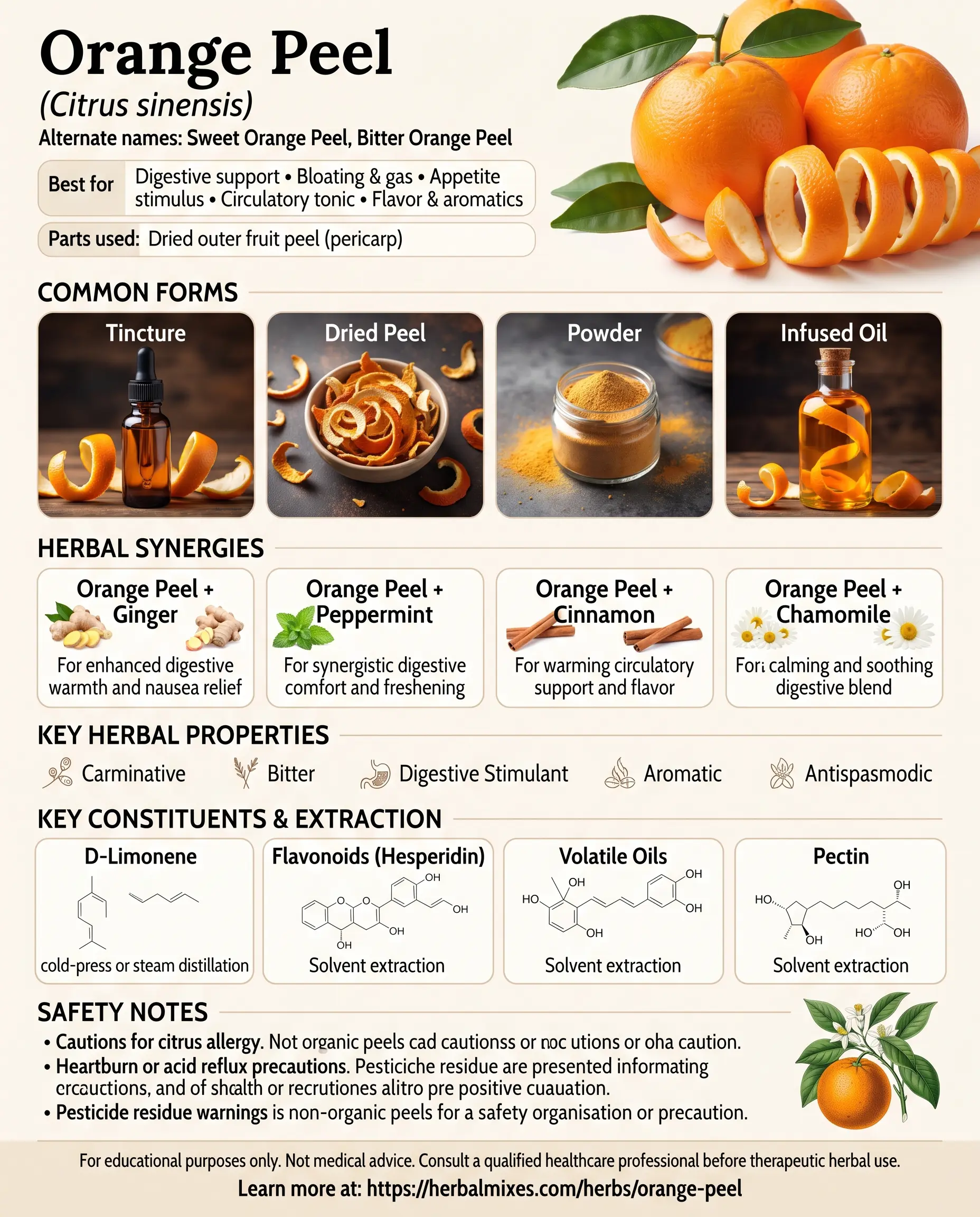
Best for: Bloating & gas • Sluggish digestion • Appetite support • Post-meal heaviness • Antioxidant support • Flavoring digestive blends
Its aromatic peel is commonly prepared as tea, tincture, powder, capsules, culinary spice, or citrus-peel extract.
Orange Peel (Citrus sinensis) — Sweet Orange Peel, Orange Rind
What Orange Peel Is Good For
Bloating & gas — Orange peel is traditionally used as a gentle carminative digestive herb. Its volatile oils and bitter flavonoids help explain its use for gas, bloating, and post-meal discomfort.
Sluggish digestion — The peel’s bitter-aromatic character can help stimulate digestive activity, making it useful when meals leave a sensation of heaviness or slow digestion.
Appetite support — Orange peel is often included in bitters formulas because its bitterness and citrus aroma can help stimulate appetite and digestive secretions.
Post-meal heaviness — Orange peel combines well with warming carminatives such as ginger, cardamom, fennel, and cinnamon when digestion feels slow or uncomfortable after eating.
Antioxidant support — Sweet orange peel contains hesperidin, narirutin, polymethoxylated flavones, phenolic acids, and limonene, all of which contribute antioxidant activity. Modern research on citrus peel confirms a particularly rich flavonoid profile. (PubMed)
Buying Guides for Available Orange Peel Products
Organic Orange Peel Cut & Sifted – Dried Citrus sinensis peel suitable for tea, digestive blends, bitters, culinary use, and homemade infusions. Currently listed in stock. Seller: Starwest Botanicals – View Starwest Botanicals Organic Orange Peel →
Organic Orange Peel Powder – Finely milled sweet orange peel suitable for capsules, culinary preparations, smoothies, baking, and custom herbal formulas. Currently listed in stock. Seller: Starwest Botanicals – View Starwest Botanicals Orange Peel Powder →
Organic Orange Peel Granules – Coarsely milled Citrus sinensis peel that is easier to measure than powder and useful in tea, spice blends, and culinary preparations. Currently listed in stock. Seller: Starwest Botanicals – View Starwest Botanicals Orange Peel Granules →
Organic Orange Peel Cut & Sifted – Mature sweet-orange peel sold as a bulk culinary and herbal ingredient. A good choice for tea, bitters, spice blends, and natural flavoring. Seller: Monterey Bay Herb Co. – View Monterey Bay Herb Co. Orange Peel →
Herbal Synergies
Orange peel pairs especially well with ginger, fennel, cardamom, cinnamon, and dandelion root depending on whether the goal is gas, sluggish digestion, appetite, or post-meal comfort.
Orange Peel + Ginger
Best for: Sluggish digestion with bloating or nausea
Orange peel contributes aromatic bitterness and citrus flavonoids, while ginger adds warming carminative and anti-nausea activity.
Best extraction: Hot infusion or tincture. Both herbs release aromatic constituents well into hot water, while hydroalcoholic extraction captures a broader range of flavonoids and volatile compounds.
Orange Peel + Fennel
Best for: Bloating and gas
Orange peel adds bitter-aromatic digestive stimulation, while fennel contributes sweeter carminative and antispasmodic activity.
Best extraction: Covered hot infusion to help preserve volatile oils.
Orange Peel + Cardamom
Best for: Post-meal heaviness and sluggish digestion
Orange peel contributes bitterness and limonene-rich aromatics, while cardamom provides warming, strongly carminative volatile oils.
Best extraction: Covered hot infusion or tincture.
Orange Peel + Cinnamon
Best for: Cold, sluggish digestion
Orange peel adds citrus bitterness and aroma, while cinnamon contributes warming aromatic activity and complements the flavor of digestive teas.
Best extraction: Hot infusion or decoction.
Orange Peel + Dandelion Root
Best for: Appetite and bitter digestive support
Orange peel contributes aromatic bitterness, while dandelion root adds a stronger earthy bitter component traditionally used for sluggish digestion.
Best extraction: Decoction or tincture. Dandelion root benefits from longer heating, while orange peel can be added toward the end of the decoction to preserve more volatile oil.
Key Herbal Properties
Carminative — Orange peel’s volatile oils help explain its traditional use for gas and bloating.
Bitter — Flavonoids and related compounds contribute mild bitterness that supports appetite and digestion.
Digestive — Its combined bitter and aromatic qualities make orange peel a classic digestive-blend ingredient.
Antioxidant — Hesperidin, narirutin, polymethoxylated flavones, and phenolic acids contribute significant antioxidant activity. (PubMed)
Anti-inflammatory — experimental — Citrus peel flavonoids influence inflammatory signaling in laboratory and preclinical research. (PubMed)
Aromatic tonic — traditional — Orange peel adds flavor and aromatic stimulation to otherwise very bitter digestive formulas.






Explore and try simple ways to prepare and use this herb at home.
Active Compounds
Orange peel contains two particularly important chemical groups: flavonoids in the peel tissue and volatile monoterpenes in the essential-oil glands.
Hesperidin
Found mainly in: Peel and white inner pith
Hesperidin is one of the major flavanone glycosides in sweet orange peel and contributes antioxidant and vascular-supportive activity.
Best extraction: Hot water or hydroalcoholic extraction. Hesperidin is much less volatile than citrus essential oils and remains in dried-peel preparations.
Narirutin
Found mainly in: Peel
Narirutin is another citrus flavanone glycoside contributing to orange peel’s antioxidant profile.
Best extraction: Hot water or hydroalcoholic extraction.
Nobiletin
Found mainly in: Outer peel
Nobiletin is a polymethoxylated flavone concentrated in citrus peel and studied for metabolic, neurological, antioxidant, and inflammatory effects experimentally.
Best extraction: Alcohol-rich or lipid-compatible extraction. It is less water soluble than glycosylated flavonoids such as hesperidin.
Tangeretin
Found mainly in: Outer peel
Tangeretin is another polymethoxylated flavone found in citrus peel.
It contributes to the peel’s broader antioxidant and experimental metabolic activity.
Best extraction: Alcohol-rich or lipid-compatible extraction.
D-Limonene
Found mainly in: Outer peel essential-oil glands
D-limonene is the dominant volatile compound in sweet-orange peel oil and gives orange peel its characteristic citrus aroma.
Best extraction: Cold expression or steam distillation for essential oil; covered hot infusion captures only a small fraction.
Linalool
Found mainly in: Essential-oil fraction
Linalool occurs in smaller amounts and contributes floral-citrus aromatic notes.
Best extraction: Steam distillation or alcohol-containing tincture.
Pectin
Found mainly in: White inner peel
Pectin is a soluble fiber that contributes to the structural and nutritional character of citrus peel.
Best extraction: Hot water.
Phenolic Acids
Found mainly in: Peel tissue
Citrus peel contains multiple phenolic acids that contribute antioxidant activity.
Best extraction: Hot water or hydroalcoholic extraction.
What Orange Peel Is Good For
Bloating & gas — Orange peel is traditionally used as a gentle carminative digestive herb. Its volatile oils and bitter flavonoids help explain its use for gas, bloating, and post-meal discomfort.
Sluggish digestion — The peel’s bitter-aromatic character can help stimulate digestive activity, making it useful when meals leave a sensation of heaviness or slow digestion.
Appetite support — Orange peel is often included in bitters formulas because its bitterness and citrus aroma can help stimulate appetite and digestive secretions.
Post-meal heaviness — Orange peel combines well with warming carminatives such as ginger, cardamom, fennel, and cinnamon when digestion feels slow or uncomfortable after eating.
Antioxidant support — Sweet orange peel contains hesperidin, narirutin, polymethoxylated flavones, phenolic acids, and limonene, all of which contribute antioxidant activity. Modern research on citrus peel confirms a particularly rich flavonoid profile. (PubMed)