

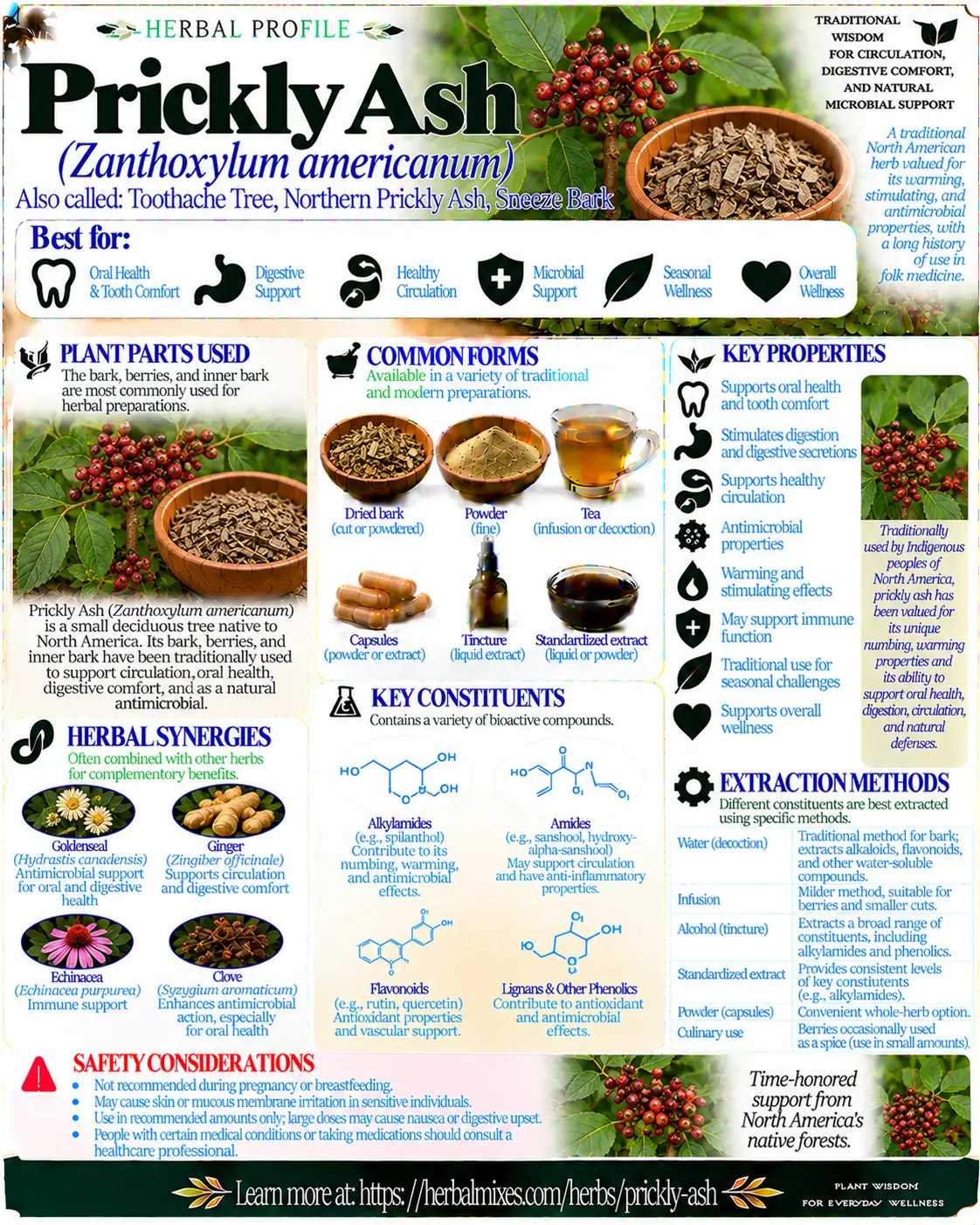
What Prickly Ash Is Good For
Circulatory support — Prickly ash has a long traditional reputation as a warming circulatory stimulant, especially for cold extremities and sluggish peripheral circulation. Modern clinical evidence is limited, so it should not replace evaluation of vascular disease.
Cold hands & feet — Its pungent bark produces a noticeable warming and tingling sensation and has traditionally been used when circulation to the hands and feet feels poor.
Sluggish digestion — Prickly ash acts as an aromatic bitter and digestive stimulant. Small traditional amounts have been used to encourage appetite, digestive secretions, and gastrointestinal activity.
Traditional toothache support — The bark was historically chewed for tooth pain, which explains names such as toothache tree and tingle tongue. Modern research on Zanthoxylum alkamides supports local tingling and numbing effects, although dental pain still requires appropriate diagnosis.
Peripheral nerve comfort — Traditional Western herbalism uses prickly ash in formulas for tingling, numbness, and poor peripheral circulation. Clinical trials for neuropathy are lacking.
Available Herbal Products
Buying Guides for Available Prickly Ash Products
Prickly Ash Liquid Herbal Extract – Wildcrafted bark tincture. Made from Zanthoxylum clava-herculis bark at a 1:4 herb-to-menstruum ratio and currently available directly from the manufacturer. Seller: Herb Pharm – View Herb Pharm Prickly Ash →
Prickly Ash Bark Tincture – Concentrated dried-bark extract. A Zanthoxylum clava-herculis liquid extract currently listed in stock in multiple bottle sizes. Seller: HawaiiPharm – View HawaiiPharm Prickly Ash Tincture →
Southern Prickly Ash Tincture – Bark liquid extract. A Zanthoxylum clava-herculis tincture currently available in several bottle sizes. Seller: Prairie Star Botanicals – View Prairie Star Southern Prickly Ash →
Prickly Ash Liquid Extract – Concentrated bark tincture. Made from Zanthoxylum clava-herculis bark at a 1:2 ratio and currently listed in stock. Seller: Naturopath Herbals – View Naturopath Herbals Prickly Ash →
Mountain Rose Herbs carries prickly ash bark and extract, but both were listed out of stock when checked, so they are not included above as current buying options.
When shopping, check the Latin name. Northern prickly ash is Zanthoxylum americanum, while many commercial products use southern prickly ash, Zanthoxylum clava-herculis.
Herbal Synergies
Prickly ash pairs especially well with ginger, hawthorn, ginkgo, gentian, and cramp bark depending on whether the goal is circulation, digestion, or muscle tension.
Prickly Ash + Ginger
Best for: Cold digestion and poor peripheral warmth
Prickly ash provides pungent circulatory stimulation, while ginger adds warming carminative and digestive activity.
Best extraction: Hydroalcoholic prickly-ash tincture combined with ginger tea or tincture.
Prickly Ash + Hawthorn
Best for: General cardiovascular and circulatory support
Prickly ash emphasizes peripheral warming, while hawthorn contributes flavonoids and oligomeric procyanidins associated with cardiac and vascular support.
Best extraction: Separate tinctures or standardized extracts.
Prickly Ash + Ginkgo
Best for: Peripheral circulation and cold extremities
Prickly ash provides traditional warming stimulation, while ginkgo has better-studied vascular and microcirculatory effects.
Best extraction: Prickly-ash tincture combined with standardized ginkgo extract.
Prickly Ash + Gentian
Best for: Poor appetite and sluggish digestion
Prickly ash contributes aromatic pungency, while gentian provides strong bitter stimulation.
Best extraction: Hydroalcoholic tincture taken before meals in appropriately formulated amounts.
Prickly Ash + Cramp Bark
Best for: Muscle cramping with poor circulation
Prickly ash contributes warming circulatory action, while cramp bark adds smooth-muscle-relaxing and antispasmodic support.
Best extraction: Combined hydroalcoholic tincture.
Herbal Properties
Circulatory stimulant — traditional — Prickly ash is best known in Western herbalism as a warming peripheral circulatory stimulant.
Digestive stimulant — Its pungent and bitter bark can stimulate appetite and digestive activity.
Sialagogue — Chewing the bark can strongly stimulate saliva and create a characteristic tingling sensation.
Local numbing / sensory-active — Zanthoxylum species contain alkamides associated with tingling, pungency, and local sensory effects.
Antimicrobial — experimental — Southern prickly ash bark extracts have shown antibacterial activity in laboratory research.
Antifungal — experimental — Northern prickly ash extracts containing furanocoumarins have inhibited several fungal species in vitro.
Anti-inflammatory — experimental — Alkaloids, lignans, coumarins, and related compounds influence inflammatory pathways experimentally.
Herbal Constituents
Prickly ash bark contains a chemically diverse mixture of alkaloids, lignans, coumarins, alkamides, tannins, resins, and volatile oils. The chemistry differs between northern and southern species.
Chelerythrine
Found mainly in: Southern prickly ash bark
Chelerythrine is a benzophenanthridine alkaloid isolated from Zanthoxylum clava-herculis bark.
It showed strong antibacterial activity against multidrug-resistant Staphylococcus aureus in laboratory research.
Best extraction: Hydroalcoholic extraction. Alkaloids are generally recovered more efficiently with alcohol-water mixtures than with plain water alone.
Magnoflorine
Found mainly in: Bark and related tissues
Magnoflorine is an aporphine alkaloid reported from prickly ash species.
It contributes to the broader neuroactive and vascular phytochemical profile of the genus.
Best extraction: Hydroalcoholic tincture.
Sesamin
Found mainly in: Bark
Sesamin is a lignan isolated from both northern and southern prickly ash.
It contributes antioxidant and experimental cellular activity.
Best extraction: Alcohol-rich extraction. Lignans are less efficiently extracted by plain water.
Asarinin
Found mainly in: Bark
Asarinin is another characteristic lignan identified in both Z. americanum and Z. clava-herculis.
Best extraction: Hydroalcoholic tincture.
Xanthyletin and Xanthoxyletin
Found mainly in: Northern prickly ash bark
These pyranocoumarins are among the characteristic compounds isolated from Zanthoxylum americanum bark.
They have demonstrated cytotoxic and other biological activity experimentally.
Best extraction: Alcohol-rich extraction.
Psoralen and Related Furanocoumarins
Found mainly in: Northern prickly ash fruit and leaves; lower levels in bark
Compounds such as psoralen, 8-methoxypsoralen, and imperatorin contribute to the antifungal activity observed in Z. americanum extracts.
Because some furanocoumarins are photosensitizing, concentrated preparations deserve caution.
Best extraction: Hydroalcoholic extraction.
Alkamides
Found mainly in: Various Zanthoxylum tissues
Zanthoxylum species contain unsaturated fatty-acid amides responsible for characteristic tingling and numbing sensations.
These compounds interact with sensory ion channels and help explain the genus’s traditional association with toothache and oral numbness.
Best extraction: Alcohol-rich or lipid-compatible preparations.
Volatile Oils
Found mainly in: Bark and leaves
Southern prickly ash bark essential oil contains aromatic monoterpenes including sabinene, limonene, and terpinen-4-ol, while the leaf oil can contain substantial limonene and 1,8-cineole.
Best extraction: Steam distillation or hydroalcoholic tincture.
Key Herbal Properties
Circulatory stimulant — traditional — Prickly ash is best known in Western herbalism as a warming peripheral circulatory stimulant.
Digestive stimulant — Its pungent and bitter bark can stimulate appetite and digestive activity.
Sialagogue — Chewing the bark can strongly stimulate saliva and create a characteristic tingling sensation.
Local numbing / sensory-active — Zanthoxylum species contain alkamides associated with tingling, pungency, and local sensory effects.
Antimicrobial — experimental — Southern prickly ash bark extracts have shown antibacterial activity in laboratory research.
Antifungal — experimental — Northern prickly ash extracts containing furanocoumarins have inhibited several fungal species in vitro.
Anti-inflammatory — experimental — Alkaloids, lignans, coumarins, and related compounds influence inflammatory pathways experimentally.





Active Compounds
Prickly ash bark contains a chemically diverse mixture of alkaloids, lignans, coumarins, alkamides, tannins, resins, and volatile oils. The chemistry differs between northern and southern species.
Chelerythrine
Found mainly in: Southern prickly ash bark
Chelerythrine is a benzophenanthridine alkaloid isolated from Zanthoxylum clava-herculis bark.
It showed strong antibacterial activity against multidrug-resistant Staphylococcus aureus in laboratory research.
Best extraction: Hydroalcoholic extraction. Alkaloids are generally recovered more efficiently with alcohol-water mixtures than with plain water alone.
Magnoflorine
Found mainly in: Bark and related tissues
Magnoflorine is an aporphine alkaloid reported from prickly ash species.
It contributes to the broader neuroactive and vascular phytochemical profile of the genus.
Best extraction: Hydroalcoholic tincture.
Sesamin
Found mainly in: Bark
Sesamin is a lignan isolated from both northern and southern prickly ash.
It contributes antioxidant and experimental cellular activity.
Best extraction: Alcohol-rich extraction. Lignans are less efficiently extracted by plain water.
Asarinin
Found mainly in: Bark
Asarinin is another characteristic lignan identified in both Z. americanum and Z. clava-herculis.
Best extraction: Hydroalcoholic tincture.
Xanthyletin and Xanthoxyletin
Found mainly in: Northern prickly ash bark
These pyranocoumarins are among the characteristic compounds isolated from Zanthoxylum americanum bark.
They have demonstrated cytotoxic and other biological activity experimentally.
Best extraction: Alcohol-rich extraction.
Psoralen and Related Furanocoumarins
Found mainly in: Northern prickly ash fruit and leaves; lower levels in bark
Compounds such as psoralen, 8-methoxypsoralen, and imperatorin contribute to the antifungal activity observed in Z. americanum extracts.
Because some furanocoumarins are photosensitizing, concentrated preparations deserve caution.
Best extraction: Hydroalcoholic extraction.
Alkamides
Found mainly in: Various Zanthoxylum tissues
Zanthoxylum species contain unsaturated fatty-acid amides responsible for characteristic tingling and numbing sensations.
These compounds interact with sensory ion channels and help explain the genus’s traditional association with toothache and oral numbness.
Best extraction: Alcohol-rich or lipid-compatible preparations.
Volatile Oils
Found mainly in: Bark and leaves
Southern prickly ash bark essential oil contains aromatic monoterpenes including sabinene, limonene, and terpinen-4-ol, while the leaf oil can contain substantial limonene and 1,8-cineole.
Best extraction: Steam distillation or hydroalcoholic tincture.
-
FAQ
What is prickly ash best used for?
Prickly ash is best known as a traditional warming circulatory and digestive stimulant, particularly for cold extremities and sluggish digestion.
Why does prickly ash make the mouth tingle?
Members of the Zanthoxylum genus contain alkamides that interact with sensory ion channels and create tingling, pungent, or numbing sensations.
This helps explain the historical name toothache tree.
Is prickly ash the same as Sichuan pepper?
No, but they are close botanical relatives.
Sichuan pepper comes from Asian Zanthoxylum species and contains similar tingling alkamides. Northern and southern American prickly ash are different species used primarily medicinally rather than as culinary spices.
Is northern prickly ash the same as southern prickly ash?
No.
Northern prickly ash is Zanthoxylum americanum, while southern prickly ash is Zanthoxylum clava-herculis.
They have overlapping traditional uses but somewhat different phytochemical profiles.
Is tincture or tea better?
For broad extraction, tincture is generally preferable because many alkaloids, lignans, coumarins, and aromatic compounds extract better into alcohol-water mixtures.
A decoction extracts tannins and other water-soluble constituents but may not represent the full chemical profile.
Safety & Precautions
Modern human safety studies of prickly ash are limited, so concentrated medicinal use should be conservative.
Because prickly ash is traditionally considered a circulatory stimulant, use caution with medications that affect blood pressure, circulation, or clotting.
Prairie Star Botanicals specifically advises against use with blood-thinning medication.
Experimental work with southern prickly ash bark has demonstrated effects on neuromuscular transmission and blood pressure in animal models, reinforcing the need for caution with concentrated preparations.
Possible adverse effects include mouth tingling, burning, salivation, gastrointestinal irritation, nausea, or dizziness, particularly at higher doses.
People with significant gastritis, ulcers, or severe reflux may find strong pungent preparations irritating.
Pregnancy requires caution. Herb Pharm advises seeking expert medical advice before using its prickly-ash extract during pregnancy, while other manufacturers advise avoiding use during pregnancy entirely.
Safety during breastfeeding has not been adequately established.
Northern prickly ash contains furanocoumarins, particularly in fruits and leaves, and some furanocoumarins can increase sensitivity to ultraviolet light. Bark appears to contain lower levels, but highly concentrated extracts should still be used conservatively.
Because reliable drug-interaction studies are lacking, caution is appropriate with anticoagulants, antiplatelet drugs, antihypertensive medications, and drugs with narrow therapeutic ranges.
Do not use prickly ash to self-treat persistent numbness, severe leg pain, sudden coldness of a limb, ulcers, suspected blood clots, or progressive neuropathy.
Cold or painful extremities can result from peripheral arterial disease, Raynaud’s phenomenon, diabetes, nerve compression, blood clots, or other conditions requiring diagnosis.
Seek urgent medical care for a limb that becomes suddenly cold, pale, blue, severely painful, weak, or numb.
Anyone who is pregnant, breastfeeding, taking blood thinners or blood-pressure medication, or managing cardiovascular or neurological disease should discuss therapeutic prickly-ash use with an appropriate healthcare professional.
References
- Kew Plants of the World Online — Zanthoxylum americanum Mill.
- Kew Plants of the World Online — Zanthoxylum clava-herculis L.
- PubMed — Zanthoxylum Species: Traditional Uses, Phytochemistry and Pharmacology
- PubMed — Alkamides in Zanthoxylum Species and Local Anesthetic Activity
- PubMed — Antifungal Constituents of Northern Prickly Ash
- PubMed — Coumarins and Lignans from Zanthoxylum americanum
- PubMed — Antibacterial Activity of Zanthoxylum clava-herculis
- PubMed — Neuromuscular Effects of Southern Prickly Ash Bark
- Herb Pharm — Prickly Ash Liquid Herbal Extract
- HawaiiPharm — Prickly Ash Bark Tincture
- Prairie Star Botanicals — Southern Prickly Ash
- Naturopath Herbals — Prickly Ash Tincture
Disclaimer
Disclaimer: This article is for educational purposes only and is not intended to diagnose, treat, cure, or prevent any disease. Herbal products can cause side effects and interact with medications. Consult a qualified healthcare professional before using herbs therapeutically, especially if you are pregnant, breastfeeding, taking prescription medications, or managing a medical condition.