

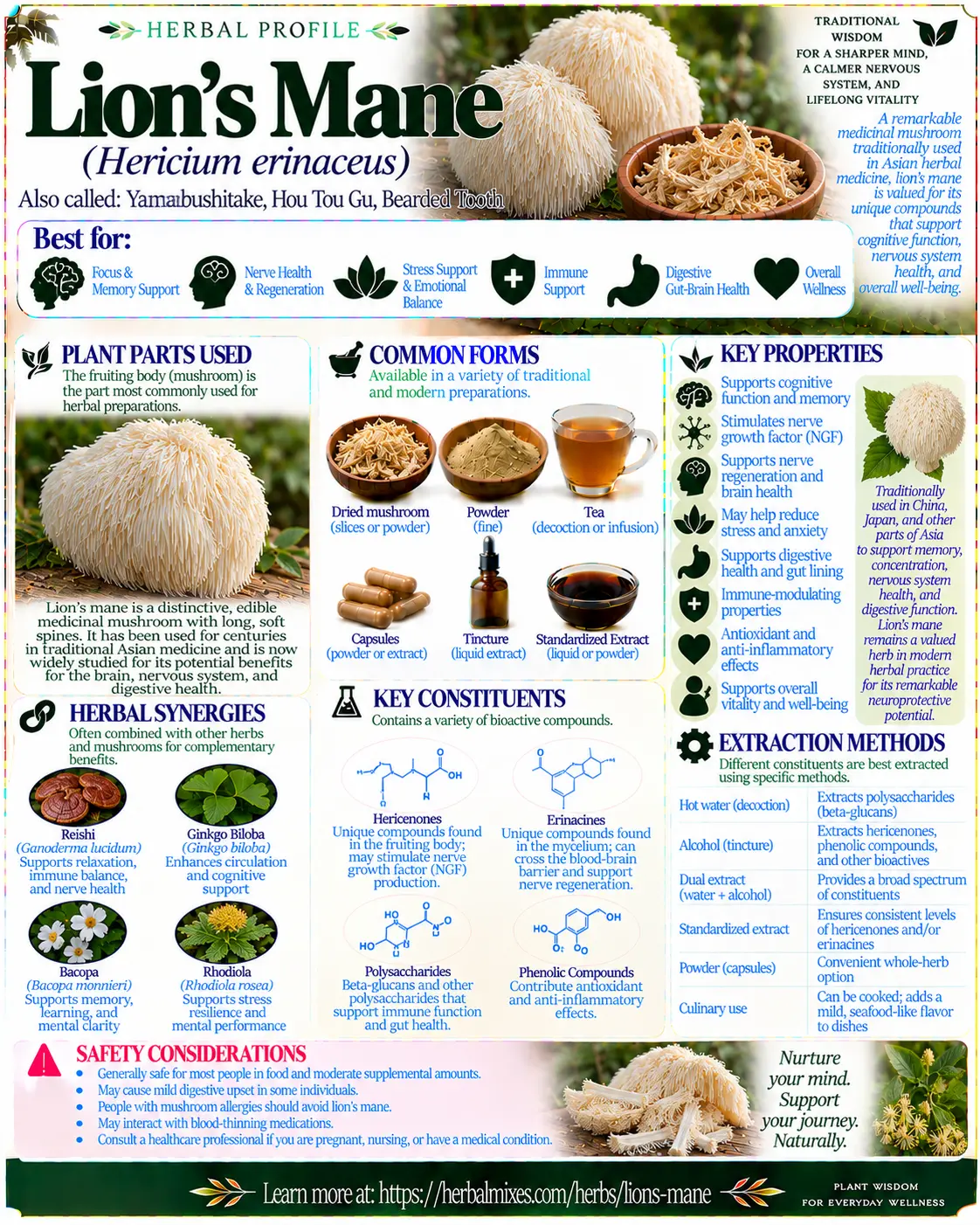
What Lion’s Mane Is Good For
Cognitive support — Lion’s mane is best known for its potential to support memory, attention, and cognitive function. Several small human trials have reported benefits, particularly in older adults or people with mild cognitive impairment, but the overall evidence remains preliminary and inconsistent.
Memory & focus — Research in healthy adults has produced mixed results. A 28-day pilot trial found faster Stroop-task performance after an acute dose and a trend toward lower stress, while a more recent acute study found no significant overall improvement in global cognition or mood.
Nerve health — Lion’s mane contains compounds called hericenones and erinacines that have attracted attention for their potential influence on nerve growth factor and neurotrophic signaling. Much of this mechanistic evidence still comes from laboratory and animal studies.
Healthy cognitive aging — Small clinical studies have investigated lion’s mane in mild cognitive impairment and early Alzheimer’s disease. Some showed improvements in cognitive testing, but these studies are too limited to establish lion’s mane as a treatment or prevention strategy for dementia.
Stress & mood support — A few small studies have explored lion’s mane for stress, anxiety, mood, and sleep. Current systematic review evidence describes promising signals but emphasizes limited sample sizes and heterogeneous preparations.
General neurological support — Beta-glucans, hericenones, erinacines, sterols, phenolic compounds, and other mushroom constituents create a broader neuroprotective and antioxidant profile, though benefits observed with isolated compounds should not automatically be attributed to every lion’s mane supplement.
Available Herbal Products
Buying Guides for Available Lion’s Mane Products
Lion’s Mane Mushroom – Dual-extracted fruiting-body capsules. Uses only certified-organic mature fruiting bodies with no mycelium or growing medium in the finished product; each capsule is equivalent to 2.5 g of dried mushroom. Seller: Gaia Herbs – View Gaia Herbs Lion’s Mane Mushroom →
Lion’s Mane 500 mg – Fruiting-body capsules. Made with organic lion’s mane mushroom fruiting bodies containing naturally occurring beta-glucans and currently available directly from the manufacturer. Seller: NOW Foods – View NOW Foods Lion’s Mane →
Lion’s Mane Capsules – Mycelium capsules. Provides 1 g of certified-organic Hericium erinaceus mycelium per serving, grown on organic brown rice in Washington State. This is a distinctly different preparation from fruiting-body-only extracts. Seller: Host Defense – View Host Defense Lion’s Mane Capsules →
Lion’s Mane Mushroom Gummies – Fruiting-body extract gummies. Provides an organic lion’s mane fruiting-body extract equivalent to 3.2 g of dry mushroom per serving in a convenient daily format. Seller: Gaia Herbs – View Gaia Herbs Lion’s Mane Gummies →
The most important buying distinction is fruiting body vs. mycelium. Fruiting bodies are generally emphasized for beta-glucans and hericenones, while some research on erinacines specifically uses enriched mycelial preparations. One is not automatically “better”—the desired constituents and extraction method matter.
Herbal Synergies
Lion’s mane pairs especially well with ginkgo, bacopa, gotu kola, rhodiola, and reishi depending on whether the goal is cognition, circulation, mental endurance, or stress resilience.
Lion’s Mane + Ginkgo Biloba
Best for: Memory, focus, and healthy cerebral circulation
Lion’s mane contributes neurotrophic and mushroom polysaccharide chemistry, while ginkgo provides flavonoids and terpene lactones associated with circulation and cognitive support.
This pairing approaches cognition through two different pathways: neural support and vascular support.
Best extraction: Lion’s mane hot-water or dual extract combined with standardized ginkgo extract. Clinical ginkgo preparations are generally standardized rather than simple teas.
Lion’s Mane + Bacopa
Best for: Long-term memory and learning support
Lion’s mane contributes hericenones, erinacines, and polysaccharides, while bacopa provides bacosides associated with memory and learning in human research.
Best extraction: Lion’s mane hot-water/dual extract plus standardized bacopa extract.
This is better suited to consistent use over time than to expecting an immediate stimulant-like effect.
Lion’s Mane + Gotu Kola
Best for: Cognitive support with nervous-system resilience
Lion’s mane contributes mushroom-derived neurotrophic compounds, while gotu kola provides centelloid triterpenes traditionally associated with cognition, connective tissue, and nervous-system support.
Best extraction: Lion’s mane extract plus gotu kola tincture or standardized extract.
Lion’s Mane + Rhodiola
Best for: Mental fatigue and demanding work periods
Lion’s mane provides longer-term cognitive and neurological support, while rhodiola offers more immediate adaptogenic support for mental fatigue and stress.
Best extraction: Lion’s mane hot-water or dual extract combined with standardized rhodiola extract.
Lion’s Mane + Reishi
Best for: Brain support with stress resilience
Lion’s mane is more strongly associated with cognition and neural support, while reishi contributes beta-glucans, triterpenes, and traditional calming adaptogenic properties.
Best extraction: Dual extraction works particularly well because hot water extracts mushroom polysaccharides while alcohol captures more lipophilic compounds such as triterpenes.
Key Herbal Properties
Nootropic — Lion’s mane is widely used as a cognitive-support mushroom, although current human evidence remains modest and product-dependent.
Neurotrophic — Hericenones and erinacines have been investigated for their ability to influence nerve growth factor and related neural pathways, primarily in preclinical research.
Neuroprotective — Laboratory and animal studies suggest lion’s mane constituents can influence oxidative stress, inflammation, neurogenesis, and neuronal survival pathways. Clinical confirmation is still limited.
Antioxidant — Phenolic compounds, polysaccharides, and other constituents demonstrate antioxidant activity.
Anti-inflammatory — Lion’s mane extracts influence inflammatory pathways experimentally, including pathways relevant to nervous-system inflammation.
Immunomodulatory — Mushroom beta-glucans interact with innate immune receptors and contribute to the broader immune-supportive properties of edible medicinal mushrooms.
Prebiotic / gut supportive — Emerging research has explored effects of lion’s mane polysaccharides on gut microbiota and short-chain-fatty-acid-producing bacteria, but human evidence is still early.







Active Compounds
Lion’s mane contains several distinct chemical groups, particularly beta-glucans, hericenones, erinacines, sterols, phenolic compounds, and other polysaccharides. Importantly, fruiting bodies and mycelium do not contain identical constituent profiles.
Beta-Glucans
Found mainly in: Fruiting body and mycelium
Beta-glucans are structural mushroom polysaccharides associated primarily with immune and gut-related activity.
They also contribute to the overall biological profile of lion’s mane extracts but should not be confused with the smaller neuroactive compounds hericenones and erinacines.
Best extraction: Hot-water extraction. Beta-glucans are polysaccharides and are efficiently released from fungal cell walls using heated water.
Hericenones
Found mainly in: Fruiting body
Hericenones are a structurally distinctive family of geranyl-resorcinol compounds found particularly in lion’s mane fruiting bodies. More than 20 naturally occurring hericenones have now been described.
Some have demonstrated neurotrophic, antioxidant, and anti-inflammatory activity experimentally, but their exact contribution to human cognitive benefits remains uncertain.
Best extraction: Hydroalcoholic or dual extraction. Hericenones include compounds with limited water solubility, so alcohol helps recover a broader spectrum than water alone.
Erinacines
Found mainly in: Cultured mycelium
Erinacines are cyathane diterpenoids that have received considerable attention for neurotrophic and neuroprotective activity.
Erinacine A is particularly prominent in research using erinacine-A-enriched mycelium, including a 49-week pilot trial in people with mild Alzheimer’s disease.
Best extraction: Specialized mycelial extracts rather than ordinary fruiting-body tea. Products seeking erinacine exposure should ideally specify mycelium and constituent standardization.
Erinacine A
Found mainly in: Mycelium
Erinacine A is one of the best-studied lion’s mane diterpenoids and has shown nerve-growth-factor-related and neuroprotective effects in preclinical research.
A clinical preparation standardized to erinacine A has also been studied in early Alzheimer’s disease, but this does not mean ordinary lion’s mane capsules reproduce those results.
Best extraction: Standardized mycelial extract.
Ergosterol
Found mainly in: Fruiting body and mycelium
Ergosterol is a major fungal sterol and a precursor to vitamin D2 when mushrooms are exposed to ultraviolet light.
It contributes to lion’s mane’s broader lipid-soluble fraction but is not considered its main cognitive constituent.
Best extraction: Alcohol or dual extract. Sterols have poor water solubility.
Phenolic Compounds
Found mainly in: Fruiting body and mycelium
Lion’s mane contains phenolic compounds that contribute antioxidant activity and complement its polysaccharides and diterpenoids.
Best extraction: Hot water or hydroalcoholic extraction depending on the individual phenolic.
Other Polysaccharides
Found mainly in: Fruiting body and mycelium
Lion’s mane contains multiple heteropolysaccharides in addition to beta-glucans. These are being investigated for immune, antioxidant, gastrointestinal, and microbiome-related effects.
Best extraction: Hot-water extraction or decoction.
Linden flowers contain a mixture of flavonoids, phenolic acids, mucilage polysaccharides, tannins, and small amounts of volatile compounds. Important flavonoids include tiliroside, quercetin derivatives, kaempferol derivatives, and rutin.
Tiliroside
Found mainly in: Flowers and bracts
Tiliroside is a glycosidic flavonoid found in Tilia species and is one of the better-studied compounds associated with linden chemistry.
Preclinical research has investigated its antioxidant and inflammatory signaling effects, but isolated tiliroside research should not be interpreted as evidence that linden tea treats inflammatory disease.
Best extraction: Hydroalcoholic extract or hot infusion. Laboratory studies of Tilia flowers commonly use alcohol-water mixtures to obtain a broad flavonoid spectrum.
Quercetin Derivatives
Found mainly in: Flowers and bracts
Linden contains quercetin and quercetin glycosides, which contribute antioxidant activity.
Best extraction: Hot-water infusion or hydroalcoholic tincture. Glycosylated flavonoids have useful polarity and extract readily into water.
Kaempferol Derivatives
Found mainly in: Flowers
Kaempferol and its glycosides form another important part of linden’s flavonoid fraction. Modern analyses identify kaempferol-related compounds alongside quercetin and tiliroside.
Best extraction: Hot infusion or hydroalcoholic extract.
Rutin
Found mainly in: Flowers and bracts
Rutin is a flavonoid glycoside contributing antioxidant and vascular-supportive activity.
Best extraction: Hot water or diluted alcohol. Its glycoside structure makes it suitable for aqueous extraction.
Phenolic Acids
Found mainly in: Flowers
Linden flower extracts contain phenolic acids including protocatechuic, chlorogenic, p-coumaric, and gallic acids. In a recent comparison of flower extracts, protocatechuic acid was prominent in linden preparations.
Best extraction: Hot water or hydroalcoholic extraction. These polar compounds extract efficiently into water-containing solvents.
Mucilage Polysaccharides
Found mainly in: Flowers and bracts
Linden contains mucilage, helping explain the soft, soothing character of linden tea and its traditional use for irritated coughs.
Best extraction: Hot or warm water. Polysaccharides are best extracted in aqueous preparations rather than high-proof alcohol.
Tannins
Found mainly in: Flowers and bracts
Tannins contribute mild astringency and complement linden’s broader polyphenol profile.
Best extraction: Hot-water infusion or hydroalcoholic tincture.