

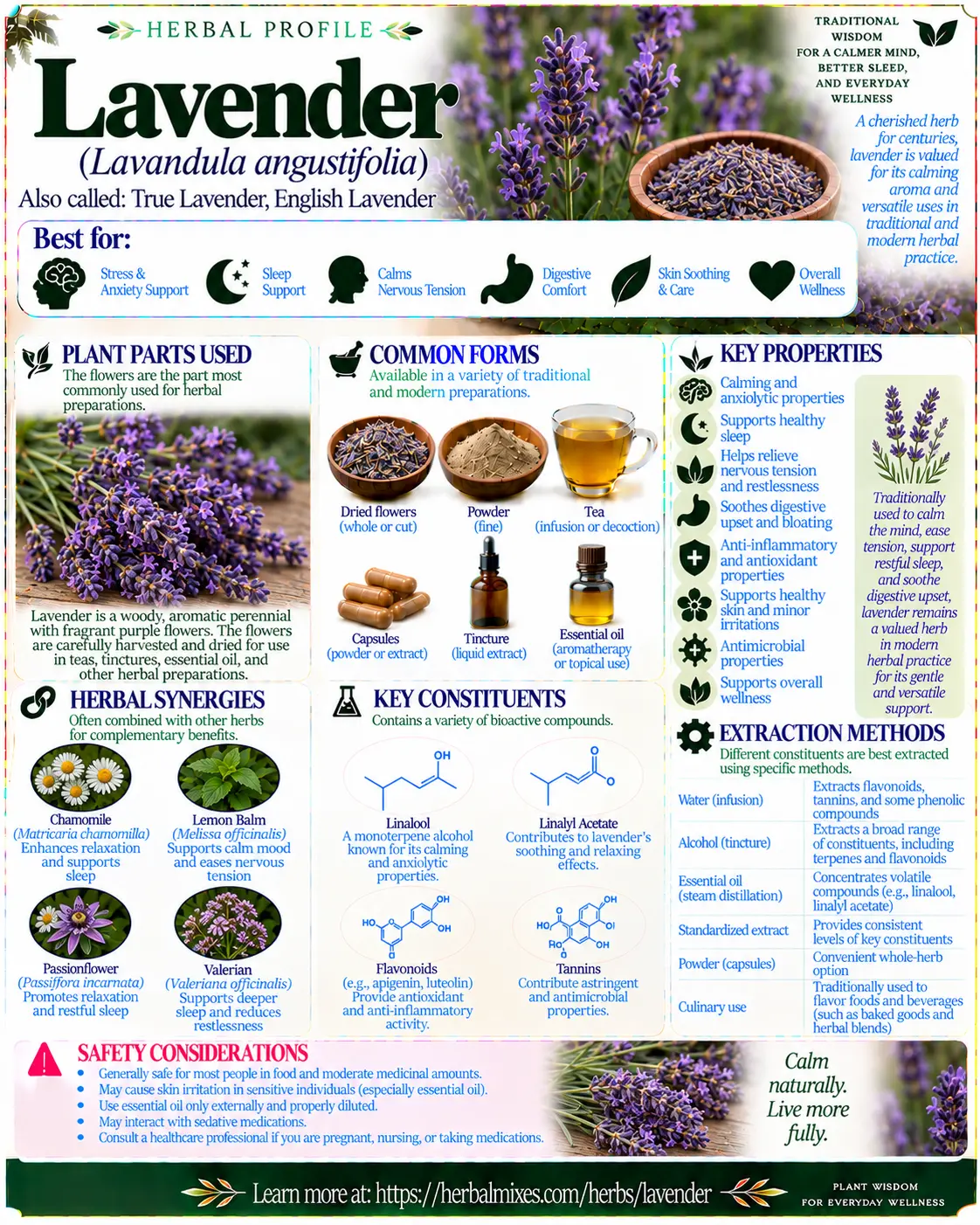
What Lavender Is Good For
Stress & nervous tension — Lavender is one of the best-known calming aromatic herbs. The European Medicines Agency recognizes Lavandula angustifolia flower and essential oil for traditional use in mild mental stress and as an aid to sleep.
Occasional anxiousness — Clinical research has investigated standardized oral lavender-oil preparations for anxiety. NCCIH reports that some studies suggest benefit, but limitations such as small sample sizes and limited independent replication mean the evidence should still be interpreted cautiously.
Sleep support — Lavender is commonly used before bed as tea, aromatherapy, or in calming herbal combinations. EMA includes sleep disorders and temporary insomnia among its traditional therapeutic areas, although evidence for aromatherapy specifically remains inconsistent.
Nervous digestion — Lavender’s aromatic volatile oils and mild bitterness make it useful when stress accompanies gas, digestive tension, or an unsettled stomach. Herb Pharm specifically describes lavender as traditionally used for nervous stomach and gas.
Relaxation without heavy sedation — Lavender is generally gentler than herbs such as valerian or hops. It is often useful when the goal is to reduce tension and encourage relaxation without producing pronounced daytime drowsiness.
Aromatherapy — Lavender essential oil is widely used through inhalation for relaxation and emotional comfort. NCCIH considers lavender aromatherapy possibly safe, although research has not established consistent benefits for every condition for which it is promoted.
Available Herbal Products
Buying Guides for Available Lavender Products
Lavender Liquid Herbal Extract – Flower tincture. A 1:5 hydroalcoholic extract of Regenerative Organic Certified Lavandula angustifolia harvested at peak bloom, suitable for people who prefer concentrated drops for relaxation or nervous digestion. Seller: Herb Pharm – View Herb Pharm Lavender →
English Lavender Flowers – Dried whole flowers. True Lavandula angustifolia flowers suitable for tea, culinary use, herbal blends, infused oils, sachets, and homemade preparations. Seller: Mountain Rose Herbs – View Mountain Rose Herbs English Lavender Flowers →
Organic Lavender Essential Oil – Steam-distilled aromatic oil. A 100% pure Lavandula angustifolia essential oil intended for inhalation or properly diluted topical use rather than direct oral use. Seller: Nature’s Answer / Vitacost – View Nature’s Answer Organic Lavender Essential Oil →
When buying dried lavender for medicinal tea or tincture, look specifically for Lavandula angustifolia. Some commercial “lavender flowers” are actually lavandin (Lavandula × intermedia), which has a different essential-oil profile and is not botanically identical.
Herbal Synergies
Lavender pairs especially well with lemon balm, chamomile, passionflower, valerian, and peppermint depending on whether the goal is relaxation, sleep, anxiousness, or stress-related digestion.
Lavender + Lemon Balm
Best for: Stress, nervous tension, and nervous digestion
Lavender contributes aromatic calming and mild antispasmodic properties, while lemon balm adds gentle nervine and carminative actions.
This is a particularly useful combination when mental tension and digestive discomfort appear together.
Best extraction: Covered hot infusion or tincture. Both herbs contain volatile oils that can escape with steam, so covering the tea preserves more of the aromatic fraction.
Lavender + Chamomile
Best for: Evening relaxation and mild sleep difficulty
Lavender provides aromatic calming activity, while chamomile contributes gentle sedative, antispasmodic, and digestive properties.
The combination is mild enough for an evening tea and is widely used in commercial relaxation blends.
Best extraction: Covered hot infusion. Both flowers release flavonoids and aromatic compounds into hot water.
Lavender + Passionflower
Best for: Racing thoughts and nighttime restlessness
Lavender helps soften tension, while passionflower contributes a more focused nervine action for mental overactivity and difficulty settling before sleep.
Best extraction: Tincture or covered infusion. A tincture is more concentrated, while tea is appropriate for gentle evening use.
Lavender + Valerian
Best for: More persistent nighttime tension
Lavender contributes a pleasant aromatic calming effect, while valerian provides stronger sedative and antispasmodic activity.
This combination is generally more suitable for nighttime than daytime use.
Best extraction: Tincture or standardized extract. Valerian’s important volatile and lipophilic constituents benefit from alcohol-containing preparations, while lavender also extracts well in alcohol.
Lavender + Peppermint
Best for: Stress-related gas and digestive tension
Lavender contributes calming and antispasmodic qualities, while peppermint adds stronger carminative and smooth-muscle-relaxing effects.
Best extraction: Covered hot infusion. Both herbs are rich in volatile oils that are readily lost if steeped uncovered.
Key Herbal Properties
Nervine — Lavender is traditionally used to calm nervous tension and help the body and mind relax. EMA recognizes traditional use for mild mental stress.
Mild sedative — Lavender may support sleep and evening relaxation without usually acting as strongly as valerian or hops.
Anxiolytic — Standardized oral lavender-oil preparations have demonstrated anxiety-reducing effects in several studies, although NCCIH considers the overall evidence promising but not definitive.
Carminative — Lavender’s volatile oils can help relax digestive tension and support the release of intestinal gas.
Antispasmodic — Aromatic constituents such as linalool may contribute to smooth-muscle and nervous-system relaxation.
Antioxidant — Rosmarinic acid, flavonoids, and aromatic compounds contribute antioxidant activity.
Anti-inflammatory — Linalool, linalyl acetate, and other constituents influence inflammatory signaling experimentally, although this does not establish lavender as a treatment for inflammatory disease.
Aromatic — Lavender’s essential oil is a major part of its medicinal identity and explains its widespread use in aromatherapy, topical products, and nervous-system formulas.







Active Compounds
Lavender contains an important volatile-oil fraction, especially linalool and linalyl acetate, together with terpenes, phenolic acids, flavonoids, tannins, and coumarin-related compounds. The exact essential-oil composition varies with cultivar, growing conditions, harvest time, and processing.
Linalool
Found mainly in: Flowers and essential oil
Linalool is one of the principal aromatic compounds in Lavandula angustifolia. It contributes strongly to lavender’s characteristic fragrance and has been studied for calming, sedative, analgesic, and anti-inflammatory effects.
Best extraction: Steam-distilled essential oil, hydroalcoholic tincture, or covered infusion. Because linalool is volatile and poorly soluble in water, essential-oil and alcohol-based preparations capture it most efficiently.
Linalyl Acetate
Found mainly in: Flowers and essential oil
Linalyl acetate is another major constituent of true lavender essential oil and contributes much of its sweet floral aroma.
It is commonly discussed together with linalool when explaining lavender’s relaxing aromatherapeutic profile.
Best extraction: Essential oil or alcohol-containing extract. It is lipophilic and volatile, so prolonged boiling is a poor extraction method.
Lavandulol
Found mainly in: Essential oil
Lavandulol is a characteristic lavender terpene alcohol that contributes to the plant’s aromatic fingerprint.
Best extraction: Steam distillation or alcohol tincture. It is poorly represented in plain water.
Lavandulyl Acetate
Found mainly in: Essential oil
Lavandulyl acetate is an ester contributing to the distinctive aroma of true lavender and helping distinguish its oil profile from related Lavandula species.
Best extraction: Steam-distilled essential oil or lipophilic extraction.
Terpinen-4-ol
Found mainly in: Essential oil
Terpinen-4-ol occurs in smaller amounts and contributes to lavender’s antimicrobial and aromatic activity.
Best extraction: Essential oil or hydroalcoholic tincture.
Rosmarinic Acid
Found mainly in: Flowers and aerial tissues
Rosmarinic acid is a water-soluble phenolic compound common to many mint-family herbs and contributes antioxidant and anti-inflammatory activity.
Best extraction: Hot-water infusion or hydroalcoholic tincture. Unlike lavender’s volatile oils, rosmarinic acid extracts readily into water.
Flavonoids
Found mainly in: Flowers and leaves
Lavender contains flavonoids that contribute antioxidant and vascular-supportive activity.
Best extraction: Hot infusion or hydroalcoholic tincture. Many flavonoid glycosides are sufficiently polar for water extraction.
Tannins
Found mainly in: Flowers and aerial parts
Tannins add mild astringency and contribute to lavender’s broader antioxidant profile.
Best extraction: Hot-water infusion or diluted alcohol.
FAQ
What is lavender best used for?
Lavender is best suited to mild stress, nervous tension, relaxation, sleep support, and stress-related digestive discomfort.
EMA recognizes traditional use of lavender flower and oil for mild mental stress and to aid sleep.
Is lavender tea or essential oil better?
They serve different purposes.
Lavender tea provides water-soluble polyphenols plus a smaller portion of the aromatic oil and works well for gentle relaxation and digestion. Essential oil is much more concentrated in volatile constituents such as linalool and linalyl acetate and is generally used through inhalation or appropriately diluted topical application.
Does lavender really help anxiety?
Some research on standardized oral lavender-oil products suggests benefit for anxiety symptoms.
NCCIH notes that the findings are encouraging but limited by study quality, sample size, funding, and other methodological issues.
Does lavender help sleep?
Lavender is traditionally used to aid sleep, particularly when stress or nervous tension is interfering with relaxation.
Research on aromatherapy and sleep has produced mixed results, so lavender is better viewed as a gentle supportive option rather than a proven insomnia treatment.
Can lavender be taken every day?
Food and tea amounts are generally considered low risk for most adults. NCCIH states that consuming lavender in amounts typically used in foods is likely safe, while short-term oral lavender products have also appeared reasonably well tolerated in studies.
Concentrated essential-oil preparations require more caution and should be used according to their specific directions.
Safety & Precautions
Lavender is generally well tolerated in culinary and tea amounts.
Oral lavender products may occasionally cause nausea, diarrhea, headache, appetite changes, or burping.
Lavender may theoretically increase the effects of sedative medicines or strongly sedating herbs, potentially increasing drowsiness. NCCIH specifically advises caution regarding sedative medications.
Because lavender may impair alertness in some individuals, avoid driving or operating machinery if a medicinal preparation makes you drowsy. EMA similarly cautions that lavender flower preparations may impair the ability to drive in affected individuals.
Topical lavender can occasionally cause allergic contact dermatitis or skin irritation.
Essential oil should not automatically be used undiluted on the skin. Nature’s Answer, for example, directs users to dilute its lavender essential oil in a carrier oil or lotion before topical application and labels the product for external use only.
Do not assume that a bottle labeled lavender essential oil is intended for swallowing. Follow the manufacturer’s route-of-use instructions; many retail essential oils are specifically labeled for external or aromatherapy use only.
NCCIH notes reports of breast-tissue enlargement in some children exposed to topical lavender-containing products, although it remains unclear whether lavender itself was responsible.
Safety during pregnancy and breastfeeding has not been adequately established for medicinal preparations. EMA does not recommend medicinal use during pregnancy or lactation because sufficient safety data are lacking.
Anyone taking sedative medication, preparing for surgery, pregnant, breastfeeding, or managing a chronic medical condition should discuss concentrated therapeutic lavender use with an appropriate healthcare professional.
References
- NCCIH — Lavender: Usefulness and Safety
- NCCIH — Anxiety and Complementary Health Approaches
- European Medicines Agency — Lavandulae Flos
- European Medicines Agency — Lavandulae Aetheroleum
- PubMed — Lavender and Anxiety Research
- PubMed — Lavender and Sleep Research
- Herb Pharm — Lavender Liquid Herbal Extract
- Mountain Rose Herbs — English Lavender Flowers
- Nature’s Answer — Organic Lavender Essential Oil via Vitacost
Disclaimer
Disclaimer: This article is for educational purposes only and is not intended to diagnose, treat, cure, or prevent any disease. Herbal products can cause side effects and interact with medications. Consult a qualified healthcare professional before using herbs therapeutically, especially if you are pregnant, breastfeeding, taking prescription medications, or managing a medical condition.