

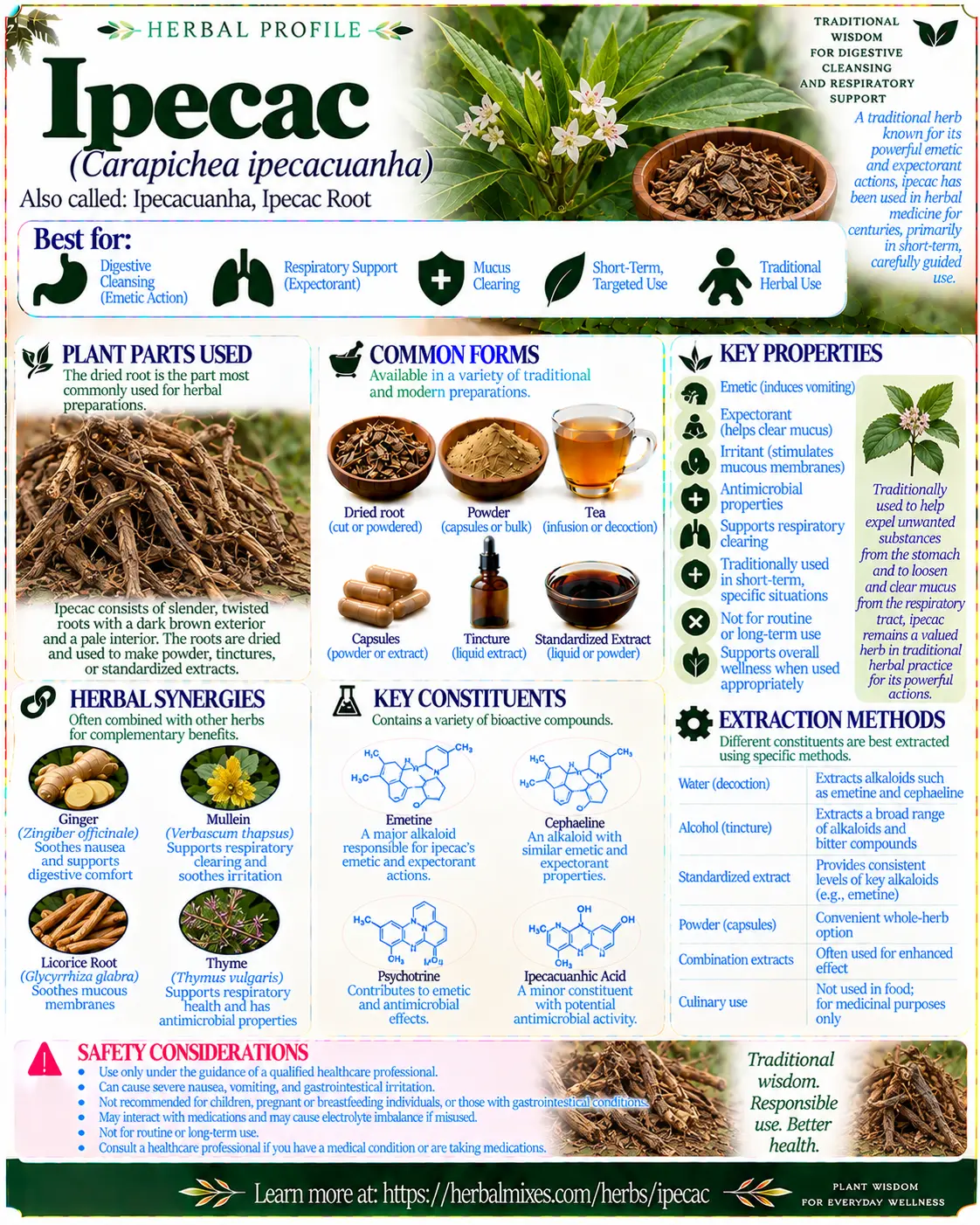
What Ipecac Is Good For
Historical expectorant use — Small amounts of ipecac were formerly included in pharmaceutical cough preparations as an expectorant, intended to increase respiratory secretions and help loosen mucus. This use has largely disappeared from modern self-care because safer alternatives are available.
Historical emetic use — Ipecac syrup was once widely kept in homes to induce vomiting after suspected poisoning. This practice is now obsolete. Poison-control authorities advise not to induce vomiting with ipecac, because it has not been shown to improve poisoning outcomes and can create additional complications.
Traditional respiratory preparations — Historically, very small pharmaceutical doses were incorporated into formulas for productive coughs and bronchial mucus. Its expectorant effect occurs at doses below those that provoke vomiting, but the narrow margin between desired and toxic effects makes home preparation inappropriate.
Pharmacognosy and constituent research — Today, ipecac is more important as a historical medicinal plant and source of alkaloids such as emetine and cephaeline than as an everyday herbal remedy. These compounds have powerful physiological effects and significant toxicity.
Modern poison-control guidance is particularly important: ipecac syrup is no longer recommended for managing swallowed poisons, and Poison Control reports that commercial syrup of ipecac is no longer manufactured in the United States.
Available Herbal Products
Buying Guides for Available Ipecac Products
Ipecac is an unusual exception to the normal HerbalMixes buying guide.
No conventional ipecac root, tincture, syrup, or concentrated extract is recommended here for self-treatment. The active alkaloids emetine and cephaeline can cause significant gastrointestinal, cardiovascular, and neuromuscular toxicity, and modern poison-control organizations no longer recommend ipecac syrup for home poisoning management.
Products labeled “Ipecacuanha” in homeopathic dilutions may still be sold, but these are fundamentally different preparations and should not be presented as substitutes for medicinal Carapichea ipecacuanha root.
For cough, congestion, or expectorant support, herbs with substantially wider safety margins—such as mullein, thyme, marshmallow root, elecampane, or horehound—are generally more appropriate for modern home herbalism.
Herbal Synergies
Because concentrated ipecac has a narrow therapeutic margin and meaningful toxicity, it is not appropriate for routine DIY herbal combinations. The combinations below explain historical formulation logic rather than recommending home preparation.
Ipecac + Mullein
Best for: Historical productive-cough formulations
Ipecac historically supplied a stimulating expectorant effect, while mullein offers gentler soothing and mucus-supportive properties.
For contemporary home herbalism, mullein can usually be paired with safer expectorants without including ipecac.
Best extraction: Historically pharmaceutical liquid preparations were used. For modern home use, omit ipecac and prepare mullein as a carefully strained hot infusion or tincture.
Ipecac + Licorice
Best for: Historical cough mixtures
Ipecac contributed stimulating expectorant action while licorice added demulcent, soothing, and expectorant qualities.
Best extraction: Historically prepared in standardized pharmaceutical mixtures rather than homemade extracts.
Licorice itself requires caution in people with hypertension, kidney disease, or certain medication regimens.
Ipecac + Senega
Best for: Historical mucus-clearing formulas
Both ipecac and senega root were historically used as stimulating expectorants. This combination belongs more to historical pharmacy than contemporary self-care.
Best extraction: Standardized pharmaceutical extraction only. It is not a suitable DIY herbal formula.
Ipecac + Marshmallow Root
Best for: Historical expectoration balanced with mucosal soothing
Ipecac’s irritating expectorant action could theoretically be balanced by marshmallow root’s soothing mucilage.
Best extraction: Do not combine as a homemade medicinal preparation. Marshmallow alone can be prepared safely as a cold infusion for soothing throat and respiratory irritation.
Key Herbal Properties
Emetic — Ipecac’s best-known pharmacological action is its ability to provoke nausea and vomiting. This property was formerly used in poisoning treatment but is no longer recommended for routine home use.
Expectorant — At lower historical pharmaceutical doses, ipecac was used to increase respiratory secretions and encourage removal of mucus.
Respiratory stimulant/irritant — Its expectorant effect is related partly to gastrointestinal irritation and reflex stimulation rather than a gentle soothing action.
Antiamoebic — The alkaloid emetine has pharmacological activity against Entamoeba histolytica and was historically used medically for amoebiasis. Toxicity severely limits its modern usefulness.
Antiparasitic-related — Emetine has demonstrated activity against certain parasites, but this pharmacological property does not make crude ipecac root an appropriate antiparasitic home remedy.




Active Compounds
Emetic — Ipecac’s best-known pharmacological action is its ability to provoke nausea and vomiting. This property was formerly used in poisoning treatment but is no longer recommended for routine home use.
Expectorant — At lower historical pharmaceutical doses, ipecac was used to increase respiratory secretions and encourage removal of mucus.
Respiratory stimulant/irritant — Its expectorant effect is related partly to gastrointestinal irritation and reflex stimulation rather than a gentle soothing action.
Antiamoebic — The alkaloid emetine has pharmacological activity against Entamoeba histolytica and was historically used medically for amoebiasis. Toxicity severely limits its modern usefulness.
Antiparasitic-related — Emetine has demonstrated activity against certain parasites, but this pharmacological property does not make crude ipecac root an appropriate antiparasitic home remedy.
FAQ
What is ipecac best used for today?
In modern herbal practice, ipecac has very little appropriate role in home self-care.
It is primarily important historically and pharmacologically because of emetine and cephaeline. Safer herbs are available for cough and expectorant support.
Should ipecac be used after someone swallows poison?
No.
The American Academy of Pediatrics concluded that ipecac should no longer be routinely used as a home poisoning treatment, and Poison Control likewise advises against keeping or using syrup of ipecac at home.
For a suspected poisoning in the United States, contact Poison Control at 1-800-222-1222 or use the official Poison Control service for case-specific instructions.
Why was ipecac abandoned for poisoning?
Induced vomiting did not reliably improve outcomes and could interfere with more effective treatment. Vomiting can also increase aspiration risk or prevent patients from keeping down other necessary medicines.
Repeated ipecac exposure itself can cause serious toxicity.
Is ipecac still used for coughs?
Historically, very small pharmaceutical doses were used as expectorants.
Today, safer expectorant and soothing herbs such as mullein, thyme, elecampane, marshmallow, and horehound generally make more sense for ordinary herbal respiratory formulas.
Is Psychotria ipecacuanha the same plant as Carapichea ipecacuanha?
Yes. Carapichea ipecacuanha is the currently accepted botanical name according to Kew Plants of the World Online. Psychotria ipecacuanha is an older botanical synonym still encountered in herbal and pharmaceutical literature.
Safety & Precautions
Ipecac should not be used routinely as a home herbal medicine.
The active alkaloids emetine and cephaeline are inherently toxic, and overdose or repeated exposure can affect the gastrointestinal tract, cardiovascular system, and skeletal muscles.
Chronic ipecac misuse has been associated with serious heart damage and deaths. Poison Control specifically notes cardiovascular complications among people who repeatedly used ipecac to induce vomiting.
Possible toxicity includes persistent vomiting, diarrhea, abdominal pain, muscle weakness, abnormal heart rhythms, cardiomyopathy, and other systemic effects.
Ipecac should not be used for weight loss, purging, “detoxification,” stomach cleansing, or routine management of food poisoning.
It should not be administered after accidental poisoning unless a medical toxicology professional specifically directs its use—which is now highly unusual. Modern poison-management guidance favors contacting Poison Control immediately rather than inducing vomiting.
Avoid medicinal use during pregnancy and breastfeeding. The vomiting and systemic toxicity produced by ipecac make unsupervised therapeutic exposure inappropriate.
Ipecac should not be given to children as a home poisoning remedy.
Anyone who has intentionally or accidentally swallowed ipecac, especially a concentrated product or repeated doses, and develops persistent vomiting, muscle weakness, chest symptoms, fainting, or abnormal heartbeat should obtain urgent medical advice.
For suspected poisoning in the United States, call Poison Control: 1-800-222-1222. Call emergency services for collapse, seizures, severe breathing difficulty, unconsciousness, or other immediately life-threatening symptoms.
References
- Kew Plants of the World Online — Carapichea ipecacuanha
- Kew Plants of the World Online — Psychotria ipecacuanha Synonym Record
- NCBI Bookshelf — Ipecac
- PubMed — Toxicology of Ipecac: A Review
- American Academy of Pediatrics — Poison Treatment in the Home
- Poison Control — Ipecac: Don’t Use It
- PubMed — Ipecac Research
- PubMed — Emetine Toxicity Research
Disclaimer
Disclaimer: This article is for educational purposes only and is not intended to diagnose, treat, cure, or prevent any disease. Herbal products can cause side effects and interact with medications. Consult a qualified healthcare professional before using herbs therapeutically, especially if you are pregnant, breastfeeding, taking prescription medications, or managing a medical condition.