

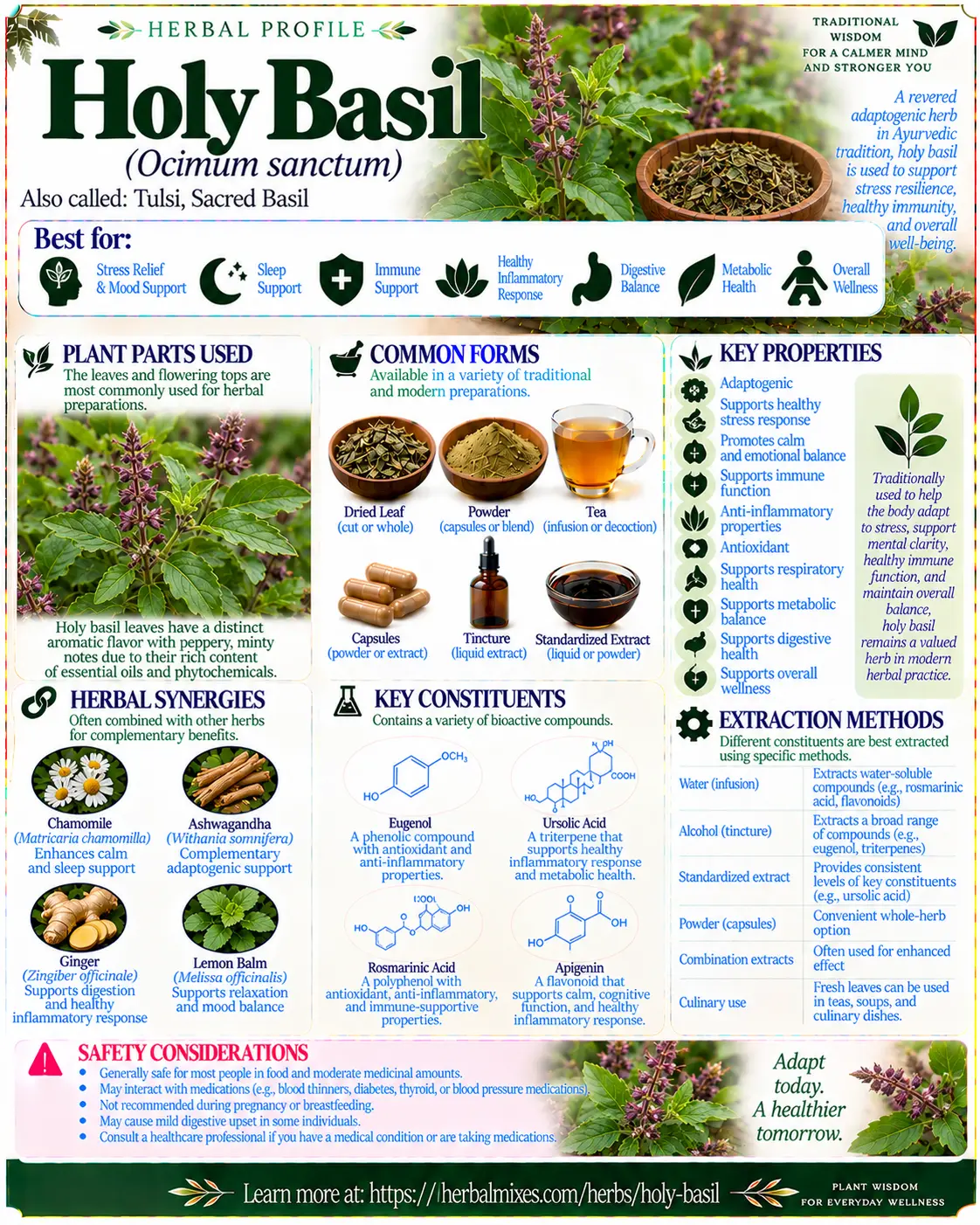
What Holy Basil Is Good For
Everyday stress — Holy basil is best known as an adaptogenic herb used to support a balanced response to ongoing physical and mental stress. A randomized placebo-controlled trial found improvements in perceived stress and several stress-related measures after eight weeks of a standardized Ocimum tenuiflorum extract.
Calm focus — Holy basil is traditionally used when stress causes mental fatigue, scattered concentration, or reduced resilience. It tends to be described as calming without functioning like a strong sedative. Herb Pharm specifically identifies it as an adaptogen traditionally used for calm, focused energy and mental concentration.
Stress-related sleep difficulty — The same clinical trial found improvement in Athens Insomnia Scale scores alongside reduced perceived stress, suggesting potential usefulness when sleep problems are connected with stress. Evidence remains preliminary rather than definitive.
Blood sugar support — Holy basil has traditionally been used for metabolic wellness, and modern research has investigated effects on glucose and carbohydrate metabolism. Evidence is still limited, so it should not replace diabetes medication or dietary management.
General resilience — In Ayurvedic herbal practice, tulsi is traditionally regarded as a restorative herb used during periods of increased physical or emotional demand. Modern supplement manufacturers commonly classify it as an adaptogen.
Inflammatory balance — Rosmarinic acid, eugenol, ursolic acid, luteolin, and related constituents demonstrate anti-inflammatory and antioxidant activity experimentally. These findings help explain some traditional uses but do not establish holy basil as a treatment for inflammatory disease.
Available Herbal Products
Buying Guides for Available Holy Basil Products
Holy Basil Liquid Herbal Extract – Aerial-parts tincture. A 1:3 hydroalcoholic extract made from certified organic Ocimum tenuiflorum and useful for people who prefer a concentrated liquid adaptogen rather than capsules or tea. Seller: Herb Pharm – View Herb Pharm Holy Basil →
Holy Basil Leaf – Dual-extract capsules. Combines holy basil leaf with a supercritical CO₂ extract, providing both water/alcohol-soluble and fat-soluble fractions in one preparation. Seller: Gaia Herbs – View Gaia Herbs Holy Basil Leaf →
Holy Basil Extract 500 mg – Standardized capsules. Standardized to a minimum of 2% ursolic acid, making it useful when a more predictable extract is preferred over loose herb or tea. Seller: NOW Foods – View NOW Holy Basil Extract →
Different holy basil products emphasize different chemistry. Tea favors water-soluble polyphenols, tinctures capture aromatic and phenolic compounds more broadly, and CO₂ extracts concentrate more lipophilic constituents such as volatile oils and triterpenes.
Herbal Synergies
Holy basil pairs especially well with ashwagandha, lemon balm, ginger, schisandra, and cinnamon depending on whether the goal is stress resilience, calm focus, digestion, or metabolic support.
Holy Basil + Ashwagandha
Best for: Chronic stress and fatigue
Holy basil contributes calming adaptogenic and aromatic activity, while ashwagandha provides deeper restorative and stress-supportive effects, particularly when ongoing stress is accompanied by fatigue.
The combination is useful when the goal is steadier resilience rather than immediate stimulation.
Best extraction: Tincture or standardized extracts. Both herbs contain mixed-polarity constituents that benefit from hydroalcoholic extraction.
Holy Basil + Lemon Balm
Best for: Stress, nervous tension, and difficulty unwinding
Holy basil supports resilience and calm focus, while lemon balm contributes gentle nervine, carminative, and relaxing properties.
This combination is particularly useful when stress affects both mood and digestion.
Best extraction: Covered hot infusion or tincture. Both herbs contain aromatic volatile compounds and polyphenols that extract well in hot water when the preparation is covered.
Holy Basil + Ginger
Best for: Stress with sluggish or unsettled digestion
Holy basil contributes adaptogenic and calming activity, while ginger adds warming, carminative, motility-supportive, and nausea-relieving actions.
A traditional Ayurvedic combination also pairs holy basil with ginger and black pepper.
Best extraction: Covered hot infusion or tincture. Both herbs perform well in tea, while alcohol captures a broader range of aromatic and pungent compounds.
Holy Basil + Schisandra
Best for: Stress resilience and mental endurance
Holy basil provides calming adaptogenic support, while schisandra contributes lignans traditionally associated with endurance, stress adaptation, and restorative toning.
Best extraction: Hydroalcoholic tincture or standardized extracts. Alcohol improves extraction of schisandra lignans while also capturing tulsi’s aromatic and triterpene constituents.
Holy Basil + Cinnamon
Best for: Stress-related eating and metabolic wellness
Holy basil has been investigated for carbohydrate metabolism, while cinnamon contributes aromatic polyphenols traditionally used in metabolic formulas.
This pairing can be useful when emotional stress and sweet-food cravings occur together.
Best extraction: Hot infusion, tincture, or separate standardized extracts.
People using glucose-lowering medication should be cautious because both herbs may influence blood sugar.
Key Herbal Properties
Adaptogenic — Holy basil is widely classified as an adaptogen and traditionally used to help maintain resilience during physical and emotional stress. Modern clinical research provides preliminary support for this role.
Nervine — Tulsi can support calm mental energy without being strongly sedating, making it particularly useful when nervous tension and poor concentration occur together.
Antioxidant — Rosmarinic acid, eugenol, ursolic acid, luteolin, and related compounds contribute significant antioxidant activity.
Anti-inflammatory — Several holy basil constituents influence inflammatory pathways experimentally, including rosmarinic acid, eugenol, ursolic acid, apigenin, and luteolin.
Metabolic supportive — Holy basil has traditionally been used for glucose-related metabolic support, and modern supplements sometimes emphasize healthy carbohydrate metabolism.
Carminative — Its aromatic volatile oils make tulsi useful in formulas for mild digestive tension, gas, or stress-related digestive discomfort.
Immunomodulatory — Experimental research suggests holy basil constituents influence immune signaling, although clinical evidence for specific immune conditions remains limited.
Aromatic — Eugenol and other volatile compounds give the plant its distinctive spicy, clove-like scent and contribute to its digestive and antimicrobial laboratory activity.








Active Compounds
Holy basil contains a diverse mixture of volatile oils, phenolic acids, flavonoids, tannins, and triterpenes. Important compounds include eugenol, rosmarinic acid, ursolic acid, oleanolic acid, luteolin, apigenin, and limonene.
Eugenol
Found mainly in: Leaves and flowering aerial parts
Eugenol is an aromatic phenylpropanoid also found prominently in cloves. It contributes to holy basil’s spicy aroma and has demonstrated antimicrobial, antioxidant, and anti-inflammatory activity experimentally.
Best extraction: Alcohol tincture, essential oil, or CO₂ extract. Eugenol is relatively lipophilic and volatile, so plain water extracts only part of the available amount.
A covered tea still captures some aromatic fraction while minimizing evaporation.
Rosmarinic Acid
Found mainly in: Leaves and aerial herb
Rosmarinic acid is a major phenolic compound common to many mint-family plants. It contributes antioxidant activity and has been extensively investigated for effects on inflammatory signaling.
Best extraction: Hot-water infusion or hydroalcoholic tincture. Rosmarinic acid is sufficiently polar to extract well into water, while diluted alcohol provides broader extraction.
Ursolic Acid
Found mainly in: Leaves and aerial portions
Ursolic acid is a pentacyclic triterpene associated with anti-inflammatory, antioxidant, and metabolic activity in experimental research.
NOW Foods currently standardizes its holy basil extract to a minimum of 2% ursolic acid.
Best extraction: Alcohol or supercritical CO₂ extraction. Ursolic acid is poorly water soluble, so ordinary tea is not an efficient extraction method.
Oleanolic Acid
Found mainly in: Leaves and aerial herb
Oleanolic acid is a triterpene structurally related to ursolic acid and contributes to holy basil’s broader antioxidant and pharmacological profile.
Best extraction: Alcohol tincture or CO₂ extract. Its lipophilic structure makes plain-water extraction relatively inefficient.
Luteolin
Found mainly in: Leaves
Luteolin is a flavonoid with antioxidant and anti-inflammatory activity. It complements rosmarinic acid and the triterpenoid fraction rather than acting as the herb’s sole active constituent.
Best extraction: Hydroalcoholic tincture or hot infusion. Glycosylated forms extract more readily into water, while alcohol improves extraction of less-polar forms.
Apigenin
Found mainly in: Leaves and aerial herb
Apigenin is another flavonoid found in holy basil and has been investigated experimentally for antioxidant, calming, and anti-inflammatory effects.
Best extraction: Hydroalcoholic tincture. Some apigenin derivatives enter tea, but alcohol provides broader recovery of the less water-soluble aglycone.
Limonene and Other Volatile Terpenes
Found mainly in: Essential oil of leaves and flowering portions
Holy basil contains limonene and other aromatic terpenes that contribute to its distinctive scent and physiological activity.
Best extraction: Essential oil, CO₂ extract, or alcohol tincture. Covered hot infusion is preferable when making tea because volatile constituents readily escape with steam.
Tannins
Found mainly in: Leaves and aerial herb
Holy basil contains tannins that contribute mild astringency and antioxidant properties. Herb Pharm includes tannins among the prominent constituent groups reported for the plant.
Best extraction: Hot-water infusion or hydroalcoholic tincture. Tannins are readily water soluble.
FAQ
What is holy basil best used for?
Holy basil is primarily used for everyday stress, mental fatigue, calm focus, and general resilience.
A controlled eight-week clinical trial found improvements in perceived stress and some sleep-related measures with a standardized Ocimum tenuiflorum extract, although more independent research is still needed.
Is holy basil the same as culinary basil?
No.
Holy basil is primarily Ocimum tenuiflorum, while common culinary sweet basil is usually Ocimum basilicum. They are related but chemically and traditionally distinct herbs.
Is holy basil tea or tincture better?
Tea is excellent for everyday stress and digestive support because it extracts rosmarinic acid, flavonoids, tannins, and some aromatic compounds.
A hydroalcoholic tincture or dual extract captures a broader range, including more lipophilic compounds. Gaia Herbs, for example, combines water/alcohol extraction with supercritical extraction specifically to cover both water- and fat-soluble constituents.
Does holy basil make you sleepy?
Usually not strongly.
Holy basil is better described as a calming adaptogen than a sedative. Some people find it helps them unwind, and one clinical trial reported improved sleep-related scores, but daytime products are also commonly used for calm concentration.
Can holy basil be taken every day?
Commercial holy basil products are commonly designed for daily use. Gaia Herbs describes its holy basil capsules as suitable for long-term use, while NOW Foods recommends one capsule one to two times daily according to its label.
Long-term concentrated supplementation still deserves more caution than ordinary culinary or tea amounts, particularly when medications are involved.
Safety & Precautions
Holy basil is generally well tolerated in ordinary tea and supplemental amounts, but high-quality long-term safety data remain limited.
Holy basil may influence blood glucose. People taking insulin, metformin, sulfonylureas, or other glucose-lowering medications should monitor carefully and discuss concentrated supplementation with a healthcare professional.
Because some experimental research suggests holy basil may affect platelet activity or blood clotting, people taking anticoagulant or antiplatelet medications should also use concentrated preparations cautiously.
Avoid therapeutic use during pregnancy unless specifically recommended by an appropriately qualified professional. Gaia Herbs and NOW Foods both advise against their concentrated holy basil products during pregnancy, and both also advise against use during lactation or nursing.
Safety during breastfeeding has not been adequately established for concentrated extracts.
People preparing for surgery should tell their surgical team about holy basil use, especially if they also take medications affecting glucose or blood clotting.
Holy basil can occasionally cause digestive upset or other individual intolerance. Stop use if persistent nausea, abdominal discomfort, rash, or other unexpected symptoms occur.
Because holy basil can be calming for some people, combining large supplemental amounts with sedative medicines or strongly sedating herbs may potentially increase drowsiness.
Choose supplements that clearly identify Ocimum tenuiflorum. The synonym Ocimum sanctum is also still widely used commercially, including on some established supplement labels.
Anyone with diabetes, a bleeding disorder, a chronic medical condition, pregnancy, breastfeeding, or prescription medications should discuss regular therapeutic holy basil use with an appropriate healthcare professional.
References
- PubMed — Randomized Trial of Ocimum tenuiflorum for Stress, Mood, and Sleep
- PubMed Central — Comprehensive Review of the Phytochemistry and Bioactivities of Ocimum tenuiflorum
- PubMed — Ocimum sanctum / Holy Basil Clinical Research
- PubMed — Holy Basil and Metabolic Health Research
- Herb Pharm — Holy Basil Liquid Herbal Extract
- Herb Pharm — Holy Basil Herb Reference
- Gaia Herbs — Holy Basil Leaf
- Gaia Herbs Professionals — Holy Basil
- NOW Foods — Holy Basil Extract 500 mg
Disclaimer
Disclaimer: This article is for educational purposes only and is not intended to diagnose, treat, cure, or prevent any disease. Herbal products can cause side effects and interact with medications. Consult a qualified healthcare professional before using herbs therapeutically, especially if you are pregnant, breastfeeding, taking prescription medications, or managing a medical condition.