

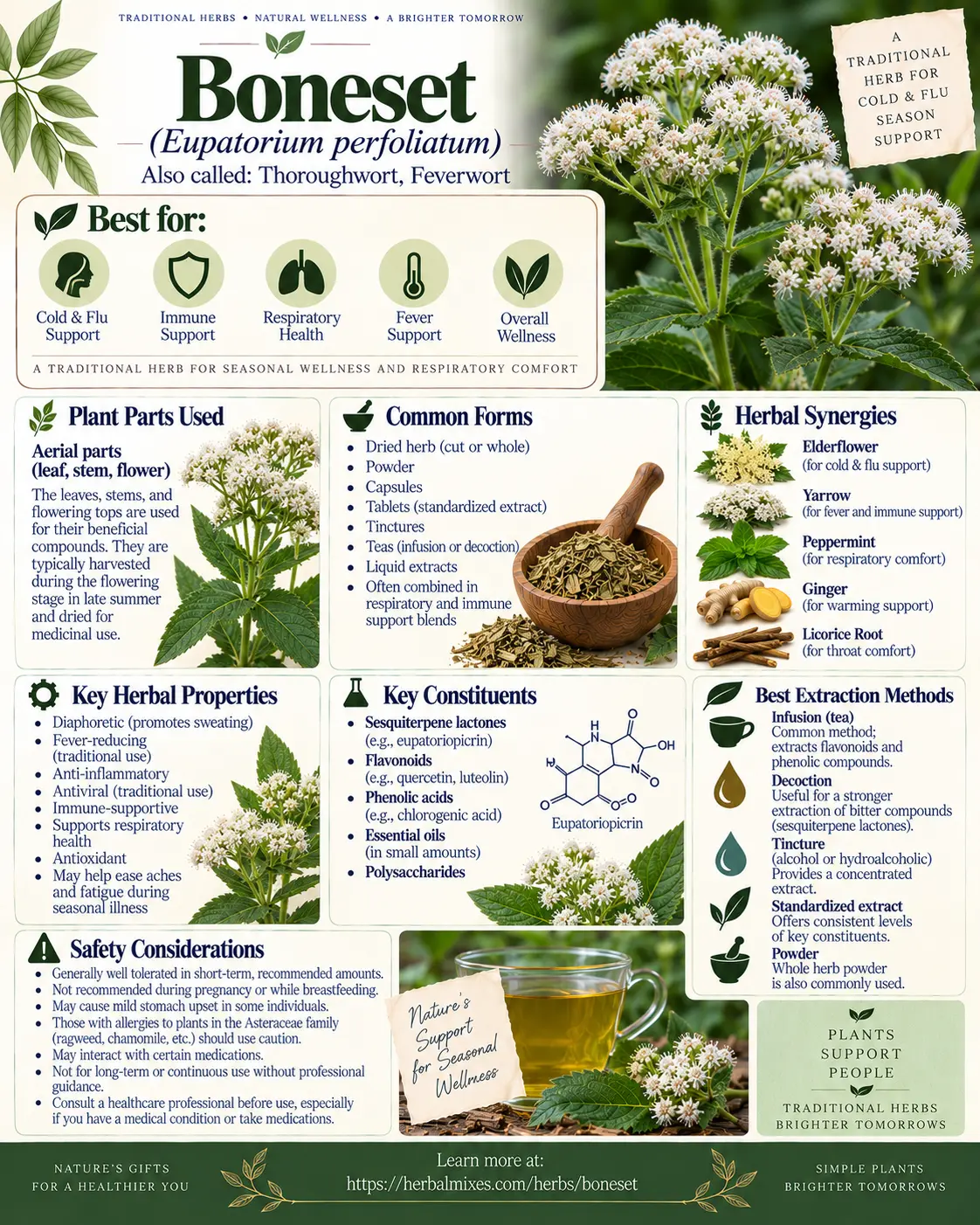
What Boneset Is Good For
Fever Management & Diaphoretic Action — Boneset is a premier historical diaphoretic traditionally used to encourage healthy perspiration and support the body’s natural cooling response during temporary fevers and chills.
Respiratory Congestion & Colds — Valued in traditional herbalism for helping clear thick mucus and ease upper respiratory congestion associated with seasonal colds and flu.
Body Aches & Muscular Discomfort — Traditionally employed to help soothe the deep-seated muscle aches, bone-deep stiffness, and physical fatigue that accompany acute winter ailments.
Immune Defense Support — Rich in bioactive polysaccharides that help prime and support white blood cell activity during seasonal immune challenges.
Bitter Tonic Action — Its natural bitter principles stimulate digestive secretions and support general physiological tone when used in small amounts.
Available Herbal Products
Organic Boneset Aerial Parts – Dried flowering herb. An authentic, traditional choice for brewing a strong, intensely bitter infusion used for short-term fever and cold management. Seller: Mountain Rose Herbs – View Mountain Rose Herbs Boneset →
Boneset Liquid Extract – Hydroalcoholic tincture. A convenient liquid format that allows for precise, drop-by-drop dosing during acute seasonal immune challenges. Seller: Herb Pharm – View Herb Pharm Boneset Extract →
Cold & Flu Botanical Formula – Professional liquid blend combining boneset with elderflower, yarrow, and peppermint. Designed to support sweating and fever management during the onset of colds. Seller: Wise Woman Herbals – View Wise Woman Herbals Formulas →
Boneset Herb Powder – Fine dried aerial powder. A versatile option for experienced herbalists compounding custom acute care capsules or tinctures. Seller: Starwest Botanicals – View Starwest Botanicals Boneset →
Herbal Synergies
Boneset pairs especially well with Yarrow, Peppermint Leaf, and Elderflower, depending on the goal of the formula.
Boneset Aerial Parts + Yarrow Aerial Parts – Best for: Comprehensive fever management, encouraging healthy sweating, and easing acute chills Boneset acts as a powerful relaxing diaphoretic to break fevers, while yarrow opens peripheral circulation and supports lymphatic drainage. Together, they form the gold standard historical combination for managing seasonal colds and flus. Best extraction: Hot infusion (tea). Steeping these dried aerial parts in covered hot water extracts their water-soluble flavonoids and volatile oils efficiently.
Boneset Aerial Parts + Peppermint Leaf -Best for: Improving flavor palatability, cooling discomfort, and opening respiratory passages Boneset possesses a notoriously bitter and unpalatable taste; pairing it with cooling peppermint leaf balances the flavor while adding carminative antispasmodic comfort. Best extraction: Covered hot infusion. Steeping these herbs together captures both boneset’s active bitter principles and peppermint’s soothing menthol oils.
Boneset Aerial Parts + Elderflower – Best for: Upper respiratory clearance, easing sinus pressure, and supporting mild fevers Boneset encourages a cleansing sweat and relieves deep body aches, whereas elderflower provides gentle diaphoretic and anti-inflammatory action for the sinuses and upper airways. Best extraction: Hot tea infusion. Both delicate flower and herb parts release their active constituents rapidly in boiling water.
Key Herbal Properties
Diaphoretic — Stimulates peripheral blood flow and promotes healthy perspiration to support the body’s fever response.
Expectorant — Promotes the thinning and clearance of mucus from the bronchial passages.
Anti-inflammatory — Helps modulate normal inflammatory pathways, easing deep muscle and bone stiffness.
Bitter Tonic — Engages taste receptors in the mouth to stimulate gastric enzyme secretion and digestion.
Immunomodulating — Contains complex polysaccharides that support white blood cell activity.






Active Compounds
Eupatorin and Flavonoids (including Quercetin and Kaempferol) Found mainly in: Flowering aerial parts Antioxidant compounds that support the plant’s immune-modulating, anti-inflammatory, and diaphoretic actions. Best extraction: Hot water infusion or alcohol-water tincture. These compounds dissolve efficiently in hot water and hydroalcoholic solvents.
Pyrrolizidine Alkaloids (PAs – including Eupatorine) Found mainly in: Leaves and stems (non-mutagenic profile compared to hepatotoxic PAs, but present in trace amounts) Bioactive organic constituents that contribute to the plant’s overall physiological activity. Best extraction: Standardized hydroalcoholic extract or short infusion. Alcohol-water solutions effectively capture the active spectrum.
Polysaccharides Found mainly in: Leaf and stem tissues High-molecular-weight carbohydrates responsible for supporting immune defense mechanisms. Best extraction: Water decoction or hot infusion. Polysaccharides dissolve readily in warm water.
FAQ
What is boneset best used for? Boneset is primarily used as a short-term acute herbal remedy for managing fevers, clearing heavy respiratory congestion, and easing deep body aches during colds and flus.
Why is it called boneset? It earned its historical name (“boneset”) from its traditional reputation for successfully treating breakbone fever—a severe form of influenza characterized by intense, bone-aching muscular pain.
How does boneset taste? Boneset has an exceptionally harsh, pungent, and intensely bitter flavor profile driven by its high concentration of bitter glycosides and active constituents.
Can boneset be taken as a daily wellness tea? No, boneset is strictly an acute-care herb intended for short-term use (typically a few days) during active illness; it is not designed for continuous daily consumption.
Can boneset cause nausea or vomiting? Yes, excessive internal doses or very strong, concentrated brews of fresh boneset can act as a mild emetic, triggering stomach upset or nausea.
Safety & Precautions
Short-Term Acute Use Only: Boneset is designed exclusively for short-term use during acute illness (typically 3 to 5 days); avoid continuous long-term consumption.
Pregnancy & Breastfeeding: Avoid internal use during pregnancy and lactation due to lack of extensive safety data and the presence of active alkaloids.
Gastrointestinal Sensitivity: High doses or overly strong tea infusions can irritate the gastric mucosa and cause nausea or vomiting due to intense bitter constituents.
Pyrrolizidine Alkaloid Awareness: While boneset contains macrocyclic pyrrolizidine alkaloids that are structurally distinct from hepatotoxic types, individuals with pre-existing liver disease should avoid use.
Consult a qualified healthcare professional before using boneset therapeutically, especially if you manage underlying medical conditions or take prescription drugs.
References
National Center for Complementary and Integrative Health (NCCIH)
PubMed Central – Eupatorium perfoliatum (Boneset) Phytochemistry and Traditional Uses
World Health Organization (WHO) Monographs on Selected Medicinal Plants
European Medicines Agency (EMA) Herbal Documentation
Mountain Rose Herbs Boneset Monograph
Disclaimer
Disclaimer: This article is for educational purposes only and is not intended to diagnose, treat, cure, or prevent any disease. Herbal products can cause side effects and interact with medications. Consult a qualified healthcare professional before using herbs therapeutically, especially if you are pregnant, breastfeeding, taking prescription medications, or managing a medical condition.