

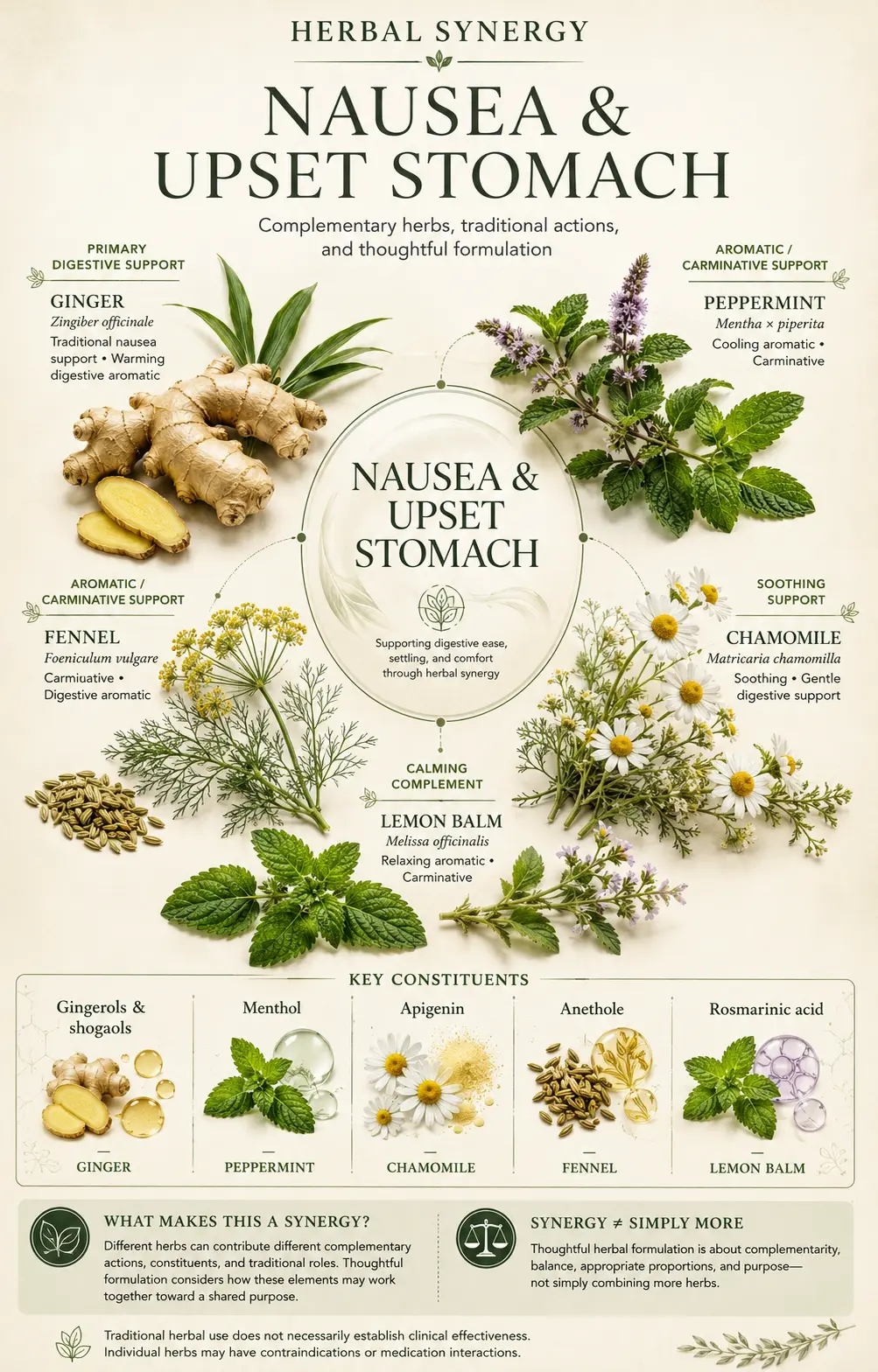
Nausea can come from a lot of directions — motion, a rough meal, pregnancy, a queasy stomach that just won’t settle. Because the triggers differ, the herbs worth reaching for aren’t all doing the same job. Some calm the stomach directly, some work almost instantly through scent alone, and some are better suited to the slower, all-day kind of queasiness.
| Herb | What It Adds |
| Ginger | The most evidence-backed single herb for nausea, from motion sickness to post-surgery |
| Peppermint | Fast-acting via aroma or tea; settles a “sour” or tense stomach |
| Chamomile | Gentle option for stomach upset paired with tension or stress |
| Lemon Balm | Eases queasiness that comes with anxiety or a nervous stomach |
| Fennel | Rounds things out when nausea comes with gas or bloating |
Ginger is the clear anchor of this group — it has the strongest research behind it of any single herb for nausea. The others are best thought of as supporting cast: peppermint for speed, chamomile and lemon balm for the nervous-stomach angle, fennel when bloating is part of the picture.
Recipe for Nausea & Upset Stomach
Ginger, Peppermint & Lemon Balm Settling Tea
Why this blend: Ginger does the heavy lifting against nausea itself, peppermint adds a fast-acting calming effect, and lemon balm softens the “unsettled” feeling that often comes along with queasiness — especially the anxious kind.
Ingredients
- ½ tsp fresh grated ginger (or ¼ tsp dried)
- 1 tsp dried peppermint leaf
- 1 tsp dried lemon balm leaf
- 1 cup (240 ml) hot water
Yield: 1 cup
Preparation
- Combine the ginger, peppermint, and lemon balm in a mug or infuser.
- Pour hot water over the herbs and cover the cup right away.
- Steep, covered, for 8–10 minutes.
- Strain and sip slowly — small sips, not big gulps.
How to Use Sip slowly at the first sign of queasiness, or throughout the day in small amounts if nausea is ongoing. Cold or room-temperature is fine too if hot liquid feels unappealing.
Herbalist’s Note When nausea is intense, sipping slowly matters more than the recipe itself — a big gulp of anything can backfire.
Safety Skip peppermint if you’re prone to reflux; ginger and lemon balm alone still make a solid tea.
Ready-to-Use Products With This Synergy
GIN GINS Original Ginger Chews Brand: The Ginger People Key herbs: Fresh ginger Why it fits: A simple, portable, single-herb option — good for the “I need something right now” moments motion sickness and morning queasiness tend to cause. Buy: gingerpeople.com
Dramamine Advanced Herbals Ginger Chews Brand: Dramamine Key herbs: Ginger Why it fits: A clinically-dosed ginger chew marketed specifically for nausea from motion sickness, morning sickness, and upset stomach, with a non-drowsy formula. Buy: amazon.com
Sea-Band Anti-Nausea Ginger Gum Brand: Sea-Band Key herbs: Natural ginger oil Why it fits: A gum format for people who want something to chew rather than swallow — popular for travel and pregnancy-related nausea. Buy: walgreens.com
Herbal Synergies for Nausea & Upset Stomach
Not all queasiness needs the same approach. Sharp, sudden nausea (motion sickness, a rough car ride) often responds well to fast-acting aromatic herbs like peppermint. Nausea tied to anxiety or a “nervous stomach” tends to respond better to calming herbs like chamomile and lemon balm. And the slower, all-day queasiness some people get with pregnancy or ongoing stomach upset is where ginger’s track record really stands out.
As always: synergy is about thoughtful complementarity — not simply adding more herbs to the pot.
Core Herbal Synergy Combinations
Ginger + Peppermint Best for: Fast-acting relief for motion sickness or sudden queasiness. Why it works: Ginger is the best-researched antiemetic herb around, and peppermint adds a quick calming effect — either as tea or, notably, just inhaled as aromatherapy, which several clinical trials have used with real success. A simple, reliable pairing.
Ginger + Lemon Balm Best for: Nausea that comes with a nervous, anxious, or “unsettled” stomach. Why it works: Lemon balm is traditionally used to calm a jittery digestive system, which pairs naturally with ginger’s more direct antiemetic action — useful when stress and stomach upset are tangled together.
Chamomile + Ginger Best for: A gentler combination for sensitive stomachs, kids, or evening use. Why it works: Chamomile brings a soft, soothing quality without ginger’s warming intensity on its own, making this the mildest option on the list — good for someone who wants something calming more than something stimulating.
Ginger + Fennel Best for: Nausea that shows up alongside bloating or gas. Why it works: Ginger addresses the queasiness while fennel’s carminative action handles the gas — useful after a meal that left you feeling both nauseated and puffy at once.
Herbs Used in These Synergies
Ginger Botanical name: Zingiber officinale Traditional actions: Antiemetic, digestive stimulant, carminative Role in the synergy: The anchor herb here — well-studied for nausea from pregnancy, motion sickness, chemotherapy, and surgery, and the herb most likely to be doing the real work in any of these combinations. Key constituents: Gingerols, shogaols
Peppermint Botanical name: Mentha × piperita Traditional actions: Antispasmodic, calming Role in the synergy: Fast-acting, especially by scent — several clinical trials have used peppermint aromatherapy alone to reduce postoperative nausea. Key constituents: Menthol, menthone
Lemon Balm Botanical name: Melissa officinalis Traditional actions: Calming, mild carminative Role in the synergy: Traditionally used for a nervous or anxious stomach, softening the “unsettled” quality of nausea rather than targeting it directly. Key constituents: Rosmarinic acid, citral
Chamomile Botanical name: Matricaria chamomilla Traditional actions: Soothing antispasmodic Role in the synergy: The gentlest option in this lineup, good for sensitive stomachs or a slower, calming approach. Key constituents: Bisabolol, chamazulene
Fennel Botanical name: Foeniculum vulgare Traditional actions: Carminative Role in the synergy: Brought in specifically when bloating or gas accompanies the nausea, rather than for the nausea itself. Key constituents: Anethole, fenchone
Safety and When to Seek Medical Advice
Use Caution If:
- You’re on blood thinners — ginger can increase bleeding risk and interacts with medications like warfarin
- You’re pregnant — culinary amounts of ginger are widely considered reasonable, but check with your provider before using concentrated supplements, and note that most sources put a general daily ceiling around 1 gram for pregnancy use
- You have reflux or GERD — peppermint can make this worse; lean on ginger, chamomile, or lemon balm instead
- You have gallstones or a bleeding disorder — ginger increases bile production and has mild blood-thinning effects
- You’re scheduled for surgery — ginger is often paused beforehand due to its effect on bleeding
See a Healthcare Professional If: Nausea is severe, persistent, or paired with repeated vomiting, inability to keep fluids down, severe abdominal pain, fever, blood in vomit, or signs of dehydration. These need medical evaluation, not just tea.
Q&A
What’s the single best herb for nausea? Ginger, by a wide margin — it has the largest and most consistent body of research behind it, from pregnancy-related nausea to chemotherapy and surgery-related nausea.
Can peppermint really work just by smelling it? Yes — several clinical trials on postoperative nausea have used inhaled peppermint aromatherapy alone, with a number of them showing a measurable reduction in nausea severity.
Is ginger safe during pregnancy? Culinary amounts are widely used and generally considered reasonable, and research specifically in pregnancy has shown a benefit for nausea symptoms. Still, check with your provider before using concentrated ginger supplements, especially at higher doses.
Can I use these herbs every day? Culinary tea amounts are fine for regular use. If nausea is a daily, ongoing issue rather than occasional, that’s worth discussing with a healthcare provider rather than just managing with herbs long-term.
Which combination is gentlest? Chamomile and ginger — soothing without much stimulation, and generally well tolerated.
I’m on blood thinners — is ginger off-limits? Not necessarily, but it’s worth a conversation with your doctor or pharmacist first, since ginger can amplify the effect of blood-thinning medications.
When should I see a doctor instead? If vomiting is repeated, you can’t keep fluids down, or nausea comes with severe pain, fever, or blood — that’s a medical situation, not a tea situation.
References
Does Ginger Interact With Any Drugs? – Drugs.com
Ginger as a Dietary Supplement – EBSCO Research Starters
Disclaimer
This article is for educational and informational purposes only and is not intended to diagnose, treat, cure, or prevent disease. Herbs are biologically active and may interact with medications or be inappropriate for some people. If you are pregnant, breastfeeding, taking medication, managing a health condition, or experiencing persistent or severe symptoms, consult a qualified healthcare professional before using herbal preparations.
Available Herbal Products
Explore and shop ready-made products offering this benefit.