

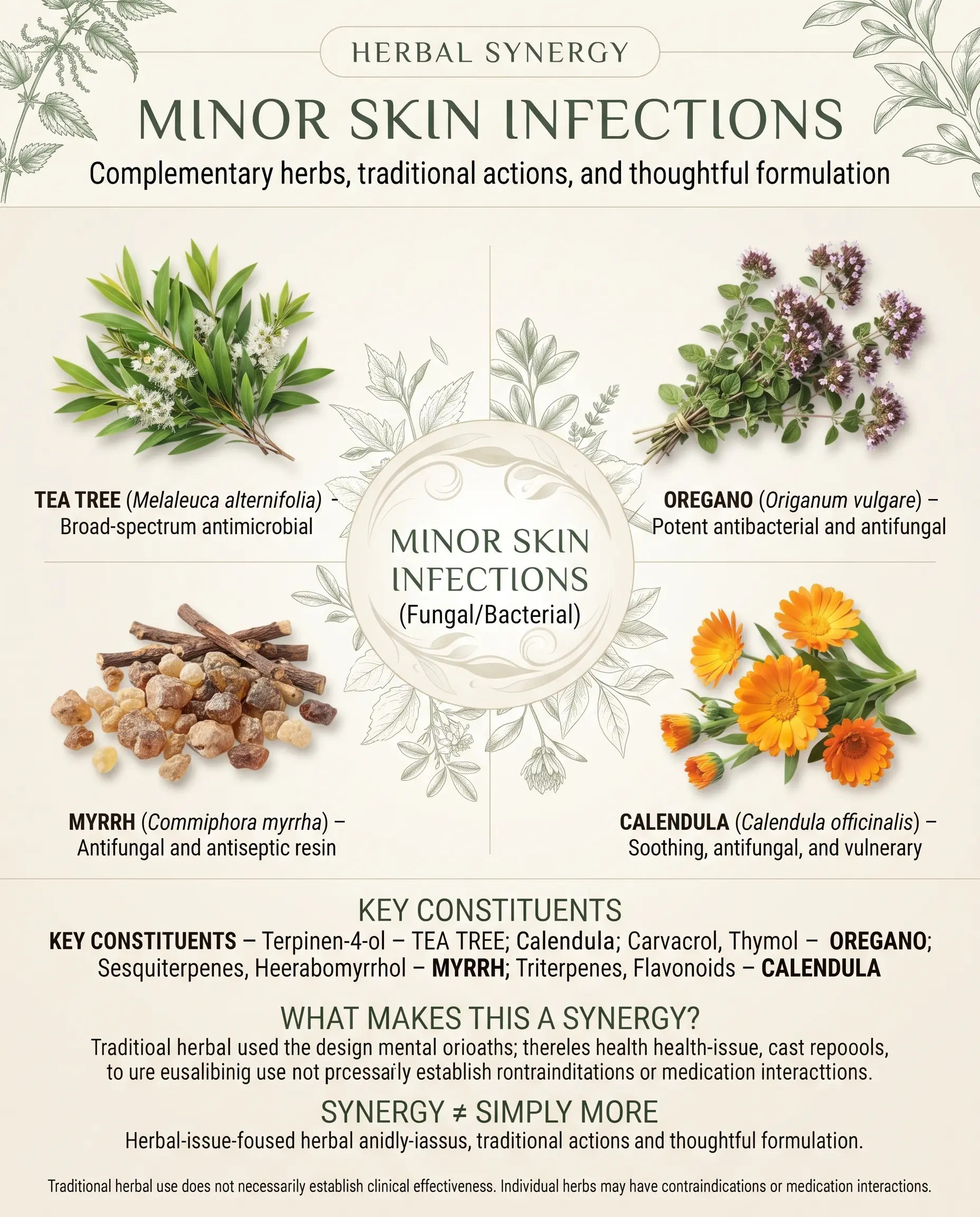
A note before we start: this article focuses specifically on minor, superficial fungal skin infections — athlete’s foot, ringworm, and similar conditions — where the evidence for herbal support is genuinely strongest. It’s not a substitute for medical care for a spreading, severe, or non-improving infection, or for infections involving the nails specifically, which are notoriously hard to treat and usually need more than topical herbal support alone.
Minor fungal skin infections (tinea — athlete’s foot, ringworm, jock itch) are actually one of the better-tested categories for a single herb in all of topical herbalism. This article leans into that specific, genuinely well-evidenced use rather than trying to cover all “skin infections” broadly.
| Herb | What It Adds |
| Tea Tree Oil | The clear evidence leader — multiple randomized trials for athlete’s foot specifically |
| Garlic | Real laboratory antifungal evidence, traditionally used topically for fungal skin concerns |
| Oregano Oil | Antifungal activity in lab studies, sometimes combined with tea tree oil in nail-focused products |
| Calendula | A gentle, traditional skin-support herb for irritation around an active fungal infection |
Tea tree oil stands well above the others here in terms of genuine human trial evidence — it’s been tested specifically for athlete’s foot in randomized, placebo-controlled trials, which is a notably higher evidence bar than most topical herbs clear. It’s worth being honest about a distinction that matters: tea tree oil’s evidence for skin-level infections like athlete’s foot is meaningfully stronger than its evidence for nail fungus, where cure rates in trials have been much more modest.
Recipe for Minor Skin Infections
Tea Tree & Calendula Antifungal Soak
Why this blend: Tea tree oil has genuine randomized trial evidence for athlete’s foot specifically, and calendula adds a gentle, soothing quality for skin that’s often irritated and cracked alongside the fungal infection itself.
Ingredients
- 5–10 drops tea tree essential oil (diluted — never applied undiluted to skin)
- 1 tbsp calendula-infused oil or 1 tbsp dried calendula flowers steeped in warm water
- 2 cups (480 ml) warm water
- 1 tbsp carrier oil (like jojoba or almond oil), if using tea tree oil directly rather than pre-diluted
Yield: One foot soak
Preparation
- If using dried calendula, steep 1 tbsp in warm water for 10 minutes, then strain and add to a foot basin of warm water.
- Dilute the tea tree oil in the carrier oil first, then add to the water — never add undiluted essential oil directly to water, since it won’t disperse evenly and can concentrate against skin.
- Soak the affected area for 15–20 minutes.
- Dry thoroughly afterward, especially between toes — this matters as much as the soak itself, since fungus thrives in moisture.
How to Use Consistency matters more than any single soak — the trials showing benefit used twice-daily application for 4 weeks, not an occasional soak.
Herbalist’s Note Thoroughly drying the skin afterward, especially between toes, is genuinely as important as the antifungal ingredients themselves — fungus needs moisture to thrive, and leaving skin damp undoes much of the benefit.
Safety Never use undiluted tea tree oil directly on skin — see the safety section below.
Ready-to-Use Products With This Synergy
NOW Foods 100% Pure Tea Tree Oil Brand: NOW Foods Key herbs: Tea tree oil (Melaleuca alternifolia) Why it fits: A pure, tested tea tree essential oil suitable for properly diluted use, reflecting the active ingredient behind the randomized trials on athlete’s foot referenced in this article. Buy: nowfoods.com
Weleda Calendula Diaper Care / Skin Cream Brand: Weleda Key herbs: Calendula extract Why it fits: A gentle calendula product for the irritated, often cracked skin that accompanies fungal infections like athlete’s foot, complementing tea tree oil’s antifungal action with genuine soothing support. Buy: weleda.com
Fungi-Nail Anti-Fungal Liquid (comparison option) Brand: Fungi-Nail Key herbs: Not herb-based (undecylenic acid, an FDA-recognized OTC antifungal) Why it fits: Included as an honest comparison point — undecylenic acid is a recognized OTC antifungal with its own evidence base, worth knowing about alongside the herbal options in this article, especially for more stubborn infections. Buy: walmart.com
Herbal Synergies for Minor Skin Infections
Not all fungal skin concerns are the same, and it’s worth matching the approach to where the evidence actually is. Athlete’s foot and similar skin-level tinea infections are where tea tree oil’s trial evidence is genuinely strong — randomized studies with real clinical response rates well above placebo. Nail fungus (onychomycosis) is a different, harder problem — tea tree oil has been tested here too, but cure rates were notably modest, and it’s worth setting realistic expectations rather than assuming skin-level evidence transfers directly to nails. And irritated, cracked skin accompanying any fungal infection is where a gentler herb like calendula adds real comfort alongside the antifungal component.
As always: synergy is about thoughtful complementarity — not simply adding more herbs to the pot.
Core Herbal Synergy Combinations
Tea Tree Oil Alone (for skin-level tinea) Best for: Athlete’s foot, ringworm, and similar skin-level fungal infections — where the evidence is strongest. Why it works: A randomized, placebo-controlled trial of 158 people with athlete’s foot found a marked clinical response in 68-72% of those using 25-50% tea tree oil solution, compared to 39% with placebo — a genuinely meaningful result, twice-daily for 4 weeks.
Tea Tree Oil + Calendula Best for: Fungal infections with accompanying skin irritation, cracking, or discomfort. Why it works: Tea tree oil addresses the fungal component with real trial support, while calendula adds gentle, traditional comfort for the often-cracked, irritated skin that comes along with conditions like athlete’s foot. This is the soak recipe above.
Tea Tree Oil (realistic expectations, for nail involvement) Best for: Early or mild nail fungus, with honest awareness of the evidence limits. Why it works, and its real limits: A well-known randomized trial found 100% tea tree oil achieved full mycological cure in only 18% of participants over 6 months, with about 56% showing some clinical improvement — comparable to an OTC antifungal cream, but neither achieved high cure rates. This is worth trying for early, mild cases, but it’s honest to say expectations should be modest, and established nail fungus often needs more than topical herbal treatment.
Garlic (topical, diluted) Best for: An alternative or complementary antifungal for those who prefer to avoid essential oils. Why it works: Garlic has real laboratory antifungal activity and a long traditional use for topical fungal concerns, though it lacks the same level of human trial testing that tea tree oil has for this specific use — always diluted, never applied raw and undiluted given real risk of skin irritation or burns.
Herbs Used in These Synergies
Tea Tree Oil Botanical name: Melaleuca alternifolia Traditional actions: Topical antifungal, antimicrobial (never internal) Role in the synergy: The best-evidenced herb in this entire article — multiple randomized, placebo-controlled human trials support its use for athlete’s foot specifically, with real clinical response rates well above placebo, though nail fungus evidence is considerably more modest. Key constituents: Terpinen-4-ol
Calendula Botanical name: Calendula officinalis Traditional actions: Traditional skin-soothing herb Role in the synergy: A gentle, traditional support herb for the irritated, cracked skin that often accompanies fungal infections, complementing tea tree oil’s antifungal action rather than addressing the fungus itself. Key constituents: Triterpenoids, flavonoids
Garlic Botanical name: Allium sativum Traditional actions: Traditional topical antifungal Role in the synergy: Real laboratory antifungal evidence and long traditional topical use, though with less human clinical trial support for skin fungal infections specifically than tea tree oil. Key constituents: Allicin
Oregano Oil Botanical name: Origanum vulgare Traditional actions: Topical antimicrobial Role in the synergy: Shows antifungal activity in laboratory studies and is sometimes combined with tea tree oil in nail-focused topical products, though it’s generally considered a complementary addition rather than a primary evidence-driven choice on its own. Key constituents: Carvacrol, thymol
Safety and When to Seek Medical Advice
This section matters more than usual for this topic. Please read it in full.
Never use undiluted essential oils directly on skin. Full-strength tea tree oil, garlic, or oregano oil can cause real irritation, contact dermatitis, or even chemical burns, especially on already-compromised skin. Always dilute in a carrier oil or as part of a properly formulated product.
Use Caution If:
- You have sensitive skin or eczema — tea tree oil can be irritating in these situations; patch test on a small area first
- You’re pregnant or breastfeeding — check with a provider before regular use of concentrated essential oils
- The infection is on your face, near your eyes, or on genital skin — these areas are more sensitive and may need a gentler approach or medical guidance
- You have diabetes or a compromised immune system — fungal skin infections can be more persistent and higher-risk in these situations, and deserve a lower threshold for medical evaluation
- You’re treating a child — dilute more conservatively and check with a pediatrician, especially for young children
See a Healthcare Professional If: The infection is spreading, doesn’t improve after 2-4 weeks of consistent treatment, involves the nails significantly, or comes with increasing pain, swelling, warmth, redness, or discharge (which can indicate a secondary bacterial infection on top of the fungal one). Also see a provider if you have diabetes, since foot infections in particular deserve closer monitoring. Widespread ringworm, infections in multiple areas, or anything not responding to consistent home care is worth a proper diagnosis and, likely, prescription antifungal treatment — which is generally very effective.
Q&A
Does tea tree oil actually work for athlete’s foot? Yes, genuinely — a randomized, placebo-controlled trial of 158 people found a marked clinical response in about 68-72% of those using tea tree oil, compared to 39% with placebo. This is real, meaningful evidence, not just tradition.
What about tea tree oil for nail fungus? The evidence here is much more modest — a well-known trial found only 18% achieved full mycological cure over 6 months, comparable to an OTC antifungal cream but not a high bar. It’s reasonable to try for mild, early nail involvement, but keep expectations realistic and don’t hesitate to move to prescription treatment if it’s not working after several months.
Can I use tea tree oil straight from the bottle? No — always dilute it first. Undiluted tea tree oil can cause skin irritation or worse, and this is one of the more important safety points in this entire article.
Why does drying my feet matter as much as the antifungal treatment? Because fungus needs moisture to thrive. Even a genuinely effective antifungal ingredient works against you if the skin stays damp afterward — thorough drying, especially between toes, is a real, evidence-aligned part of treatment, not just a suggestion.
How long should I try herbal treatment before switching to something else? The trials behind tea tree oil’s evidence used 4 weeks of consistent, twice-daily treatment for skin-level infections. If you’re not seeing improvement after that, or after several months for nail involvement, it’s reasonable to move to a prescription antifungal or see a healthcare provider.
Is garlic as good as tea tree oil for fungal skin infections? It has real laboratory evidence, but nowhere near the human clinical trial support that tea tree oil has for this specific use. It’s a reasonable complementary or alternative option, not necessarily an equally well-proven one.
When should I see a doctor instead of trying herbs? If the infection is spreading, not improving after several weeks, involves the nails significantly, or shows signs of a secondary bacterial infection (increasing pain, swelling, warmth, discharge) — those need proper medical evaluation and likely prescription treatment.
References
Evaluation of the Therapeutic Efficacy of Tea Tree Oil in Treatment of Onychomycosis – ResearchGate
Tea Tree Oil for Nail Fungus: How-To, Effectiveness, Safety – Healthline
Disclaimer
This article is for educational and informational purposes only and covers minor, superficial fungal skin infections. It is not intended to diagnose, treat, cure, or prevent any condition, and it is not a substitute for medical care for a spreading, severe, or non-improving infection, or for infections in people with diabetes or a compromised immune system. Herbs and essential oils are biologically active and may interact with medications, irritate skin, or be inappropriate for some people. If you are pregnant, breastfeeding, taking medication, managing a health condition, or an infection isn’t improving with consistent care, consult a qualified healthcare professional rather than relying on herbal preparations alone.
Available Herbal Products
Explore and shop ready-made products offering this benefit.