

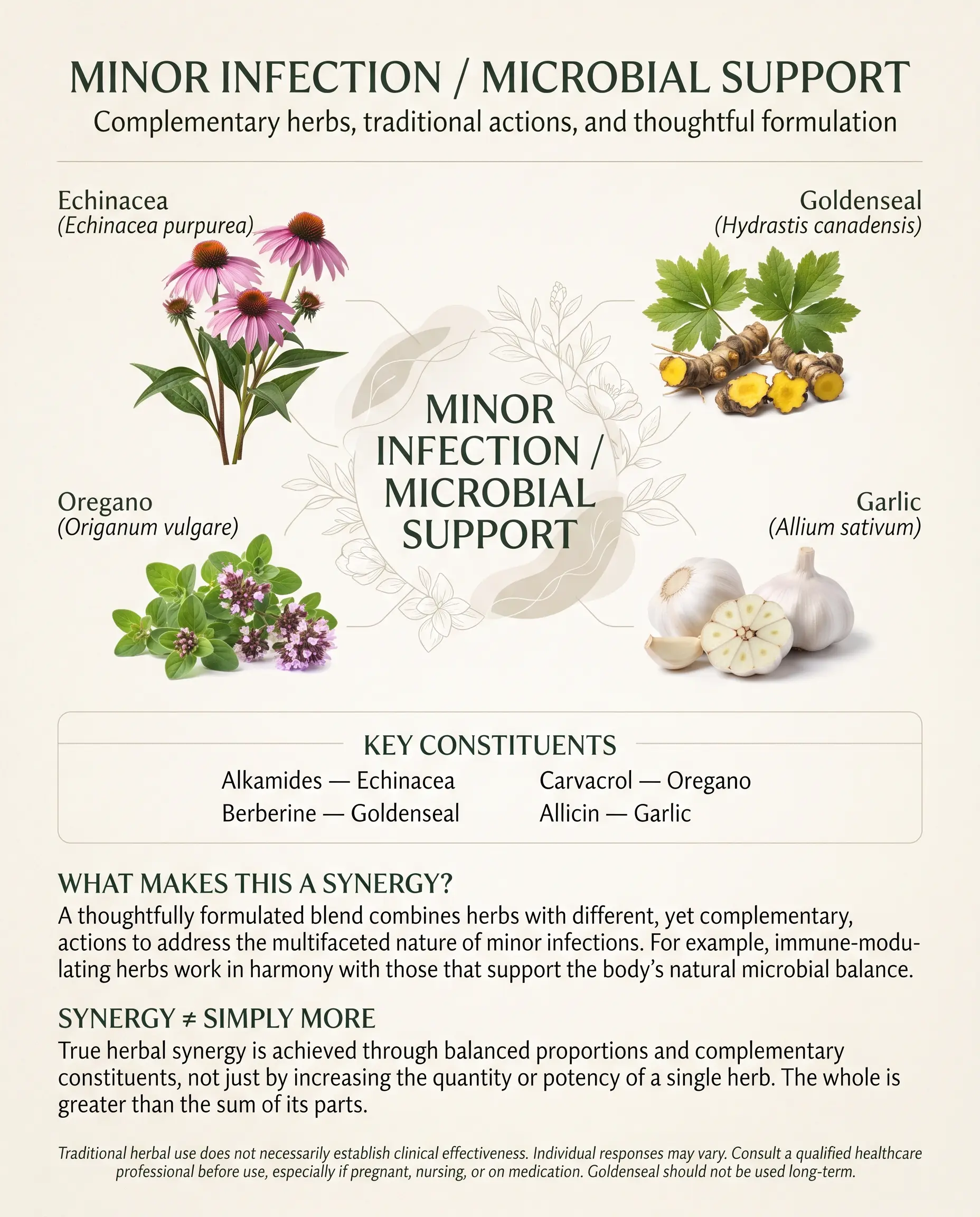
A note before we start: this article covers topical support for truly minor skin concerns — a small cut or scrape at risk of infection, minor skin irritation. It is not guidance for treating a confirmed infection, and it’s not a substitute for antibiotics when they’re genuinely needed. Internal infections, urinary tract infections, and anything showing signs of spreading (covered in the safety section below) need medical evaluation, not herbal self-treatment. Please read that section before using anything here.
For minor skin-level concerns, herbal and food-based antimicrobials work through genuinely different mechanisms — some create an environment hostile to bacteria, some physically protect the area while it heals, and it’s worth knowing which have real clinical evidence behind them versus which are mostly preclinical.
| Herb/Substance | What It Adds |
| Medical-Grade Manuka Honey | The clear evidence leader — real randomized trials in wound care, used in hospitals |
| Tea Tree Oil (diluted, topical only) | Genuine antimicrobial evidence, but with real toxicity risk if used incorrectly |
| Garlic | Strong laboratory antimicrobial evidence, though direct clinical trials on skin use are limited |
| Calendula | Traditional wound-support herb, gentle enough for sensitive or broken skin |
Medical-grade Manuka honey stands well above the others here in terms of real, hospital-grade clinical evidence — it’s genuinely used in wound care settings, not just home remedies. Tea tree oil has real antimicrobial activity but needs to be handled carefully given its toxicity if used incorrectly. Garlic’s antimicrobial properties are well documented in the lab, though evidence for topical skin use specifically is thinner. Calendula rounds things out as the gentlest option for general skin support during healing.
Recipe for Minor Infection / Microbial Support
Calendula & Manuka Honey Skin Support
Why this blend: Medical-grade Manuka honey has genuine clinical evidence for supporting minor wound care, and calendula adds a gentle, traditional skin-soothing quality — a simple combination for minor, already-clean skin concerns.
Ingredients
- 1 tsp medical-grade Manuka honey (not culinary honey — see note below)
- 1 tbsp strong calendula infusion (steep 1 tbsp dried calendula in ¼ cup hot water for 15 minutes, then cool)
Yield: Enough for one application
Preparation
- Prepare the calendula infusion and let it cool completely.
- Mix a small amount of the cooled infusion with the Manuka honey to create a spreadable consistency.
- Apply a thin layer to clean, minor, unbroken or superficially broken skin.
- Cover with a clean bandage if the area needs protection.
How to Use Apply once or twice daily to a minor, already-clean area, changing any covering regularly. This is for surface-level support, not a treatment for an actual infection.
Herbalist’s Note Culinary honey from the grocery store isn’t the same as medical-grade honey — it isn’t sterilized to the same standard, so use a product specifically labeled medical-grade for anything applied to skin.
Safety This is for minor, superficial skin concerns only — see the safety section below for signs that need medical attention instead.
Ready-to-Use Products With This Synergy
Medihoney Antibacterial Wound Gel Brand: Medihoney Key herbs: Medical-grade Manuka honey (UMF 15+) Why it fits: This is genuine medical-grade honey, the exact type used in the hospital-based clinical trials referenced in this article, FDA-cleared and appropriate for minor cuts, scrapes, and burns. Buy: getmedihoney.com
TheraHoney Honey Wound Gel Brand: Medline Key herbs: Sterile, medical-grade Manuka honey Why it fits: Another genuine medical-grade honey product, specifically labeled appropriate for minor abrasions, cuts, and scalds in addition to more significant clinical wound care. Buy: medline.com
Weleda Calendula Baby Cream Brand: Weleda Key herbs: Calendula extract Why it fits: A gentle, well-established calendula product suitable for sensitive or irritated skin, complementing the honey’s antimicrobial action with traditional soothing support. Buy: weleda.com
Herbal Synergies for Minor Infection / Microbial Support
Not all minor skin concerns call for the same approach. A small, clean scrape that just needs support while it heals is where medical-grade honey and calendula fit well — gentle, well-tolerated, genuinely evidenced for minor wound care. Skin that’s more actively irritated or where a slightly stronger antimicrobial approach feels warranted is where properly diluted tea tree oil comes in, used carefully and briefly. And it’s worth being honest that most of what’s discussed here is preventive and supportive — helping a minor issue heal cleanly — rather than a treatment for something that’s already become a real infection.
As always: synergy is about thoughtful complementarity — not simply adding more herbs to the pot, and never a substitute for medical care when it’s genuinely needed.
Core Herbal Synergy Combinations
Medical-Grade Manuka Honey + Calendula Best for: General support for a minor, clean cut or scrape while it heals. Why it works: Medical-grade honey has real randomized clinical trial evidence — including reduced bacterial load and faster healing in wound care settings — while calendula adds a gentle, traditional soothing quality appropriate even for sensitive skin. This is the recipe above.
Diluted Tea Tree Oil (topical only) Best for: Minor skin blemishes or areas where a targeted antimicrobial approach is wanted, used briefly. Why it works: Tea tree oil has genuine, well-documented antimicrobial activity against a broad range of skin bacteria, effective at concentrations as low as 1%. It’s a fundamentally different, more concentrated approach than the gentler honey-and-calendula combination — appropriate for targeted use, not broad daily application, and never at full strength.
Medical-Grade Manuka Honey Alone Best for: The single most evidence-backed option, especially for something you want the best-supported choice for. Why it works: This is genuinely hospital-grade evidence, not just traditional use — randomized controlled trials have shown medical-grade honey reduces bacterial load and speeds healing across various wound types, and it’s used as an adjunct treatment for antibiotic-resistant infections in real clinical settings.
Calendula Alone Best for: Very sensitive skin, or general soothing support without a stronger antimicrobial component. Why it works: The gentlest option here, appropriate for skin that’s simply irritated rather than at meaningful infection risk — a good starting point before considering anything more targeted.
Herbs Used in These Synergies
Medical-Grade Manuka Honey Not a traditional herb (a specially processed honey from Leptospermum scoparium nectar) Traditional actions: Not applicable — this is a modern, clinically-developed wound care product derived from a traditional remedy Role in the synergy: The clear evidence leader in this article — randomized controlled trials have shown reduced bacterial load, faster healing, and effectiveness against antibiotic-resistant bacteria including MRSA, with medical-grade formulations used in hospitals worldwide. Key constituents: Methylglyoxal, hydrogen peroxide (generated by glucose oxidase), high sugar content creating osmotic antibacterial effect
Tea Tree Oil Botanical name: Melaleuca alternifolia Traditional actions: Topical antimicrobial (never internal) Role in the synergy: Has genuine, well-documented antibacterial activity at low concentrations against a broad range of skin bacteria, but carries real toxicity risk if ingested or used undiluted — see safety section. Key constituents: Terpinen-4-ol
Garlic Botanical name: Allium sativum Traditional actions: Traditional antimicrobial Role in the synergy: Strong laboratory (in vitro) evidence for antimicrobial activity against a range of bacteria, though direct clinical trials specifically for topical skin use are limited — worth knowing this is stronger lab evidence than clinical evidence. Key constituents: Allicin
Calendula Botanical name: Calendula officinalis Traditional actions: Traditional wound-support herb, gentle Role in the synergy: A long-standing traditional herb for skin support, gentle enough for sensitive or already-irritated skin, complementing stronger antimicrobial options with a soothing quality. Key constituents: Triterpenoids, flavonoids, carotenoids
Safety and When to Seek Medical Advice
This section matters more than usual for this topic. Please read it in full.
Never ingest tea tree oil. It is toxic if swallowed, even in small amounts, and can cause serious symptoms including confusion, difficulty walking, and coma. It’s for topical use only, always diluted (commonly to around 1% or less for skin use), and never applied near the eyes or on infants without professional guidance.
Use Caution If:
- You’re applying anything to broken skin — dilute tea tree oil appropriately and never apply it at full strength to an open wound; it can be toxic to healing tissue at high concentrations
- You’re considering raw garlic applied directly to skin — undiluted garlic can cause chemical burns with prolonged skin contact; this is a real, documented risk, not a minor caution
- You’re allergic to bees or bee products — avoid honey-based wound products
- You’re allergic to ragweed, daisies, or related plants — calendula and tea tree (Myrtaceae family, though a different family than ragweed) can occasionally cause reactions in sensitive individuals; patch test first
- You’re using culinary (non-medical-grade) honey on a wound — this isn’t sterilized to the same standard and isn’t appropriate for actual wound care
See a Healthcare Professional If:
- A wound shows signs of spreading infection: increasing redness, warmth, swelling, or pain; red streaking extending from the wound; pus or foul-smelling drainage; fever
- A wound isn’t improving after 2–3 days of basic care, or is getting worse
- The wound is deep, was caused by something dirty or rusty, or involves an animal or human bite
- You have diabetes, a compromised immune system, or poor circulation — any wound in these situations deserves closer monitoring and a lower threshold for medical care
- You suspect a urinary tract infection, respiratory infection, or any internal infection — these need proper diagnosis and, when appropriate, antibiotics; this article does not cover internal infections
- You haven’t had a tetanus booster in the last 5–10 years and the wound is deep or dirty
None of the herbs in this article are appropriate substitutes for antibiotics when a real infection is present.
Q&A
Is honey actually proven to help with wounds, or is that just a home remedy myth? It’s genuinely proven — but specifically medical-grade honey, not the honey in your kitchen cabinet. Randomized clinical trials have shown real reductions in bacterial load and faster healing, and medical-grade Manuka honey is used in real hospital wound care, including for antibiotic-resistant infections.
Can I use my regular jar of honey on a cut? Not ideal — culinary honey isn’t sterilized to the standard needed for wound care and can introduce contaminants. If you want to use honey on skin, look specifically for a product labeled medical-grade.
Is tea tree oil safe to use on a cut? Diluted, on unbroken or minor superficial skin, it has real antimicrobial evidence. On more significant open wounds or at full strength, it can actually be harmful to healing tissue. And it should never, under any circumstances, be swallowed.
Can I put crushed garlic directly on my skin? This is genuinely risky — undiluted garlic can cause chemical burns with prolonged contact. If you want to use garlic topically, it needs to be properly diluted in a carrier oil, not applied raw and left in place.
Does any of this work for a UTI or internal infection? No — this article covers topical, minor skin concerns only. Internal infections, including UTIs, need proper medical evaluation and often antibiotics; herbal approaches here aren’t a substitute.
How do I know if a minor cut has turned into a real infection? Watch for increasing redness, warmth, swelling, or pain; red streaking; pus; or fever. Any of those mean it’s time to see a healthcare provider, not continue with home care.
When should I see a doctor instead of trying herbs? If there are any signs of spreading infection, the wound isn’t improving after a few days, it’s deep or dirty, or you have a condition like diabetes that affects healing — those situations need medical evaluation, not ongoing herbal self-treatment.
References
Evidence Summary: Wound Management: Medical-Grade Honey – Wound Practice and Research
Tea Tree Oil as a Topical Antimicrobial Agent
Tea Tree Oil: Remedy and Poison – Poison Control
Disclaimer
This article is for educational and informational purposes only and covers topical support for minor, superficial skin concerns only. It is not intended to diagnose, treat, cure, or prevent infection, and it is not a substitute for antibiotics or medical care when a real infection is present, including internal infections such as UTIs or respiratory infections. Herbs and honey are biologically active and may interact with medications or be inappropriate for some people. If you notice any signs of spreading infection, a wound isn’t healing, or you are pregnant, breastfeeding, taking medication, or managing a health condition, consult a qualified healthcare professional rather than relying on herbal preparations alone.
Available Herbal Products
Explore and shop ready-made products offering this benefit.