

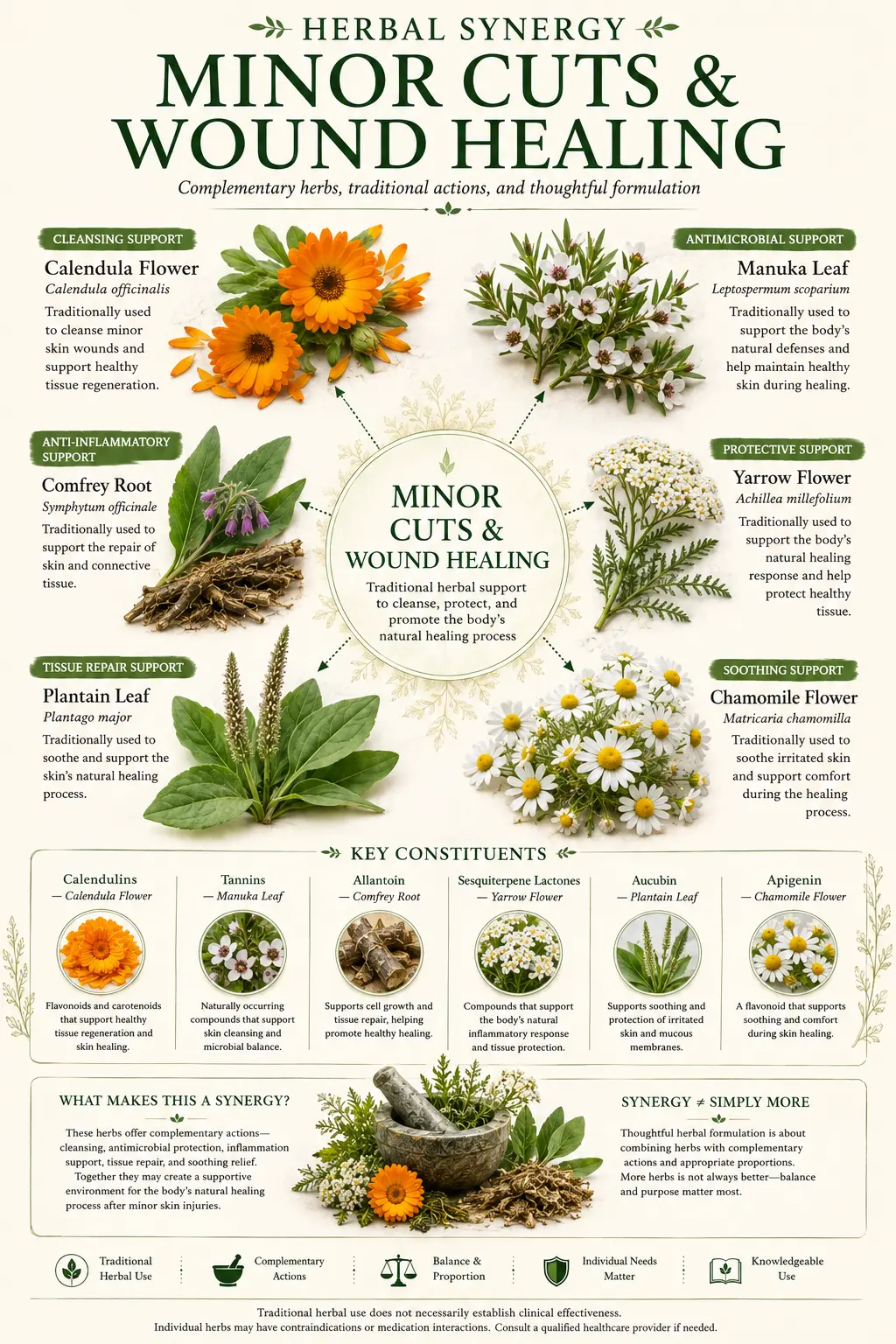
A note before we start: this article covers support for minor cuts and scrapes once bleeding has stopped and the wound is clean — the healing and tissue-repair phase, not first aid for active bleeding or a substitute for care when a wound needs it. The safety section below covers when a “minor” cut actually needs medical attention.
Once a minor cut or scrape is clean and bleeding has stopped, the focus shifts to supporting the skin’s own repair process — collagen formation, new tissue growth, and reducing the risk of a noticeable scar. This is a category with a genuinely interesting evidence story, including one important correction to common herbal advice.
| Herb | What It Adds |
| Centella Asiatica (Gotu Kola) | The clear evidence leader — real research showing it stimulates collagen synthesis and speeds wound closure |
| Calendula | A traditional wound-support herb, gentle and appropriate for actual open, healing skin |
| Aloe Vera | Cooling and moisturizing, with the most evidence specifically for burns |
| Comfrey | Genuinely effective for tissue repair — but only on unbroken skin, not actual open cuts (see below) |
Centella asiatica has the strongest direct evidence here — real research on its active compounds (asiaticoside, madecassoside) showing they genuinely stimulate collagen production and speed wound closure. Calendula is the gentlest, most broadly appropriate option for skin that’s actually open and healing. Comfrey is worth including specifically to correct a common misconception: despite its long “wound herb” reputation, current guidance restricts it to unbroken skin only — not open cuts, which is exactly what most people reach for it for.
Recipe for Minor Cuts & Wound Healing
Calendula & Centella Healing Compress
Why this blend: Calendula is a gentle, traditional wound-support herb appropriate for actual healing skin, and centella asiatica adds genuine research-backed support for collagen formation and tissue repair.
Ingredients
- 1 tbsp dried calendula flowers
- 1 tbsp dried centella asiatica (gotu kola)
- 2 cups (480 ml) hot water
Yield: Enough for 2–3 compress applications
Preparation
- Combine the calendula and centella asiatica in a heatproof bowl.
- Pour hot water over the herbs and cover.
- Steep, covered, for 15–20 minutes to make a strong infusion.
- Strain and let cool to room temperature before use.
How to Use Soak a clean, soft cloth in the cooled infusion and apply gently to the clean, minor wound for 10–15 minutes, once or twice daily while it heals. Discard any unused infusion after 24 hours.
Herbalist’s Note Centella asiatica is sometimes sold as “gotu kola” in the US — same herb, different common name, so check labels carefully if shopping for it specifically.
Safety This is for minor, already-clean wounds only — not a substitute for proper wound care if the cut is deep, dirty, or shows any sign of infection.
Ready-to-Use Products With This Synergy
La Roche-Posay Cicaplast Balm B5+ Brand: La Roche-Posay Key herbs: Centella asiatica (madecassoside) Why it fits: A widely available, dermatologist-recommended balm featuring centella asiatica’s madecassoside for general skin barrier repair — worth noting this specific product’s own label advises against use on broken skin, so it’s positioned for chapped, irritated, or already-closing skin rather than fresh open cuts. Buy: laroche-posay.us
Weleda Calendula Baby Cream Brand: Weleda Key herbs: Calendula extract Why it fits: A gentle, well-established calendula product suitable for sensitive, healing skin, including areas that are still closing. Buy: weleda.com
TOSOWOONG Madagascar Centella 70% Cream Brand: TOSOWOONG Key herbs: Centella asiatica (concentrated) Why it fits: A high-concentration centella asiatica cream for readers who want to try the herb with the strongest wound-healing evidence at a more concentrated dose than typical general-skincare formulas. Buy: amazon.com
Herbal Synergies for Minor Cuts & Wound Healing
Not every stage of healing calls for the same herb. Once a wound is clean and closed enough that skin is intact again, comfrey’s genuine tissue-repair properties become appropriate — but not before then. While a cut is still open and actively healing, calendula and centella asiatica are the better fits, since they’re appropriate for open, healing skin rather than requiring it to be fully closed first. And general scar-minimizing support, once a wound has closed, is where centella asiatica’s collagen-related evidence becomes most relevant.
As always: synergy is about thoughtful complementarity — not simply adding more herbs to the pot.
Core Herbal Synergy Combinations
Centella Asiatica + Calendula Best for: An open, minor, already-clean wound during active healing. Why it works: Centella asiatica’s active compounds have real, well-documented research showing they stimulate collagen synthesis, cell migration, and wound closure, while calendula adds a gentle, traditional soothing quality appropriate for skin that’s still healing. This is the compress recipe above.
Centella Asiatica Alone Best for: The single most evidence-backed option, especially once skin has begun to close. Why it works: This is genuinely one of the better-researched herbs in all of topical herbalism — its compounds (asiaticoside, madecassoside) have documented effects on collagen production, cell proliferation, and wound contraction, with clinical use extending to more significant wounds like diabetic ulcers and burns.
Comfrey (unbroken skin only, once closed) Best for: Later-stage healing, once the skin has closed, or for bruising and sprains rather than open cuts. Why it works: Comfrey genuinely does support tissue repair through allantoin and rosmarinic acid — but current safety guidance specifically restricts it to intact, unbroken skin, generally for no more than 4-6 weeks. This makes it a poor fit for an actual open cut and a better fit once skin has closed, or for bruises and sprains where skin was never broken in the first place.
Aloe Vera + Calendula Best for: Minor scrapes with some heat or irritation involved, like a mild rug burn or minor abrasion. Why it works: Aloe’s cooling, moisturizing quality (with its best evidence specifically for burns) pairs with calendula’s gentle wound-support tradition — a soothing combination for irritated, minor abrasions.
Herbs Used in These Synergies
Centella Asiatica (Gotu Kola) Botanical name: Centella asiatica Traditional actions: Traditional wound-healer (Ayurvedic and traditional Chinese medicine) Role in the synergy: The best-evidenced herb in this article — research has identified specific active compounds (asiaticoside, madecassoside, asiatic acid) that stimulate collagen synthesis, reduce inflammatory markers, and speed cell migration and wound closure, with clinical applications extending to diabetic ulcers and burns. Key constituents: Triterpenoid saponins (asiaticoside, madecassoside, asiatic acid, madecassic acid)
Calendula Botanical name: Calendula officinalis Traditional actions: Traditional wound-support herb Role in the synergy: A gentle, long-standing traditional herb appropriate specifically for open, healing skin — unlike comfrey, calendula doesn’t carry the same restriction and is widely used on actual wounds, not just intact skin. Key constituents: Triterpenoids, flavonoids, carotenoids
Comfrey Botanical name: Symphytum officinale Traditional actions: Traditional tissue-repair herb (“knitbone”) Role in the synergy: Genuinely effective for tissue repair through allantoin and rosmarinic acid, but current regulatory guidance (including from European medical authorities) restricts topical use to unbroken skin only, due to pyrrolizidine alkaloids that absorb more readily through broken skin — an important correction to comfrey’s popular reputation as an open-wound herb. Key constituents: Allantoin, rosmarinic acid, mucilage (also contains pyrrolizidine alkaloids, which is the source of its restrictions)
Aloe Vera Botanical name: Aloe vera (syn. Aloe barbadensis) Traditional actions: Cooling, moisturizing Role in the synergy: Best evidence is specifically for minor burns rather than cuts generally, where some trials found faster healing compared to standard care — a good complementary option when heat or a burn-like quality is part of the injury. Key constituents: Polysaccharides (acemannan), glycoproteins
Safety and When to Seek Medical Advice
Use Caution If:
- You’re considering comfrey for an actual open cut — don’t. Current safety guidance restricts topical comfrey to unbroken, intact skin only, due to pyrrolizidine alkaloids that can be absorbed more readily through broken skin; save it for bruises, sprains, or use once skin has fully closed
- You’re allergic to ragweed, daisies, or related plants — calendula and centella asiatica (part of the carrot/parsley family) can occasionally cause reactions in sensitive people; patch test first
- The wound is on a young infant — check with a pediatrician before using any concentrated herbal product, even generally gentle ones like calendula
- You’re using a comfrey product on skin — never apply near the eyes, never on broken skin, and never take comfrey internally in any form
- You have a known sensitivity to any topical botanical — always patch-test a small area 24 hours before wider use
See a Healthcare Professional If: The wound is deep, gaping, or might need stitches; shows any signs of infection (increasing redness, warmth, swelling, pus, red streaking, fever); was caused by something dirty, rusty, or by an animal or human bite; or isn’t healing normally after a week or two. You haven’t had a tetanus booster in the last 5–10 years and the wound is deep or dirty. These situations need proper medical evaluation and care, not ongoing herbal support alone.
Q&A
What’s the best-evidenced herb for wound healing here? Centella asiatica, clearly — its active compounds have well-documented research showing real effects on collagen synthesis and wound closure, with clinical use extending well beyond home remedies into treatment for diabetic ulcers and burns.
Isn’t comfrey supposed to be the classic wound-healing herb? It’s genuinely effective for tissue repair, but current safety guidance specifically restricts it to unbroken skin — not actual open cuts, which is exactly what most people assume it’s for. This is a common misconception worth correcting: use calendula or centella asiatica on an actual open wound, and save comfrey for bruises, sprains, or skin that’s already closed.
When should I switch from calendula/centella to comfrey? Once the wound has actually closed and new skin has formed over it — comfrey’s tissue-repair benefits are best used at that later stage, or for injuries where skin was never broken (bruises, sprains) in the first place.
Can I use these on a child’s scraped knee? Calendula is generally considered gentle enough for children, but check with a pediatrician for use on infants specifically, and avoid comfrey on any child’s open wound given the same broken-skin restriction that applies to adults.
Will centella asiatica actually reduce scarring? There’s genuine research support for this — its effect on collagen synthesis and cell migration is part of why it’s used clinically for wound healing and is a common ingredient in scar-focused skincare products.
Which combination is gentlest? Calendula alone, or calendula with aloe vera — both are broadly well-tolerated and appropriate for sensitive skin during healing.
When should I see a doctor instead of trying herbs? If the wound is deep, might need stitches, shows any sign of infection, resulted from something dirty or a bite, or isn’t healing after a week or two — those need medical evaluation, not continued herbal care.
References
Centella Asiatica for Skin: The Ancient Herb With Modern Clinical Evidence
Comfrey – LiverTox, NCBI Bookshelf
Comfrey: Overview, Uses, Side Effects, Precautions, Interactions – WebMD
Effect of Aloe Vera Gel on Healing of Burn Wound: A Clinical and Histologic Study – PubMed
Disclaimer
This article is for educational and informational purposes only and covers support for minor, already-clean cuts and scrapes during the healing phase. It is not intended to diagnose, treat, cure, or prevent any condition, and it is not a substitute for proper wound care or medical attention when a wound needs it. Herbs are biologically active and may interact with medications or be inappropriate for some people. If you notice signs of infection, the wound is deep or hasn’t healed normally, or you are pregnant, breastfeeding, taking medication, or managing a health condition, consult a qualified healthcare professional rather than relying on herbal preparations alone.
Available Herbal Products
Explore and shop ready-made products offering this benefit.