

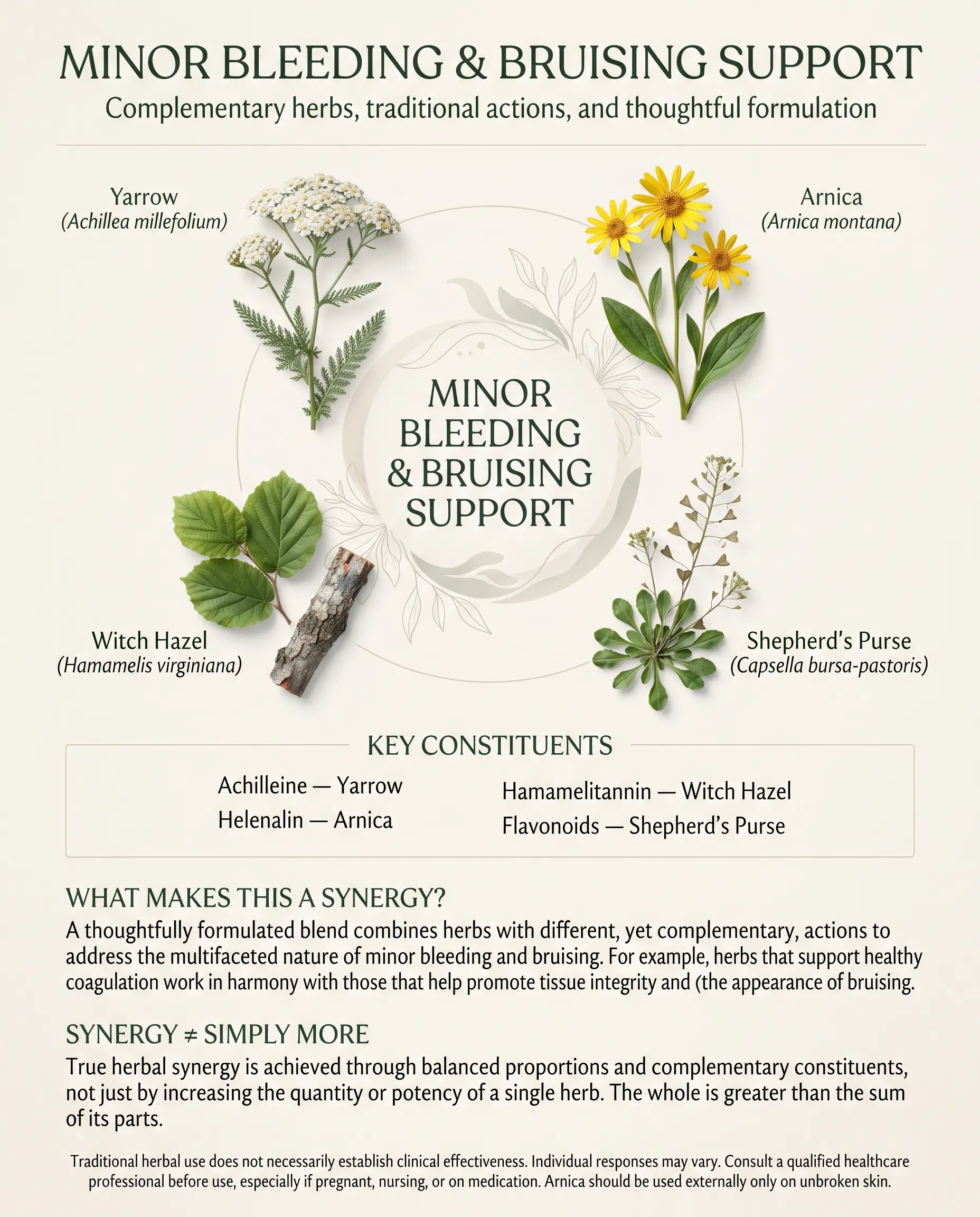
Minor bruising and minor bleeding are actually two different problems that call for different support. A bruise is blood already trapped under the skin, which needs help being reabsorbed and cleared. A small cut or scrape is active, ongoing bleeding that needs help clotting, plus support for the skin afterward. Different herbs are suited to each.
| Herb | What It Adds |
| Arnica (topical) | The best-evidenced option for bruising specifically — helps speed up how quickly a bruise fades |
| Vitamin K (topical) | Genuine trial support for hastening bruise resolution, often paired with arnica in commercial products |
| Yarrow | A traditional styptic used to help minor bleeding, though this is tradition, not clinical trial evidence |
| Witch Hazel | A traditional astringent used to tone and tighten skin around minor cuts and bruises |
Arnica and vitamin K address bruising specifically, with real (if modest) trial support behind the combination. Yarrow and witch hazel are more oriented toward active minor bleeding and general skin first aid, and it’s worth being upfront that their evidence is traditional rather than clinical-trial-based — still widely used, just not the same evidence tier as the bruising pair.
Recipe for Minor Bleeding & Bruising Support
Witch Hazel & Arnica Bruise Compress
Why this blend: Witch hazel’s astringent, tannin-rich properties are traditionally used to tone skin and reduce swelling, and arnica has genuine (if modest) trial support for helping a bruise resolve faster — a simple topical compress rather than anything taken internally.
Ingredients
- 2 tbsp witch hazel extract (distilled, alcohol-free is gentlest)
- 1 tsp arnica-infused oil or a small amount of arnica gel
- A clean soft cloth
Yield: Enough for one compress application
Preparation
- Combine the witch hazel and arnica oil in a small bowl.
- Soak a clean cloth in the mixture.
- Apply gently to the bruised area — never to broken skin — for 10–15 minutes.
- Repeat up to 2–3 times a day while the bruise is visible.
How to Use This is for bruised, unbroken skin only. Apply gently — don’t press hard on a fresh bruise, which can be uncomfortable and doesn’t speed anything up.
Herbalist’s Note The trial evidence for arnica and bruising is genuinely more consistent than for arnica and muscle pain — this is one of arnica’s better-supported uses.
Safety Never apply arnica to broken skin, and never take arnica internally in anything other than a properly diluted homeopathic form — the plant is toxic if ingested in concentrated form.
Ready-to-Use Products With This Synergy
VitaMedica Arnica + K Cream Brand: VitaMedica Key herbs: Arnica montana, vitamin K, vitamin C, botanicals Why it fits: This is very close to an exact match for the arnica-and-vitamin-K pairing with genuine trial support for bruise resolution, formulated specifically for post-procedure and injury bruising. Buy: vitamedica.com
Boiron Arnicare Gel Brand: Boiron Key herbs: Arnica montana Why it fits: A simple, single-ingredient topical arnica gel for bruising and minor swelling, non-greasy and fragrance-free. Buy: walmart.com
Thayers Original Witch Hazel Astringent Brand: Thayers Key herbs: Witch hazel (non-distilled, certified organic) Why it fits: A widely available, gentle witch hazel astringent that can be used on a clean cloth as a soothing compress for bruised or irritated skin. Buy: thayers.com
Herbal Synergies for Minor Bleeding & Bruising Support
Bruising and active minor bleeding call for genuinely different approaches. A bruise — blood already under the skin — benefits from arnica and vitamin K, applied once bleeding has already stopped and the skin is intact. Active minor bleeding from a small cut or scrape is a different situation entirely: the first and most important response is always clean the area and apply firm, direct pressure with a clean cloth or gauze. Herbal support, where used at all, comes after that, not instead of it.
As always: synergy is about thoughtful complementarity — not simply adding more herbs to the pot, and never a substitute for basic first aid.
Core Herbal Synergy Combinations
Arnica + Vitamin K (topical) Best for: A bruise that’s already formed, on unbroken skin. Why it works: This is the combination with the most genuine trial support in this article — a randomized study comparing topical vitamin K, vitamin K with retinol, arnica, and plain petrolatum on laser-induced bruising found both arnica and vitamin K performed better than the plain control. This is the compress recipe above.
Witch Hazel + Clean Technique Best for: General care around a minor cut or scrape after bleeding has stopped. Why it works: Witch hazel’s traditional astringent, tannin-based action is commonly used to help tone and soothe the skin around a healing minor wound — worth pairing with basic clean-wound-care principles rather than treating it as a bleeding-control herb on its own.
Yarrow (traditional use only) Best for: Historical and traditional first-aid reference — included here for completeness, with an important caveat. Why it works: Yarrow has a long folk history as a styptic — an herb traditionally packed onto a wound to help slow bleeding. That tradition is genuine and long-standing. But it’s worth being direct: there’s no modern clinical trial evidence confirming this works in humans, and current wound-care guidance generally favors clean technique and direct pressure over introducing any plant material into an open wound, however small. We’re including yarrow here for informational completeness, not as a practical recommendation over standard first aid.
Herbs Used in These Synergies
Arnica Botanical name: Arnica montana Traditional actions: Traditional anti-inflammatory, used for bruising (topical only) Role in the synergy: The best-evidenced herb in this article for its specific use — a randomized trial on laser-induced bruising found topical arnica performed comparably to topical vitamin K in speeding bruise resolution, both outperforming a plain petrolatum control. Key constituents: Sesquiterpene lactones, flavonoids
Vitamin K (topical) Not a botanical (a vitamin, included here because it’s so frequently paired with arnica in bruise-care products) Traditional actions: Not applicable — this is a nutrient, not an herb Role in the synergy: Genuine trial support for hastening the resolution of bruising when applied topically, which is why it appears alongside arnica in most commercial bruise-care formulas. Key constituents: Phytonadione (vitamin K1)
Witch Hazel Botanical name: Hamamelis virginiana Traditional actions: Astringent, traditionally soothing Role in the synergy: A long-standing traditional skin-care herb, valued for its tannin content, used to tone and soothe skin around minor bruises and healed cuts — genuinely useful for general skin comfort, though not itself a bleeding-control agent. Key constituents: Tannins
Yarrow Botanical name: Achillea millefolium Traditional actions: Traditional styptic (folk use only — no clinical trial confirmation) Role in the synergy: Included for informational completeness given its long traditional reputation, but its use here is explicitly flagged as tradition rather than evidence — see the caution above. Key constituents: Achilleine, tannins, sesquiterpene lactones
Safety and When to Seek Medical Advice
This section matters more than usual for this topic. Please read it in full.
Use Caution If:
- You’re allergic to ragweed, daisies, or related plants — arnica and yarrow are both part of this plant family
- You have any bleeding disorder, or take blood-thinning medication — do not rely on any herbal styptic for bleeding control; seek medical guidance for wound care instead
- The skin is broken — never apply arnica directly to an open wound; it’s for intact, bruised skin only, and can cause irritation or worse on broken skin
- You’re pregnant or breastfeeding — arnica isn’t recommended internally, and topical use in pregnancy should be discussed with a provider
- The bruise appears without a clear cause, is unusually large, or bruising happens easily and frequently — this can be worth mentioning to a doctor, since it’s occasionally a sign of something that needs medical evaluation rather than home care
See a Healthcare Professional or Emergency Care Immediately If:
- Bleeding doesn’t stop after 10 minutes of firm, direct pressure
- The wound is deep, gaping, or was caused by something that could have left debris in it
- The cut is on the face, over a joint, or is large enough that it might need stitches
- There are signs of infection developing (increasing redness, warmth, swelling, pus, fever)
- Bruising is unexplained, unusually severe, or the person is on blood thinners
- Any bleeding involves a young child, an older adult, or anyone with a known bleeding or clotting disorder
None of the herbs in this article are a substitute for these situations. Herbal support here is genuinely limited to minor, everyday skin bruising and small, already-controlled cuts and scrapes.
Q&A
Does arnica actually help bruises heal faster? There’s real, if modest, trial evidence — a study on laser-induced bruising found topical arnica performed comparably to topical vitamin K in speeding up bruise resolution, both better than a plain control. It’s one of arnica’s more solidly supported uses.
Is yarrow actually proven to stop bleeding? No — it’s a long-standing traditional remedy, but there’s no clinical trial evidence confirming it in humans. We included it for completeness, but modern first aid (clean wound, firm direct pressure) is the actual evidence-based response for minor bleeding.
Can I put arnica directly on a cut? No — arnica is for bruised, unbroken skin only. Applying it to an open wound isn’t appropriate and can cause irritation.
What should I actually do first if I get a small cut? Clean the area, then apply firm, direct pressure with a clean cloth for several minutes. That’s the real first response — herbs, if used at all, come after bleeding has stopped, as part of general skin care.
Can I take arnica internally for bruising? Only in a properly diluted homeopathic form, if at all — concentrated arnica is toxic if ingested. Topical use on unbroken, bruised skin is the appropriate route for the herb itself.
Is witch hazel safe for everyday use? Yes, it’s a very gentle, widely used astringent, appropriate for general skin care around healed minor cuts or scrapes and for soothing bruised skin.
When should I see a doctor instead of using these herbs? If bleeding doesn’t stop with 10 minutes of pressure, the wound is deep or gaping, there are signs of infection, or bruising is unexplained or unusually severe — those need medical attention, not herbal home care.
- This article covers herbal support for truly minor skin-level issues — small cuts, scrapes, shaving nicks, and everyday bruises. It is not guidance for anything beyond that. For any bleeding that doesn’t stop within about 10 minutes of firm direct pressure, any deep or gaping wound, or bleeding in someone with a bleeding disorder or on blood-thinning medication, stop reading this and get medical care instead. The safety section above covers this in more detail.
References
Arnica – Memorial Sloan Kettering Cancer Center
Disclaimer
This article is for educational and informational purposes only and covers minor, superficial skin bruising and small, already-controlled cuts and scrapes only. It is not intended to diagnose, treat, cure, or prevent any condition, and it is not a substitute for first aid training or emergency medical care. Herbs are biologically active and may interact with medications or be inappropriate for some people. If bleeding does not stop with direct pressure, if a wound is deep or serious, or if you are pregnant, breastfeeding, taking medication, or managing a health condition, consult a qualified healthcare professional or seek emergency care rather than relying on herbal preparations.
Available Herbal Products
Explore and shop ready-made products offering this benefit.