

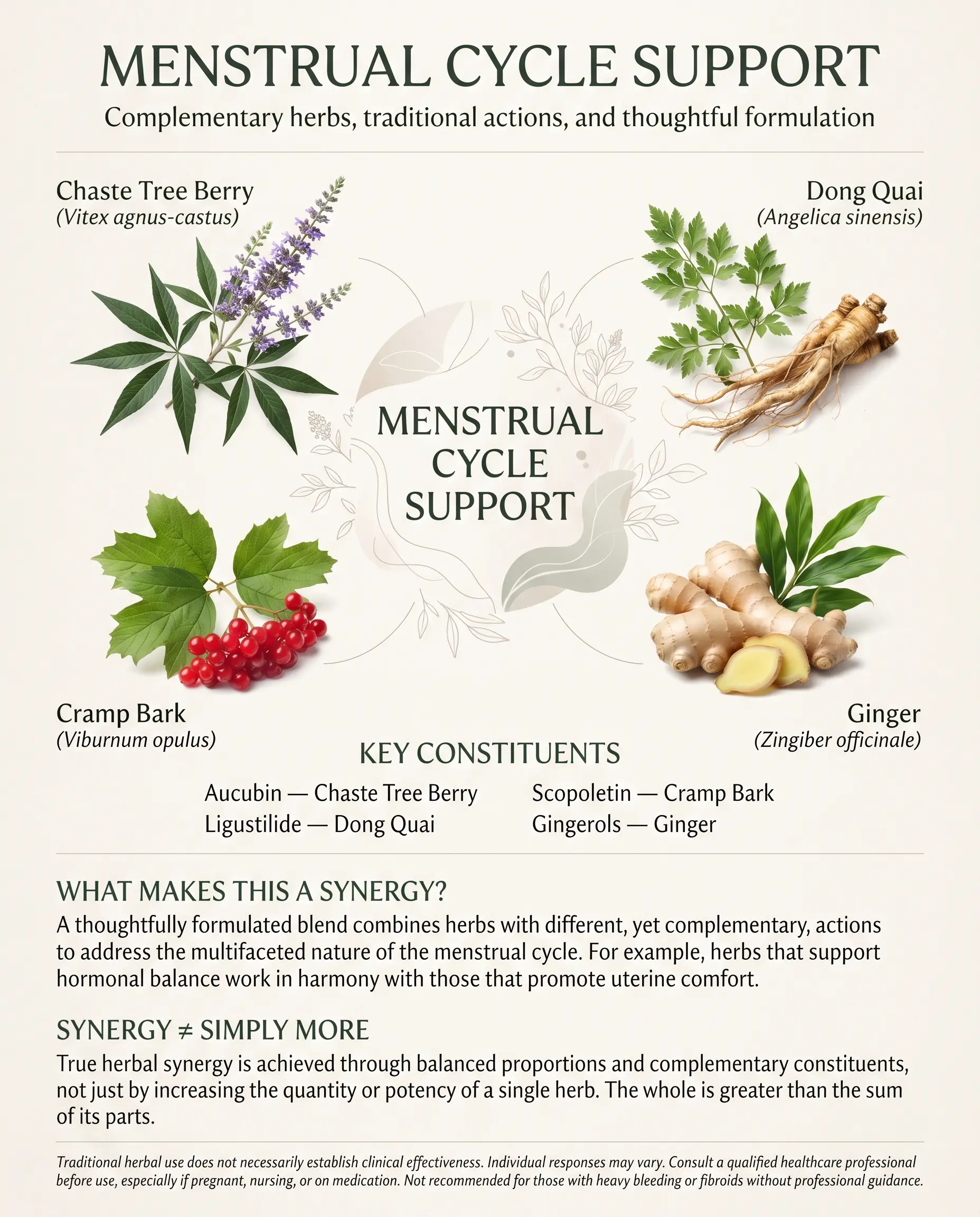
Menstrual cycle discomfort isn’t one thing — PMS mood and physical symptoms happen in the days before a period, while cramping happens once it starts. Different herbs are suited to each phase, and this is a category with a real split in evidence quality worth knowing about upfront.
| Herb | What It Adds |
| Chasteberry (Vitex) | The best-evidenced herb here for PMS symptoms specifically, taken daily throughout the cycle |
| Ginger | Genuinely comparable to NSAIDs in trials for menstrual cramp pain, taken during the first few days of bleeding |
| Cramp Bark | A traditional antispasmodic for uterine cramping, though it lacks human clinical trials |
| Raspberry Leaf | A traditional uterine tonic, also with limited formal research but a long history of use |
Chasteberry addresses the PMS phase — mood, irritability, breast tenderness — taken continuously, not just when symptoms hit. Ginger is for the cramping phase specifically, with evidence strong enough to rival standard pain relievers. Cramp bark and raspberry leaf are worth including for completeness, but it’s honest to say they lean much more on tradition than on clinical trials.
Recipe for Menstrual Cycle Support
Ginger & Cramp Bark Cramp Relief Tea
Why this blend: Ginger has real trial evidence comparable to NSAIDs for menstrual pain, and cramp bark is a traditional antispasmodic specifically used for uterine cramping — a practical pairing for the first few days of a period.
Ingredients
- 1 tsp fresh grated ginger (or ½ tsp dried)
- 1 tsp dried cramp bark
- 1 cup (240 ml) hot water
Yield: 1 cup
Preparation
- Combine the ginger and cramp bark in a mug or small saucepan.
- If simmering, cook gently for 5 minutes; if steeping, pour hot water over the herbs and cover.
- Steep, covered, for 10 minutes.
- Strain and drink warm.
How to Use Drink up to 3 times a day starting at the first sign of cramping, or on day one of your period — this mirrors how ginger was dosed in the clinical trials that found it effective.
Herbalist’s Note Cramp bark has an assertively bitter, earthy taste — this is one recipe where a bit of honey genuinely helps you finish the cup.
Safety Skip cramp bark if you’re on blood-thinning medication, since it contains mild coumarin compounds.
Ready-to-Use Products With This Synergy
Gaia Herbs Vitex Berry Brand: Gaia Herbs Key herbs: Organic chaste tree (Vitex agnus-castus) berry Why it fits: A single-herb, standardized chasteberry supplement reflecting the form and daily-use pattern behind most of the PMS clinical trial evidence. Buy: gaiaherbs.com
Gaia Herbs Vitex PRO Brand: Gaia Herbs Key herbs: Organic chaste tree, organic ginger root, cramp bark Why it fits: This is close to an exact match for the combination discussed in this article — chasteberry for the PMS phase alongside ginger and cramp bark for cramping — in a single formula. Buy: dailybenefit.com
Traditional Medicinals Organic Cramp Bark Brand: Traditional Medicinals Key herbs: Cramp bark Why it fits: A simple, single-herb tea option for the cramping phase specifically, for readers who prefer to start with one traditional herb rather than a full formula. Buy: traditionalmedicinals.com
Herbal Synergies for Menstrual Cycle Support
Not all cycle-related discomfort calls for the same herb at the same time. PMS symptoms — mood changes, irritability, breast tenderness, bloating — show up in the days before a period and respond best to something taken continuously across the cycle, like chasteberry, rather than reached for only when symptoms peak. Cramping, by contrast, is acute and happens once bleeding starts, which is exactly when ginger’s trial evidence was tested. Trying to use a PMS herb for acute cramps (or vice versa) is a common mismatch worth avoiding.
As always: synergy is about thoughtful complementarity — not simply adding more herbs to the pot.
Core Herbal Synergy Combinations
Chasteberry (daily) + Ginger (as needed during period) Best for: Covering both PMS symptoms and cramping across the full cycle. Why it works: Chasteberry is taken continuously to address the PMS phase, while ginger is used specifically during the first few days of bleeding for cramps — two herbs on two different schedules, each matched to its own part of the cycle rather than one herb trying to do everything.
Ginger + Cramp Bark Best for: Acute menstrual cramping once bleeding has started. Why it works: Ginger has genuine clinical trial support comparable to NSAIDs for pain reduction, while cramp bark adds a traditional antispasmodic action aimed specifically at uterine muscle. This is the tea recipe above — practical, immediate-use support rather than a daily supplement.
Chasteberry + Raspberry Leaf Best for: Ongoing, cycle-long support for someone who wants a gentler, more traditional daily routine. Why it works: Chasteberry brings the strongest evidence in this category, while raspberry leaf’s traditional reputation as a uterine tonic rounds out a daily herbal routine — worth being upfront that raspberry leaf’s own evidence is thin, so this leans more traditional than the ginger-based combinations.
Chasteberry Alone Best for: PMS symptoms specifically, without a cramping component. Why it works: Sometimes the simplest answer is right — chasteberry has the most substantial trial evidence of anything in this article, and for PMS-predominant symptoms, adding more herbs on top doesn’t necessarily add more benefit.
Herbs Used in These Synergies
Chasteberry (Vitex) Botanical name: Vitex agnus-castus Traditional actions: Traditionally used to support hormonal balance Role in the synergy: The best-evidenced herb in this entire article — multiple meta-analyses of randomized trials found it meaningfully more effective than placebo for total PMS symptoms, though study quality varies and results should be viewed with some caution. Taken daily, with benefits generally building over 2–3 cycles. Key constituents: Agnuside, casticin
Ginger Botanical name: Zingiber officinale Traditional actions: Anti-inflammatory, analgesic Role in the synergy: Multiple meta-analyses found oral ginger more effective than placebo for menstrual pain, with at least two trials finding it performed comparably to the NSAID mefenamic acid — genuinely strong evidence for an herb in this category. Key constituents: Gingerols, shogaols
Cramp Bark Botanical name: Viburnum opulus Traditional actions: Traditional antispasmodic, used for uterine cramping Role in the synergy: A long-standing traditional remedy for menstrual cramps with a plausible mechanism (animal studies show uterine muscle relaxation), but no human clinical trials currently confirm its effectiveness — included here as traditional support alongside ginger’s stronger evidence. Key constituents: Coumarins (aesculetin, scopoletin), viburnin
Raspberry Leaf Botanical name: Rubus idaeus Traditional actions: Traditional uterine tonic Role in the synergy: Widely used traditionally for general reproductive health and toning, though formal research is limited — a long history of safe use, but not a herb with strong trial-based evidence behind it. Key constituents: Tannins, flavonoids
Safety and When to Seek Medical Advice
Use Caution If:
- You’re on hormonal birth control, hormone therapy, or have a hormone-sensitive condition — chasteberry influences hormone production and isn’t appropriate to combine with these without medical guidance
- You’re on blood-thinning medication — cramp bark contains mild coumarin compounds; check with a provider first
- You’re pregnant or breastfeeding — chasteberry is generally not recommended during pregnancy or lactation; cramp bark and raspberry leaf have more mixed traditional guidance around pregnancy specifically, so check with your midwife or provider rather than assuming either is automatically safe
- You’re taking dopamine-related medications — chasteberry may interact with dopamine agonists or antagonists due to its hormonal mechanism
- Cramps are unusually severe or getting worse over time — this deserves evaluation rather than assuming it’s always “normal” menstrual pain
See a Healthcare Professional If: Pain is severe enough to interfere with daily activities, bleeding is unusually heavy or irregular, symptoms suddenly change from your normal pattern, or PMS symptoms are severe enough to significantly affect mood or functioning (which may indicate PMDD, a condition that benefits from professional evaluation). These deserve proper diagnosis rather than ongoing herbal self-management alone.
Q&A
What’s the best-evidenced herb here? Chasteberry for PMS symptoms, and ginger for menstrual cramps — they’re the two herbs in this article with real, substantial clinical trial support, though they’re used differently and for different phases of the cycle.
Can I take chasteberry and ginger together? Yes — they’re commonly combined since they address different phases (chasteberry continuously for PMS, ginger specifically during your period for cramps) rather than competing for the same job.
How long before chasteberry works? Most trials show benefits building over 2–3 menstrual cycles, not immediately. It’s meant to be taken daily and consistently, not just when symptoms show up.
Is ginger really as good as ibuprofen for cramps? Several trials found it performed comparably to mefenamic acid (an NSAID) for pain severity, though results vary across studies and the overall evidence quality is moderate. It’s a reasonable option to try, especially if you prefer to limit NSAID use.
Does cramp bark actually work, or is it just tradition? Honestly, it’s mostly tradition at this point — there’s a plausible mechanism from animal studies, but no human clinical trials confirming its effectiveness in people. Still widely used and reported as helpful, just not the same evidence tier as ginger.
Can I use chasteberry if I’m on birth control? Generally not recommended without medical guidance — chasteberry works by influencing hormone production, which can interact with hormonal contraceptives. Talk to your provider first.
When should I see a doctor instead of trying herbs? If pain is severe enough to disrupt daily life, bleeding is unusually heavy or irregular, or your symptoms suddenly change from what’s normal for you — those deserve a proper evaluation rather than ongoing herbal management.
References
Chasteberry for PMS and PMDD – MGH Center for Women’s Mental Health
Cramp Bark Uses, Benefits & Dosage – Drugs.com
Disclaimer
This article is for educational and informational purposes only and is not intended to diagnose, treat, cure, or prevent disease. Herbs are biologically active and may interact with medications or be inappropriate for some people. If you are pregnant, breastfeeding, taking medication, managing a health condition, or experiencing persistent or severe symptoms, consult a qualified healthcare professional before using herbal preparations.
Available Herbal Products
Explore and shop ready-made products offering this benefit.