

A note before we start: this article covers gentle, traditional support for general puffiness or sluggish-feeling lymph in otherwise healthy people. It’s not guidance for diagnosed lymphedema — a genuine medical condition, often following cancer surgery or lymph node removal, that needs evaluation and care from a certified lymphedema therapist. It’s worth knowing upfront that even manual lymphatic drainage massage, the actual clinical technique used for lymphedema, has surprisingly mixed evidence in rigorous trials — so it’s honest to say herbal “lymphatic support” claims deserve real skepticism, not less.
Lymphatic herbs are a genuinely tradition-heavy corner of herbalism — this is a category where it’s worth being more careful than usual about the gap between reputation and proof.
| Herb | What It Adds |
| Cleavers | The gentlest, most commonly recommended option, with a long traditional reputation and a good safety record |
| Red Root | Traditionally used for lymph node and spleen support, often paired with echinacea |
| Poke Root | A genuinely potent traditional herb — but also genuinely toxic and not appropriate for home use |
| Calendula | Gentle, traditional anti-inflammatory support, often included alongside the others |
It’s honest to say upfront: none of the herbs traditionally associated with “lymphatic support” have strong modern human clinical trial evidence behind them for this specific use. Cleavers has the best safety profile of the group and is the most reasonable starting point. Red root is more traditionally specific but similarly under-researched. Poke root deserves a very different level of caution than the other two — it’s genuinely toxic and restricted to practitioner use in some countries, and this article does not recommend it for home use.
Recipe for Lymph Flow Support
Cleavers & Calendula Infusion
Why this blend: Cleavers is the gentlest and most traditionally established herb for general lymphatic support, and calendula adds a mild anti-inflammatory quality — a genuinely low-risk combination appropriate for regular use.
Ingredients
- 1 tbsp fresh or 1 tsp dried cleavers
- 1 tsp dried calendula flowers
- 1 cup (240 ml) hot water
Yield: 1 cup
Preparation
- Combine the cleavers and calendula in a mug or infuser.
- Pour hot water over the herbs and cover.
- Steep, covered, for 10 minutes.
- Strain and drink warm, up to 3 cups daily.
How to Use This is meant to be a gentle, ongoing daily habit rather than an intensive “cleanse” — cleavers is traditionally taken this way, as a light, regular tonic.
Herbalist’s Note Fresh cleavers (if you can find or forage it responsibly) has a milder, greener taste than the dried herb, and is traditionally considered the preferred form when available.
Safety This is for general, gentle support in otherwise healthy people — not a treatment for diagnosed lymphedema or any swelling that hasn’t been evaluated by a healthcare provider.
Ready-to-Use Products With This Synergy
Mountain Rose Herbs Organic Cleavers Brand: Mountain Rose Herbs Key herbs: Cleavers (Galium aparine) Why it fits: A high-quality, single-herb cleavers product reflecting the gentlest and most traditionally established option in this category. Buy: mountainroseherbs.com
Mountain Rose Herbs Red Root Extract Brand: Mountain Rose Herbs Key herbs: Red root (Ceanothus americanus) Why it fits: A single-herb red root tincture for readers wanting to try this more traditionally specific (though similarly under-researched) lymphatic herb. Buy: mountainroseherbs.com
Gaia Herbs Cleavers Brand: Gaia Herbs Key herbs: Cleavers Why it fits: Another reputable, single-herb cleavers option for readers who prefer this brand’s sourcing and formulation. Buy: gaiaherbs.com
Herbal Synergies for Lymph Flow Support
Not everyone reaching for “lymph support” has the same situation, and this is a category where matching the approach to the actual need matters more than usual. General, mild puffiness or a sluggish feeling, without any diagnosed condition, is where gentle herbs like cleavers reasonably fit as a low-risk daily habit. Genuine, diagnosed lymphedema — often following cancer treatment or lymph node removal — needs evaluation and care from a certified lymphedema therapist, since even the clinical gold-standard technique (manual lymphatic drainage massage) has mixed evidence in rigorous trials; herbal support alone is not an appropriate substitute. And anything involving poke root specifically belongs only under the direct guidance of a qualified medical herbalist, not home use.
As always: synergy is about thoughtful complementarity — not simply adding more herbs to the pot, and never a substitute for proper medical evaluation of diagnosed swelling.
Core Herbal Synergy Combinations
Cleavers + Calendula Best for: General, gentle daily support for mild puffiness in otherwise healthy people. Why it works: Cleavers is the best-known and gentlest of the traditional lymphatic herbs, with calendula adding mild anti-inflammatory support — this is the lowest-risk combination in this entire article, appropriate as an everyday tonic rather than an intensive intervention. This is the infusion recipe above.
Red Root + Echinacea Best for: Traditional support for swollen lymph nodes accompanying a cold or minor infection. Why it works: This is a classic traditional pairing — red root’s traditional association with lymph node and spleen support alongside echinacea’s traditional immune-supportive role. Worth being honest that this reflects tradition more than modern clinical evidence.
Cleavers Alone Best for: The single gentlest, most traditionally established option. Why it works: Of everything in this category, cleavers has the best combination of a long traditional track record and a genuinely good safety profile — a reasonable, low-risk starting point precisely because it doesn’t carry the safety concerns that come with stronger traditional lymphatic herbs like poke root.
Poke Root (practitioner use only — not recommended for home use) Best for: Nothing, in a self-directed context — included here specifically to explain why it’s excluded from this article’s recommendations. Why it’s excluded: Poke root has a genuine traditional reputation as a potent lymphatic herb, but it’s also genuinely toxic — restricted to practitioner-only use in some countries, associated with documented poisoning cases, and capable of causing serious symptoms including vomiting, dangerously slow heart rate, and respiratory depression if used incorrectly. This article does not recommend it for home use under any circumstances.
Herbs Used in These Synergies
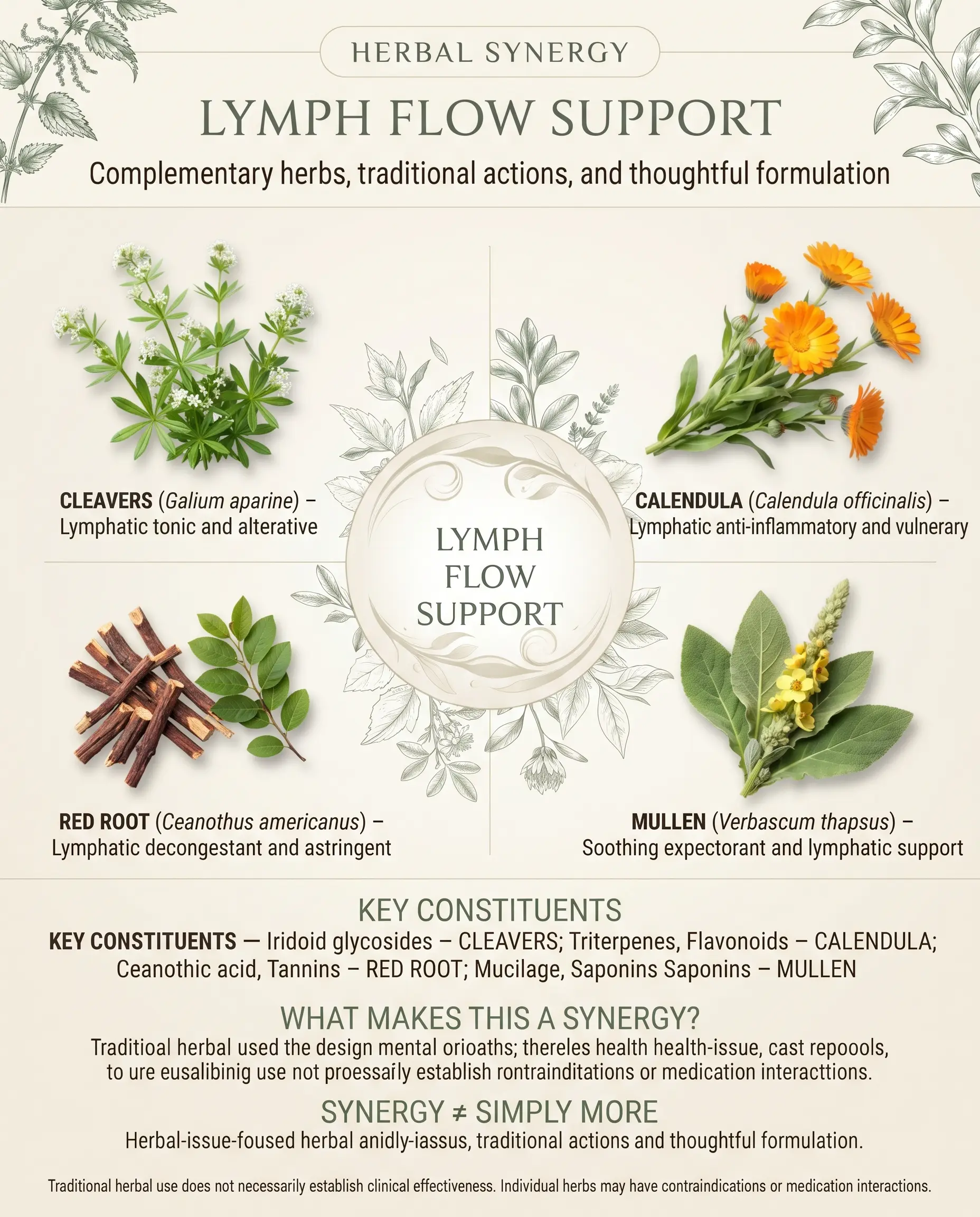
Cleavers Botanical name: Galium aparine Traditional actions: Traditional lymphatic tonic, gentle diuretic Role in the synergy: The gentlest and most commonly recommended herb in this category, with a long traditional reputation as a spring tonic and general lymphatic support — genuinely low-risk, even though formal modern clinical trial evidence for this specific use is limited. Key constituents: Iridoid glycosides, tannins
Red Root Botanical name: Ceanothus americanus Traditional actions: Traditional lymphatic and splenic support Role in the synergy: Traditionally used, particularly in Native American herbal practice, for lymph node and spleen support — a more specifically targeted traditional reputation than cleavers, though similarly under-researched in modern clinical terms. Key constituents: Tannins, alkaloids
Poke Root Botanical name: Phytolacca americana Traditional actions: Traditional potent lymphatic stimulant (practitioner use only) Role in the synergy: A genuinely potent traditional herb with real toxicity — included in this article specifically to explain its exclusion, not as a recommendation. It’s restricted to medical herbalist supervision in some countries for good reason. Key constituents: Phytolaccatoxin, phytolaccigenin, lectins (including pokeweed antiviral protein)
Calendula Botanical name: Calendula officinalis Traditional actions: Traditional anti-inflammatory Role in the synergy: A gentle, well-tolerated herb often included alongside lymphatic herbs for its mild anti-inflammatory support, complementing cleavers without adding any real safety concern. Key constituents: Triterpenoids, flavonoids
Safety and When to Seek Medical Advice
A specific and important warning about poke root: This herb is genuinely toxic. It’s restricted to practitioner-only use in some countries (including under Schedule 20 restrictions in the UK), and poisoning cases have been documented, with symptoms including nausea, vomiting, dangerously low blood pressure, slowed heart rate, and respiratory depression. This article does not recommend poke root for home or self-directed use under any circumstances. If you’re interested in it specifically, that conversation belongs with a qualified medical herbalist, not a home recipe.
Use Caution If:
- You have diagnosed lymphedema — this needs evaluation and care from a certified lymphedema therapist, not herbal self-treatment; even manual lymphatic drainage massage, the actual clinical technique, has shown mixed results in rigorous trials, so herbs alone are not an appropriate substitute for proper care
- You notice new, unexplained swelling, especially if it’s one-sided, painful, or comes with warmth or redness — this needs prompt medical evaluation, since it can have causes (including blood clots or infection) that need immediate attention, not herbal tea
- You’re pregnant or breastfeeding — check with a provider before regular use of red root or any concentrated lymphatic herb tincture; cleavers is generally considered gentle but check with a provider regardless
- You’re on diuretic medication — cleavers has a mild diuretic action; check with a provider before combining
- You notice a swollen lymph node that’s hard, fixed in place, growing, or persists beyond a few weeks — this deserves prompt medical evaluation rather than ongoing herbal management
See a Healthcare Professional If: Any new or unexplained swelling, a swollen lymph node lasting more than a few weeks, swelling that’s painful or one-sided, or any symptoms alongside swelling like fever, unexplained weight loss, or night sweats. These deserve proper diagnosis, not herbal self-management, and diagnosed lymphedema specifically deserves care from a specialist trained in it.
Q&A
Do lymphatic herbs actually work? Honestly, the evidence is thin across the board — even manual lymphatic drainage massage, the real clinical technique used for lymphedema, has shown mixed results in rigorous trials. Herbs like cleavers have a long, gentle traditional reputation and a good safety profile, which makes them reasonable to try for general wellbeing, but it’s fair to have modest expectations rather than assuming they’re a proven “detox” solution.
Is poke root safe to use at home? No — this article specifically does not recommend it. Poke root is genuinely toxic, restricted to practitioner use in some countries, and associated with real poisoning cases. If you’re interested in it, that’s a conversation for a qualified medical herbalist, not a home remedy.
What’s the gentlest option in this category? Cleavers, clearly — it has the best combination of long traditional use and genuine safety, without the toxicity concerns of poke root or the more concentrated action of red root.
Can herbs treat diagnosed lymphedema? No — diagnosed lymphedema needs evaluation and care from a certified lymphedema therapist. This is a genuine medical condition, and herbal support isn’t a substitute for appropriate treatment, especially given that even the standard clinical massage technique has shown mixed results in trials.
Should I be worried about a swollen lymph node? A lymph node that’s soft, tender, and appeared alongside a cold or minor infection is usually not concerning and often resolves on its own. One that’s hard, fixed in place, growing, or persists beyond a few weeks deserves medical evaluation.
Can I use cleavers every day? Yes, that’s how it’s traditionally used — as a gentle, ongoing daily habit rather than an intensive treatment, similar to how nettle or other nutritive herbs are used.
When should I see a doctor instead of trying herbs? If you notice any new or unexplained swelling, a lymph node that’s hard or persistent, swelling that’s one-sided or painful, or any accompanying symptoms like fever or unexplained weight loss — those need proper medical evaluation, not ongoing herbal self-management.
References
Poke Root (Phytolacca americana): Benefits, Medicinal Uses & Evidence – Herbal Reality
Poisoning by Phytolacca – PMC (Historical Toxicology Reference)
Disclaimer
This article is for educational and informational purposes only and covers general, gentle traditional support in otherwise healthy people. It is not intended to diagnose, treat, cure, or prevent lymphedema or any other medical condition, and it is not a substitute for evaluation and care from a qualified healthcare provider or certified lymphedema therapist. Herbs are biologically active and may interact with medications or be inappropriate for some people. If you notice new, unexplained, persistent, or painful swelling, or are pregnant, breastfeeding, taking medication, or managing a health condition, consult a qualified healthcare professional rather than relying on herbal preparations alone.
Available Herbal Products
Explore and shop ready-made products offering this benefit.