

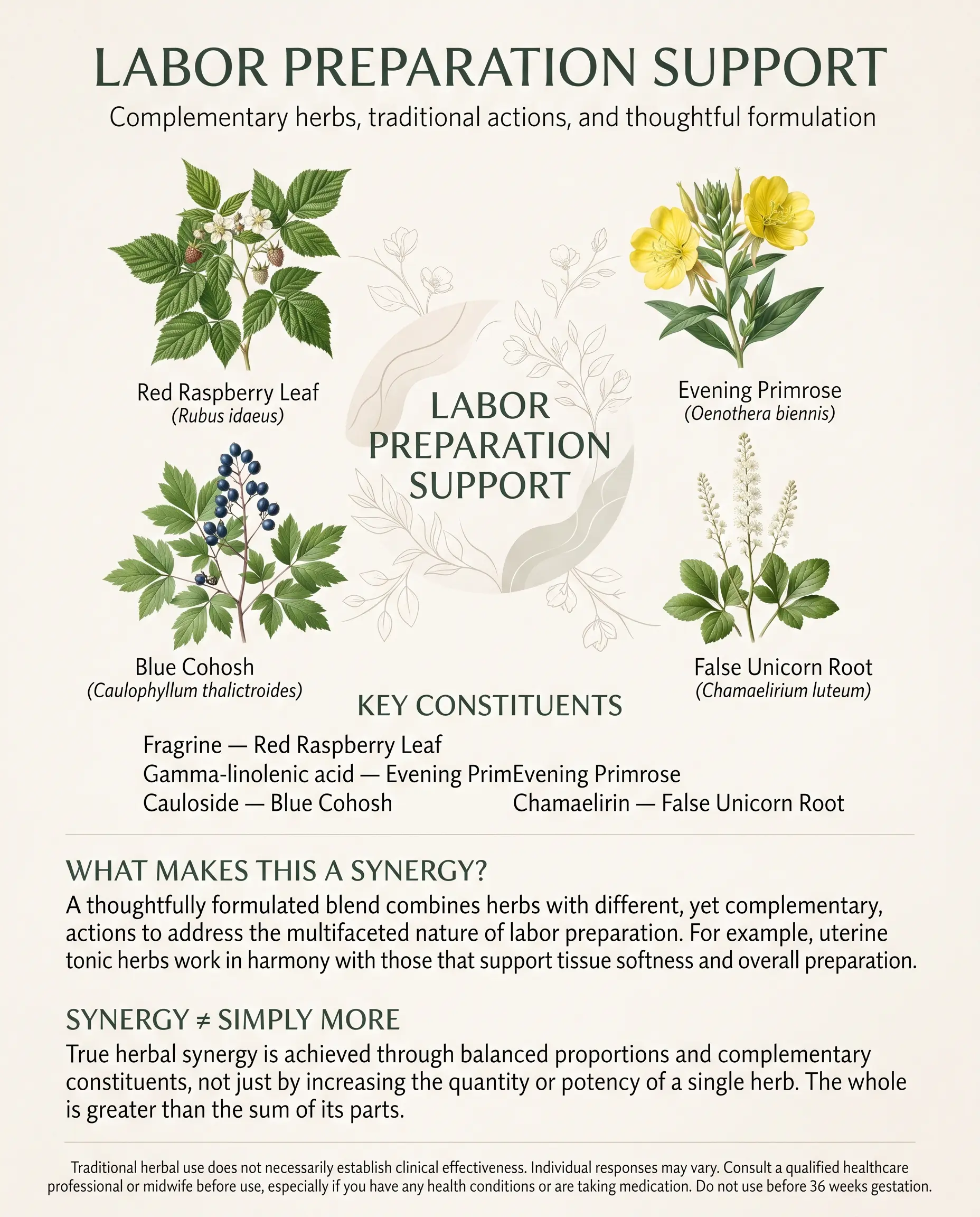
A note before we start: this article is specifically about full-term pregnancy (37 weeks and beyond), and it’s written for use alongside your midwife or OB, not instead of them. Please talk to your care provider before starting any of this — ideally at a regular prenatal visit, well before you’d plan to use it. This article also names several herbs sometimes marketed for “labor prep” or “natural induction” that have real, documented safety concerns. Please read the safety section in full, especially before considering any product with those ingredients.
“Labor preparation” in herbalism generally means gentle, traditional support in the final weeks of pregnancy — not induction, and not a way to start labor early. The best-evidenced options here work in genuinely different ways, which is worth understanding rather than assuming more herbs means more effect.
| Herb/Food | What It Adds |
| Red Raspberry Leaf | The most traditionally used “toning” herb, with modest but real supportive evidence and a good safety record |
| Dates | The best-evidenced option in this entire article — real meta-analysis support for cervical readiness and shorter labor |
| Nettle Leaf | A nutritive herb, valued for iron and general mineral support in late pregnancy rather than any direct effect on labor |
| Oatstraw | Another nutritive, mineral-rich herb often included in third-trimester blends for general wellbeing |
Dates have the strongest and most consistent research behind them of anything in this article — and they’re just food, not even an herb in the traditional sense. Red raspberry leaf is the most iconic “labor prep” herb, with a long history of use and a reassuring safety record, even though the evidence for what it actually does is more modest than its popularity suggests. Nettle and oatstraw round things out nutritionally rather than working toward labor directly.
Recipe for Labor Preparation Support
Raspberry Leaf & Nettle Third-Trimester Tea
Why this blend: Red raspberry leaf is the traditional cornerstone of third-trimester preparation, and nettle leaf adds iron and general mineral support during a stage of pregnancy where nutritional needs are high.
Ingredients
- 1 tsp dried red raspberry leaf
- 1 tsp dried nettle leaf
- 1 cup (240 ml) hot water
Yield: 1 cup
Preparation
- Combine the raspberry leaf and nettle in a mug or infuser.
- Pour hot water over the herbs and cover.
- Steep, covered, for 8–10 minutes.
- Strain and drink warm.
How to Use Traditionally started around 32–36 weeks (check with your provider on timing for your specific pregnancy), sipped once or twice daily and building up gradually — not before, and not as a way to bring on labor early.
Herbalist’s Note This tea is traditionally described as “toning,” not “inducing” — the honest evidence supports it as a gentle, low-key habit, not a labor-starting tool.
Safety Confirm with your midwife or OB before starting, and don’t begin before term (37 weeks) without their specific guidance.
Ready-to-Use Products With This Synergy
Earth Mama Organic Third Trimester Tea Brand: Earth Mama Key herbs: Red raspberry leaf, nettle, oatstraw, spearmint, rosehips, chamomile, alfalfa Why it fits: A well-established, nurse-and-herbalist-formulated blend combining the nutritive and traditional toning herbs discussed in this article, widely used in the third trimester. Buy: earthmamaorganics.com
Earth Mama Organic Raspberry Leaf Tea Brand: Earth Mama Key herbs: Red raspberry leaf (single herb) Why it fits: A simple, single-herb option for readers who want to start with just raspberry leaf before considering a broader blend. Buy: earthmamaorganics.com
Traditional Medicinals Organic Raspberry Leaf Tea Brand: Traditional Medicinals Key herbs: Red raspberry leaf Why it fits: Another widely available, reputable single-herb raspberry leaf option. Buy: traditionalmedicinals.com
Note: dates (the fruit) have the strongest evidence in this article and require no special product — eating several whole dates daily in the last few weeks of pregnancy is how this was studied, not a supplement or extract.
⚠️ Herbs and Products to Avoid for This Purpose
Some products marketed for “labor prep” or “natural induction” contain ingredients with real, documented safety concerns. This section is as important as anything else in this article.
Blue cohosh (sometimes combined with black cohosh as a “partus preparator”) has documented case reports of serious harm when used to bring on labor, including neonatal heart failure, perinatal stroke, and multi-organ injury from lack of oxygen. Multiple medical reviews explicitly recommend against its use for this purpose, and some conclude it shouldn’t be available over the counter at all. Avoid products containing blue cohosh entirely, and check ingredient labels carefully — it sometimes appears in combination formulas without being prominently marketed.
Castor oil, while not an herb, is frequently mentioned alongside herbal induction methods and deserves the same caution — research has linked it to increased nausea, excessive uterine activity, and meconium-stained amniotic fluid, which can affect newborn outcomes. This should only ever be considered under direct medical guidance, never self-directed.
Evening primrose oil is extremely commonly used for this purpose, but it’s worth knowing the evidence doesn’t clearly support it, and some research has raised questions about whether it may be associated with more complications rather than fewer. If you’re already using it, mention it to your provider; it’s not something this article recommends adding.
Herbal Synergies for Labor Preparation Support
Not everyone’s situation calls for the same combination, and none of this should be used before your pregnancy has reached term. General nutritional support throughout the third trimester is where nettle and oatstraw fit — they’re not about labor directly, just overall wellbeing during a demanding stretch. Traditional uterine “toning” in the final weeks before your due date is where raspberry leaf’s long history comes in, alongside honest acknowledgment that the clinical evidence for it is modest. And genuine, meaningful support for cervical readiness in the final weeks specifically is where dates have real research behind them.
As always: synergy is about thoughtful complementarity — not simply adding more herbs to the pot, and never a substitute for your care provider’s guidance on timing and appropriateness for your specific pregnancy.
Core Herbal Synergy Combinations
Dates (daily, from 37 weeks) Best for: The single most evidence-backed option in this entire article. Why it works: Multiple meta-analyses of randomized trials found that eating dates daily in the last few weeks of pregnancy was associated with greater cervical dilation on admission, a reduced need for labor induction or augmentation, and a shorter latent phase and second stage of labor. This is genuinely one of the best-evidenced natural approaches covered anywhere in this content series — and it’s just food.
Red Raspberry Leaf (from 32–36 weeks) Best for: Traditional third-trimester toning, alongside dates rather than instead of them. Why it works: The evidence here is honestly modest — the main randomized trial found no effect on the first stage of labor, though it did find a clinically meaningful shortening of the second stage, with no adverse effects reported. It’s the most iconic herb in this category, with a long safety track record, even if the research doesn’t fully match its reputation.
Nettle + Oatstraw Best for: General nutritional support through the third trimester, separate from labor preparation specifically. Why it works: Both are mineral-rich, nutritive herbs traditionally valued for supporting the increased nutritional demands of late pregnancy — iron, calcium, and general wellbeing — rather than working toward labor itself.
Dates + Red Raspberry Leaf Best for: Combining the best-evidenced option with the most traditional one. Why it works: Dates bring the strongest research support, while raspberry leaf tea is simply a well-established, low-risk daily habit many people already enjoy. Neither interferes with the other.
Herbs Used in These Synergies
Dates Not a botanical herb (a fruit — Phoenix dactylifera) Traditional actions: Not applicable — this is a food, studied specifically for late-pregnancy use Role in the synergy: The best-evidenced item in this article — meta-analyses of randomized trials found that consuming roughly 70–75 grams of dates daily from around 37 weeks was associated with greater cervical readiness and reduced need for medical induction, with a favorable safety profile since it’s simply a whole food. Key constituents: Natural sugars, potassium, fiber
Red Raspberry Leaf Botanical name: Rubus idaeus Traditional actions: Traditional uterine tonic Role in the synergy: The most iconic herb in this category, with a long tradition of third-trimester use and a reassuring safety record in the trials that exist, though the evidence for a meaningful effect on labor itself is modest and mixed across studies. Key constituents: Tannins, flavonoids
Nettle Leaf Botanical name: Urtica dioica Traditional actions: Nutritive, mineral-rich Role in the synergy: Valued in late pregnancy primarily for its iron and general nutrient content rather than any direct effect on labor — a supportive, background herb rather than a targeted one. Key constituents: Iron, calcium, vitamin K
Oatstraw Botanical name: Avena sativa Traditional actions: Nutritive, calming Role in the synergy: Another background, nutritive herb commonly included in third-trimester blends for general mineral support and a gentle calming quality. Key constituents: Silica, minerals
Safety and When to Seek Medical Advice
This section matters more than usual for this topic. Please read it in full, and discuss all of it with your midwife or OB before use.
Never use before term: None of this is appropriate before 37 weeks of pregnancy. Herbs and foods that support labor readiness at term can carry real risks earlier in pregnancy, including preterm labor.
Never use the following for this purpose, and check ingredient labels on any “labor prep” or “natural induction” product for them:
- Blue cohosh (alone or combined with black cohosh) — documented serious neonatal harm
- Castor oil, except under direct medical supervision
- Pennyroyal — genuinely dangerous, associated with severe toxicity; has no place in labor preparation
Use Caution and Talk to Your Provider If:
- You have any high-risk pregnancy factors — placenta previa, a history of preterm labor, or any condition your provider is monitoring closely
- You’ve had a previous cesarean — discuss any uterine-toning herb with your provider specifically given the different considerations involved
- You’re taking any medication or have any bleeding disorder
- You’re unsure about timing — “when” matters as much as “what” for everything in this article, and your provider knows your specific situation
See Your Provider or Go to the Hospital If:
- Your water breaks, whether or not contractions have started
- You notice a significant decrease in fetal movement
- You have vaginal bleeding
- You have signs of preeclampsia (severe headache, vision changes, upper abdominal pain, sudden swelling)
- Contractions become regular and are increasing in intensity and frequency
- You have any concern at all — when it comes to late pregnancy, checking in is always the right call
Q&A
Can any of these herbs actually induce labor? No — and it’s important to be clear about that. Everything discussed here is traditionally described as “preparation” or “toning,” not induction. Dates have the best evidence for supporting labor readiness, but none of this reliably starts labor the way a medical induction does.
When should I start drinking raspberry leaf tea? Traditional guidance generally suggests starting around 32–36 weeks, but this varies by provider and pregnancy — ask your midwife or OB what they recommend for your specific situation rather than following a generic timeline.
Why are dates given so much emphasis here? Because the evidence genuinely supports it more strongly than anything else in this category — multiple meta-analyses of randomized trials, a plausible mechanism, and it’s simply a food with an excellent safety profile.
Is it true that some “natural induction” products are actually dangerous? Yes, specifically ones containing blue cohosh. There are documented case reports of serious harm to newborns, including heart failure and stroke, associated with its use for this purpose. This isn’t a minor caution — multiple medical reviews recommend against its use outright.
Can I use these herbs if I’ve had a previous C-section? Talk to your provider specifically about this before using any uterine-toning herb — your situation involves considerations that a general article like this can’t account for.
What if I’m past my due date and want to try something natural? This is exactly the conversation to have with your provider rather than self-directing — they can discuss genuinely evidence-based options (including some of what’s covered here) in the context of your specific pregnancy and how far past your due date you are.
When should I go straight to the hospital instead of trying anything at home? If your water breaks, you notice reduced fetal movement, you have vaginal bleeding, or you have any signs of preeclampsia — those situations need immediate medical attention, not herbal preparation.
References
EBB 139: Evidence on Red Raspberry Leaf Tea for Natural Labor Induction – Evidence Based Birth
Raspberry Leaf (Rubus idaeus) Use in Pregnancy: A Prospective Observational Study – PMC
Blue Cohosh – Drugs and Lactation Database (LactMed), NCBI Bookshelf
Castor Oil Safety and Effectiveness on Labour Induction and Neonatal Outcome
Disclaimer
This article is for educational and informational purposes only and covers general, traditional support for full-term (37+ weeks) pregnancy preparation. It is not intended to diagnose, treat, cure, or prevent any condition, and it is not a substitute for the guidance of your midwife, obstetrician, or other qualified prenatal care provider. Timing and appropriateness of any herb or food discussed here should be confirmed with your own provider based on your specific pregnancy. If you are experiencing any of the warning signs described above, seek medical care immediately rather than relying on herbal preparations.
Available Herbal Products
Explore and shop ready-made products offering this benefit.