

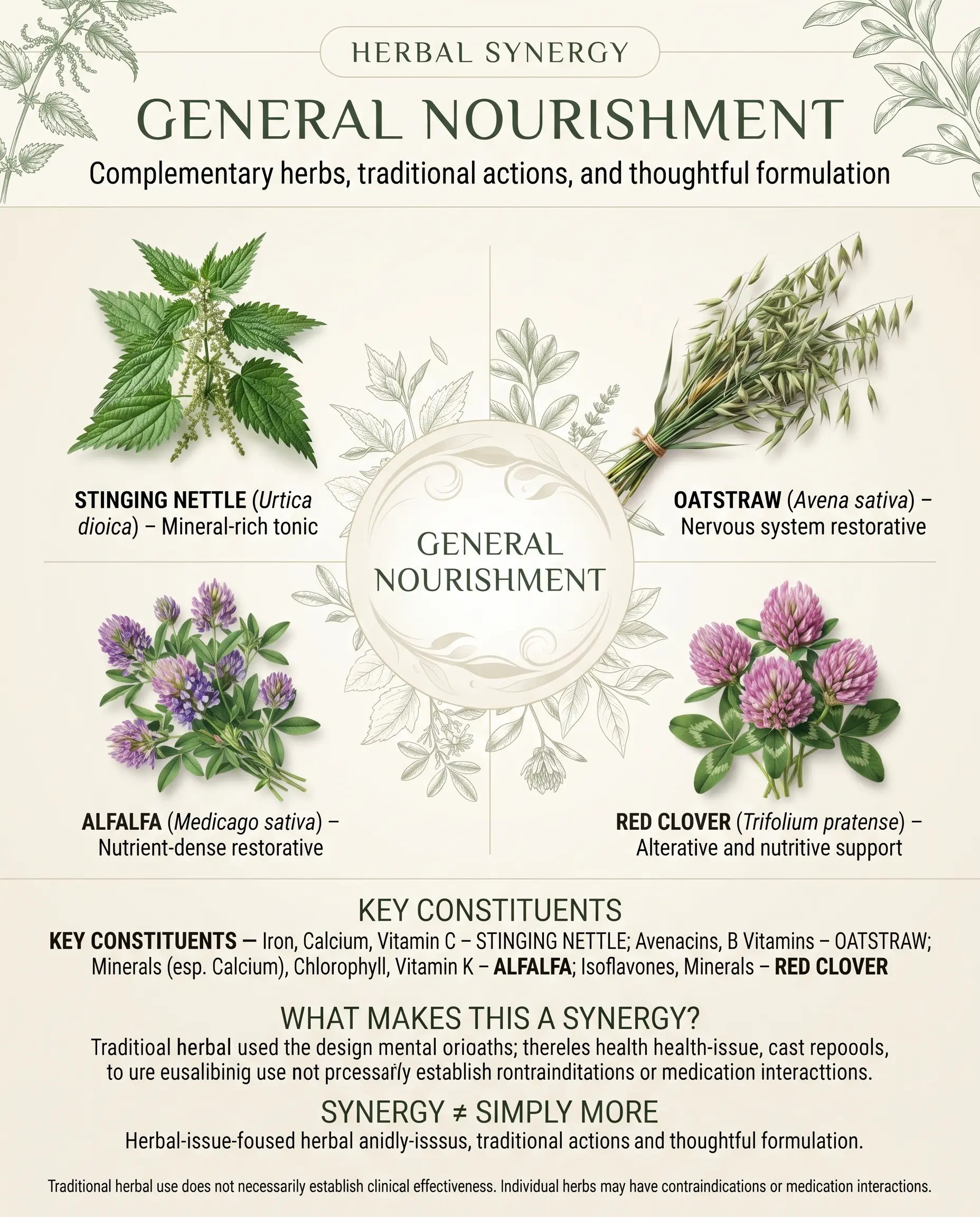
This category is a bit different from most herbal synergy topics — it’s not about treating a specific symptom, but about nutrient density. “Nutritive herbs” is a real, distinct category in herbalism: mineral- and vitamin-rich plants traditionally used as a daily foundation rather than a targeted remedy, closer to a nutrient-dense food than a medicine.
| Herb | What It Adds |
| Nettle Leaf | The nutrient-density leader — genuinely high in iron, calcium, magnesium, and vitamins A, C, and K |
| Oatstraw | A traditional nutritive and mildly calming herb, valued for its mineral content |
| Red Clover | Traditionally included for its own nutrient and mineral profile as part of a nourishing blend |
| Alfalfa | Nutrient-dense, though it comes with real safety caveats worth understanding clearly |
Nettle leaf is the clear standout here — its mineral density is genuinely well documented, not just a herbal marketing claim. Oatstraw and red clover round out a traditional “nourishing infusion” approach, a category popularized in modern Western herbalism specifically for daily, food-like use rather than acute treatment. Alfalfa is worth including with an important caveat: it’s nutrient-dense, but a specific compound in its seeds and sprouts has been linked to lupus flares in susceptible people, which is worth knowing clearly before reaching for it.
Recipe for General Nourishment
Nettle & Oatstraw Nourishing Infusion
Why this blend: Nettle leaf has genuinely well-documented mineral density, and oatstraw adds its own traditional nutritive, gently calming quality — together forming a classic “nourishing infusion,” a style of tea meant to be a daily nutritional habit rather than an acute remedy.
Ingredients
- 1 tbsp dried nettle leaf
- 1 tbsp dried oatstraw
- 2 cups (480 ml) hot water
Yield: 2 cups
Preparation
- Combine the nettle and oatstraw in a large jar or teapot.
- Pour hot water over the herbs and cover.
- Steep, covered, for a minimum of 4 hours, or overnight for a stronger infusion — this is a genuinely long steep by design, meant to draw out more of the mineral content than a quick 10-minute cup would.
- Strain and drink throughout the day, warm or chilled.
How to Use This is meant to be a regular, ongoing habit rather than a one-time remedy — think of it more like a daily glass of nutrient-dense broth than a medicinal tea.
Herbalist’s Note The long steep genuinely matters here — a quick dunk-and-remove tea bag extracts far less mineral content than a proper multi-hour infusion, since many of nettle’s minerals need time to release into the water.
Safety Nettle can occasionally cause mild stomach upset in sensitive people, and both herbs should be introduced gradually if you’re new to daily herbal infusions.
Ready-to-Use Products With This Synergy
Frontier Co-op Organic Stinging Nettle Leaf Brand: Frontier Co-op Key herbs: Organic nettle leaf Why it fits: A high-quality, single-herb nettle leaf suited to making a proper long-steeped nourishing infusion at home. Buy: frontiercoop.com
Frontier Co-op Organic Oatstraw Green Tops Brand: Frontier Co-op Key herbs: Organic oatstraw Why it fits: A single-herb oatstraw option to pair with nettle for the nourishing infusion recipe above. Buy: amazon.com
Traditional Medicinals Organic Nettle Leaf Tea Brand: Traditional Medicinals Key herbs: Nettle leaf Why it fits: A convenient, pre-portioned tea bag option for readers who want an easier daily nettle habit without measuring loose herb. Buy: traditionalmedicinals.com
Herbal Synergies for General Nourishment
Not everyone’s reason for wanting “general nourishment” is the same. A daily, food-like mineral boost — especially for iron and calcium — is where nettle leaf’s genuinely strong nutrient profile fits best, ideally as a long-steeped infusion rather than a quick tea. A gentler, more calming nutritive habit is where oatstraw’s traditional reputation comes in, often alongside nettle. And it’s worth being honest that “nourishing” doesn’t mean “risk-free” — alfalfa in particular needs a specific caveat that the other herbs here don’t.
As always: synergy is about thoughtful complementarity — not simply adding more herbs to the pot.
Core Herbal Synergy Combinations
Nettle Leaf + Oatstraw Best for: A daily, general nutrient-density habit — the classic “nourishing infusion.” Why it works: This is the most traditional pairing in this category, combining nettle’s well-documented mineral density with oatstraw’s own nutritive and gently calming reputation. This is the recipe above, and the combination most closely associated with the modern “nourishing herbal infusion” approach in Western herbalism.
Nettle Leaf Alone Best for: The single most nutrient-dense option, especially for iron and calcium. Why it works: Nettle’s mineral content is genuinely well-documented — it’s rich in iron, calcium, magnesium, and vitamins A, C, and K, and it naturally pairs vitamin C with its iron content, which can support absorption. It’s worth knowing that a brewed infusion won’t deliver the full mineral content of the dry leaf — bioavailability from a tea is meaningfully lower than eating the whole leaf — but it’s still a genuinely nutrient-contributing daily habit.
Nettle Leaf + Red Clover Best for: A broader nutritive blend, especially favored in some traditional “spring tonic” approaches. Why it works: Red clover is traditionally included in nourishing blends for its own nutrient profile, rounding out nettle’s mineral density with additional traditional nutritive support — a common pairing in classic herbal tonic formulas.
Oatstraw Alone Best for: A gentler, calming nutritive option, especially for evening use. Why it works: Oatstraw is milder than nettle and carries a traditional reputation for gentle nervous-system support alongside its nutritive content, making it a good standalone choice for someone wanting a calmer daily habit rather than nettle’s more assertive mineral punch.
Herbs Used in These Synergies
Nettle Leaf Botanical name: Urtica dioica Traditional actions: Nutritive, traditional spring tonic Role in the synergy: The clear nutrient-density leader in this article — genuinely documented for its mineral content (iron, calcium, magnesium, potassium) and vitamins A, C, and K, recognized in an official European herbal monograph for traditional use, though it’s worth knowing that brewed-tea bioavailability is lower than raw-leaf nutrient content might suggest. Key constituents: Iron, calcium, magnesium, vitamin K, vitamin C, flavonoids
Oatstraw Botanical name: Avena sativa Traditional actions: Nutritive, traditionally calming Role in the synergy: A gentle, traditional nutritive herb often paired with nettle, valued for a milder mineral contribution alongside a traditional reputation for gentle nervous-system support. Key constituents: Silica, minerals, avenanthramides
Red Clover Botanical name: Trifolium pratense Traditional actions: Traditional nutritive tonic Role in the synergy: Traditionally included in nourishing herbal blends and “spring tonic” formulas, contributing its own nutrient profile alongside nettle and oatstraw — commonly recognized for isoflavone content in other contexts, but included here specifically for its traditional nutritive role. Key constituents: Isoflavones, minerals
Alfalfa Botanical name: Medicago sativa Traditional actions: Traditional nutritive herb Role in the synergy: Genuinely nutrient-dense, but included here with an important caveat — L-canavanine, found specifically in alfalfa seeds and sprouts (not the leaves), has been linked to lupus flares and lupus-like symptoms in susceptible individuals; those with lupus or a family history of it are generally advised to avoid alfalfa supplements specifically. Key constituents: L-canavanine (in seeds/sprouts), saponins, vitamin K
Safety and When to Seek Medical Advice
Use Caution If:
- You have lupus or a family history of lupus — avoid alfalfa supplements specifically, given documented links between L-canavanine and lupus flares; this doesn’t apply to nettle, oatstraw, or red clover
- You’re on blood-thinning medication like warfarin — alfalfa’s vitamin K content can reduce warfarin’s effectiveness; nettle also contains vitamin K and is worth mentioning to your provider if you’re on anticoagulants
- You’re pregnant or breastfeeding — check with a provider before regular use of any of these herbs in concentrated or supplement form, though culinary tea amounts of nettle are widely used traditionally
- You have a hormone-sensitive condition — red clover contains isoflavones (plant compounds with mild estrogen-like activity); check with a provider if this is a concern for your specific situation
- You’re taking hormonal birth control — alfalfa may reduce its effectiveness; use an additional method or check with a provider
See a Healthcare Professional If: You’re using herbs as an attempt to address a genuine nutritional deficiency (like diagnosed anemia) rather than general daily support — a real deficiency deserves proper testing and, often, a more concentrated and reliable source of the specific nutrient than an herbal infusion can consistently provide. Nourishing herbs are a reasonable daily habit, not a substitute for addressing a confirmed medical deficiency.
Q&A
Is nettle tea really as nutrient-dense as people say? The dry leaf genuinely is nutrient-dense — real mineral analysis backs this up. What’s worth knowing is that a brewed tea extracts less of that content than eating the whole leaf would, so think of it as a meaningful contribution to your daily intake rather than a complete substitute for dietary sources.
Why does the recipe call for such a long steep? Because nettle’s minerals need real time to release into the water — a quick 5-10 minute steep, like you’d use for a flavor-focused tea, pulls out much less mineral content than a 4-hour or overnight infusion.
Is alfalfa dangerous? For most people, no — but if you have lupus or a family history of it, alfalfa supplements specifically carry a documented risk of triggering or worsening symptoms, tied to a compound called L-canavanine found in the seeds and sprouts. This is a real, specific caution, not a generic “check with your doctor” disclaimer.
Can these herbs replace my iron or calcium supplement? Not reliably — if you have a diagnosed deficiency, a nutritive herbal infusion is a nice daily habit alongside proper treatment, but it shouldn’t replace a supplement or dietary approach specifically calibrated to correct a confirmed deficiency.
Can I drink nettle infusion every day? Yes, that’s how it’s traditionally used — as an ongoing daily habit rather than an occasional remedy, much like drinking a daily glass of vegetable broth.
Which combination is gentlest? Oatstraw alone — milder than nettle, with a traditional calming reputation alongside its nutritive content.
When should I see a doctor instead of relying on herbs? If you suspect an actual nutritional deficiency — persistent fatigue, unusual paleness, or other symptoms that could indicate anemia or another deficiency — that deserves proper testing and treatment, not just a daily cup of nettle tea.
References
- Boosting Nutritional Quality of Urtica dioica L. to Resist Climate Change – PMC
- Nettle Tea Guide: Buying, Brewing, and Safety – Valley of Tea
- Effects of L-Canavanine on T Cells May Explain the Induction of Systemic Lupus Erythematosus by Alfalfa – Wiley Online Library
- Lupus Nutrition FAQs – Lupus Foundation of America
- Alfalfa – Health Encyclopedia, URochester Medicine
Disclaimer
This article is for educational and informational purposes only and is not intended to diagnose, treat, cure, or prevent disease. Herbs are biologically active and may interact with medications or be inappropriate for some people. If you are pregnant, breastfeeding, taking medication, managing a health condition, or experiencing persistent or severe symptoms, consult a qualified healthcare professional before using herbal preparations.
Available Herbal Products
Explore and shop ready-made products offering this benefit.