

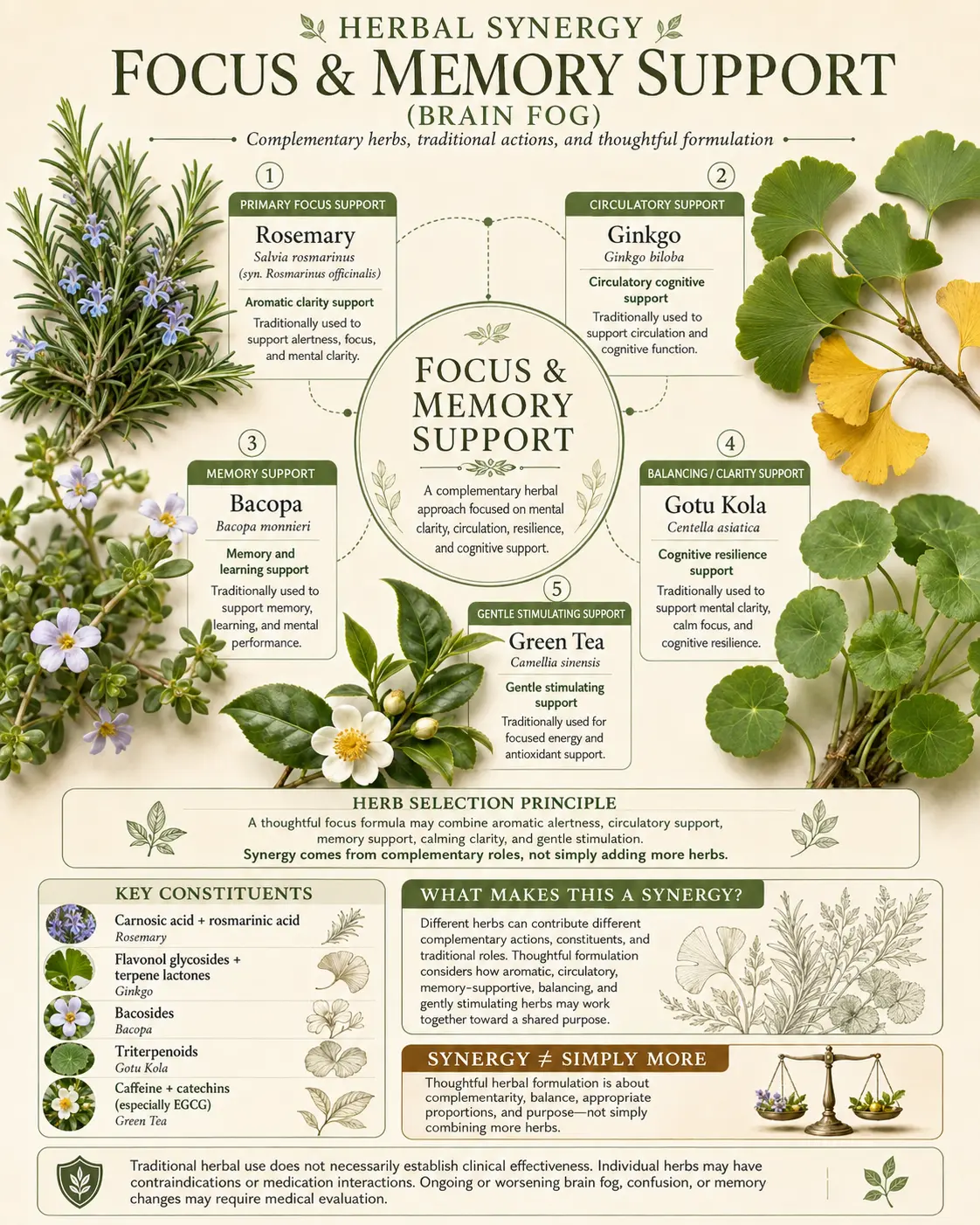
Brain fog isn’t one thing — sometimes it’s mental fatigue that builds through the day, sometimes it’s trouble holding focus on a task, and sometimes it’s just a general sense that thoughts aren’t coming as easily as they should. This is a category where it’s worth being direct: the evidence for these herbs is real but modest, and matching the herb to the actual problem matters more than reaching for whatever’s most hyped.
| Herb | What It Adds |
| Bacopa | The most traditionally established memory herb, though recent, better-designed trials have found mixed results |
| Rhodiola | Better evidence for fatigue and acute mental performance under stress than for memory itself |
| American Ginseng | Trial support for working memory and attention, particularly a few hours after taking it |
| Ginkgo | Mixed evidence overall — modest support in older adults with mild impairment, little support in healthy adults |
Rhodiola and American ginseng are your faster-acting options for a specific day’s mental fatigue or focus dip. Bacopa is more of a slow-build, weeks-long herb, with a more mixed evidence picture than its popularity suggests. Ginkgo is worth knowing the real limits of — it’s the most commonly recommended “memory herb,” but its strongest evidence is in older adults with existing impairment, not in otherwise healthy people fighting everyday brain fog.
Recipe for Focus & Memory Support
Rhodiola & Ginger Focus Tea
Why this blend: Rhodiola has direct trial support for reducing mental fatigue and improving concentration during demanding periods, and ginger adds a bit of warmth and digestive support to round out the cup.
Ingredients
- ½ tsp dried rhodiola root (or as directed on a standardized extract if using powder)
- ½ tsp fresh grated ginger (or ¼ tsp dried)
- 1 cup (240 ml) hot water
Yield: 1 cup
Preparation
- Combine the rhodiola and ginger in a mug or infuser.
- Pour hot water over the herbs and cover the cup.
- Steep, covered, for 8–10 minutes.
- Strain and drink warm.
How to Use Drink in the morning or early afternoon during a demanding stretch of work — rhodiola’s acute effects on attention and mental clarity have been shown within 1–2 hours in some studies, so timing it before you need focus makes sense.
Herbalist’s Note Rhodiola is generally considered a “daytime” herb — its mildly stimulating quality means it’s not the best choice within a few hours of bedtime.
Safety Skip this in the late afternoon or evening if you’re sensitive to mild stimulant effects, and check with a provider if you’re on medication for bipolar disorder, since rhodiola’s activating effects warrant caution there.
Ready-to-Use Products With This Synergy
Gaia Herbs Nootropic Focus Brand: Gaia Herbs Key herbs: Lion’s mane, ginkgo, saffron, lemon balm Why it fits: A multi-herb blend built specifically around mental clarity and concentration, combining ginkgo with other traditionally focus-supportive herbs. Buy: gaiaherbs.com
Gaia Herbs Bacopa Brand: Gaia Herbs Key herbs: Bacopa monnieri Why it fits: A single-herb, standardized bacopa supplement for anyone who wants to try the most traditionally established memory herb on its own before combining it with anything else. Buy: amazon.com
Neuro Memory & Focus Gum Brand: Neuro Key herbs: Cereboost (American ginseng extract), L-theanine Why it fits: Features the specific American ginseng extract (Cereboost) studied in clinical trials for working memory and attention, in a fast-acting, caffeine-free gum format. Buy: amazon.com
Herbal Synergies for Focus & Memory Support
Not all brain fog calls for the same herb. A single demanding day — a big presentation, a deadline crunch — is where fast-acting rhodiola or American ginseng fit best, since both have shown effects within hours rather than requiring weeks of buildup. A more general, ongoing sense of mental fogginess is closer to where bacopa’s traditional use lies, though it’s worth knowing its evidence has become more mixed as trial quality has improved. And age-related memory concerns specifically are where ginkgo’s evidence is strongest — its support in otherwise healthy adults is much weaker.
As always: synergy is about thoughtful complementarity — not simply adding more herbs to the pot.
Core Herbal Synergy Combinations
Rhodiola + American Ginseng Best for: A demanding day requiring sustained focus and mental energy. Why it works: Both herbs have trial support for relatively fast-acting cognitive benefits — rhodiola for reducing mental fatigue and improving concentration under stress, American ginseng (as Cereboost) for working memory and attention within hours. A pairing built around “today,” not “this month.”
Bacopa + Ginkgo Best for: A longer-term, ongoing memory-support routine. Why it works: Both are traditionally used for memory specifically, taken daily over weeks rather than as an acute remedy. It’s worth being candid that recent, better-designed trials have found more inconsistent results for both than older research suggested — this combination reflects traditional pairing logic more than a strong recent evidence base.
Rhodiola + Ginger Best for: An everyday, gentle focus habit without a strong stimulant feel. Why it works: Rhodiola’s acute attention-supporting effects are complemented by ginger’s warming, digestive-friendly quality — a simple pairing and the tea recipe above.
American Ginseng + Bacopa Best for: Covering both an immediate focus need and a longer-term memory-support goal at once. Why it works: American ginseng’s faster-acting attention benefits pair with bacopa’s traditional, slower-building memory reputation — useful for someone who wants both same-day support and a longer-term routine without choosing just one.
Herbs Used in These Synergies
Bacopa Botanical name: Bacopa monnieri Traditional actions: Traditional memory tonic (Ayurvedic) Role in the synergy: The most traditionally established herb here, with a large body of research overall — but it’s worth knowing that a well-designed 2024 trial found no cognitive benefit over placebo after 12 weeks, even though it found reduced stress and fatigue. The evidence is real but genuinely mixed depending on the study. Key constituents: Bacosides A and B
Rhodiola Botanical name: Rhodiola rosea Traditional actions: Adaptogen, traditionally used for fatigue Role in the synergy: Better evidence here than for most herbs in this article — multiple trials show it reduces mental fatigue and improves concentration and attention, especially under stress, with effects noted within 1–2 hours in some studies. Key constituents: Rosavins, salidroside
American Ginseng Botanical name: Panax quinquefolius Traditional actions: Traditional cognitive and energy tonic Role in the synergy: A specific standardized extract (Cereboost) has shown improved working memory and attention in randomized trials, with effects appearing within hours and strengthening with two weeks of daily use. Key constituents: Ginsenosides
Ginkgo Botanical name: Ginkgo biloba Traditional actions: Traditionally used for circulation and memory Role in the synergy: The most recognizable “memory herb,” but its strongest evidence is in older adults with existing mild cognitive impairment — a large, rigorous trial in healthy older adults found it did not prevent cognitive decline, and evidence in healthy younger adults is even weaker. Key constituents: Flavone glycosides, terpene lactones
Safety and When to Seek Medical Advice
Use Caution If:
- You’re on blood-thinning medication — ginkgo can increase bleeding risk, and this is one of its more established cautions
- You have bipolar disorder — rhodiola’s activating, mildly stimulating quality warrants caution and a conversation with your provider
- You’re pregnant or breastfeeding — safety data is limited for bacopa, rhodiola, and ginseng in pregnancy; check with a provider first
- You have a bleeding disorder or upcoming surgery — both ginkgo and ginseng carry some bleeding-related caution and are often paused before surgery
- You’re on thyroid medication — bacopa may affect thyroid hormone levels; check with a provider if this applies to you
See a Healthcare Professional If: Memory or focus problems are sudden, severe, worsening, or accompanied by confusion, difficulty with familiar tasks, or changes in personality or mood. These can be signs of something that needs proper medical evaluation rather than ongoing herbal self-management — everyday brain fog is a reasonable target for herbal support, but a real cognitive change is not.
Q&A
What’s the best-evidenced option here? Rhodiola has some of the more consistent trial support in this category, particularly for mental fatigue and concentration under stress, with effects that show up relatively quickly.
Is bacopa actually as good as everyone says? It’s genuinely mixed. Older meta-analyses found memory benefits, but a rigorous, more recent 12-week trial found no cognitive improvement over placebo, even though participants reported less stress and fatigue. It’s reasonable to try, but temper expectations.
Does ginkgo actually help with brain fog? Its strongest evidence is in older adults with existing mild cognitive impairment, not in healthy people with everyday brain fog. A large clinical trial in healthy older adults found it didn’t prevent cognitive decline, and evidence in younger, healthy adults is weaker still.
Can I take these together? Generally yes, especially rhodiola with ginger or American ginseng, since they work on more similar, faster timeframes. Combining a fast-acting herb with a slow-building one (like bacopa) is also reasonable, just don’t expect the slow-building one to show results quickly.
Can I use these every day? Bacopa and ginkgo are typically used daily for weeks to see any effect. Rhodiola and American ginseng are often used more flexibly — daily, or just on demanding days — since their effects show up faster.
Which combination is gentlest? Rhodiola and ginger — no strong stimulant feel, and a simple, low-key daily habit.
When should I see a doctor instead of trying herbs? If memory or focus problems are sudden, severe, or come with confusion or difficulty with familiar tasks — that’s a signal for proper medical evaluation, not herbal tea.
References
Ginkgo biloba for Preventing Cognitive Decline in Older Adults: A Randomized Trial – PubMed
Rhodiola rosea in Stress-Induced Fatigue — A Double-Blind Cross-Over Study – ScienceDirect
Disclaimer
This article is for educational and informational purposes only and is not intended to diagnose, treat, cure, or prevent disease. Herbs are biologically active and may interact with medications or be inappropriate for some people. If you are pregnant, breastfeeding, taking medication, managing a health condition, or experiencing persistent or severe symptoms, consult a qualified healthcare professional before using herbal preparations.
Available Herbal Products
Explore and shop ready-made products offering this benefit.