

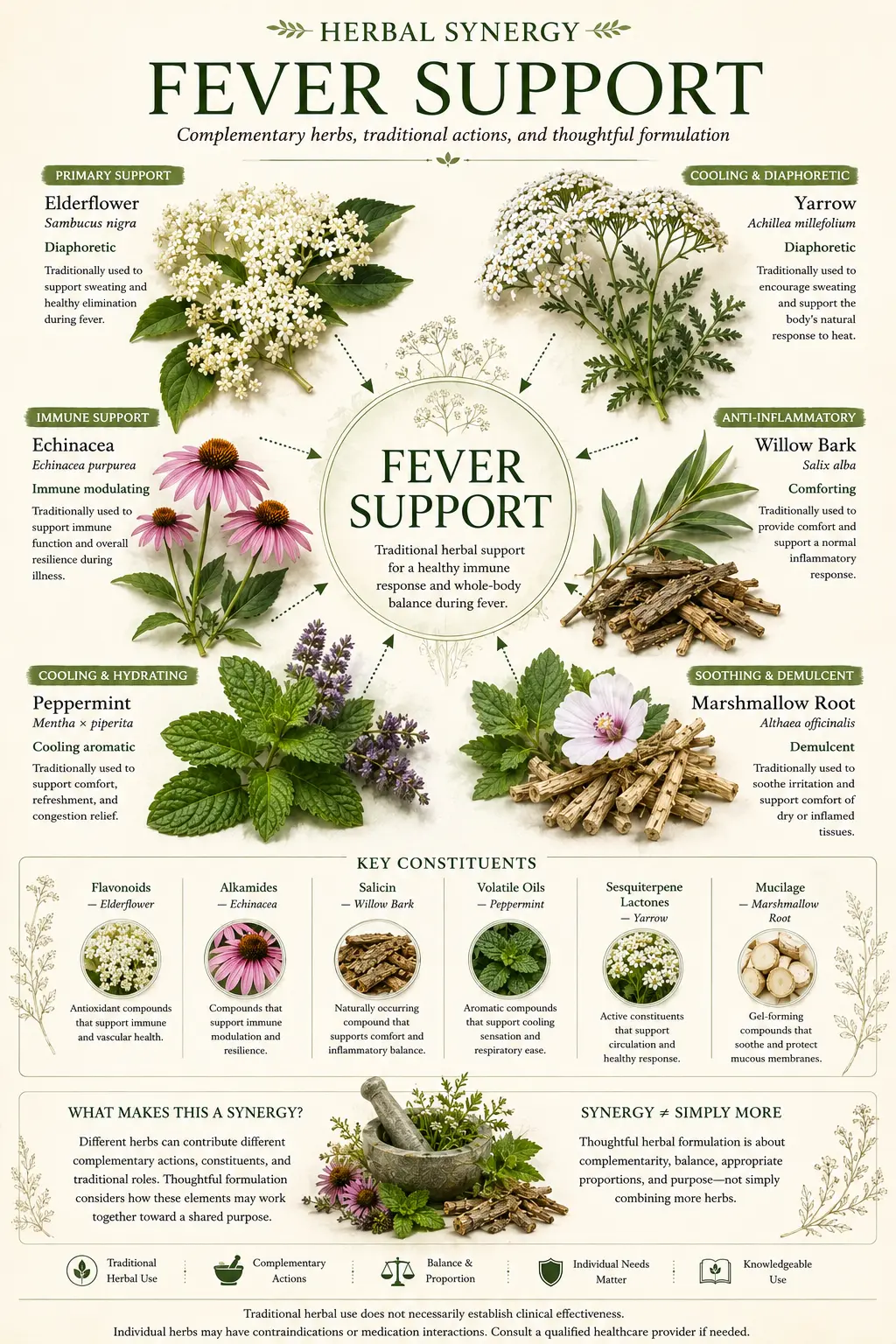
A note before we start: herbs can offer real comfort during a mild fever, but it’s important to be honest about what they can and can’t do. Unlike acetaminophen or ibuprofen, herbal diaphoretics haven’t been shown in clinical trials to reliably lower body temperature — their traditional role is to support the body’s own process (sweating, warmth, fluid intake) rather than acting as a proven antipyretic. The safety section below covers exactly when a fever needs real medical attention instead of tea, and it’s worth reading in full, especially if the fever involves a child.
A fever moves through phases — chills and a rising temperature, then heat and sweating, then the temperature coming back down — and different herbs traditionally support different phases of that process, rather than one herb doing everything.
| Herb | What It Adds |
| Elderflower | A classic diaphoretic, traditionally used to support the sweating phase as a fever breaks |
| Yarrow | Traditionally considered the strongest of the diaphoretics in this group |
| Boneset | A traditional North American fever herb, specifically associated with the aches and chills of flu-like illness |
| Ginger | Warming support for the chilly, early phase of a fever |
Elderflower, yarrow, and boneset all fall into the same traditional category — diaphoretics, meant to support sweating and warmth during a fever rather than suppress it. Ginger’s role is different: it’s for the shivery, cold-feeling early phase, before the sweating stage sets in. None of these are proven to lower temperature the way medication does — their traditional role is comfort and support, not a substitute for fever-reducing medication when that’s genuinely needed.
Recipe for Fever Support
Elderflower, Yarrow & Ginger Fever Tea
Why this blend: This reflects one of the most established traditional combinations in Western herbalism for an active fever — elderflower and yarrow to support sweating, ginger to add warmth during the chilly phase.
Ingredients
- 1 tsp dried elderflower
- 1 tsp dried yarrow
- ½ tsp fresh grated ginger (or ¼ tsp dried)
- 1 cup (240 ml) hot water
Yield: 1 cup
Preparation
- Combine all three ingredients in a mug or infuser.
- Pour hot water over them and cover immediately.
- Steep, covered, for 10 minutes.
- Strain and drink hot.
How to Use Drink hot, several times throughout the day during an active, mild fever — the warmth is part of the traditional intent, supporting sweating rather than working against it.
Herbalist’s Note Staying well-hydrated matters more than any herb here — a fever increases fluid loss, and water or diluted juice alongside this tea genuinely helps.
Safety This tea is not appropriate for a high fever (see the safety section below for exact thresholds), for infants, or for anyone whose fever needs actual medical evaluation.
Ready-to-Use Products With This Synergy
Mountain Rose Herbs Boneset Extract Brand: Mountain Rose Herbs Key herbs: Organic boneset Why it fits: A single-herb boneset tincture reflecting the traditional North American fever herb discussed in this article, made in small batches with organic ingredients. Buy: mountainroseherbs.com
Traditional Medicinals Organic Herbal Cold Care Tea Brand: Traditional Medicinals Key herbs: Elderflower, yarrow, peppermint, hyssop, ginger, cinnamon Why it fits: Built around the same elderflower-yarrow-ginger diaphoretic logic as this article’s recipe, in a ready-made tea format. Buy: traditionalmedicinals.com
Gaia Herbs Black Elderberry Syrup Brand: Gaia Herbs Key herbs: Organic black elderberry, acerola cherry (vitamin C) Why it fits: A general immune-support complement for the illness that’s often causing the fever in the first place, useful alongside (not instead of) fever-specific comfort measures. Buy: gaiaherbs.com
Herbal Synergies for Fever Support
Not every fever calls for the same herb, and it’s worth being clear that this whole category is about comfort during a mild, low-grade fever — not a substitute for evaluating or treating a fever that’s genuinely high or concerning. The early, chilly phase (feeling cold, shivering, temperature still rising) is where ginger’s warming quality fits. The active, hot, sweating phase is where elderflower and yarrow’s traditional diaphoretic role comes in. And body aches alongside the fever — the kind that comes with flu — is specifically where boneset’s traditional reputation lies.
As always: synergy is about thoughtful complementarity — not simply adding more herbs to the pot, and never a substitute for appropriate medical care when a fever needs it.
Core Herbal Synergy Combinations
Elderflower + Yarrow Best for: The classic, active sweating phase of a mild fever. Why it works: This is one of the most established traditional pairings in Western herbalism for exactly this purpose — both herbs are considered diaphoretics, traditionally used to support the body’s sweating response as a fever runs its course.
Boneset + Ginger Best for: Flu-like illness with body aches and chills alongside the fever. Why it works: Boneset has a specific, long traditional association with the deep muscle aches of flu-like illness (its name literally referring to bone-deep aching), while ginger adds warmth for the chilly phase. Important: boneset carries its own specific caution — see the safety section below.
Elderflower + Peppermint Best for: A gentler, cooling option once the sweating phase is well underway. Why it works: Where yarrow leans warming and intensifying the diaphoretic effect, peppermint adds a cooling, refreshing quality — useful for someone who finds the classic hot tea combination too intense.
Ginger Alone Best for: The earliest, chilly, “coming down with something” stage. Why it works: Sometimes the simplest approach is right — a warming ginger tea at the very first chills, before reaching for a fuller diaphoretic blend, matches the traditional logic of supporting each phase as it comes rather than treating the whole illness the same way throughout.
Herbs Used in These Synergies
Elderflower Botanical name: Sambucus nigra (flower) Traditional actions: Diaphoretic Role in the synergy: A cornerstone of traditional European fever formulas, used to support the sweating process during an active fever. Key constituents: Flavonoids, mucilage
Yarrow Botanical name: Achillea millefolium Traditional actions: Diaphoretic, traditionally used to support a fever’s natural course Role in the synergy: Traditionally considered the strongest diaphoretic in this group, working by improving circulation to the skin’s surface. Key constituents: Sesquiterpene lactones, flavonoids
Boneset Botanical name: Eupatorium perfoliatum Traditional actions: Traditional diaphoretic, specifically associated with flu-like body aches Role in the synergy: A once-official North American fever remedy (listed in the U.S. Pharmacopoeia for nearly a century) with no modern clinical trials confirming its effects, and a specific traditional caution: it’s generally not recommended once a fever is already high. See safety section. Key constituents: Sesquiterpene lactones, polysaccharides
Ginger Botanical name: Zingiber officinale Traditional actions: Warming Role in the synergy: Traditionally used for the chilly, early phase of a fever, adding warmth rather than directly addressing the fever itself. Key constituents: Gingerols, shogaols
Safety and When to Seek Medical Advice
This is the most important section in this article. Please read it fully.
A crucial warning about willow bark, aspirin, and children: Some fever content recommends willow bark (a salicylate-containing herb) for fever in children. Don’t do this. Salicylates — including aspirin and willow bark — are linked to Reye’s syndrome, a rare but serious illness, when given to children or teenagers recovering from a viral illness like flu or chickenpox. This applies to willow bark exactly as it applies to aspirin. None of the recipes or combinations in this article use willow bark for this reason.
Use Caution If:
- The fever is already high — boneset specifically is traditionally not recommended once a fever exceeds about 102°F (38.9°C); this is a genuine traditional caution, not just general caution
- You’re pregnant or breastfeeding — yarrow and boneset are both generally avoided during pregnancy
- The person is a young child — check with a pediatrician before giving any herbal fever remedy to a child, and never use willow bark or aspirin for a child’s fever
- You’re on blood-thinning medication — yarrow can affect bleeding risk; check with a provider
- You have liver disease — boneset contains trace amounts of compounds (pyrrolizidine alkaloids) that are a concern in higher amounts; avoid regular or prolonged use regardless
See a Healthcare Professional or Emergency Care If:
- An infant under 3 months has any fever at all (100.4°F/38°C or higher) — this always needs immediate medical evaluation, no exceptions
- Fever in anyone reaches 103°F (39.4°C) or higher, or a child’s fever reaches 104°F (40°C) or higher
- Fever lasts more than 3 days in an adult, or more than 24 hours in a young child, without improvement
- Fever comes with a stiff neck, severe headache, rash, confusion, difficulty breathing, repeated vomiting, or a seizure
- The person seems unusually lethargic, difficult to wake, or is showing signs of dehydration (very little urination, no tears when crying, dry mouth)
- You’re ever unsure — when in doubt about a fever, especially in a child, checking with a doctor is always the right call over waiting it out with tea
None of the herbs in this article are appropriate substitutes for these situations.
Q&A
Do these herbs actually lower a fever the way medication does? No, and it’s worth being direct about that — there’s no clinical trial evidence that diaphoretic herbs reliably reduce body temperature the way acetaminophen or ibuprofen do. Their traditional role is supporting comfort and the body’s own process, not acting as a proven substitute for fever-reducing medication.
Is it true you shouldn’t “break” a fever? This is debated even among herbalists, and reasonable people land differently on it. What’s not debated: a fever that’s genuinely high, prolonged, or accompanied by concerning symptoms needs medical evaluation, regardless of anyone’s philosophy about letting fevers run their course.
Can I give this tea to my child? Check with a pediatrician first, and never use willow bark or aspirin-containing herbs for a child’s fever due to Reye’s syndrome risk. Many of these herbs (yarrow, boneset) aren’t typically recommended for young children without professional guidance.
Why can’t I use boneset once a fever is high? This is a specific, traditional caution — boneset is generally reserved for milder fevers, with guidance suggesting it’s not appropriate once a fever exceeds about 102°F. A fever at that level is also a point where medical evaluation becomes more important anyway.
What’s the difference between elderflower and elderberry? Different parts of the same plant, used differently — elderflower is the traditional fever-support herb discussed here, while elderberry (the fruit) has its own separate evidence base for flu symptom severity, covered in more depth in a dedicated Immune Support or Cold & Flu article.
When should I just see a doctor instead of trying herbs? If the fever is very high, lasts an unusually long time, comes with a stiff neck, rash, confusion, or breathing difficulty, or involves an infant under 3 months — those situations need medical care, not herbal tea, every time.
References
Boneset – Health Information Library, PeaceHealth
Boneset Uses, Benefits & Dosage – Drugs.com
Willow Bark – Memorial Sloan Kettering Cancer Center
Fever in Children – Mayo Clinic
Disclaimer
This article is for educational and informational purposes only and covers herbal comfort measures for a mild fever only. It is not intended to diagnose, treat, cure, or prevent any condition, and it is not a substitute for medical evaluation of a fever, particularly in infants, young children, or anyone with a high, prolonged, or concerning fever. Herbs are biologically active and may interact with medications or be inappropriate for some people. If you are pregnant, breastfeeding, taking medication, managing a health condition, or if a fever is severe or accompanied by any warning signs described above, seek medical care rather than relying on herbal preparations.
Available Herbal Products
Explore and shop ready-made products offering this benefit.