

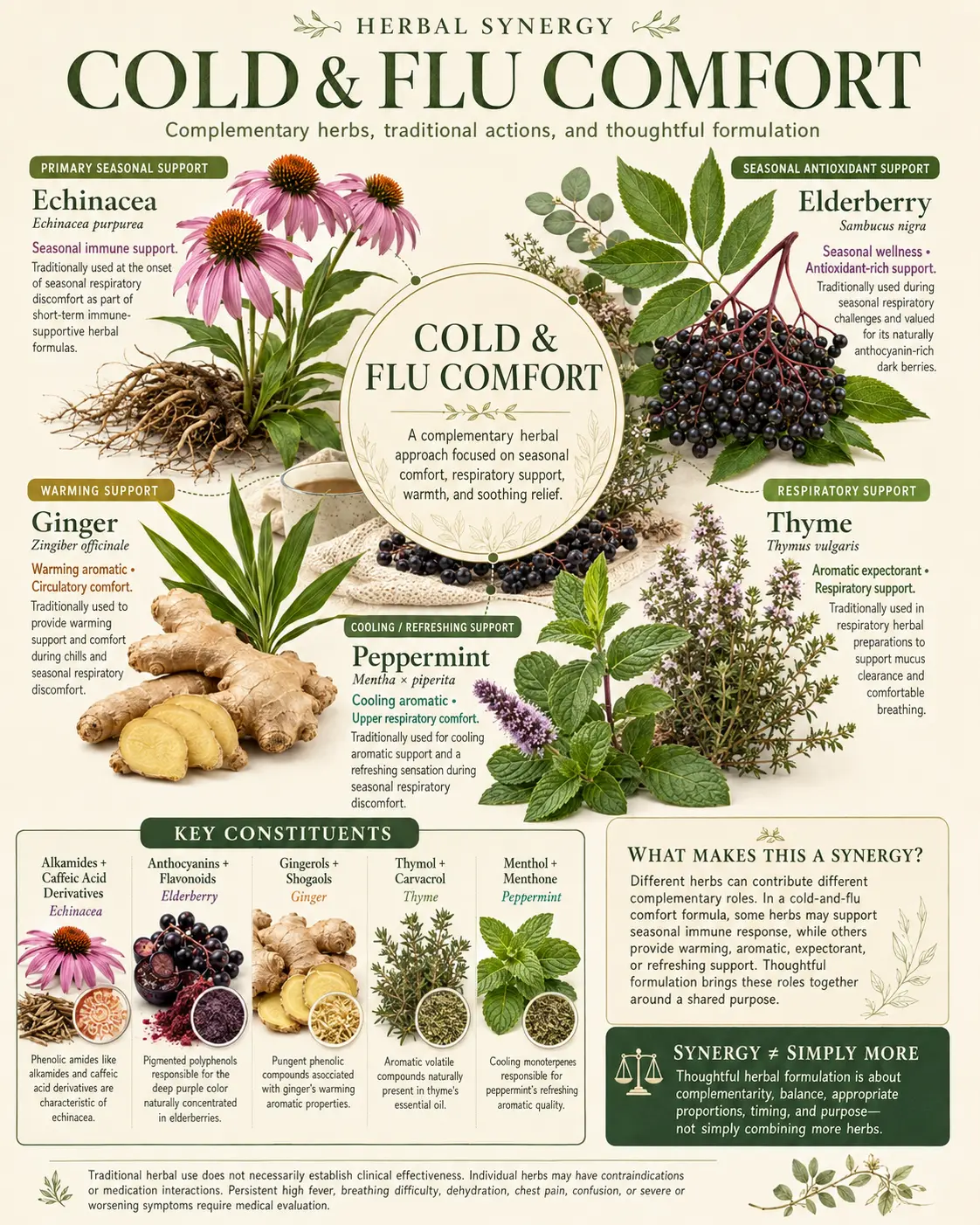
Once a cold or flu has actually taken hold, the goal shifts from prevention to comfort — easing fever and chills, calming body aches, and clearing congestion while your body does the work of fighting off the virus. Herbalists have traditionally leaned on a specific category of herbs for exactly this stage: diaphoretics, which support the sweating process that often accompanies a fever breaking.
| Herb | What It Adds |
| Elderflower | A classic diaphoretic, traditionally used to support fever and ease congestion |
| Yarrow | Traditionally the strongest diaphoretic of the three, helping bring a fever “to a head” |
| Peppermint | Cools, clears congestion, and makes the whole blend easier to actually drink |
| Elderberry | Different from elderflower — has real clinical trial evidence for reducing flu symptom severity and duration |
| Willow Bark | A traditional source of salicin, used for body aches, though evidence is stronger for chronic pain than acute flu aches |
Elderflower, yarrow, and peppermint form one of the most traditional and widely used European cold-and-flu combinations — genuinely built around supporting the fever process rather than suppressing it outright. Elderberry (from the same plant family, but a different part) is worth treating separately, since it has real clinical trial data behind it. Willow bark rounds things out for the ache-and-pain side, though its evidence is more solid for chronic pain than for acute flu aches specifically.
Recipe for Cold & Flu Comfort
Elderflower, Yarrow & Peppermint Fever Tea
Why this blend: This is one of the most traditional combinations in Western herbalism for an active fever — elderflower and yarrow both support the sweating process, while peppermint cools and makes the tea genuinely pleasant to drink while you’re feeling unwell.
Ingredients
- 1 tsp dried elderflower
- 1 tsp dried yarrow
- 1 tsp dried peppermint leaf
- 1 cup (240 ml) hot water
Yield: 1 cup
Preparation
- Combine all three herbs in a mug or infuser.
- Pour hot water over the herbs and cover the cup immediately.
- Steep, covered, for 10 minutes.
- Strain and drink hot.
How to Use Drink hot, several times throughout the day during an active fever — traditionally taken hot specifically to support sweating, rather than cooled or iced.
Herbalist’s Note This tea is traditionally taken hot on purpose — the warmth is part of how it’s meant to work, so resist the urge to let it cool before drinking.
Safety Avoid yarrow if pregnant, and use caution if you’re on blood-thinning medication — see the safety section below for details.
Ready-to-Use Products With This Synergy
Traditional Medicinals Organic Herbal Cold Care Tea Brand: Traditional Medicinals Key herbs: Elderflower, yarrow, peppermint, hyssop, ginger, cinnamon Why it fits: This is essentially the classic elderflower-yarrow-peppermint combination discussed in this article, built out into a full seasonal formula. Buy: traditionalmedicinals.com
Gaia Herbs Black Elderberry Syrup Brand: Gaia Herbs Key herbs: Organic black elderberry, acerola cherry (vitamin C) Why it fits: A concentrated elderberry syrup reflecting the form used in most clinical trials on elderberry and flu symptom reduction. Buy: gaiaherbs.com
Cold-EEZE Zinc Lozenges Brand: Cold-EEZE Key herbs: Zinc gluconate (plus homeopathic-dose sambucus, echinacea) Why it fits: A fast-acting option for the early symptomatic stage, complementing the herbal tea’s fever and comfort support with the strongest single piece of duration-shortening evidence in this category. Buy: coldeeze.com
Herbal Synergies for Cold & Flu Comfort
Not every stage of a cold or flu calls for the same support. During an active fever, warming diaphoretic herbs like elderflower and yarrow are traditionally used to support the sweating process rather than fight the fever directly. Once the acute fever has passed but congestion, aches, and general misery remain, the focus often shifts to comfort — something for the aches, something for the stuffiness, something that just makes you feel less awful. And for the flu specifically, elderberry has a research base worth reaching for separately from the traditional fever tea.
As always: synergy is about thoughtful complementarity — not simply adding more herbs to the pot.
Core Herbal Synergy Combinations
Elderflower + Yarrow + Peppermint Best for: An active fever, especially the “achy, hot, want to sweat it out” stage. Why it works: This is one of the most established traditional formulas in Western herbalism for exactly this purpose — elderflower and yarrow both support diaphoresis (sweating), while peppermint cools the whole experience and makes the tea pleasant enough to actually finish. This is the tea recipe above.
Elderberry + Zinc Best for: Active flu symptoms, where duration and severity are the main concern. Why it works: Elderberry has real (though mixed — see below) clinical trial evidence for reducing flu symptom severity and duration, while zinc has the strongest evidence of anything in this category for shortening a cold when started early. A pairing based on genuine research rather than pure tradition.
Willow Bark + Ginger Best for: Body aches and general achiness during a cold or flu. Why it works: Willow bark’s salicin content is traditionally used similarly to aspirin for aches and pain, while ginger adds warmth and its own traditional anti-inflammatory reputation. Worth noting willow bark’s strongest evidence is actually for chronic pain conditions like back pain, so treat this pairing as more traditional than clinically proven for acute flu aches specifically.
Elderflower + Peppermint + Honey Best for: A gentler, everyday comfort tea when a full fever tea feels like too much. Why it works: Drops the more intensely diaphoretic yarrow in favor of something milder, with honey adding real evidence-backed comfort for any accompanying cough. A good option for children over 12 months or anyone who prefers a gentler approach.
Herbs Used in These Synergies
Elderflower Botanical name: Sambucus nigra (flower) Traditional actions: Diaphoretic, traditionally decongestant Role in the synergy: A cornerstone of traditional European cold-and-flu formulas, generally used during active fever to support the sweating process rather than suppress the fever itself. Key constituents: Flavonoids, mucilage
Yarrow Botanical name: Achillea millefolium Traditional actions: Diaphoretic, traditionally used to “break” a fever Role in the synergy: Traditionally considered the strongest diaphoretic of this trio, working by improving circulation to the skin’s surface to support sweating. Key constituents: Sesquiterpene lactones, flavonoids
Peppermint Botanical name: Mentha × piperita Traditional actions: Cooling, decongestant Role in the synergy: Balances the warming, sweat-inducing action of elderflower and yarrow, and helps clear nasal and chest congestion at the same time. Key constituents: Menthol, menthone
Elderberry Botanical name: Sambucus nigra (berry) Traditional actions: Traditionally antiviral, immune-supportive Role in the synergy: The berry (not the flower) has real clinical trial evidence for reducing flu symptom severity and duration, though a more recent, larger emergency-room trial found no benefit — the evidence here is genuinely mixed rather than uniformly positive. Key constituents: Anthocyanins, flavonoids
Willow Bark Botanical name: Salix alba Traditional actions: Traditional analgesic, anti-inflammatory Role in the synergy: Contains salicin, a natural precursor related to aspirin’s active compound, with the clearest clinical evidence for chronic pain conditions rather than acute flu-related aches specifically. Key constituents: Salicin
Safety and When to Seek Medical Advice
Use Caution If:
- You’re pregnant — yarrow is generally avoided during pregnancy due to a theoretical miscarriage risk
- You’re taking blood-thinning medication — both yarrow and willow bark can affect bleeding risk; check with a provider before combining either with anticoagulants
- You have an aspirin allergy or salicylate sensitivity — avoid willow bark entirely, since it shares aspirin’s active mechanism
- You’re giving this to a child — never give honey to a child under 12 months, and check with a pediatrician before giving yarrow or willow bark to children at all
- You have gallstones, a bile duct obstruction, or acid reflux — some commercial cold-care tea blends include licorice or other herbs that carry their own cautions; check individual product labels
See a Healthcare Professional If: Fever is very high (above 103°F/39.4°C in adults), lasts more than three days, or is accompanied by difficulty breathing, chest pain, confusion, persistent vomiting, or a rash. These are signs that need medical evaluation rather than home herbal management — flu, in particular, can turn into complications like pneumonia that require prompt treatment.
Q&A
What’s the classic fever tea everyone talks about? Elderflower, yarrow, and peppermint — this trio has been used in Western herbalism for generations specifically to support the body through an active fever, and it’s the tea recipe featured in this article.
Is elderberry the same as elderflower? No — they’re different parts of the same plant, used differently. Elderflower is traditionally used during active fever, while elderberry (the fruit) is the part with clinical trial evidence for reducing flu symptom severity and duration.
Does elderberry actually work for the flu? The evidence is genuinely mixed. Several smaller trials found meaningfully reduced symptom duration and severity, but a larger, more recent emergency-room trial found no benefit and even suggested a possible downside in one subgroup. It’s reasonable to try, but not a guaranteed fix.
Can I combine the fever tea with zinc lozenges? Yes — they’re not redundant. The tea supports comfort and the fever process, while zinc lozenges have separate evidence for shortening the cold itself when started early.
Is willow bark a good aspirin substitute for flu aches? It’s traditionally used that way, but its actual clinical evidence is strongest for chronic conditions like back pain, not acute flu aches specifically. It’s reasonable to try, but don’t expect aspirin-level reliability.
Can I use these every day? During an active cold or flu, yes — these are typically used for the duration of the illness rather than as a long-term daily habit.
When should I see a doctor instead? If fever is very high, lasts more than three days, or comes with difficulty breathing, chest pain, confusion, or persistent vomiting — those need medical evaluation, not more tea.
References
Willow Bark Uses, Benefits & Dosage – Drugs.com
Yarrow (Achillea millefolium): Benefits, Medicinal Uses, Safety – Herbal Reality
Disclaimer
This article is for educational and informational purposes only and is not intended to diagnose, treat, cure, or prevent disease. Herbs are biologically active and may interact with medications or be inappropriate for some people. If you are pregnant, breastfeeding, taking medication, managing a health condition, or experiencing persistent or severe symptoms, consult a qualified healthcare professional before using herbal preparations.
Available Herbal Products
Explore and shop ready-made products offering this benefit.