

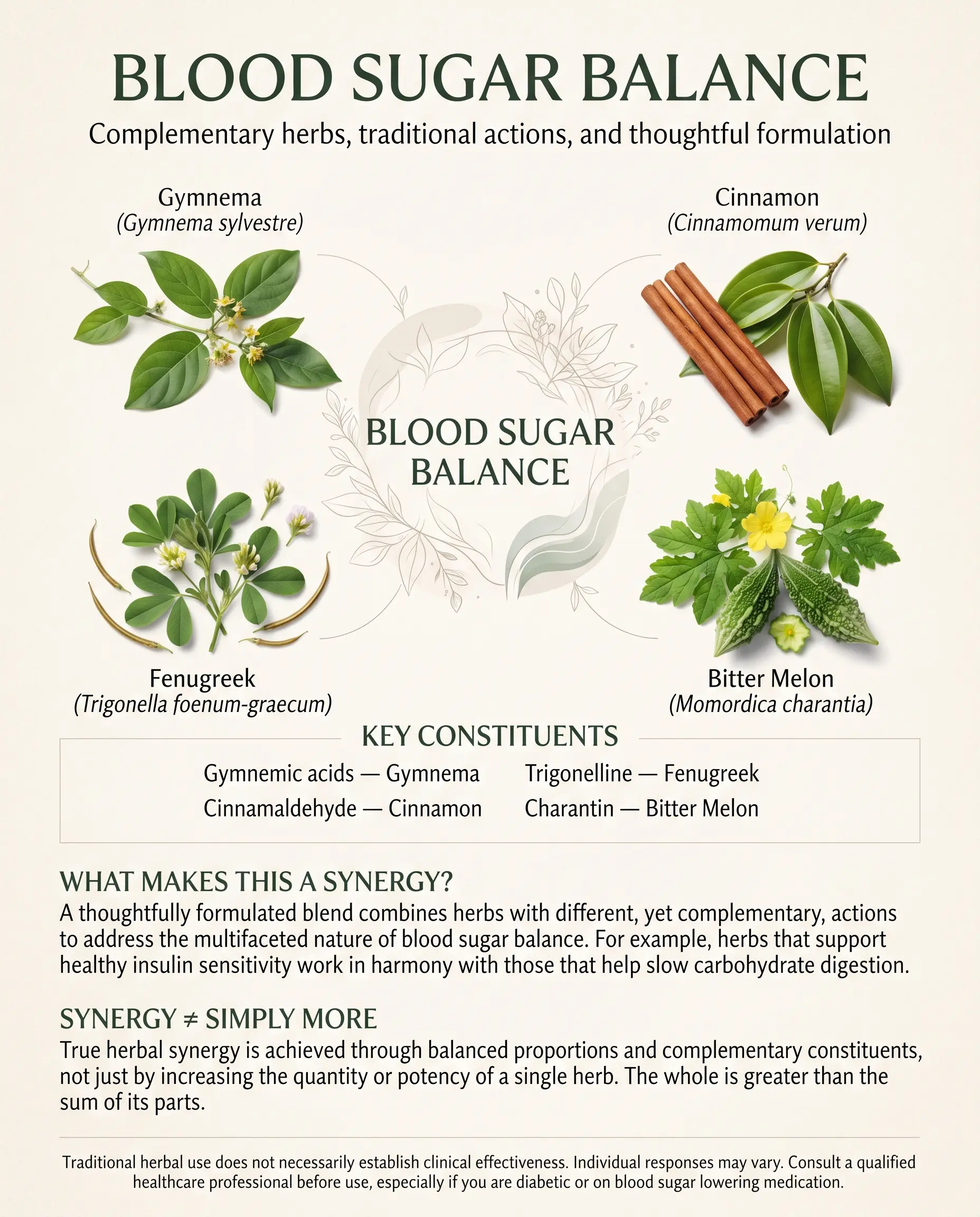
Blood sugar support is a category where the evidence is unusually strong for an herbal topic — several ingredients here have been studied head-to-head against actual diabetes medications, not just placebo. Different herbs work through different biological pathways, which is exactly why combining them thoughtfully makes sense rather than just picking the most popular one.
| Herb | What It Adds |
| Berberine | The standout here — multiple meta-analyses show effects on blood sugar comparable to metformin |
| Ceylon Cinnamon | Genuine trial support for lowering fasting glucose, working through a different mechanism than berberine |
| Fenugreek | Traditionally used to slow carbohydrate absorption, with some supportive trial evidence |
| Gymnema | Traditionally called the “sugar destroyer” in Ayurveda, with modest supportive research |
Berberine and Ceylon cinnamon are the two heavy hitters, and — unusually for this whole content series — there’s an actual clinical trial testing the combination itself, not just each herb separately. This is a category where “start simple and know what you’re taking” matters more than usual, especially given how these herbs interact with actual diabetes medications.
Recipe for Blood Sugar Balance
Ceylon Cinnamon & Fenugreek Morning Tea
Why this blend: Ceylon cinnamon has real trial support for lowering fasting glucose, and fenugreek is traditionally used to slow carbohydrate absorption after a meal — a gentle, food-based combination rather than a concentrated supplement.
Ingredients
- 1 cinnamon stick (Ceylon, not cassia — see safety note) or ½ tsp ground Ceylon cinnamon
- 1 tsp fenugreek seeds
- 1 cup (240 ml) hot water
Yield: 1 cup
Preparation
- Combine the cinnamon and fenugreek seeds in a mug or small saucepan.
- If simmering, cook gently for 5 minutes; if steeping, pour hot water over the ingredients and cover.
- Steep, covered, for 10 minutes.
- Strain and drink warm, ideally with or shortly before a meal.
How to Use Drink with breakfast or your largest meal of the day, since both herbs are traditionally used around meal timing rather than on an empty stomach.
Herbalist’s Note Always check the label specifically says Ceylon (Cinnamomum verum) — most grocery-store cinnamon is cassia, which is a different species with a real safety difference explained below.
Safety If you’re on any blood sugar medication, monitor your glucose closely when starting this — the combined effect can be stronger than either herb alone.
Ready-to-Use Products With This Synergy
Thorne Berberine-500 Brand: Thorne Key herbs: Berberine HCl Why it fits: A single-herb, high-potency berberine supplement reflecting the dose and form used in most of the clinical trials showing effects comparable to metformin. Buy: thorne.com
Gaia Herbs PRO Berberine Metabolic Brand: Gaia Herbs Key herbs: Berberine (from Indian barberry root) Why it fits: Another standardized single-herb berberine option, for readers who prefer Gaia Herbs’ sourcing and formulation style. Buy: amazon.com
Global Healing Organic Berberine with Ceylon Cinnamon & Black Pepper Brand: Global Healing Key herbs: Berberine, Ceylon cinnamon, black pepper Why it fits: A combined formula reflecting the berberine-and-cinnamon pairing that’s been specifically tested together in a 2025 randomized trial, rather than relying on two separate bottles. Buy: amazon.com
Herbal Synergies for Blood Sugar Balance
Not everyone reaching for blood sugar support has the same situation. Someone managing type 2 diabetes alongside prescribed medication needs to think carefully about additive effects and drug interactions — this is not a “more is better” category. Someone with prediabetes or general metabolic concern, without other medication, has more room to combine herbs like berberine and cinnamon, which work through different mechanisms. And someone simply wanting food-based, everyday support might reach for cinnamon and fenugreek as part of meals rather than concentrated supplements at all.
As always: synergy is about thoughtful complementarity — not simply adding more herbs to the pot.
Core Herbal Synergy Combinations
Berberine + Ceylon Cinnamon Best for: The most evidence-backed combination in this entire article, for general metabolic support. Why it works: This isn’t a guess — a 2025 randomized controlled trial specifically tested this combination in people with type 2 diabetes and found improved metabolic markers. Berberine works primarily through AMPK activation, cinnamon through insulin receptor sensitization — genuinely different pathways rather than redundant ones.
Berberine Alone Best for: The strongest single-herb option, when simplicity is preferred. Why it works: Multiple meta-analyses of randomized trials have found berberine’s effects on fasting glucose and HbA1c comparable to metformin. It’s worth being direct: this is one of the very few herbs in this whole content series where “comparable to a prescription drug” is a genuinely supportable claim, though the overall evidence base is still smaller than metformin’s decades of use.
Ceylon Cinnamon + Fenugreek Best for: A gentler, food-based, everyday approach without concentrated extracts. Why it works: Cinnamon’s glucose-lowering effect and fenugreek’s traditional role in slowing carbohydrate absorption complement each other around meal timing, without the stronger pharmacological effect (and corresponding caution) that comes with berberine. This is the tea recipe above.
Gymnema + Fenugreek Best for: Those wanting to avoid berberine specifically, perhaps due to its more significant drug interaction profile. Why it works: Both are traditional Ayurvedic herbs for blood sugar support with more modest research than berberine or cinnamon, but a gentler overall profile — a reasonable option for someone prioritizing a lower-intensity approach.
Herbs Used in These Synergies
Berberine Not a single botanical (an alkaloid found in several plants, including barberry and goldenseal) Traditional actions: Traditionally used in Ayurvedic and Chinese medicine for metabolic and digestive support Role in the synergy: The strongest evidence in this article — meta-analyses of randomized trials show effects on fasting glucose and HbA1c that have been described as comparable to metformin, working primarily through AMPK activation. Key constituents: Berberine (an isoquinoline alkaloid)
Ceylon Cinnamon Botanical name: Cinnamomum verum (also called “true cinnamon”) Traditional actions: Traditionally used for blood sugar and metabolic support Role in the synergy: Multiple meta-analyses show it meaningfully reduces fasting blood glucose, insulin resistance (HOMA-IR), and in some analyses HbA1c — genuine evidence, though more modest than berberine’s. Key constituents: Cinnamaldehyde
Fenugreek Botanical name: Trigonella foenum-graecum Traditional actions: Traditionally used to slow carbohydrate absorption Role in the synergy: A traditional support herb, with its soluble fiber content thought to slow glucose absorption after meals — a gentler, food-timing-oriented mechanism rather than a systemic pharmacological effect. Key constituents: Soluble fiber (galactomannan), 4-hydroxyisoleucine
Gymnema Botanical name: Gymnema sylvestre Traditional actions: Traditional Ayurvedic “sugar destroyer” herb Role in the synergy: Traditionally chewed or taken to reduce sugar cravings and support glucose metabolism, with modest supportive research — included here as a gentler alternative rather than a strongly evidence-backed standalone option. Key constituents: Gymnemic acids
Safety and When to Seek Medical Advice
Use Caution If:
- You’re on any diabetes medication, including insulin, metformin, or sulfonylureas — this is the single most important caution in this entire article. Berberine and cinnamon both lower blood sugar through mechanisms that can add to your medication’s effect, creating real hypoglycemia risk. Glucose monitoring and medical guidance are essential, not optional, if combining
- You’re using cassia cinnamon regularly at supplement-level doses — cassia contains meaningfully more coumarin than Ceylon cinnamon, which can affect liver function and blood clotting at higher, sustained doses; Ceylon is the safer choice for regular supplemental use
- You’re on blood-thinning medication — both berberine and cinnamon (especially cassia) carry mild interactions with anticoagulants
- You’re pregnant or breastfeeding — berberine is generally not recommended in pregnancy; check with a provider about any of these herbs
- You’re taking other medications metabolized by the liver — berberine can affect certain liver enzymes (CYP2D6, CYP2C9, CYP3A4) that process many common drugs; check for interactions with a pharmacist
See a Healthcare Professional If: You experience symptoms of hypoglycemia (shakiness, confusion, sweating, rapid heartbeat) after starting any of these herbs, your blood sugar readings are consistently outside your target range, or you’re considering these herbs as a replacement for prescribed diabetes medication rather than a complement to it. Blood sugar management is not a category where self-directed herbal use should substitute for medical supervision, especially for anyone with an existing diagnosis.
Q&A
Is berberine really as effective as metformin? Multiple meta-analyses have found its effects on fasting glucose and HbA1c comparable to metformin in head-to-head trials, which is genuinely notable. That said, metformin has decades more safety data and regulatory oversight — “comparable in trials” isn’t the same as “equivalent in overall evidence,” and berberine shouldn’t be swapped in for prescribed medication without medical guidance.
Can I take berberine with my diabetes medication? Not without your doctor’s involvement. Berberine and most diabetes medications lower blood sugar through related pathways, and combining them can cause genuinely low blood sugar. This needs medical supervision, not just careful reading.
What’s the difference between Ceylon and cassia cinnamon? Ceylon (Cinnamomum verum) contains far less coumarin, a compound that can affect the liver and blood clotting at higher doses. Cassia is what’s typically sold as generic “cinnamon” in grocery stores. For regular supplemental use, Ceylon is the safer choice.
Can I just use cinnamon from my spice cabinet? Check the label — most standard grocery-store cinnamon is cassia. For occasional culinary use, this is fine. For daily therapeutic-level use, Ceylon cinnamon specifically is the better choice given the coumarin difference.
Which combination has the best evidence? Berberine and Ceylon cinnamon together — this is one of the few combinations in this whole series that’s actually been tested as a pairing in a real clinical trial, not just assembled from separate single-herb studies.
Are these herbs safe for someone without diabetes? Generally yes, at reasonable doses, for someone using them for general metabolic support. The main caution zone is specifically for people already on blood-sugar-lowering medication, where the interaction risk is real.
When should I see a doctor instead of trying herbs? If you have symptoms of low blood sugar, your glucose readings are outside your target range, or you’re thinking about these herbs as a replacement for prescribed treatment rather than a supplement to it — this category needs medical involvement, not just herbal self-management.
References
Berberine in the Treatment of Type 2 Diabetes Mellitus: A Systemic Review and Meta-Analysis – PMC
Cinnamon Use in Type 2 Diabetes: An Updated Systematic Review and Meta-Analysis – PubMed
Is Cinnamon Toxic to the Liver? – The People’s Pharmacy
Disclaimer
This article is for educational and informational purposes only and is not intended to diagnose, treat, cure, or prevent disease. Herbs are biologically active and may interact with medications or be inappropriate for some people. If you are pregnant, breastfeeding, taking medication, managing a health condition, or experiencing persistent or severe symptoms, consult a qualified healthcare professional before using herbal preparations.
Available Herbal Products
Explore and shop ready-made products offering this benefit.