

What Yellow Dock Is Good For
Sluggish digestion — Yellow dock root is traditionally used as a bitter digestive tonic. Its bitter anthraquinone-related compounds may encourage digestive activity and bowel movement, although high-quality human clinical evidence is lacking.
Occasional constipation — The root contains anthraquinone derivatives related to those found in other stimulant-laxative plants. Yellow dock is generally considered gentler than senna or cascara, but it can still loosen stools and should not be used as a daily laxative.
Traditional liver & digestive support — Western herbalists commonly use yellow dock in formulas intended to support digestion and normal elimination. This “alterative” or cleansing use is traditional rather than supported by modern clinical trials.
Traditional skin support — Yellow dock has historically been paired with herbs such as burdock and cleavers when skin complaints are thought to accompany sluggish digestion or elimination. Evidence for directly improving skin conditions is insufficient.
Antioxidant support — experimental — Root extracts contain anthraquinones, flavonoids, and phenolic compounds with antioxidant activity in laboratory research.
Available Herbal Products
Buying Guides for Available Yellow Dock Products
Yellow Dock Liquid Herbal Extract – Certified-organic Rumex crispus root tincture with a 1:5 herb-to-menstruum ratio. A concentrated bitter liquid preparation for people who prefer flexible dosing over capsules. Seller: Herb Pharm – View Herb Pharm Yellow Dock →
Yellow Dock Alcohol-Free Extract – Concentrated 1:1 liquid root extract providing the equivalent of 2,000 mg yellow dock per serving. A useful option for people who prefer an alcohol-free liquid preparation. Seller: Nature’s Answer – View Nature’s Answer Yellow Dock →
Organic Yellow Dock Extract – Certified-organic Rumex crispus root tincture prepared at a 1:4 ratio with organic alcohol and water. Currently listed in stock. Seller: Oregon’s Wild Harvest – View Oregon’s Wild Harvest Yellow Dock →
Yellow Dock Root Cut & Sifted – Wildcrafted dried Rumex crispus root suitable for decoction, tincture making, and custom herbal formulas. Seller: Monterey Bay Herb Co. – View Monterey Bay Herb Co. Yellow Dock Root →
Yellow Dock Root Powder – Finely powdered Rumex crispus root suitable for capsules, poultices, or custom preparations. Seller: Monterey Bay Herb Co. – View Monterey Bay Herb Co. Yellow Dock Root Powder →
Herbal Synergies
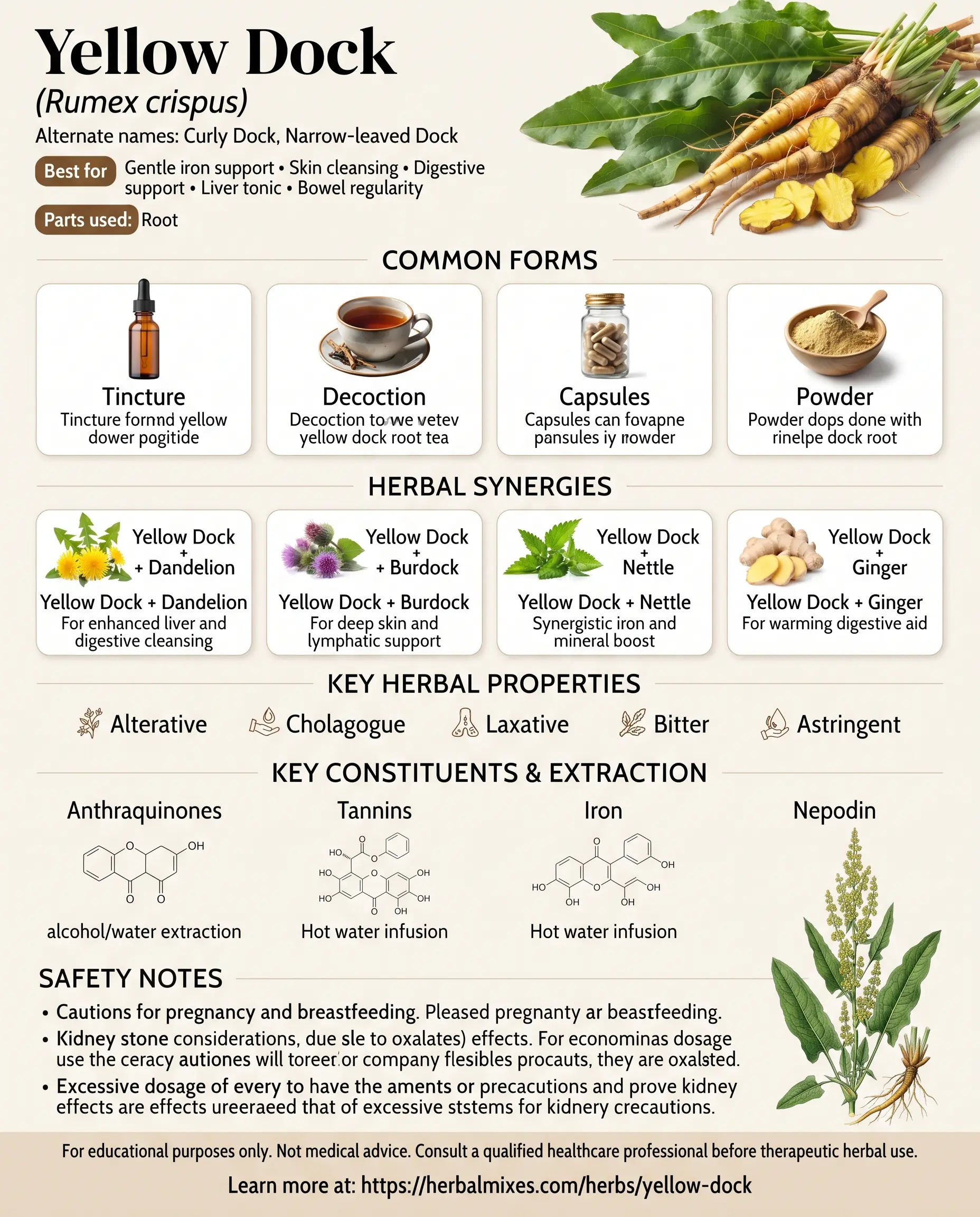
Yellow dock pairs especially well with dandelion root, burdock root, ginger, cleavers, and marshmallow root depending on whether the goal is digestion, elimination, skin support, or bowel comfort.
Yellow Dock + Dandelion Root
Best for: Sluggish digestion and bitter digestive support
Yellow dock contributes stronger anthraquinone-related bowel stimulation, while dandelion root adds gentler bitter and digestive support.
Best extraction: Decoction or tincture. Both roots tolerate heat well, while alcohol-water extraction captures a broader range of bitter and phenolic compounds.
Yellow Dock + Burdock Root
Best for: Traditional skin and elimination support
Both herbs are commonly used in traditional alterative formulas. Burdock contributes inulin and polyphenols, while yellow dock adds bitter digestive and mild laxative activity.
Best extraction: Decoction. Both roots are dense and extract well with prolonged simmering.
Yellow Dock + Ginger
Best for: Sluggish digestion with bloating
Yellow dock provides bitter and bowel-stimulating activity, while ginger adds warming carminative and anti-nausea effects.
Best extraction: Yellow dock tincture or decoction combined with ginger tea or tincture.
Yellow Dock + Cleavers
Best for: Traditional skin and lymphatic formulas
Yellow dock contributes digestive and elimination support, while cleavers is traditionally used for lymphatic and fluid-movement support.
Best extraction: Use separate preparations when practical—yellow dock as decoction or tincture and cleavers as fresh-plant tincture or cold infusion.
Yellow Dock + Marshmallow Root
Best for: Constipation accompanied by dry or irritated digestive tissues
Yellow dock may encourage bowel movement, while marshmallow root contributes soothing mucilage.
Best extraction: Prepare yellow dock as a decoction or tincture and marshmallow separately as a cold infusion, then combine.
Key Herbal Properties
Bitter — Yellow dock root has a pronounced bitter quality that supports its traditional use as a digestive tonic.
Mild laxative — Anthraquinone derivatives may stimulate intestinal motility and contribute to looser stools.
Alterative — traditional — Western herbalists traditionally use yellow dock in formulas aimed at supporting normal elimination and skin health.
Digestive — Bitter and anthraquinone constituents contribute to its use for sluggish digestion.
Astringent — Tannins temper some of the laxative activity and contribute tissue-tightening effects.
Antioxidant — experimental — Anthraquinones, flavonoids, catechin, and gallic acid demonstrate antioxidant activity in laboratory studies.
Anti-inflammatory — experimental — Root extracts have reduced inflammatory mediators in cell studies, but this has not been established clinically.







Active Compounds
Yellow dock root contains anthraquinone glycosides and aglycones, flavonoids, tannins, phenolic acids, sterols, and oxalates. Anthraquinones are especially important to its laxative and digestive profile.
Emodin
Found mainly in: Root
Emodin is an anthraquinone found in Rumex crispus and several other laxative herbs. It has experimental laxative, antimicrobial, and inflammatory-modulating effects.
Best extraction: Hydroalcoholic extraction. Emodin is less water soluble than many simple phenolics and is more efficiently recovered with alcohol-containing solvents.
Chrysophanol
Found mainly in: Root
Chrysophanol is another major anthraquinone identified in yellow dock root.
It contributes to the broader stimulant-laxative and experimental antimicrobial profile.
Best extraction: Hydroalcoholic or alcohol-rich extraction.
Physcion
Found mainly in: Root
Physcion is a related anthraquinone found alongside emodin and chrysophanol.
Best extraction: Hydroalcoholic extraction.
Anthraquinone Glycosides
Found mainly in: Root
Yellow dock contains glycosides of emodin, chrysophanol, and physcion.
These forms can break down during extraction, especially with prolonged heat and water exposure, converting into their corresponding aglycones.
Best extraction: Controlled hydroalcoholic extraction. Prolonged high-temperature extraction can alter the natural glycoside profile.
Catechin
Found mainly in: Root and aerial tissues
Catechin contributes antioxidant activity and mild astringency.
Best extraction: Hot water or diluted alcohol.
Quercetin
Found mainly in: Root and aerial tissues
Quercetin and related flavonoids contribute antioxidant and inflammatory-modulating effects.
Best extraction: Hydroalcoholic extraction or hot water.
Gallic Acid
Found mainly in: Root
Gallic acid contributes antioxidant and astringent activity.
Best extraction: Water or hydroalcoholic extraction.
Tannins
Found mainly in: Root
Tannins contribute astringency and may partially balance the root’s anthraquinone-related laxative effect.
Best extraction: Hot water.
-
FAQ
What is yellow dock best used for?
Yellow dock is best described as a traditional bitter digestive and mild laxative root used for sluggish digestion and occasional constipation.
Its traditional “liver cleansing” and skin-support uses are much less well supported clinically.
Does yellow dock contain iron?
Yellow dock is often marketed as an “iron-rich” herb, but that claim is frequently overstated.
It should not be used as a substitute for an iron supplement or medical treatment for iron-deficiency anemia unless a clinician has confirmed that approach.
Is yellow dock a strong laxative?
Usually not as strong as senna or cascara, but its anthraquinone compounds can still stimulate bowel activity.
People who develop cramping or diarrhea should stop use.
Can yellow dock be used every day?
Regular long-term use is not well studied.
Because the root contains anthraquinones, oxalates, and tannins, it is better suited to short-term or practitioner-guided use rather than indefinite daily supplementation.
Is tincture or decoction better?
A tincture extracts the anthraquinone fraction more broadly, while a decoction is a traditional whole-root preparation that also extracts tannins and water-soluble constituents.
Safety & Precautions
Yellow dock has limited modern clinical safety data, and several constituents justify caution.
Possible adverse effects include:
- abdominal cramping;
- diarrhea;
- nausea;
- digestive irritation.
Kidney Stones & Kidney Disease
Yellow dock contains oxalates, including oxalic acid and calcium oxalate.
Use caution or avoid concentrated preparations if you have:
- a history of calcium oxalate kidney stones;
- chronic kidney disease;
- impaired kidney function.
Herb Pharm specifically advises caution in people with kidney stones.
Intestinal Obstruction & Unexplained Abdominal Pain
Because yellow dock can have laxative effects, avoid it in:
- intestinal obstruction;
- severe unexplained abdominal pain;
- acute inflammatory bowel symptoms;
- persistent vomiting.
Do not use stimulant-laxative herbs when bowel obstruction is possible.
Pregnancy & Breastfeeding
Concentrated yellow dock is generally not recommended during pregnancy or breastfeeding because adequate safety data are lacking and anthraquinone laxatives may stimulate intestinal activity.
Oregon’s Wild Harvest advises against use during pregnancy or nursing.
Diarrhea & Electrolytes
Excessive use may cause diarrhea.
Repeated diarrhea can contribute to:
- dehydration;
- potassium loss;
- electrolyte imbalance.
This is especially important for older adults and people taking diuretics or heart medications.
Medication Interactions
Clinically established interactions are poorly studied.
Use caution with:
- prescription laxatives;
- diuretics;
- digoxin and other medications sensitive to potassium changes;
- medicines affected by rapid intestinal transit.
Tannins may also reduce absorption of some medications or minerals when taken at the same time.
Separating yellow dock from prescription medicines by a few hours is a reasonable precaution unless a healthcare professional advises otherwise.
Iron-Deficiency Anemia
Do not rely on yellow dock to correct anemia.
Iron deficiency can result from gastrointestinal bleeding, heavy menstrual bleeding, malabsorption, poor dietary intake, or other medical conditions that require diagnosis.
Long-Term Constipation
Persistent constipation warrants evaluation rather than repeated laxative use, especially if accompanied by:
- blood in stool;
- unexplained weight loss;
- severe abdominal pain;
- vomiting;
- sudden bowel-habit changes;
- anemia.
Anyone who is pregnant, breastfeeding, taking prescription medications, or managing kidney disease, kidney stones, bowel disorders, or persistent constipation should discuss therapeutic yellow dock use with an appropriate healthcare professional.
References
- Kew Medicinal Plant Names Services — Yellow Dock / Rumex crispus
- PubMed — Chemical Constituents of Rumex crispus
- PubMed — Anthraquinones and Antioxidant/Anti-Inflammatory Activity of Rumex crispus Root
- PubMed — Hydrolytic Stability of Anthraquinone Glycosides in Rumex crispus
- Drugs.com — Yellow Dock Clinical Overview
- Herb Pharm — Yellow Dock
- Nature’s Answer — Yellow Dock Alcohol-Free Extract
- Oregon’s Wild Harvest — Organic Yellow Dock Extract
- Monterey Bay Herb Co. — Yellow Dock Root
- Monterey Bay Herb Co. — Yellow Dock Root Powder
Disclaimer
Disclaimer: This article is for educational purposes only and is not intended to diagnose, treat, cure, or prevent any disease. Herbal products can cause side effects and interact with medications. Consult a qualified healthcare professional before using herbs therapeutically, especially if you are pregnant, breastfeeding, taking prescription medications, or managing a medical condition.