

What Wormwood Is Good For
Temporary loss of appetite — Wormwood is one of the classic bitter herbs. EMA recognizes traditional use for temporary appetite loss, with its intense bitterness thought to stimulate digestive secretions and appetite. (European Medicines Agency (EMA))
Sluggish digestion — Wormwood is traditionally used when digestion feels slow or heavy. Its bitter sesquiterpene lactones help explain its long-standing use as a digestive stimulant.
Mild bloating & gas — Wormwood has traditional carminative and digestive use for mild gastrointestinal discomfort, especially when symptoms accompany poor appetite or sluggish digestion. (European Medicines Agency (EMA))
Mild heartburn or stomach discomfort — traditional use — EMA includes mild heartburn and gastrointestinal disorders among wormwood’s traditional indications, while also noting that supporting clinical trials are lacking. (European Medicines Agency (EMA))
Inflammatory digestive support — preliminary evidence — Small clinical studies have investigated wormwood in Crohn’s disease and reported improvements in inflammatory markers and symptoms, but these were limited studies involving people under medical treatment and do not establish wormwood as a treatment for inflammatory bowel disease. (PubMed)
Available Herbal Products
Buying Guides for Available Wormwood Products
Wormwood Liquid Herbal Extract – Fresh flowering aerial-part tincture made from certified-organic Artemisia absinthium. A concentrated bitter preparation intended for short-term digestive support. Seller: Herb Pharm – View Herb Pharm Wormwood →
Organic Wormwood Capsules – Organic Artemisia absinthium aerial parts in vegan capsules. A practical option for people who dislike wormwood’s extremely bitter flavor. Seller: Oregon’s Wild Harvest / Vitacost – View Oregon’s Wild Harvest Wormwood →
Wormwood 450 mg Capsules – Single-herb wormwood capsules currently available online. A simple capsule form for short-term use when a liquid bitter is not preferred. Seller: Nutricost / Vitacost – View Nutricost Wormwood →
Wormwood Herb Tincture – Cold-extracted Artemisia absinthium liquid preparation made from dried herb. This particular product is labeled for external use only, so it should not be substituted for an internal medicinal tincture. Seller: HawaiiPharm – View HawaiiPharm Wormwood Tincture →
Starwest Botanicals currently lists both its organic cut-and-sifted wormwood and wormwood powder as out of stock, so they are not included above as current buying recommendations. (Starwest Botanicals)
Herbal Synergies
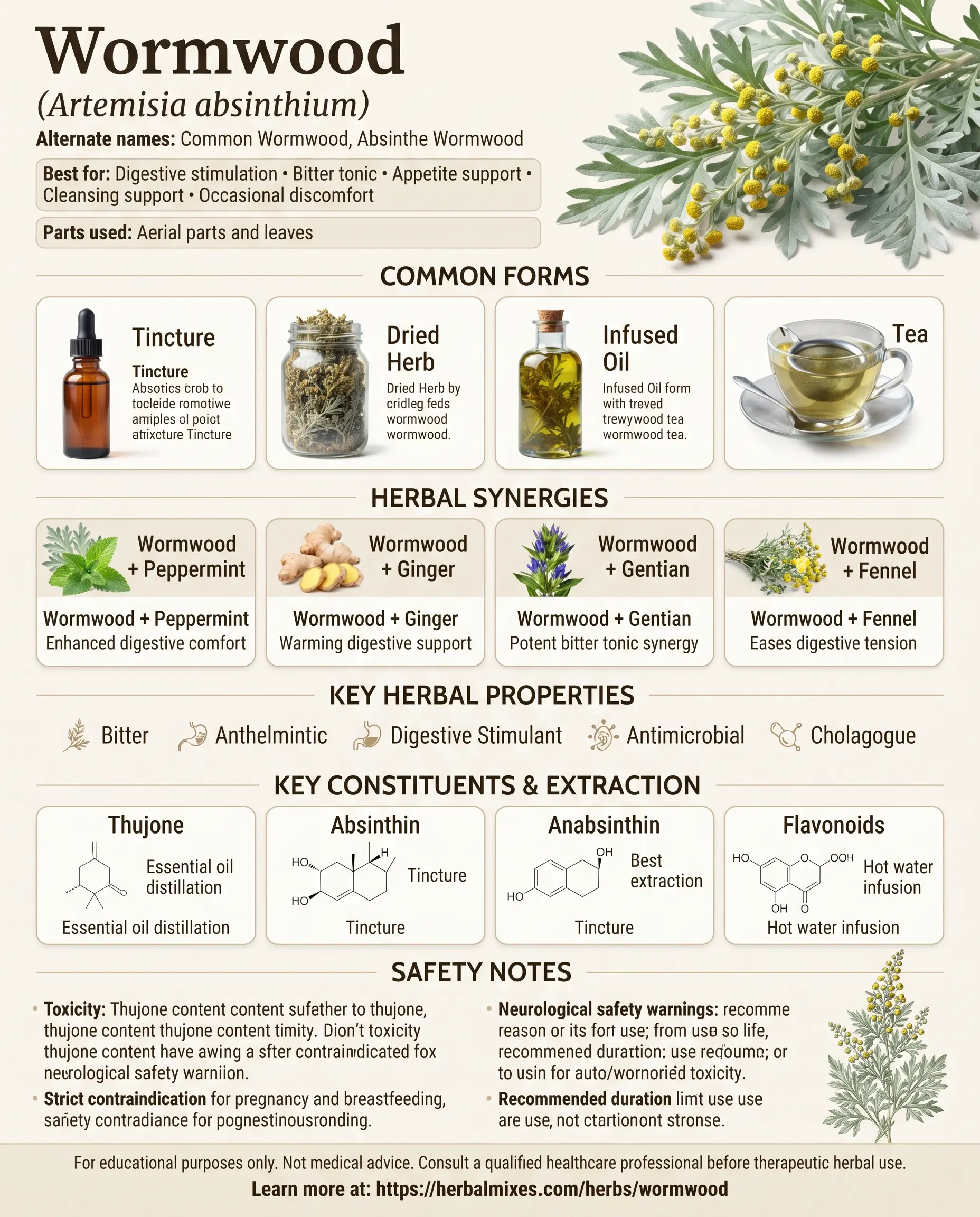
Wormwood pairs especially well with gentian, ginger, peppermint, fennel, and dandelion root depending on whether the goal is appetite, sluggish digestion, gas, or post-meal heaviness.
Wormwood + Gentian
Best for: Poor appetite and sluggish digestion
Both herbs are intensely bitter and stimulate digestive activity. Gentian reinforces bitter signaling without adding wormwood’s thujone-related safety concerns.
Best extraction: Tincture or low-volume bitter extract. Alcohol-water preparations efficiently capture bitter sesquiterpene lactones and other digestive constituents.
Wormwood + Ginger
Best for: Sluggish digestion with nausea or coldness
Wormwood contributes strong bitter digestive stimulation, while ginger adds warming carminative and anti-nausea activity.
Best extraction: Wormwood tincture combined with ginger tea or tincture.
Wormwood + Peppermint
Best for: Bloating, gas, and digestive tension
Wormwood stimulates digestion, while peppermint provides carminative and antispasmodic activity that may help with cramping and gas.
Best extraction: Wormwood tincture paired with a covered peppermint infusion.
Wormwood + Fennel
Best for: Gas and post-meal heaviness
Wormwood adds bitter digestive stimulation, while fennel contributes sweeter aromatic carminative activity and helps balance wormwood’s intense bitterness.
Best extraction: Wormwood as a measured tincture combined with fennel tea.
Wormwood + Dandelion Root
Best for: Sluggish digestion and poor appetite
Both herbs support bitter digestive signaling, while dandelion root provides a gentler background bitter suitable for broader digestive formulas.
Best extraction: Tincture or decoction combination, with wormwood used conservatively.
Key Herbal Properties
Bitter — Wormwood is one of the strongest bitter herbs commonly used in Western herbalism and may stimulate appetite and digestive secretions.
Digestive — EMA recognizes traditional use for appetite loss and mild gastrointestinal complaints. (European Medicines Agency (EMA))
Carminative — traditional — Aromatic volatile compounds complement its bitter action in formulas for gas and digestive discomfort.
Antimicrobial — experimental — Wormwood extracts and essential oil demonstrate antibacterial and antifungal effects in laboratory research, but this is not an established clinical indication. (PubMed)
Anti-inflammatory — experimental / preliminary clinical evidence — Several constituents influence inflammatory signaling, and small Crohn’s-disease trials reported reductions in inflammatory activity. (PubMed)
Antioxidant — Flavonoids, phenolic acids, and related compounds contribute antioxidant activity.
Anthelmintic — traditional / experimental — Wormwood has a historical reputation in parasite formulas, but modern human evidence is insufficient to recommend self-treatment of intestinal parasites.








Active Compounds
Wormwood’s chemistry is dominated by bitter sesquiterpene lactones, volatile monoterpenes, flavonoids, phenolic acids, azulenes, tannins, and lignans. (PubMed)
Absinthin
Found mainly in: Leaves and flowering aerial parts
Absinthin is one of wormwood’s characteristic intensely bitter sesquiterpene lactones and contributes strongly to its appetite-stimulating and digestive reputation.
Best extraction: Hydroalcoholic tincture. Absinthin extracts efficiently into alcohol-water mixtures.
Anabsinthin
Found mainly in: Aerial herb
Anabsinthin is another bitter guaianolide associated with wormwood’s characteristic flavor and digestive action.
Best extraction: Hydroalcoholic extraction.
Alpha-Thujone
Found mainly in: Essential oil fraction
Alpha-thujone is a monoterpene ketone and one of wormwood’s most important safety-related compounds.
At sufficiently high exposure, thujone is neurotoxic and can provoke seizures, which is why low-thujone preparations are preferred and medicinal intake is restricted. (European Medicines Agency (EMA))
Best extraction: Steam distillation concentrates thujone and is therefore not appropriate for casual internal use. Internal medicinal products should control rather than maximize thujone exposure.
Beta-Thujone
Found mainly in: Essential oil
Beta-thujone is closely related to alpha-thujone and contributes to the same safety concerns.
Best extraction: Steam distillation, but concentrated essential oil should not be used internally without specialized professional oversight.
Artemisetin
Found mainly in: Aerial herb
Artemisetin is a flavonoid identified in wormwood and contributes to its broader antioxidant profile.
Best extraction: Hydroalcoholic extraction.
Guaiazulene
Found mainly in: Essential-oil and azulene fraction
Guaiazulene is an azulene-related aromatic compound associated with anti-inflammatory and antioxidant activity.
Best extraction: Steam distillation or alcohol-rich extraction.
Phenolic Acids
Found mainly in: Leaves and aerial parts
Wormwood contains several phenolic acids that contribute antioxidant activity.
Best extraction: Hot water or diluted alcohol.
Tannins
Found mainly in: Aerial herb
Tannins add mild astringency to wormwood’s overwhelmingly bitter profile.
Best extraction: Hot water.
FAQ
What is wormwood best used for?
Its clearest traditional medicinal roles are temporary appetite loss and mild digestive complaints such as sluggish digestion, mild gas, and stomach discomfort. EMA formally recognizes these uses as traditional rather than clinically established. (European Medicines Agency (EMA))
Is wormwood good for parasites?
Wormwood has a long traditional reputation as an anthelmintic and shows antiparasitic activity experimentally, but reliable modern human evidence for treating intestinal parasites is insufficient.
Suspected parasitic infections should be properly diagnosed rather than treated with prolonged wormwood “cleanses.”
Is wormwood the same as sweet wormwood?
No.
Wormwood is Artemisia absinthium. Sweet wormwood is Artemisia annua, the plant from which the antimalarial drug artemisinin was originally isolated. Their chemistry and medicinal uses are different.
Can wormwood be taken every day?
It is better suited to short-term use.
EMA limits medicinal wormwood preparations to adults and advises medical evaluation if symptoms persist beyond two weeks. Thujone-containing preparations should be used for the shortest appropriate duration. (European Medicines Agency (EMA))
Can wormwood essential oil be swallowed?
It should not be used casually internally.
The essential oil can concentrate thujone, a neurotoxic compound associated with seizures at excessive exposure.
Safety & Precautions
Wormwood requires more caution than ordinary culinary bitters because some preparations contain alpha- and beta-thujone, compounds with neurotoxic potential. (European Medicines Agency (EMA))
EMA recommends choosing preparations with low thujone content and limiting exposure. Its thujone safety statement established a medicinal maximum of 3 mg thujone per person per day for wormwood preparations, for no longer than two weeks. (European Medicines Agency (EMA))
Pregnancy & Breastfeeding
Do not use medicinal wormwood during pregnancy or breastfeeding.
EMA specifically advises against use because safety data are lacking and thujone has uterus-stimulating activity; animal studies have also raised reproductive-safety concerns. (European Medicines Agency (EMA))
Seizure Disorders
Avoid wormwood if you have epilepsy or another seizure disorder.
Thujone can antagonize GABA-related nervous-system signaling and may provoke convulsions at excessive exposure.
Avoid combining high-thujone preparations with medications that lower seizure threshold unless specifically approved by a healthcare professional.
Liver Disease
EMA states that wormwood should not be used in people with liver disease. (European Medicines Agency (EMA))
Gallbladder & Biliary Conditions
Do not use wormwood with:
- bile-duct obstruction;
- cholangitis;
- serious biliary disease.
People with gallstones or other gallbladder disorders should seek medical advice before use because bitter herbs may stimulate digestive and biliary activity. (European Medicines Agency (EMA))
Asteraceae Allergy
Avoid wormwood if you are allergic to plants in the Asteraceae family, which includes ragweed, chamomile, chrysanthemum, yarrow, and related species.
Children & Adolescents
EMA does not recommend medicinal wormwood for children or adolescents. (European Medicines Agency (EMA))
Driving & Attention
EMA’s safety assessment notes that higher thujone exposures may affect attention and mood, and advises caution with driving or machinery after medicinal wormwood preparations. (European Medicines Agency (EMA))
Essential Oil
Do not swallow wormwood essential oil.
Steam distillation can strongly concentrate thujone compared with ordinary tea or appropriately controlled herbal extracts.
Long-Term “Parasite Cleanses”
Avoid prolonged homemade wormwood regimens marketed as parasite cleanses.
There is insufficient clinical evidence to justify extended exposure, while thujone-related neurological risk increases the importance of limiting duration.
Anyone who is pregnant, breastfeeding, under 18, taking prescription medication, managing seizures, liver disease, gallbladder disease, or persistent digestive symptoms should discuss wormwood use with an appropriate healthcare professional.
References
- European Medicines Agency — Wormwood Herb
- EMA — European Union Herbal Monograph on Artemisia absinthium
- EMA — Assessment Report on Artemisia absinthium
- EMA — Public Statement on Herbal Medicines Containing Thujone
- PubMed — Artemisia absinthium: Phytochemistry and Therapeutic Uses
- PubMed — Bioactive Compounds and Pharmacology of Wormwood
- PubMed — Wormwood and Crohn’s Disease: Controlled Clinical Trial
- PubMed — Wormwood, TNF-Alpha and Crohn’s Disease
- Herb Pharm — Wormwood Liquid Herbal Extract
- Oregon’s Wild Harvest / Vitacost — Organic Wormwood
Disclaimer
Disclaimer: This article is for educational purposes only and is not intended to diagnose, treat, cure, or prevent any disease. Herbal products can cause side effects and interact with medications. Consult a qualified healthcare professional before using herbs therapeutically, especially if you are pregnant, breastfeeding, taking prescription medications, or managing a medical condition.