

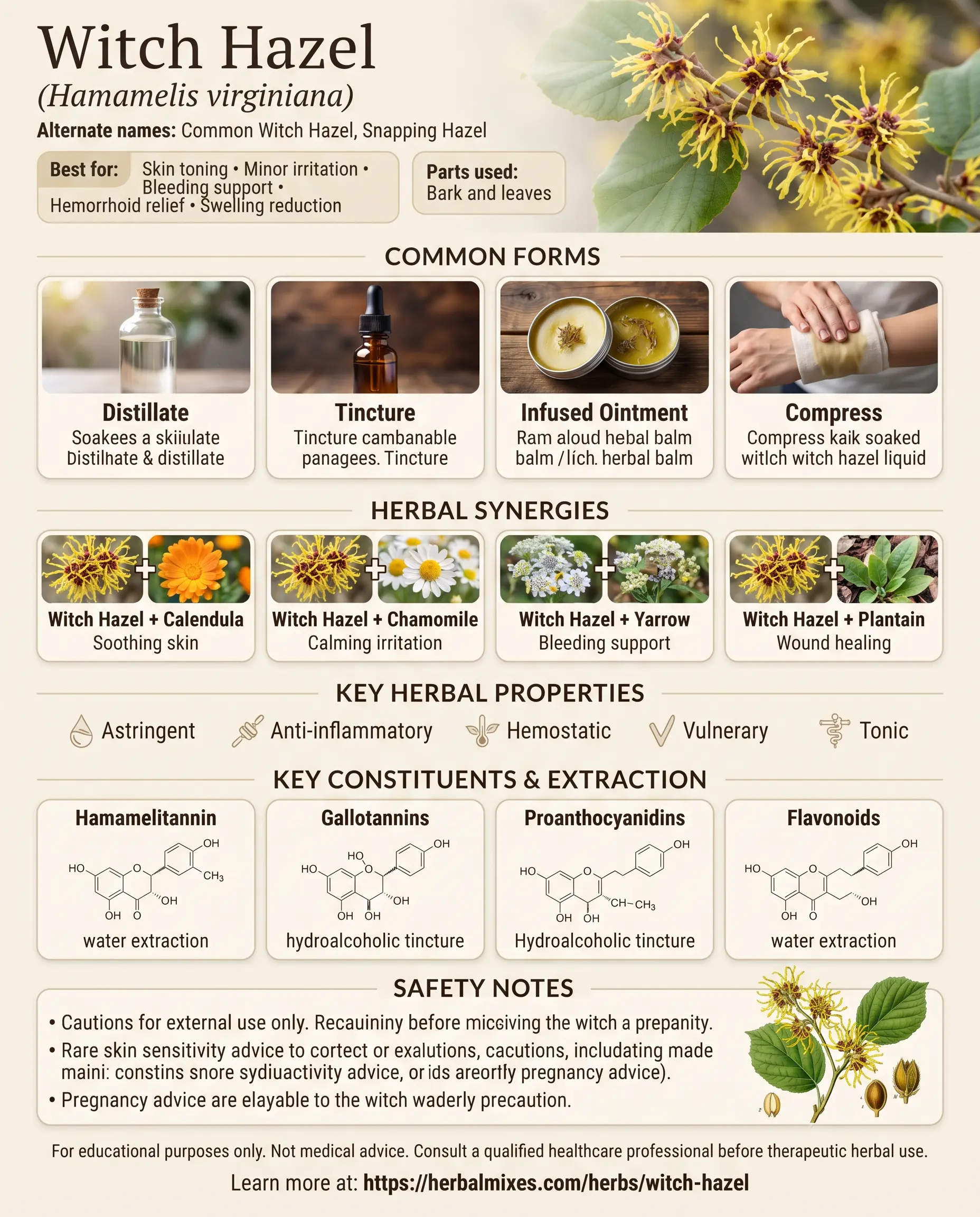
What Witch Hazel Is Good For
Minor skin irritation — Witch hazel is best known as a topical astringent for irritated, inflamed, or mildly damaged skin. EMA recognizes witch hazel leaf preparations for skin disorders, minor wounds, and circulatory complaints. (European Medicines Agency (EMA))
Redness & inflammation — Tannins, flavonoids, and phenolic compounds contribute anti-inflammatory and antioxidant activity. Modern reviews describe encouraging evidence for topical skin-soothing effects, although large clinical trials remain limited. (PubMed)
Hemorrhoid discomfort — Witch hazel is traditionally used externally for itching, irritation, and discomfort around hemorrhoids because of its astringent and soothing properties.
Minor cuts & abrasions — Topical preparations have longstanding traditional use for superficial wounds and skin irritation. Witch hazel should not be applied as a substitute for proper care of deep, infected, or heavily bleeding wounds.
Oily or blemish-prone skin — Witch hazel is widely used in facial toners because its tannins create an astringent effect that can temporarily make skin feel tighter and reduce surface oiliness. Alcohol-free preparations are generally gentler for frequent facial use.
Available Herbal Products
Buying Guides for Available Witch Hazel Products
Witch Hazel Liquid Herbal Extract – Alcohol-based extract made from responsibly wildcrafted Hamamelis virginiana leaves and young twigs. A concentrated internal-style herbal extract rather than a cosmetic toner. Seller: Herb Pharm – View Herb Pharm Witch Hazel →
Unscented Witch Hazel Facial Toner – Alcohol-free topical toner containing witch hazel bark/leaf/twig extract with aloe vera and glycerin. A practical choice for sensitive or easily irritated facial skin. Seller: Thayers – View Thayers Unscented Facial Toner →
Original Witch Hazel Facial Toner – Alcohol-free witch hazel and aloe toner designed for daily facial cleansing and skin toning without drying alcohol. Seller: Thayers – View Thayers Original Facial Toner →
Unscented Witch Hazel Facial Toner Mist – Alcohol-free witch hazel mist with aloe and glycerin. A convenient lighter-format option for refreshing or soothing facial skin during the day. Seller: Thayers – View Thayers Unscented Toner Mist →
For frequent facial use, alcohol-free witch hazel is usually preferable to strongly alcohol-containing astringents, especially for dry, reactive, or sensitive skin.
Herbal Synergies
Witch hazel pairs especially well with aloe vera, calendula, chamomile, rose, and plantain depending on whether the goal is redness, minor irritation, oily skin, or superficial wound support.
Witch Hazel + Aloe Vera
Best for: Red, irritated, or combination skin
Witch hazel contributes astringent tannins, while aloe vera adds cooling, hydrating, and soothing polysaccharides.
Best extraction: Topical water-based gel, toner, or lotion. This combination is especially suitable when you want astringency without excessive dryness.
Witch Hazel + Calendula
Best for: Minor superficial skin irritation
Witch hazel adds astringent and anti-inflammatory activity, while calendula contributes vulnerary and tissue-soothing properties.
Best extraction: Topical wash, cream, or compress. Calendula-infused oil can also be incorporated separately into creams.
Witch Hazel + Chamomile
Best for: Sensitive or inflamed skin
Witch hazel provides tannins and antioxidant polyphenols, while chamomile contributes soothing flavonoids and sesquiterpenes.
Best extraction: Water-based compress or topical cream.
Witch Hazel + Rose
Best for: Facial toning and mildly reactive skin
Witch hazel provides astringency, while rose contributes aromatic and soothing polyphenols.
Best extraction: Alcohol-free hydrosol or toner formulation.
Witch Hazel + Plantain Leaf
Best for: Minor bites, abrasions, and irritated skin
Both herbs offer astringent and soothing properties, while plantain adds mucilage and allantoin-related tissue support.
Best extraction: Cool infusion or topical compress.
Key Herbal Properties
Astringent — This is witch hazel’s defining herbal property. Its tannins tighten and tone superficial tissues and reduce weeping or irritation.
Anti-inflammatory — Witch hazel extracts influence inflammatory signaling and can help calm redness and irritation. (PubMed)
Antioxidant — Flavonoids, catechins, proanthocyanidins, and phenolic acids contribute antioxidant activity. (PubMed)
Vulnerary — Traditionally used externally to support minor wounds and irritated tissues.
Venotonic supportive — traditional — Witch hazel has longstanding use in preparations for hemorrhoids and superficial venous discomfort.
Antimicrobial — experimental — Laboratory research suggests activity against selected bacteria and fungi, but witch hazel should not be viewed as a replacement for antimicrobial treatment. (PubMed)





Active Compounds
Witch hazel’s effects are driven primarily by tannins, proanthocyanidins, flavonoids, catechins, and phenolic acids. Bark and leaf are not chemically identical.
Hamamelitannin
Found mainly in: Bark
Hamamelitannin is one of witch hazel’s characteristic hydrolyzable tannins and contributes strongly to its astringent chemistry.
Research found bark extract to contain substantially more hamamelitannin than leaf or stem extract. (PubMed)
Best extraction: Water or hydroalcoholic extraction. Tannins are highly compatible with water-based preparations.
Proanthocyanidins
Found mainly in: Bark and leaves
These condensed tannins contribute astringency, antioxidant activity, and vascular-supportive effects.
Best extraction: Hot water or hydroalcoholic extraction.
Catechins
Found mainly in: Leaves and bark
Catechin-type flavanols add antioxidant and anti-inflammatory activity.
Best extraction: Hot water or diluted alcohol.
Quercetin Derivatives
Found mainly in: Leaves
Quercetin-related flavonoids contribute antioxidant and inflammatory-modulating effects.
Best extraction: Hot water or hydroalcoholic extraction.
Gallic Acid
Found mainly in: Bark and leaves
Gallic acid is a phenolic compound associated with antioxidant and astringent activity.
Best extraction: Water or diluted alcohol.
Ellagitannins
Found mainly in: Bark
Ellagitannin-type compounds add to witch hazel’s strong astringency and polyphenol profile.
Best extraction: Hot water or hydroalcoholic extraction.
Volatile Compounds
Found mainly in: Distilled witch hazel preparations
Commercial witch hazel distillate captures a different chemical profile than whole bark or leaf extracts and contains far fewer tannins than non-distilled extracts.
Best extraction: Steam distillation for distillate; hydroalcoholic extraction if tannins are the therapeutic target.
-
FAQ
What is witch hazel best used for?
Witch hazel is best suited to topical skin irritation, redness, hemorrhoid discomfort, minor wounds, and oily or blemish-prone skin.
Is witch hazel good for acne?
It may help reduce surface oil and calm mild redness, but it does not directly treat all causes of acne.
Alcohol-free products are generally a better choice for daily facial use because very drying formulas can worsen irritation.
Is witch hazel toner the same as witch hazel extract?
No.
A facial toner is a cosmetic topical formulation, often containing aloe or glycerin, while herbal tinctures or concentrated extracts contain a broader range of constituents and may use alcohol.
Can witch hazel be used every day?
Many people tolerate alcohol-free witch hazel toner daily.
If skin becomes tight, flaky, stinging, or more irritated, reduce frequency or stop use.
Is distilled witch hazel stronger than bark extract?
Not necessarily.
Distillation changes the chemical profile and removes much of the tannin-rich fraction. A non-distilled bark extract can therefore be more astringent than a clear witch hazel distillate.
Safety & Precautions
Witch hazel is generally well tolerated when used topically in appropriately formulated products.
Possible adverse effects include:
- dryness;
- stinging;
- redness;
- contact irritation;
- allergic reaction.
Sensitive or Dry Skin
Strong astringents can worsen dryness or compromise the skin barrier in sensitive individuals.
Choose alcohol-free products and reduce frequency if skin feels tight, flaky, or irritated.
Broken or Infected Skin
Witch hazel is appropriate only for minor superficial irritation or wounds.
Do not rely on it for:
- deep cuts;
- puncture wounds;
- severe burns;
- infected wounds;
- spreading cellulitis;
- wounds that will not heal.
Hemorrhoids
Topical witch hazel may temporarily soothe irritation and itching.
Persistent rectal bleeding, severe pain, black stool, or recurrent hemorrhoid symptoms should be medically evaluated.
Internal Use
Herbal witch hazel extracts exist for internal use, but most modern consumer use is topical.
Because witch hazel is tannin-rich, large or prolonged internal doses may cause stomach irritation, nausea, or constipation.
Do not drink cosmetic witch hazel products or distilled facial toners.
Pregnancy & Breastfeeding
Topical cosmetic use on small areas is different from internal medicinal use.
Reliable safety data for concentrated oral witch hazel during pregnancy and breastfeeding are limited, so internal therapeutic use should be discussed with a healthcare professional.
Children
External witch hazel preparations are commonly used in family skin-care products, but avoid application near the eyes, mouth, or large areas of damaged skin in young children.
Medication Interactions
Significant interactions are unlikely with normal topical use.
For concentrated internal extracts, clinically meaningful interaction data are limited. People taking multiple prescription medications should use regular internal witch hazel cautiously.
Anyone who is pregnant, breastfeeding, using witch hazel internally, treating persistent hemorrhoids, or managing significant skin disease should discuss regular therapeutic use with an appropriate healthcare professional.
References
- European Medicines Agency — Hamamelis Leaf
- PubMed — Hamamelis virginiana in Skin Care: Pharmacology and Cosmetological Applications
- PubMed Central — Hamamelis virginiana in Skin Care
- PubMed — Hamamelitannin and Proanthocyanidins in Witch Hazel
- Herb Pharm — Witch Hazel Liquid Herbal Extract
- Thayers — Unscented Facial Toner
- Thayers — Original Facial Toner
- Thayers — Unscented Facial Toner Mist
Disclaimer
Disclaimer: This article is for educational purposes only and is not intended to diagnose, treat, cure, or prevent any disease. Herbal products can cause side effects and interact with medications. Consult a qualified healthcare professional before using herbs therapeutically, especially if you are pregnant, breastfeeding, taking prescription medications, or managing a medical condition.