

What Willow Bark Is Good For
Lower back pain — Standardized willow bark extracts have some of the strongest clinical evidence for this use. In a randomized trial, an extract providing 240 mg salicin daily produced significantly more pain-free participants than placebo after four weeks.
Osteoarthritis discomfort — Clinical trials suggest willow bark extract may modestly reduce pain in hip or knee osteoarthritis, although effects have generally been smaller than with conventional NSAIDs.
Minor musculoskeletal aches — Willow bark is traditionally used for temporary relief of mild aches associated with exertion, stiffness, and everyday musculoskeletal discomfort.
Inflammatory joint support — Salicin-related compounds plus polyphenols and flavonoids may contribute complementary anti-inflammatory and antioxidant activity.
Headache and fever — traditional use — Willow bark has a long association with pain and fever, but modern EMA indications emphasize lower-back pain and traditional use for minor joint pain, fever associated with colds, and headache rather than treating serious or persistent symptoms.
Available Herbal Products
Buying Guides for Available Willow Bark Products
Willow Bark Extract 400 mg – Standardized capsule extract containing 15% salicin. A convenient option when a measured salicin content is preferred over loose bark. Seller: NOW Foods – View NOW Willow Bark Extract →
White Willow Bark 400 mg – Whole-bark capsules made from white willow bark. A simpler whole-herb preparation for people who prefer nonstandardized bark rather than a concentrated extract. Seller: Solaray – View Solaray White Willow Bark →
White Willow Bark Extract 600 mg – Combination of white willow bark extract and whole bark in vegan capsules. A concentrated capsule form for people who prefer extracts over tea or tincture. Seller: Solaray – View Solaray White Willow Bark Extract →
White Willow Bark Tincture – Cold-extracted liquid preparation made from dried Salix alba bark. Useful when a liquid format and flexible serving size are preferred. Seller: HawaiiPharm – View HawaiiPharm White Willow Bark Tincture →
Starwest Botanicals’ organic white willow bark powder is currently listed out of stock, and Herb Pharm’s willow bark tincture is also currently out of stock, so they are not included above as current recommendations.
Herbal Synergies
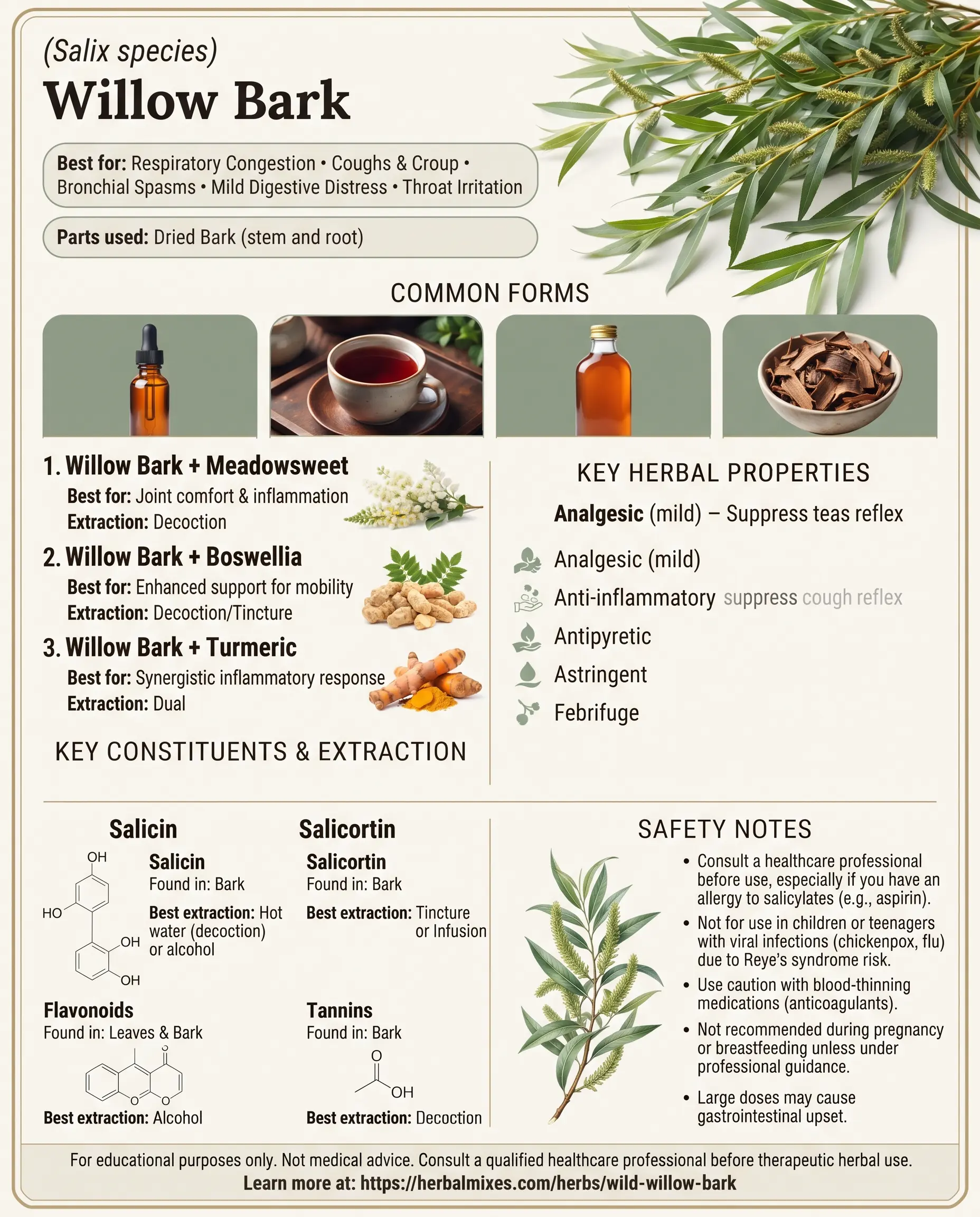
Willow bark pairs especially well with boswellia, turmeric, ginger, meadowsweet, and devil’s claw depending on whether the goal is joint discomfort, inflammatory support, or muscle-related aches.
Willow Bark + Boswellia
Best for: Osteoarthritis and joint discomfort
Willow bark contributes salicin-related analgesic activity, while boswellia provides boswellic acids that influence inflammatory pathways such as 5-lipoxygenase.
Best extraction: Standardized extracts. This makes the active constituent levels easier to compare and avoids relying on large volumes of bitter bark tea.
Willow Bark + Turmeric
Best for: Joint stiffness and inflammatory support
Willow bark provides salicylate-related compounds, while turmeric contributes curcuminoids that affect complementary inflammatory pathways.
Best extraction: Willow bark standardized extract combined with an enhanced-bioavailability turmeric preparation.
Willow Bark + Ginger
Best for: Musculoskeletal discomfort with stiffness
Willow bark contributes pain-supportive salicin derivatives, while ginger adds warming, digestive, and inflammatory-modulating actions.
Best extraction: Willow bark extract with ginger tea, powder, or standardized extract.
Willow Bark + Meadowsweet
Best for: Traditional pain and inflammatory support
Both plants contain salicylate-related chemistry, though in different forms.
Best extraction: Water or hydroalcoholic preparation.
Because both contribute salicylate-related compounds, this combination may increase total salicylate exposure and is not appropriate for people with aspirin allergy, bleeding risk, or anticoagulant use.
Willow Bark + Devil’s Claw
Best for: Lower back and joint discomfort
Willow bark contributes salicin-related effects, while devil’s claw provides iridoid glycosides such as harpagoside.
Best extraction: Standardized extracts.
Key Herbal Properties
Analgesic supportive — Standardized willow bark extracts have demonstrated modest pain-reducing effects in lower-back pain and some osteoarthritis trials.
Anti-inflammatory — Salicin metabolites plus polyphenols and flavonoids influence inflammatory processes.
Antipyretic — traditional — Willow bark has traditionally been used during fever associated with colds.
Antioxidant — Flavonoids and phenolic compounds complement the better-known salicin fraction.
Astringent — Bark tannins contribute tissue-tightening and astringent effects.
Bitter — Willow bark has a distinctly bitter taste that reflects its salicylate and phenolic chemistry.




Active Compounds
Willow bark contains a mixture of salicin-related phenolic glycosides, flavonoids, tannins, and other polyphenols. Salicin is the best-known marker, but the whole extract is chemically broader than salicin alone.
Salicin
Found mainly in: Bark
Salicin is a phenolic glycoside and one of willow bark’s principal marker compounds.
After ingestion, it is converted through several metabolic steps into salicylic acid, which contributes to the herb’s pain-supportive and anti-inflammatory effects.
Best extraction: Hot water or hydroalcoholic extraction. Standardized commercial extracts make salicin exposure more predictable.
Salicortin
Found mainly in: Bark
Salicortin is another salicylate-related phenolic glycoside occurring in Salix species.
It contributes to the broader salicylate profile rather than acting as an isolated aspirin equivalent.
Best extraction: Hot water or hydroalcoholic extraction.
Tremulacin
Found mainly in: Bark of various Salix species
Tremulacin belongs to the salicylate-related glycoside fraction and may contribute to the herb’s overall pharmacological activity.
Best extraction: Water-alcohol mixtures.
Salicylic Acid Metabolites
Found mainly in: Produced in the body after salicin metabolism
Willow bark does not simply contain aspirin. Instead, salicin is converted metabolically into salicyl alcohol, salicylaldehyde, and ultimately salicylic acid.
Best extraction: Not applicable as a direct preparation target; this transformation occurs after ingestion.
Flavonoids
Found mainly in: Bark
Willow bark contains flavonoids including quercetin-related compounds that contribute antioxidant and inflammatory-modulating effects.
Best extraction: Hot water or hydroalcoholic extraction.
Tannins
Found mainly in: Bark
Tannins contribute willow bark’s astringency and bitter-dry taste.
Best extraction: Hot water.
Polyphenols
Found mainly in: Bark
A range of phenolic compounds may help explain why whole willow bark extract does not behave exactly like isolated salicin.
Best extraction: Hot water or diluted alcohol.
-
FAQ
What is willow bark best used for?
Its strongest clinical evidence is for short-term lower-back pain, with additional but less consistent evidence for osteoarthritis-related discomfort.
Is willow bark the same as aspirin?
No.
Willow bark contains salicin and related glycosides, which the body converts partly into salicylic acid. Aspirin is acetylsalicylic acid, a different pharmaceutical compound with a different pharmacokinetic and platelet-effect profile.
How quickly does willow bark work?
It is generally slower than aspirin or many NSAIDs.
In a randomized lower-back-pain trial, benefit from the higher-salicin extract became evident within about one week.
Is standardized extract better than willow bark tea?
For pain support, standardized extract is easier to compare with clinical research because the salicin content is known.
Tea provides a broader traditional preparation but delivers less predictable amounts of salicylate-related compounds.
Can willow bark be taken with aspirin or ibuprofen?
Not casually.
Combining willow bark with aspirin, NSAIDs, anticoagulants, or other salicylate-containing products may increase the risk of bleeding or gastrointestinal irritation.
Safety & Precautions
Willow bark requires many of the same general cautions associated with salicylates, even though it is not chemically identical to aspirin.
The most commonly reported adverse effects are gastrointestinal, including nausea, stomach discomfort, and digestive irritation. Allergic reactions can also occur.
Aspirin or Salicylate Allergy
Avoid willow bark if you have:
- aspirin allergy;
- salicylate sensitivity;
- aspirin-triggered asthma;
- a history of severe reactions to NSAIDs associated with salicylates.
Cross-reactivity is possible because willow bark is metabolized to salicylic acid.
Bleeding Risk
Willow bark may increase bleeding risk in susceptible people.
Use caution or avoid combining it with:
- aspirin;
- warfarin;
- apixaban;
- rivaroxaban;
- clopidogrel;
- other anticoagulants;
- other antiplatelet medicines;
- high-dose NSAIDs.
People with bleeding disorders, active ulcers, or a history of gastrointestinal bleeding should not self-treat with willow bark.
Children & Teenagers
Willow bark should generally be avoided in children and adolescents, particularly during viral illnesses.
Salicylates are associated with Reye syndrome, a rare but serious condition in children.
Pregnancy & Breastfeeding
Avoid medicinal willow bark during pregnancy and breastfeeding unless specifically directed by a healthcare professional.
Salicylates cross the placenta, and safety data for willow bark products in pregnancy and nursing are inadequate.
Kidney & Liver Conditions
Use caution with significant kidney or liver disease, particularly when other medications affecting these organs are used.
Asthma
People with aspirin-sensitive asthma or nasal-polyposis/NSAID sensitivity should avoid willow bark because salicylates can provoke serious reactions.
Surgery
Because of potential effects on bleeding, tell your surgical team if you use willow bark.
Follow the surgeon’s instructions about when to stop supplements before a procedure.
Duration of Use
EMA recognizes standardized dry willow bark extract for short-term treatment of lower-back pain and traditional preparations for limited symptomatic use.
Persistent or worsening pain should be evaluated rather than managed indefinitely with willow bark.
Seek medical care for pain accompanied by:
- weakness or numbness;
- bowel or bladder changes;
- fever;
- unexplained weight loss;
- major injury;
- severe nighttime pain;
- chest pain;
- neurological symptoms.
Anyone taking anticoagulants, antiplatelet drugs, aspirin, NSAIDs, or other salicylate-containing medicines, or anyone with ulcers, bleeding disorders, kidney disease, pregnancy, or aspirin-sensitive asthma should discuss willow bark with an appropriate healthcare professional before use.
References
- European Medicines Agency — Willow Bark
- EMA — Willow Bark Summary for the Public
- PubMed — Willow Bark for Chronic Lower Back Pain
- PubMed — Willow Bark Compared With Rofecoxib for Lower Back Pain
- PubMed — Willow Bark Extract in Osteoarthritis
- PubMed — Willow Bark in Osteoarthritis and Rheumatoid Arthritis
- PubMed — United States Pharmacopeia Safety Review of Willow Bark
- NOW Foods — Willow Bark Extract 400 mg
- Solaray — White Willow Bark 400 mg
- HawaiiPharm — White Willow Bark Tincture
Disclaimer
Disclaimer: This article is for educational purposes only and is not intended to diagnose, treat, cure, or prevent any disease. Herbal products can cause side effects and interact with medications. Consult a qualified healthcare professional before using herbs therapeutically, especially if you are pregnant, breastfeeding, taking prescription medications, or managing a medical condition.