

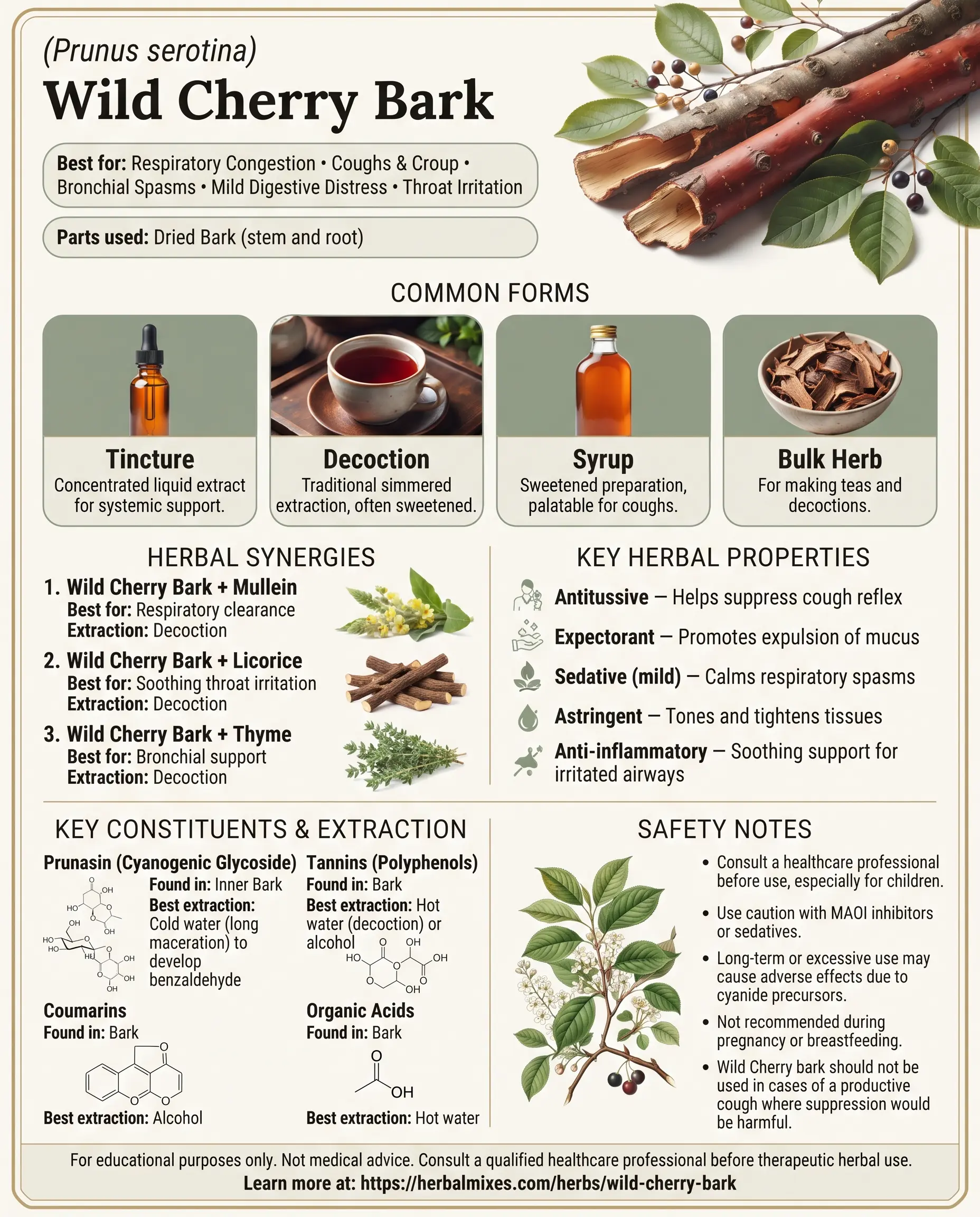
What Wild Cherry Bark Is Good For
Dry, irritating cough — Wild cherry bark is traditionally used as a soothing antitussive herb when coughing is dry, repetitive, or irritating rather than heavily productive. Modern clinical evidence is limited, so its role is best described as traditional respiratory support rather than a proven cough treatment.
Nighttime cough — Its traditional relaxing effect on cough reflexes is one reason wild cherry bark has long appeared in nighttime cough syrups and respiratory formulas.
Throat irritation — Tannins contribute mild astringency, while syrup or glycerite preparations can provide additional coating and soothing effects for an irritated throat.
Respiratory comfort — Wild cherry bark is traditionally paired with expectorant or demulcent herbs when coughing accompanies a cold or mild upper-respiratory irritation.
Mild digestive astringency — Bark tannins provide an astringent action that may help explain some of the herb’s older traditional digestive uses, although this is not its primary modern application.
Available Herbal Products
Buying Guides for Available Wild Cherry Bark Products
Organic Wild Cherry Bark Cut & Sifted – Dried organic Prunus serotina bark from the United States. A useful loose-herb form for people who want to incorporate wild cherry bark into professionally guided respiratory tea or syrup formulas. Seller: Starwest Botanicals – View Starwest Botanicals Wild Cherry Bark → (Starwest Botanicals)
Wild Cherry Bark Cut & Sifted – Loose dried bark suitable for herbal formulations, syrups, and infusions. The supplier currently lists it for purchase in several bulk sizes. Seller: Monterey Bay Herb Co. – View Monterey Bay Herb Co. Wild Cherry Bark → (Monterey Bay Herb Co.)
Wild Cherry Bark Powder – Finely powdered Prunus serotina bark. This form is convenient for manufacturers and experienced herbal formulators, although loose powdered bark is less suitable for casual self-dosing because naturally occurring cyanogenic compounds make accurate use important. Seller: Monterey Bay Herb Co. – View Monterey Bay Herb Co. Wild Cherry Bark Powder → (Monterey Bay Herb Co.)
Wild Cherry Bark Tincture – Alcohol-based liquid extract made from dried Prunus serotina bark. A concentrated format for people who prefer liquid herbal preparations. Seller: HawaiiPharm – View HawaiiPharm Wild Cherry Bark Tincture → (HawaiiPharm)
Wild Cherry Bark Alcohol-Free Extract – Glycerin-and-water extract made from dried wild cherry bark. A practical alcohol-free option for people who prefer a glycerite-style preparation. Seller: HawaiiPharm – View HawaiiPharm Wild Cherry Bark Glycerite → (HawaiiPharm)
Herb Pharm’s Wild Cherry liquid extract and Mountain Rose Herbs’ wild cherry bark products are currently listed as out of stock, so they are not included above as current buying recommendations. (Herb Pharm)
Herbal Synergies
Wild cherry bark pairs especially well with marshmallow root, mullein, horehound, thyme, and licorice root, depending on whether the cough is dry, productive, or accompanied by throat irritation.
Wild Cherry Bark + Marshmallow Root
Best for: Dry cough with an irritated throat
Wild cherry bark contributes traditional cough-calming activity, while marshmallow root adds abundant mucilage that coats and moistens irritated tissues.
Best extraction: Combination extraction. Prepare marshmallow as a cold infusion for maximum mucilage, while wild cherry bark is better used as a professionally prepared syrup or liquid extract.
Wild Cherry Bark + Mullein
Best for: Irritated cough with mild chest congestion
Wild cherry bark is traditionally used to calm excessive coughing, while mullein provides soothing respiratory support and gentle expectorant activity.
Best extraction: Mullein as a well-filtered infusion combined with a measured commercial wild cherry bark extract or syrup.
Wild Cherry Bark + Horehound
Best for: Cough with thicker mucus
Wild cherry bark contributes cough-calming activity, while horehound is a bitter expectorant traditionally used to encourage productive coughing.
Best extraction: Professionally formulated syrup or tincture combination. The herbs play complementary rather than identical roles.
Wild Cherry Bark + Thyme
Best for: Cough associated with a common cold
Wild cherry bark provides traditional antitussive support, while thyme adds aromatic expectorant and antimicrobial properties.
Best extraction: Thyme as a covered hot infusion paired with a prepared wild cherry bark syrup or tincture.
Wild Cherry Bark + Licorice Root
Best for: Dry, irritated cough and sore throat
Wild cherry bark contributes cough-calming effects, while licorice root adds demulcent and soothing activity.
Best extraction: Prepared syrup or professionally formulated liquid extract.
Whole licorice requires caution in people with high blood pressure, low potassium, or certain cardiovascular conditions.
Key Herbal Properties
Antitussive — traditional — Wild cherry bark has a longstanding reputation for calming dry, irritating, repetitive coughs.
Astringent — Bark tannins tighten tissues and contribute to its characteristic dry mouthfeel.
Expectorant — mild traditional use — It is sometimes included in respiratory formulas alongside stronger expectorants.
Sedative respiratory supportive — traditional — Historically valued when excessive coughing interfered with rest.
Antioxidant — experimental — Polyphenols in Prunus serotina demonstrate antioxidant activity in laboratory research. (PubMed)
Anti-inflammatory — experimental — Bark and other plant extracts contain compounds with preclinical anti-inflammatory activity, but this is not an established clinical indication. (PubMed)






Active Compounds
Wild cherry bark contains an important combination of cyanogenic glycosides, tannins, phenolic compounds, flavonoids, and aromatic degradation products. Its cyanogenic chemistry is central both to its traditional respiratory reputation and to its safety limitations. (PubMed)
Prunasin
Found mainly in: Bark, leaves, and other tissues
Prunasin is a cyanogenic glycoside naturally present in Prunus serotina. When plant tissue is broken down and the compound is enzymatically hydrolyzed, it can ultimately release hydrogen cyanide.
This chemistry is one reason wild cherry bark should be used conservatively and not treated like an unrestricted everyday tea herb. (PubMed)
Best extraction: Commercially controlled liquid preparations are preferable. Because cyanogenic-glycoside content can vary, concentrated DIY extraction is not recommended.
Amygdalin
Found mainly in: Seeds and various Prunus tissues; amounts vary by plant part
Amygdalin is another cyanogenic glycoside found in Prunus serotina. Research on black cherry demonstrates its ability to participate in cyanide-producing metabolism after tissue disruption. (PubMed)
Best extraction: Not a target for home extraction. Safety depends on controlling exposure rather than maximizing extraction.
Tannins
Found mainly in: Bark
Tannins provide wild cherry bark’s characteristic astringent quality and contribute to traditional tissue-toning effects.
Best extraction: Water or diluted alcohol.
Phenolic Compounds
Found mainly in: Bark and other plant tissues
Wild cherry contains multiple phenolic compounds associated with antioxidant activity in laboratory research. (PubMed)
Best extraction: Water-alcohol mixtures generally recover a broader range than water alone.
Flavonoids
Found mainly in: Bark, leaves, and fruit tissues
Flavonoids contribute to the broader antioxidant and inflammatory-modulating chemistry of Prunus serotina. (PubMed)
Best extraction: Hot water or hydroalcoholic extraction.
Benzaldehyde
Found mainly in: Produced as cyanogenic compounds break down
Benzaldehyde contributes the characteristic almond/cherry-like aroma associated with several Prunus species.
Its presence is closely related to the same cyanogenic pathway that produces hydrogen cyanide.
Best extraction: Volatile and semi-volatile aromatic compounds are better represented in controlled alcohol-based extracts than in prolonged boiling.
FAQ
What is wild cherry bark best used for?
Its main traditional use is short-term support for dry, irritating or repetitive coughs, especially when throat irritation is present.
Modern human clinical evidence is limited, so it should not be presented as a substitute for medical cough treatment.
Is wild cherry bark the same as cherry fruit?
No.
Medicinal wild cherry bark comes from the bark of Prunus serotina. The chemistry of the bark differs substantially from ripe cherry fruit.
Can wild cherry bark be taken every day?
It is better suited to short-term use rather than continuous daily supplementation because the bark naturally contains cyanogenic glycosides capable of releasing hydrogen cyanide.
Why is wild cherry bark used in cough syrups?
Syrups make the bark easier to take and add a soothing coating effect for the throat. Wild cherry bark also has a long traditional association with calming irritating coughs.
Is wild cherry bark safe for children?
Because cyanogenic-glycoside content can vary and children are more vulnerable to toxic exposure, do not give homemade or concentrated wild cherry bark preparations to children without guidance from a qualified pediatric healthcare professional.
Safety & Precautions
Wild cherry bark requires more caution than many ordinary respiratory herbs because it contains cyanogenic glycosides such as prunasin and amygdalin that can ultimately release hydrogen cyanide. (PubMed)
Use only properly identified Prunus serotina products from reputable suppliers and follow the manufacturer’s directions.
Avoid Excessive or Long-Term Use
Wild cherry bark is best considered a short-term respiratory herb.
Do not use unusually large quantities, concentrated homemade extracts, or repeated long-term doses.
Possible signs of excessive cyanogenic exposure can include:
- headache;
- dizziness;
- nausea or vomiting;
- weakness;
- confusion;
- shortness of breath;
- rapid breathing;
- loss of consciousness.
Significant suspected exposure requires urgent medical attention.
Pregnancy & Breastfeeding
Avoid medicinal wild cherry bark during pregnancy and breastfeeding unless specifically directed by a qualified healthcare professional.
There is insufficient modern safety information, and cyanogenic compounds create unnecessary theoretical risk during these periods.
Children
Do not give concentrated or homemade wild cherry bark preparations to infants or young children without professional supervision.
Keep extracts and bulk bark out of reach of children.
Liver & Kidney Conditions
People with significant liver or kidney disease should avoid unsupervised use because these organs participate in processing and eliminating potentially toxic metabolites.
Medication Interactions
Reliable modern interaction studies are limited.
Because wild cherry bark can have respiratory-calming and potentially sedating traditional effects, use caution when combining concentrated preparations with:
- prescription sedatives;
- opioid pain medicines;
- alcohol;
- other strongly sedating herbs.
Do not assume that lack of documented interactions means the herb is risk-free.
Do Not Substitute It for Medical Cough Care
Seek medical evaluation for a cough accompanied by:
- difficulty breathing;
- chest pain;
- coughing blood;
- high or persistent fever;
- blue lips;
- severe wheezing;
- confusion;
- dehydration;
- symptoms lasting several weeks.
A persistent cough can result from asthma, pneumonia, reflux, heart disease, medication side effects, COPD, pertussis, or other conditions that require diagnosis.
Anyone who is pregnant, breastfeeding, treating a child, taking prescription medications, or managing significant liver, kidney, or respiratory disease should discuss wild cherry bark use with an appropriate healthcare professional.
References
- Kew Plants of the World Online — Prunus serotina
- PubMed — Phytopharmacological Possibilities of Prunus serotina and Related Species
- PubMed Central — Cyanogenic Glycosides in Prunus serotina Review
- PubMed — Development of Cyanogenesis in Black Cherry
- PubMed — Amygdalin Metabolism in Prunus serotina
- Starwest Botanicals — Organic Wild Cherry Bark
- Monterey Bay Herb Co. — Wild Cherry Bark Cut & Sifted
- Monterey Bay Herb Co. — Wild Cherry Bark Powder
- HawaiiPharm — Wild Cherry Bark Tincture
- HawaiiPharm — Wild Cherry Bark Alcohol-Free Extract
Disclaimer
Disclaimer: This article is for educational purposes only and is not intended to diagnose, treat, cure, or prevent any disease. Herbal products can cause side effects and interact with medications. Consult a qualified healthcare professional before using herbs therapeutically, especially if you are pregnant, breastfeeding, taking prescription medications, or managing a medical condition.