

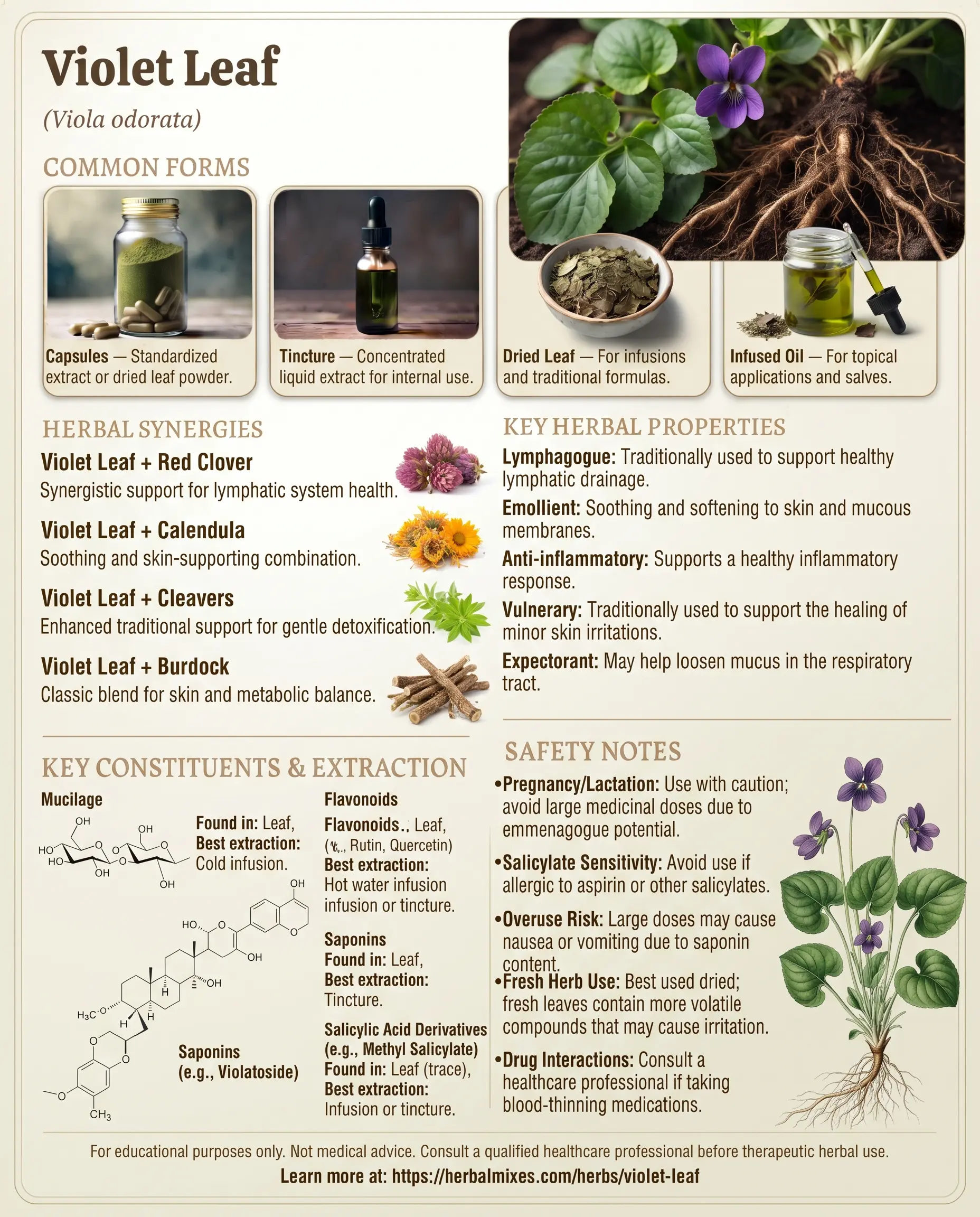
What Violet Leaf Is Good For
Dry cough & throat irritation — Violet leaf is traditionally used as a soothing respiratory herb. Its mucilage can coat irritated throat tissues, while Viola odorata has a longstanding association with cough support. Clinical research exists for violet preparations, especially flower syrup, but should not automatically be attributed specifically to the leaf. (pubmed.ncbi.nlm.nih.gov)
Irritated mucous membranes — The leaf contains mucilage that becomes slippery when hydrated, making violet particularly suited to dry or irritated tissues of the throat and digestive tract.
Mild skin irritation — Violet leaf has traditional topical use in poultices, washes, oils, and salves for dry, irritated, or inflamed skin. Modern evidence for this use is primarily traditional and preclinical.
Traditional lymphatic support — Western herbalists commonly include violet leaf in gentle formulas for swollen or congested tissues, particularly around the breasts and lymphatic system. Strong clinical evidence for a direct lymphatic effect is lacking.
Inflammatory balance — Flavonoids, salicylate-related compounds, cyclotides, and phenolics from Viola species demonstrate anti-inflammatory activity experimentally. Human clinical research on violet leaf itself remains limited. (pubmed.ncbi.nlm.nih.gov)
Available Herbal Products
Buying Guides for Available Violet Leaf Products
Violet Leaf Cut & Sifted – Loose dried violet herb suitable for tea, infusions, topical washes, and custom herbal blends. Currently available for purchase. Seller: Monterey Bay Herb Co. – View Monterey Bay Herb Co. Violet Leaf →
Dried Violet Leaf – Cut-and-sifted Viola odorata leaf intended for loose-leaf tea and botanical preparations. Currently listed for purchase. Seller: Nature’s Remedy Apothecary / Etsy – View Dried Violet Leaf →
Sweet Violet Leaf Tincture – Alcohol-based extract made specifically from dried Viola odorata leaf. Currently listed in stock and useful when a concentrated liquid preparation is preferred. Seller: HawaiiPharm – View HawaiiPharm Violet Leaf Tincture →
Sweet Violet Leaf Alcohol-Free Extract – Glycerite made from dried Viola odorata leaf with glycerin and water. Currently listed in stock and useful for people who prefer an alcohol-free liquid preparation. Seller: HawaiiPharm – View HawaiiPharm Violet Leaf Glycerite →
Violet Leaf Absolute – Highly concentrated solvent-extracted Viola odorata leaf aromatic intended primarily for perfumery and topical aromatic formulations, not internal herbal use. Seller: Eden Botanicals – View Eden Botanicals Violet Leaf Absolute →
For throat or digestive soothing, loose leaf prepared with water makes more sense than violet leaf absolute, which is a concentrated aromatic material intended for external use.
Herbal Synergies
Violet leaf pairs especially well with marshmallow root, mullein, plantain leaf, calendula, and cleavers depending on whether the goal is throat soothing, respiratory comfort, skin support, or traditional lymphatic support.
Violet Leaf + Marshmallow Root
Best for: Dry throat and irritated mucous membranes
Both herbs contribute soothing mucilage. Marshmallow root is especially rich in demulcent polysaccharides, while violet adds gentle traditional respiratory and tissue-soothing activity.
Best extraction: Cold or warm-water infusion. Water is the most appropriate solvent when mucilage is the main goal.
Violet Leaf + Mullein
Best for: Dry or irritated cough
Violet contributes moistening demulcent action, while mullein is traditionally used for irritated respiratory tissues and cough comfort.
Best extraction: Warm infusion. Filter mullein especially well to remove its irritating leaf hairs.
Violet Leaf + Plantain Leaf
Best for: Irritated throat and tissues
Both herbs provide soothing mucilage, while plantain adds mild astringent and inflammatory-supportive properties.
Best extraction: Hot or warm infusion.
Violet Leaf + Calendula
Best for: Minor skin irritation
Violet contributes soothing mucilage and cooling traditional use, while calendula provides better-established vulnerary and skin-supportive herbal properties.
Best extraction: Infusion for washes or separate infused oils combined in a topical preparation.
Violet Leaf + Cleavers
Best for: Traditional lymphatic and tissue support
Violet and cleavers are commonly paired in Western herbalism when gentle support for swollen or congested tissues is desired.
Best extraction: Fresh-plant tincture or cold infusion when suitable material is available. This use remains primarily traditional rather than clinically established.
Key Herbal Properties
Demulcent — Violet leaf contains mucilage that coats and moistens irritated tissues.
Nervine — mild traditional use — Sweet violet has a traditional reputation as a gentle soothing herb, although leaf-specific clinical evidence is limited.
Expectorant — traditional — Viola odorata preparations have traditionally been used for cough and respiratory complaints. Kew specifically records respiratory medicinal use for the species. (powo.science.kew.org)
Anti-inflammatory — experimental — Flavonoids, cyclotides, phenolics, and other constituents demonstrate anti-inflammatory activity in preclinical research.
Antioxidant — Violet contains flavonoids and phenolic compounds with antioxidant activity.
Mild diuretic — traditional / experimental — The leaf has a history of urinary and fluid-balance use, with limited experimental support.
Vulnerary — traditional — Violet leaf is used externally in gentle preparations intended to soothe irritated skin.







Active Compounds
Violet leaf contains a broad mixture of mucilage polysaccharides, flavonoids, salicylate-related compounds, saponins, tannins, phenolics, coumarins, and unusual cyclic peptides called cyclotides. (pubmed.ncbi.nlm.nih.gov)
Mucilage Polysaccharides
Found mainly in: Leaves
Violet’s mucilage consists of water-binding complex carbohydrates that produce a soft, slippery texture when hydrated.
This fraction contributes most directly to violet leaf’s traditional demulcent use for dry or irritated tissues.
Best extraction: Cold or warm water. Alcohol does not extract mucilage efficiently.
Rutin
Found mainly in: Leaves and aerial tissues
Rutin is a flavonoid glycoside identified in Viola odorata and contributes antioxidant and vascular-supportive activity.
Best extraction: Hot water or hydroalcoholic extraction.
Quercetin-Related Flavonoids
Found mainly in: Leaves
Quercetin derivatives contribute antioxidant and inflammatory-modulating effects.
Best extraction: Hot water or diluted alcohol.
Salicylate-Related Compounds
Found mainly in: Leaves and other aerial tissues
Viola odorata has been reported to contain salicylates, methyl-salicylate-related compounds, and salicylic-acid derivatives.
These may contribute to its traditional soothing and inflammatory-supportive reputation, although their concentrations in ordinary leaf preparations are not equivalent to pharmaceutical aspirin. (pmc.ncbi.nlm.nih.gov)
Best extraction: Water and hydroalcoholic preparations can extract various salicylate-related compounds.
Cyclotides
Found mainly in: Leaves and other plant tissues
Cyclotides, including cycloviolacin-related peptides, are unusually stable cyclic plant peptides found in Viola species.
They demonstrate antimicrobial, cytotoxic, and other biological activities in laboratory research, but these findings should not be interpreted as established clinical effects of violet tea.
Best extraction: Specialized aqueous or solvent extraction is used in research. Ordinary tea is not a standardized cyclotide preparation.
Saponins
Found mainly in: Leaves and aerial tissues
Saponins may contribute to violet’s traditional expectorant activity by influencing respiratory secretions.
Best extraction: Hot water or hydroalcoholic extraction.
Tannins
Found mainly in: Leaves
Tannins contribute mild astringency and complement violet’s soothing mucilage.
Best extraction: Hot water.
Phenolic Compounds
Found mainly in: Leaves
A range of phenolics contributes antioxidant and inflammatory-modulating effects.
Best extraction: Hot water or hydroalcoholic extraction.
FAQ
What is violet leaf best used for?
Violet leaf is best suited to dry throat, irritated respiratory tissues, minor skin irritation, and other situations where gentle demulcent action is useful.
Its traditional lymphatic use is popular in Western herbalism but has much less clinical evidence.
Is violet leaf the same as violet flower?
No.
Both may come from Viola odorata, but they are different plant parts with somewhat different chemistry and traditional preparations. Several clinical studies of sweet violet used flower syrup or flower oil, so those results should not automatically be attributed to violet leaf. (pubmed.ncbi.nlm.nih.gov)
Is violet leaf tea or tincture better?
For mucilage and throat soothing, tea or cold infusion is usually better because mucilage extracts well into water.
A tincture provides broader extraction of flavonoids and other less-water-soluble compounds but captures less mucilage.
Can violet leaf be used topically?
Yes.
Traditional preparations include cooled infusions, poultices, infused oils, and salves for mildly irritated skin. Patch test concentrated products before broader application.
Is violet leaf absolute the same as violet leaf tincture?
No.
Violet leaf absolute is a highly concentrated solvent-extracted aromatic used mainly in perfumery and topical fragrance formulations. It should not be treated like an internal herbal tincture.
Safety & Precautions
Violet leaf has a relatively gentle traditional safety profile when used in food-like or ordinary herbal amounts, but modern human safety research is limited.
The American Herbal Products Association classifies Viola odorata leaf as Safety Class 1 with no identified clinically relevant herb-drug interactions, while also noting that pregnancy and lactation data are lacking.
Possible adverse effects may include digestive upset or allergic reaction in sensitive individuals.
Pregnancy & Breastfeeding
Reliable safety information during pregnancy and breastfeeding is insufficient.
A government medicinal-plant reference advises avoiding medicinal sweet violet during pregnancy and breastfeeding because of the lack of adequate data. (medicinalplants.doh.gov.ae)
Ordinary culinary exposure is different from concentrated tinctures or extracts.
Salicylate Sensitivity
Violet contains salicylate-related compounds.
People with a known aspirin or salicylate sensitivity should use concentrated violet preparations cautiously, even though ordinary violet leaf does not contain pharmaceutical aspirin doses.
There is not enough evidence to establish a clinically important interaction with anticoagulants from ordinary violet-leaf use, so this concern should not be overstated.
Children
Sweet-violet preparations have been used in clinical studies involving children, particularly flower syrups, but those findings involved specific preparations and medical supervision.
Do not assume that any concentrated violet product is automatically appropriate for young children.
Violet Leaf Absolute
Violet leaf absolute is not intended for internal medicinal use.
It is a concentrated aromatic extract produced by solvent extraction.
Dilute before topical application and patch test sensitive skin. Keep concentrated material away from the eyes and mucous membranes. (edenbotanicals.com)
Species Identification
The word “violet” can refer to many Viola species.
For medicinal use, choose a product that clearly identifies Viola odorata and the leaf as the plant part when you specifically want sweet-violet leaf.
Do not confuse medicinal violet with African violet, which belongs to a different botanical group.
Persistent cough, shortness of breath, coughing blood, unexplained swollen lymph nodes, persistent breast lumps, severe skin inflammation, or symptoms lasting more than a few weeks warrant medical evaluation rather than repeated herbal self-treatment.
Anyone who is pregnant, breastfeeding, taking prescription medication, or managing a significant medical condition should discuss regular therapeutic violet-leaf use with an appropriate healthcare professional.
References
- Kew Plants of the World Online — Viola odorata
- PubMed — Critical Review of Viola odorata Phytochemistry and Pharmacology
- PubMed — Comprehensive Review of the Genus Viola
- PubMed — Systematic Review of Viola Phytochemistry and Pharmacology
- PubMed — Viola odorata Flower Syrup and Cough: Randomized Trial
- PubMed — Viola odorata Leaf Extract Pharmacology
- Abu Dhabi Department of Health — Viola odorata
- Monterey Bay Herb Co. — Violet Leaf
- HawaiiPharm — Sweet Violet Leaf Tincture
- HawaiiPharm — Sweet Violet Leaf Alcohol-Free Extract
Disclaimer
Disclaimer: This article is for educational purposes only and is not intended to diagnose, treat, cure, or prevent any disease. Herbal products can cause side effects and interact with medications. Consult a qualified healthcare professional before using herbs therapeutically, especially if you are pregnant, breastfeeding, taking prescription medications, or managing a medical condition.