

What Valerian Root Is Good For
Occasional sleep difficulty — Valerian is traditionally used to help people relax and settle into sleep. EMA recognizes valerian root preparations for mild nervous tension and sleep disorders, although modern reviews find the evidence for chronic insomnia inconsistent.
Difficulty winding down — Valerian is particularly suited to bedtime restlessness and a “tired but unable to switch off” pattern. Its valerenic acids interact with GABA-related signaling involved in nervous-system relaxation.
Nervous tension — Valerian has traditional use for mild mental stress and nervous excitability. Human evidence for anxiety is less established than its traditional reputation, although some clinical research suggests calming effects.
Sleep quality — Some systematic reviews report improvements in subjective sleep quality, while more rigorous evaluations conclude that objective evidence for treating insomnia remains weak or inconclusive. It is better regarded as a sleep-support herb than a proven treatment for chronic insomnia.
Stress-related physical tension — Valerian is traditionally used when nervousness is accompanied by muscular restlessness or tension. Its relaxing effects make it a frequent partner in nighttime formulas with hops, passionflower, and lemon balm.
Available Herbal Products
Buying Guides for Available Valerian Root Products
Valerian Liquid Herbal Extract – Fresh root and rhizome tincture. A concentrated liquid preparation using certified-organic Valeriana officinalis with a 1:1.25 fresh-herb ratio, useful when flexible liquid dosing is preferred. Seller: Herb Pharm – View Herb Pharm Valerian →
Valerian Capsules – Standardized root and rhizome extract. Provides 4.8 mg valerenic acid per two-capsule serving and avoids valerian’s distinctive taste and smell. Seller: Herb Pharm – View Herb Pharm Valerian Capsules →
Organic Valerian Root Liquid Extract – Concentrated organic root extract containing both valerian root and root extract, with valerenic-acid derivatives identified by the manufacturer. Seller: Gaia Herbs – View Gaia Herbs Valerian Root →
Valerian Root 500 mg – Whole-root capsules. A straightforward option for people who prefer an unstandardized whole-herb preparation rather than a liquid extract. Currently listed in stock. Seller: NOW Foods / iHerb – View NOW Valerian Root →
Valerian Root 530 mg – Whole-root vegan capsules providing 1,590 mg per three-capsule serving. Currently available online. Seller: Nature’s Way / Vitacost – View Nature’s Way Valerian Root →
Mountain Rose Herbs currently lists its organic valerian root as out of stock, so it is not included above as a current buying recommendation.
Herbal Synergies
Herbal Synergies
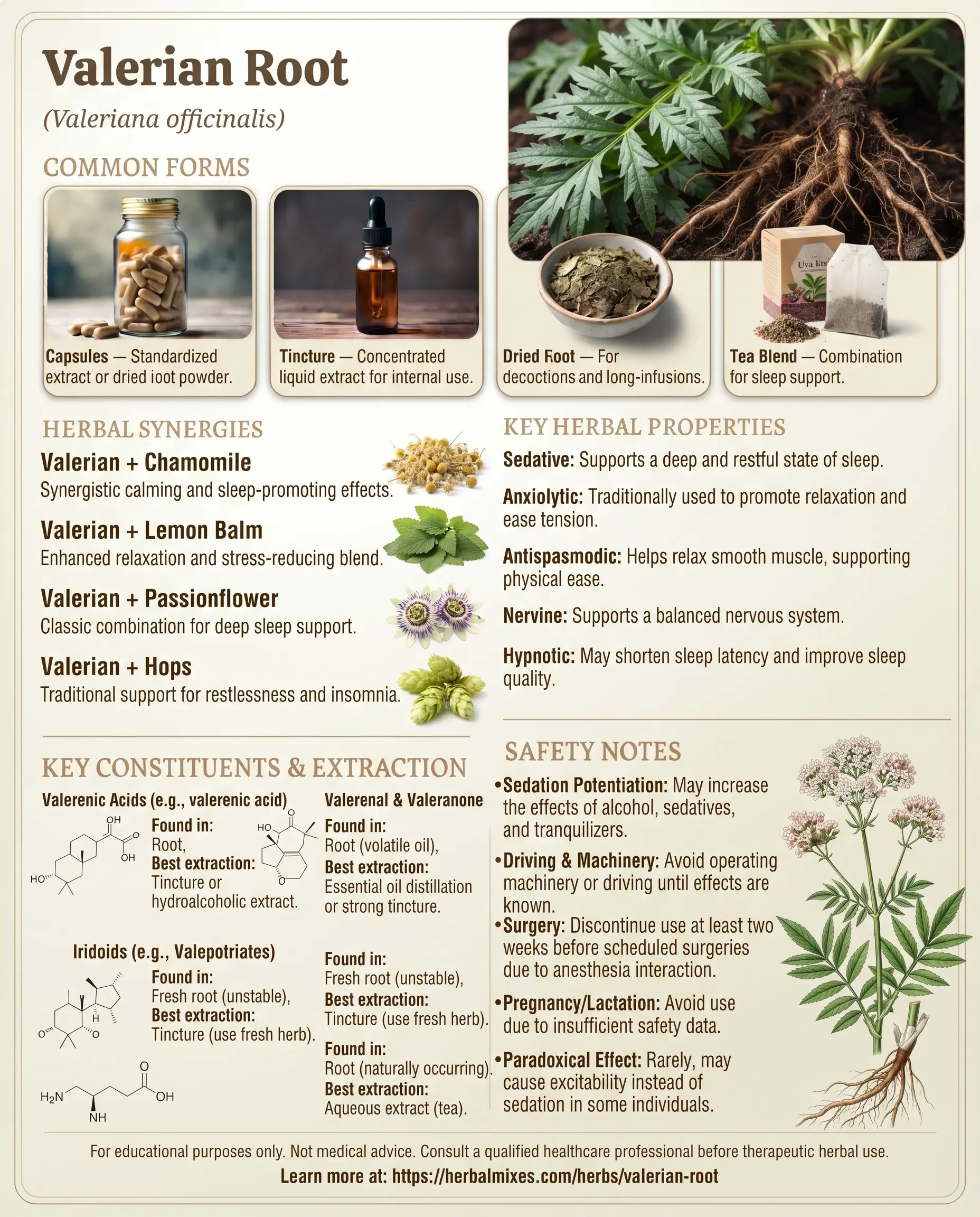
Valerian pairs especially well with hops, passionflower, lemon balm, chamomile, and skullcap, depending on whether the goal is sleep, nervous tension, or nighttime restlessness.
Valerian + Hops
Best for: Difficulty falling asleep with nervous restlessness
Valerian contributes stronger relaxing and GABA-related activity, while hops adds sedative bitter compounds that complement nighttime formulas.
Best extraction: Hydroalcoholic tincture or standardized extracts. Alcohol captures valerian’s valerenic acids and hops’ less-water-soluble bitter compounds more broadly than tea alone.
Valerian + Passionflower
Best for: Racing thoughts and difficulty settling at bedtime
Valerian emphasizes physical relaxation, while passionflower is especially useful when mental overactivity and nervous tension interfere with sleep. EMA recognizes combinations containing valerian and passionflower for mild mental stress and sleep support.
Best extraction: Tincture or a combination of extracts. Tea is also practical, although valerian’s strongest aromatic constituents are better represented in hydroalcoholic preparations.
Valerian + Lemon Balm
Best for: Stress-related sleep difficulty with nervous digestion
Valerian contributes stronger nighttime relaxation, while lemon balm adds gentler calming and carminative digestive support.
Best extraction: Valerian tincture combined with a covered lemon-balm infusion, or a professionally formulated liquid blend.
Valerian + Chamomile
Best for: Mild sleeplessness with digestive or muscular tension
Chamomile adds gentle antispasmodic and digestive activity while valerian provides the stronger relaxing component.
Best extraction: Covered chamomile infusion combined with valerian tincture, or both as a tea when a gentler preparation is preferred.
Valerian + Skullcap
Best for: Nervous exhaustion with physical restlessness
Both herbs are relaxing nervines. Skullcap is traditionally used for nervous tension and overstimulation, while valerian is more strongly associated with sleep support.
Best extraction: Hydroalcoholic tinctures.
Key Herbal Properties
Nervine — Valerian is one of the classic relaxing nervines used when nervous tension makes it difficult to settle.
Sedative — It may promote relaxation and subjective sleep quality, although clinical evidence for chronic insomnia remains inconsistent.
Anxiolytic supportive — Valerenic acid influences GABA-A signaling experimentally, providing a plausible mechanism for valerian’s calming effects.
Antispasmodic — Valerian has traditional use for tension and spasm associated with nervous-system overactivity.
Relaxant — Its combination of sesquiterpenes and other constituents contributes to its traditional use for physical and mental restlessness.
Bitter digestive — secondary use — The root has bitter and aromatic qualities, although digestive support is not its primary modern use.






Active Compounds
Valerian’s activity appears to come from a combination of sesquiterpenic acids, volatile compounds, lignans, and related constituents rather than one single molecule. Valerenic acids are particularly important markers in modern extracts.
Valerenic Acid
Found mainly in: Root and rhizome
Valerenic acid is one of valerian’s best-studied constituents. Laboratory research shows that it can positively modulate certain GABA-A receptors involved in nervous-system inhibition and relaxation.
Best extraction: Hydroalcoholic tincture or standardized extract. Valerenic acid is better represented in alcohol-containing preparations than in water alone.
Acetoxyvalerenic Acid
Found mainly in: Root and rhizome
This sesquiterpenic acid occurs alongside valerenic acid and is commonly measured when chemically characterizing valerian extracts.
Best extraction: Hydroalcoholic extraction.
Hydroxyvalerenic Acid
Found mainly in: Root and rhizome
Hydroxyvalerenic acid belongs to the same sesquiterpenic-acid group and contributes to the broader chemical fingerprint of medicinal valerian root.
Best extraction: Alcohol-water extraction.
Valerenol
Found mainly in: Root and rhizome
Valerenol has demonstrated GABA-A-receptor-related activity experimentally and appears to complement valerenic acid’s nervous-system effects.
Best extraction: Hydroalcoholic extraction.
Valepotriates
Found mainly in: Fresh underground parts
Valepotriates are iridoid compounds historically associated with valerian’s sedative reputation.
They are chemically unstable and can break down during drying, storage, and processing, so their concentrations vary greatly among preparations.
Best extraction: Fresh-plant alcohol extraction better preserves this fraction, although valepotriates are not the main modern standardization target.
Isovaleric Acid
Found mainly in: Root, especially as material ages or constituents degrade
Isovaleric acid contributes strongly to valerian’s characteristic pungent odor.
Best extraction: Alcohol-containing preparations capture the volatile and semi-volatile aromatic fraction more broadly than water alone.
Volatile Oils
Found mainly in: Root and rhizome
Valerian contains a small volatile-oil fraction composed of multiple aromatic compounds that contribute to its characteristic smell and overall pharmacological profile.
Best extraction: Hydroalcoholic tincture or steam distillation for analytical essential oil. Ordinary medicinal use generally favors whole-root extracts rather than valerian essential oil.
FAQ
Is valerian root actually effective for sleep?
The evidence is mixed. Some studies and systematic reviews report better subjective sleep quality, while a 2024 umbrella review found no convincing evidence that valerian treats insomnia based on objective outcomes. EMA nevertheless recognizes certain preparations for sleep disorders and traditional sleep support.
Does valerian work immediately?
Not always.
EMA notes that valerian has a gradual onset and is not ideal as an acute intervention. For some preparations, continued use over roughly 2–4 weeks may be needed for the optimal effect.
Is valerian tea or tincture better?
Tea extracts water-soluble compounds and is useful when a gentler preparation is preferred.
A hydroalcoholic tincture or standardized extract generally provides broader recovery of valerenic acids and aromatic constituents, making it a better match for much of valerian’s modern phytochemistry.
Why does valerian root smell so strong?
The root contains volatile compounds and develops isovaleric acid, which gives dried valerian its distinctive earthy, cheesy, or musky odor.
The smell is normal and does not necessarily indicate spoilage.
Can valerian be taken every night?
Short-term use appears reasonably safe for most adults, but long-term safety is not well established. NCCIH notes apparent safety in studies lasting up to about six weeks, while chronic use should be reviewed if sleep problems persist.
Safety & Precautions
Valerian is generally well tolerated during short-term adult use, but possible adverse effects include:
- headache;
- stomach upset;
- dizziness;
- mental dullness;
- daytime drowsiness;
- restlessness or paradoxical excitability;
- vivid dreams.
Because valerian can cause drowsiness, avoid driving, operating machinery, or other activities requiring full alertness until you know how it affects you.
Alcohol & Sedative Medications
Do not combine valerian casually with alcohol or strong sedatives.
Additive drowsiness may occur with:
- benzodiazepines;
- prescription sleep medicines;
- sedating antihistamines;
- opioids;
- some anticonvulsants;
- other strongly sedating herbs.
NCCIH specifically advises against combining valerian with alcohol or sedatives because of its possible sleep-inducing effect.
Pregnancy & Breastfeeding
There is insufficient reliable information to establish safety during pregnancy or breastfeeding.
NCCIH notes that little is known about safety in these groups, and several current commercial products advise avoiding medicinal valerian during pregnancy or nursing.
Children
EMA does not recommend its medicinal valerian-root preparations for children under 12 years old.
Long-Term Use & Stopping
Long-term safety is uncertain.
NCCIH reports that people taking valerian chronically have occasionally experienced withdrawal-like symptoms such as anxiety, irritability, insomnia, or rarely more significant symptoms when stopping abruptly.
People using valerian heavily or continuously for a prolonged period should consider discussing gradual discontinuation with a healthcare professional rather than suddenly stopping.
Liver Safety
Rare cases of clinically apparent liver injury have been reported, often involving multi-herb products rather than valerian alone. LiverTox considers valerian a probable but very rare cause of herbal-associated liver injury.
Stop use and seek medical evaluation for:
- yellow skin or eyes;
- dark urine;
- persistent nausea;
- severe unexplained fatigue;
- right-upper-abdominal pain.
Persistent Insomnia
Valerian should not be used indefinitely to mask persistent sleep problems.
Chronic insomnia can be related to sleep apnea, restless legs syndrome, depression, anxiety disorders, thyroid problems, medication effects, chronic pain, alcohol use, or other medical conditions.
If sleep problems continue for several weeks, regularly impair daytime function, or involve loud snoring, breathing pauses, severe daytime sleepiness, or worsening mood, seek professional evaluation.
Anyone who is pregnant, breastfeeding, taking sedatives or other prescription medications, managing liver disease, or experiencing persistent sleep problems should discuss regular therapeutic valerian use with an appropriate healthcare professional.
References
- European Medicines Agency — Valerian Root
- NCCIH — Valerian: Usefulness and Safety
- Kew Plants of the World Online — Valeriana officinalis
- PubMed — Valerian Root in Treating Sleep Problems: Systematic Review and Meta-Analysis
- PubMed — Valerian and Insomnia: 2024 Umbrella Review
- PubMed — Valerenic Acid and GABA-A Receptors
- PubMed — GABA-A Receptors and the Anxiolytic Action of Valerenic Acid
- NCBI LiverTox — Valerian
- Herb Pharm — Valerian Liquid Herbal Extract
- Herb Pharm — Valerian Capsules
Disclaimer
Disclaimer: This article is for educational purposes only and is not intended to diagnose, treat, cure, or prevent any disease. Herbal products can cause side effects and interact with medications. Consult a qualified healthcare professional before using herbs therapeutically, especially if you are pregnant, breastfeeding, taking prescription medications, or managing a medical condition.