

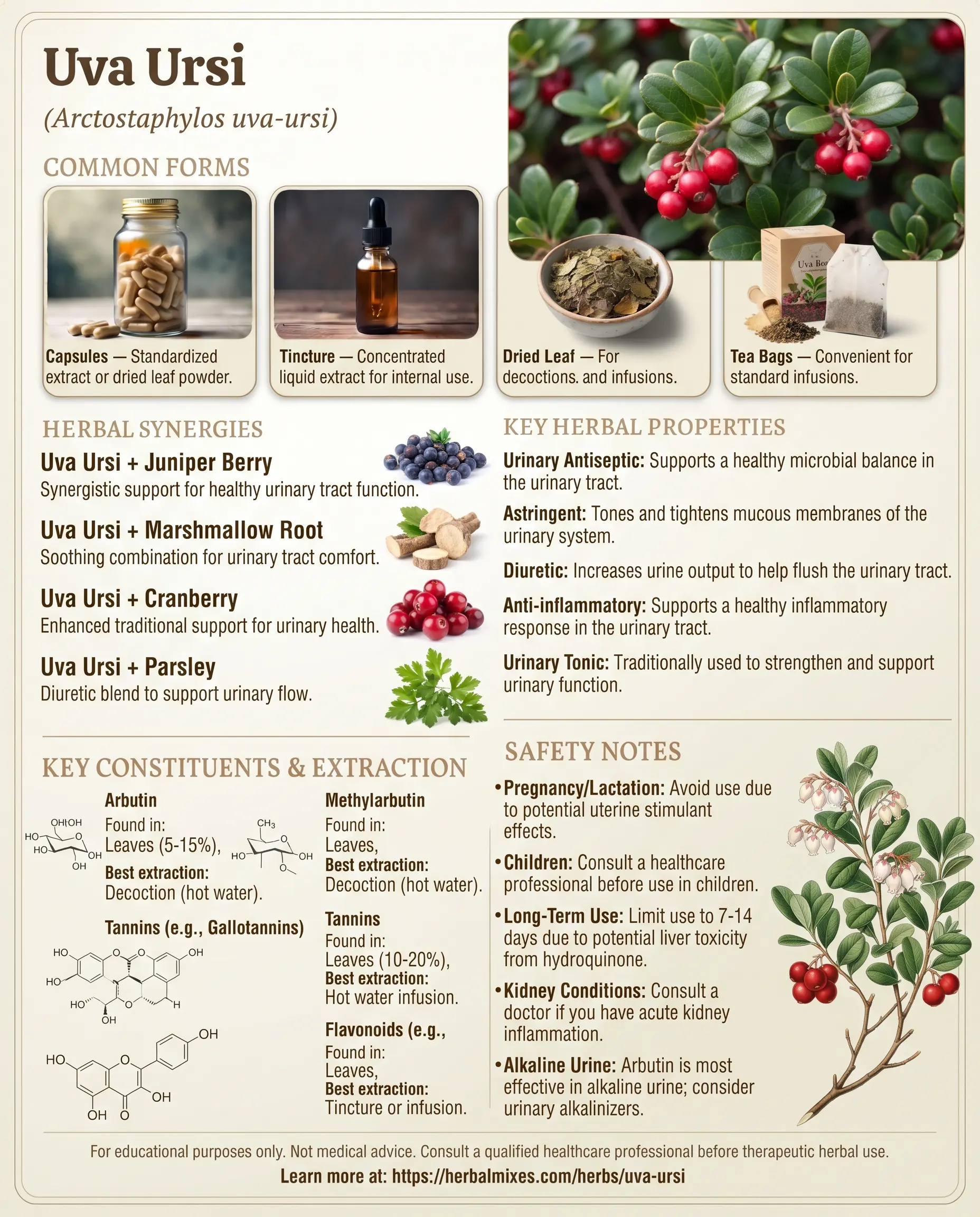
What Uva Ursi Is Good For
Mild recurrent lower-urinary symptoms — The European Medicines Agency recognizes bearberry leaf for traditional short-term relief of symptoms such as burning during urination and frequent urination in adult women, after serious conditions have been excluded.
Urinary burning — Uva ursi contains arbutin, which is absorbed and metabolized into hydroquinone-related compounds that are ultimately excreted into urine. These metabolites are considered central to the herb’s traditional urinary antiseptic activity.
Urinary frequency — Uva ursi may be useful when frequent urination accompanies a mild recurrent lower-urinary complaint, but it should not be used to delay diagnosis of a urinary tract infection.
Traditional bladder support — Bearberry leaf has a long history in European and North American herbal medicine as a short-term urinary herb.
Uva ursi is not appropriate as an everyday urinary tonic or long-term preventive supplement. EMA limits traditional medicinal use to no more than one week.
Available Herbal Products
Buying Guides for Available Uva Ursi Products
Uva-Ursi Liquid Herbal Extract – Leaf extract made from responsibly wildcrafted and/or certified-organic Arctostaphylos uva-ursi. Currently available directly from the manufacturer. Seller: Herb Pharm – View Herb Pharm Uva-Ursi →
Organic Uva Ursi Leaf Cut & Sifted – Loose organic bearberry leaf from Albania/Croatia, currently listed in stock. Suitable for short-term infusion or cold-maceration preparations. Seller: Starwest Botanicals – View Organic Uva Ursi Leaf →
Organic Uva Ursi Leaf Powder – Finely milled organic Arctostaphylos uva-ursi leaf, currently listed in stock. Because powdered preparations are easier to overuse, follow product-specific directions carefully. Seller: Starwest Botanicals – View Organic Uva Ursi Leaf Powder →
Uva Ursi Extract – Low Alcohol Liquid – 1:1 liquid extract providing 1,000 mg herb equivalent per serving and currently listed in stock. Seller: Nature’s Answer – View Nature’s Answer Uva Ursi Extract →
Uva Ursi Extract 450 mg – Concentrated 10:1 leaf extract, equivalent to 4,500 mg of herb per capsule and currently listed in stock. Seller: Nutricost / iHerb – View Nutricost Uva Ursi →
Nature’s Way Uva Ursi Leaves are currently backordered directly from the manufacturer, so they are not included above as a current direct-purchase recommendation.
Herbal Synergies
Uva ursi pairs most appropriately with cranberry, marshmallow root, corn silk, goldenrod, and nettle depending on whether the goal is urinary comfort, mucosal soothing, or fluid balance.
Uva Ursi + Cranberry
Best for: Short-term urinary support with recurrent-UTI prevention strategies
Uva ursi is traditionally used during active mild urinary symptoms, while cranberry is better studied for helping reduce recurrence in some people rather than treating an active infection.
Best extraction: Uva ursi as short-term tea or standardized extract; cranberry as juice or standardized PAC-containing extract.
Uva Ursi + Marshmallow Root
Best for: Burning or irritated urinary tissues
Uva ursi provides arbutin-related urinary activity, while marshmallow root contributes soothing mucilage.
Best extraction: Prepare marshmallow separately as a cold infusion and use uva ursi only short term.
Uva Ursi + Corn Silk
Best for: Bladder irritation and urinary comfort
Corn silk provides gentle demulcent and traditional urinary support without adding more hydroquinone-related compounds.
Best extraction: Infusion or tincture.
Uva Ursi + Goldenrod
Best for: Traditional urinary and fluid-balance formulas
Uva ursi contributes arbutin-related chemistry, while goldenrod adds mild diuretic and urinary-supportive effects.
Best extraction: Uva ursi short-term extract combined with goldenrod tea or tincture.
Uva Ursi + Nettle
Best for: Urinary support with gentle fluid movement
Nettle leaf adds nutritive and mild diuretic activity.
Best extraction: Uva ursi short term with nettle infusion.
Key Herbal Properties
Urinary antiseptic — traditional — Arbutin-derived metabolites are considered responsible for much of uva ursi’s traditional lower-urinary activity.
Astringent — Bearberry leaf contains substantial tannins that contribute tissue-tightening effects.
Diuretic — traditional — The herb has traditional use for increasing urinary output, although this is not its primary modern indication.
Antibacterial — experimental — Arbutin/hydroquinone-related compounds and extracts show antibacterial effects in laboratory research.
Anti-inflammatory — experimental — Polyphenols and related constituents may influence inflammatory pathways.
Antioxidant — Flavonoids and phenolic compounds contribute antioxidant activity.






Active Compounds
Uva ursi is dominated by hydroquinone glycosides, especially arbutin, along with tannins, flavonoids, phenolic acids, triterpenes, and related compounds.
Arbutin
Found mainly in: Leaves
Arbutin is uva ursi’s key marker compound.
It is absorbed in the intestine, metabolized mainly to hydroquinone conjugates, and excreted through the kidneys.
Best extraction: Hot water, cold maceration, or hydroalcoholic extraction.
Methylarbutin
Found mainly in: Leaves
Methylarbutin is a related hydroquinone glycoside that contributes to the broader urinary-active profile.
Best extraction: Water or hydroalcoholic extraction.
Hydroquinone
Found mainly in: Generated metabolically from arbutin-related compounds
Free hydroquinone is not the primary compound ingested from the herb. Instead, arbutin is metabolized and hydroquinone-related metabolites are excreted in urine.
A pharmacokinetic safety review estimated free hydroquinone exposure under recommended therapeutic use to be below the proposed permitted daily exposure level.
Best extraction: Not a target for DIY extraction; the clinically relevant chemistry depends largely on metabolism after ingestion.
Gallotannins
Found mainly in: Leaves
Bearberry leaves contain substantial tannins responsible for their strong astringent taste.
Best extraction: Hot water.
Gallic Acid
Found mainly in: Leaves
Gallic acid contributes antioxidant and astringent properties.
Best extraction: Water or hydroalcoholic extraction.
Quercetin Derivatives
Found mainly in: Leaves
Quercetin-related flavonoids contribute antioxidant activity.
Best extraction: Hot water or diluted alcohol.
Ursolic Acid
Found mainly in: Leaves
Ursolic acid is a triterpene investigated for anti-inflammatory and antimicrobial effects.
Best extraction: Alcohol-rich or lipid-compatible extraction.
FAQ
What is uva ursi best used for?
Its best-established traditional use is short-term relief of mild recurrent lower-urinary symptoms such as burning and frequent urination in adult women, after serious causes have been excluded.
Can uva ursi treat a UTI?
It should not be relied upon as a substitute for medical diagnosis or antibiotics when antibiotics are indicated.
EMA recognizes it only for traditional symptomatic relief of mild recurrent lower-urinary infections, not for kidney infections or complicated UTIs.
How long can uva ursi be taken?
EMA advises no longer than one week.
If symptoms persist longer than four days or worsen, medical evaluation is recommended.
Why is arbutin important?
Arbutin is metabolized into hydroquinone-related compounds that are excreted through the urinary tract and are believed to contribute to uva ursi’s traditional antibacterial activity.
Is cold maceration better than tea?
Both are traditional preparations.
Cold maceration may extract somewhat fewer tannins while still extracting arbutin, which can make the preparation less harsh or astringent for some people.
Safety & Precautions
Uva ursi is a short-term medicinal herb, not a daily wellness supplement.
EMA recommends use only in adult women, only after serious conditions have been excluded, and for no more than one week.
If urinary symptoms last longer than four days, worsen, or recur frequently, seek medical evaluation.
Kidney Disease
Do not self-treat with uva ursi if you have kidney disease.
Nature’s Way specifically advises people with kidney disease to consult a healthcare professional before use, and EMA guidance restricts the herb to uncomplicated lower-urinary symptoms.
Kidney pain, flank pain, fever, chills, nausea, or vomiting may indicate an upper urinary infection and require prompt medical care.
Pregnancy
Avoid medicinal uva ursi during pregnancy unless specifically directed by an appropriate healthcare professional.
Safety has not been adequately established, and concentrated hydroquinone-glycoside exposure is unnecessary when safer urinary options are available.
Breastfeeding
LactMed states that uva ursi should generally be avoided while breastfeeding because no safety data exist for nursing infants and the herb contains arbutin that is converted to hydroquinone-related compounds.
Children & Men
EMA does not recommend traditional medicinal bearberry-leaf preparations for children, adolescents, or men.
Urinary symptoms in these groups should receive appropriate medical assessment.
Gastrointestinal Effects
The high tannin content can cause:
- nausea;
- vomiting;
- stomach irritation;
- constipation.
Taking large amounts or extending use beyond the recommended short period increases concern.
Medication Interactions
Robust modern human interaction data are limited.
Use caution when combining uva ursi with:
- prescription diuretics;
- medicines affecting kidney function;
- multiple nephrotoxic medications;
- medications where dehydration or electrolyte changes are a concern.
Older herbal references also caution that urine-acidifying drugs or strongly acidic urinary conditions may reduce the traditional antibacterial effect of hydroquinone-related metabolites, although the clinical importance of deliberately altering urine pH remains uncertain.
Do not use bicarbonate or other alkalinizing agents specifically to manipulate urine pH without professional guidance.
Do Not Delay UTI Treatment
Seek prompt medical care for urinary symptoms accompanied by:
- fever;
- chills;
- flank or back pain;
- vomiting;
- visible blood in urine;
- pregnancy;
- severe pelvic pain;
- inability to urinate;
- rapidly worsening symptoms.
Untreated urinary infections can ascend to the kidneys and become serious.
Recurrent urinary symptoms may also result from stones, sexually transmitted infections, vaginal conditions, prostate disease, interstitial cystitis, diabetes, or other causes.
Anyone who is pregnant, breastfeeding, male, under 18, taking prescription medication, or managing kidney disease should discuss therapeutic uva ursi use with an appropriate healthcare professional.
References
- European Medicines Agency — Bearberry Leaf
- PubMed — Hydroquinone Exposure From Uva Ursi Preparations
- PubMed / LactMed — Uva Ursi During Breastfeeding
- Herb Pharm — Uva-Ursi Liquid Herbal Extract
- Starwest Botanicals — Organic Uva Ursi Leaf
- Starwest Botanicals — Organic Uva Ursi Leaf Powder
- Nature’s Answer — Uva Ursi Extract
- Nutricost / iHerb — Uva Ursi Extract
- Nature’s Way — Uva Ursi Leaves
Disclaimer
Disclaimer: This article is for educational purposes only and is not intended to diagnose, treat, cure, or prevent any disease. Herbal products can cause side effects and interact with medications. Consult a qualified healthcare professional before using herbs therapeutically, especially if you are pregnant, breastfeeding, taking prescription medications, or managing a medical condition.