

What Turkey Tail Is Good For
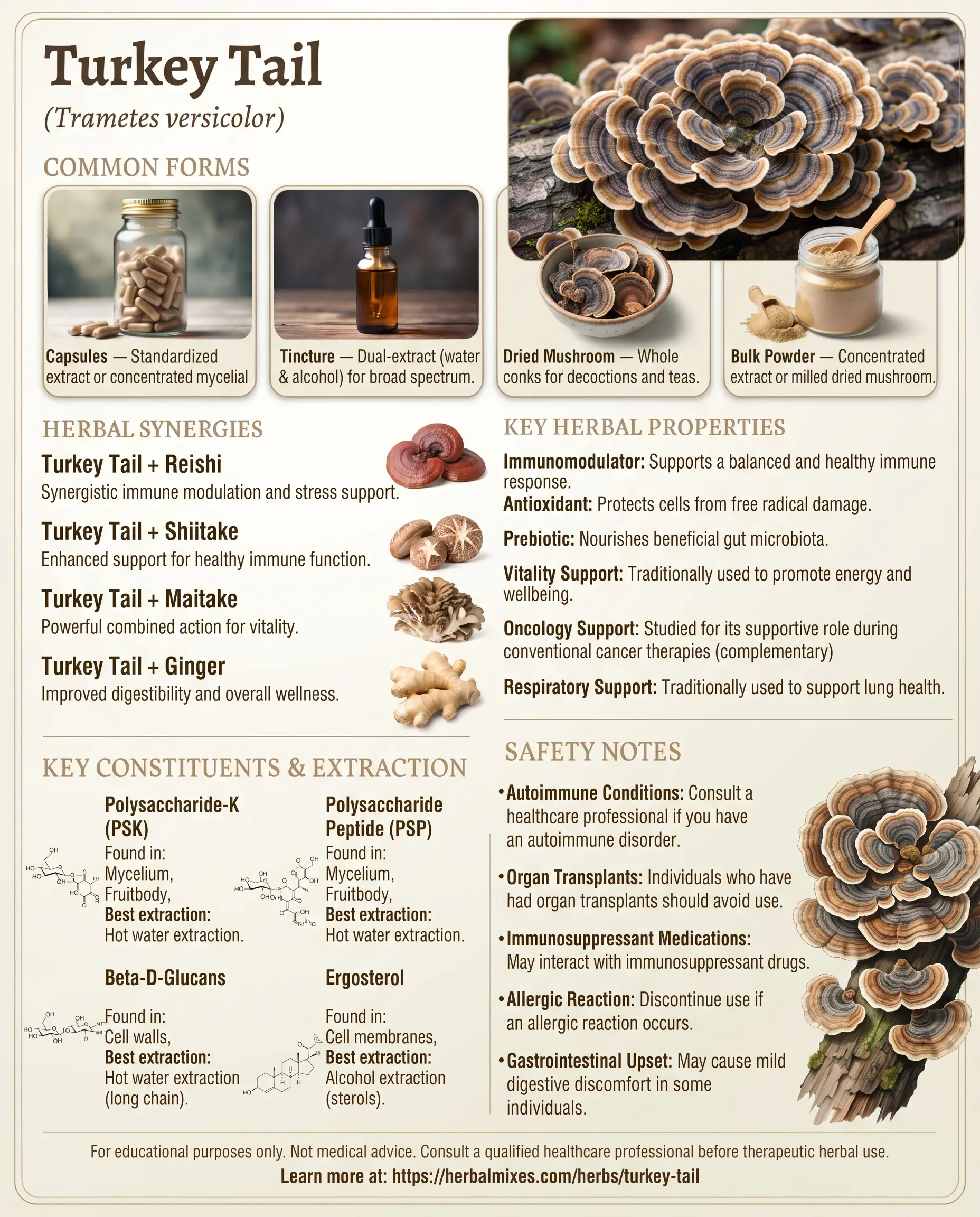
Immune support — Turkey tail is one of the most extensively researched medicinal mushrooms for immune-modulating polysaccharides. Its beta-glucans and protein-bound polysaccharides interact with innate and adaptive immune pathways rather than simply “boosting” immunity.
Gut microbiome support — Turkey tail polysaccharides and fungal fibers can function as prebiotic substrates for intestinal microorganisms. This helps explain its traditional digestive use and growing interest in microbiome support.
General resilience — Turkey tail is traditionally used as a restorative mushroom during periods of weakness or recovery. Human evidence for ordinary supplements remains more limited than the extensive laboratory and pharmaceutical-polysaccharide research.
Adjunctive oncology research — Turkey tail has an unusually large history of research involving PSK (polysaccharide-K) and PSP (polysaccharopeptide) as adjuncts to conventional cancer treatment. Meta-analyses have reported favorable outcomes in some gastrointestinal cancers when PSK was combined with standard therapy.
This does not mean over-the-counter turkey tail capsules treat cancer. Pharmaceutical PSK and PSP preparations are not interchangeable with ordinary mushroom supplements.
Post-treatment immune recovery — preliminary evidence — A small phase I study in women who had completed breast-cancer radiation found oral turkey tail preparations were generally well tolerated and produced dose-related changes in several immune markers.
Antioxidant support — Turkey tail contains phenolic compounds, polysaccharides, sterols, and other metabolites that contribute antioxidant and inflammatory-modulating activity.
Available Herbal Products
Buying Guides for Available Turkey Tail Products
Turkey Tail Mushroom Capsules – 100% organic fruiting-body extract with guaranteed beta-glucan content above 30% and no grain or starch fillers. Currently available directly from the manufacturer. Seller: Real Mushrooms – View Real Mushrooms Turkey Tail Capsules →
Turkey Tail Mushroom – 100% organic Trametes versicolor fruiting-body extract in capsules, with no grain, starch, or mycelium listed. Currently available directly from the manufacturer. Seller: Gaia Herbs – View Gaia Herbs Turkey Tail Mushroom →
Turkey Tail Capsules – Certified-organic turkey tail mycelium grown on organic brown rice, with fermented substrate included. Currently available in several bottle sizes. Seller: Host Defense – View Host Defense Turkey Tail Capsules →
Turkey Tail Extract – Triple-extracted organic turkey tail preparation made from mycelium and fruit bodies grown in the United States. Currently available directly from the manufacturer. Seller: Host Defense – View Host Defense Turkey Tail Extract →
Organic Turkey Tail Extract Powder – Fruiting-body extract providing 300 mg beta-(1,3)(1,6)-glucans per 1 g serving and currently available through iHerb. Seller: Real Mushrooms / iHerb – View Turkey Tail Extract Powder →
When comparing products, look beyond total mushroom milligrams. Useful quality information includes species identification, fruiting body versus mycelium, extraction method, beta-glucan percentage, starch content, and contaminant testing.
Herbal Synergies
Turkey tail pairs especially well with reishi, maitake, astragalus, shiitake, and ginger depending on whether the goal is immune resilience, gut support, recovery, or general vitality.
Turkey Tail + Reishi
Best for: Long-term immune resilience and restorative support
Turkey tail contributes beta-glucans and protein-bound polysaccharides, while reishi adds beta-glucans plus triterpenoids such as ganoderic acids.
Best extraction: Turkey tail hot-water extract combined with reishi dual extract.
Turkey Tail + Maitake
Best for: Immune and metabolic support
Both mushrooms contain structurally different beta-glucans capable of interacting with innate immune receptors.
Best extraction: Hot-water extracts.
Turkey Tail + Astragalus
Best for: Everyday immune resilience and recovery
Turkey tail provides fungal polysaccharides, while astragalus contributes plant polysaccharides, saponins, and traditional tonic activity.
Best extraction: Turkey tail hot-water extract combined with astragalus decoction or standardized extract.
Turkey Tail + Shiitake
Best for: Immune and gut support
Turkey tail contributes PSK/PSP-related chemistry and beta-glucans, while shiitake contributes lentinan and other fungal polysaccharides.
Best extraction: Long cooking, decoction, or concentrated hot-water extracts.
Turkey Tail + Ginger
Best for: Digestive comfort during restorative mushroom use
Turkey tail can be earthy and sometimes difficult for sensitive digestion, while ginger contributes warming carminative and anti-nausea activity.
Best extraction: Turkey tail decoction or extract with ginger tea.
Key Herbal Properties
Immunomodulatory — Turkey tail polysaccharides influence macrophages, natural killer cells, T cells, B cells, and cytokine signaling.
Prebiotic supportive — Fungal polysaccharides and fibers can influence gastrointestinal microbial communities.
Antioxidant — Polysaccharides, phenolics, and other compounds contribute antioxidant activity.
Anti-inflammatory — experimental — Turkey tail constituents influence inflammatory signaling pathways in laboratory and animal research.
Adjunctive oncology supportive — preparation-specific evidence — Pharmaceutical PSK and PSP have been studied alongside chemotherapy and other standard treatments.
Restorative tonic — traditional — Turkey tail has longstanding traditional use for general vitality and recovery.




Active Compounds
Turkey tail is best known for its beta-glucans and protein-bound polysaccharides, but it also contains sterols, phenolics, proteins, peptides, and other fungal metabolites.
Beta-(1→3)(1→6)-Glucans
Found mainly in: Fungal cell walls
These branched polysaccharides are among the most important constituents of medicinal mushrooms.
They interact with immune receptors including Dectin-1, complement receptor 3, and related pattern-recognition pathways.
Best extraction: Prolonged hot-water extraction.
PSK — Polysaccharide-K
Found mainly in: Cultured Trametes versicolor preparations
PSK, also called polysaccharide-Kureha or Krestin, is a standardized protein-bound polysaccharide preparation developed in Japan.
It has been studied as an adjunct to conventional cancer therapy, particularly in gastric and colorectal cancers.
Best extraction: Pharmaceutical manufacturing uses controlled aqueous extraction and purification.
Ordinary turkey tail supplements should not be assumed to contain clinical-equivalent PSK.
PSP — Polysaccharopeptide
Found mainly in: Cultured turkey tail preparations
PSP is another protein-bound polysaccharide fraction developed and studied primarily in China.
It has demonstrated immunomodulatory effects, including effects on monocytes, cytokines, and lymphocytes.
Best extraction: Controlled hot-water extraction followed by purification.
Heteropolysaccharides
Found mainly in: Fruiting body and mycelium
Turkey tail contains multiple polysaccharides made from glucose, mannose, galactose, xylose, and other sugars.
Their activity depends on molecular size, branching, protein binding, and extraction method.
Best extraction: Hot water.
Ergosterol
Found mainly in: Fungal cell membranes
Ergosterol is the fungal precursor of vitamin D2.
Exposure to ultraviolet light can convert some ergosterol into vitamin D2.
Best extraction: Alcohol-rich or lipid-compatible extraction.
Phenolic Compounds
Found mainly in: Fruiting body
Phenolic acids and related compounds contribute antioxidant activity.
Best extraction: Hot water or hydroalcoholic extraction.
Sterols
Found mainly in: Fruiting body and mycelium
Various fungal sterols contribute to the mushroom’s broader chemical profile.
Best extraction: Alcohol-containing or lipid-compatible extraction.
-
FAQ
What is turkey tail best used for?
Turkey tail is best suited to immune support, gut-microbiome support, and general restorative use.
Its most extensive clinical history involves purified PSK and PSP preparations used alongside conventional cancer treatment.
Does turkey tail treat cancer?
No over-the-counter turkey tail supplement should be presented as a cancer treatment.
A systematic review of medicinal-mushroom clinical studies found promising outcomes with PSK in several gastric-cancer studies, but concluded that the overall evidence remains insufficient to recommend routine mushroom supplementation for all cancer patients.
What is PSK?
PSK is a standardized protein-bound polysaccharide derived from turkey tail that has been used medically in Japan as an adjunctive immunotherapy.
It is not the same thing as ordinary turkey tail powder or capsules.
Is fruiting body better than mycelium?
They are different rather than automatically “good” or “bad.”
Fruiting-body extracts can provide high measured beta-glucan concentrations, while some researched products use mycelium or cultured biomass.
The important question is whether the manufacturer clearly states the material used and provides meaningful testing for beta-glucans, starch, identity, and contaminants.
Is hot-water extraction important?
Yes.
The major beta-glucans and protein-bound polysaccharides are primarily water-soluble or water-extractable, and turkey tail’s tough woody fruiting body is difficult to digest without cooking or extraction.
Safety & Precautions
Turkey tail is generally well tolerated in research studies, but modern supplement safety data are less extensive than its long history of use suggests.
Possible adverse effects include:
- nausea;
- bloating;
- diarrhea;
- digestive discomfort;
- darkened stool;
- allergic reaction.
A 2023 systematic review of medicinal mushrooms in cancer studies reported that most adverse events were mild to moderate, commonly including nausea, vomiting, diarrhea, and muscle pain.
Cancer Treatment
People undergoing chemotherapy, radiation therapy, immunotherapy, or other cancer treatment should not add turkey tail without informing their oncology team.
PSK and PSP research involves specific preparations, defined treatment protocols, and medical supervision.
Turkey tail supplements should never be used to replace:
- chemotherapy;
- radiation;
- surgery;
- immunotherapy;
- hormone therapy;
- targeted therapy.
Immunosuppressive Medications
Turkey tail has substantial immune-modulating activity.
People taking immunosuppressive medications after organ transplantation or for autoimmune disease should discuss concentrated turkey tail products with their specialist.
Potential concern is especially relevant with medicines such as:
- tacrolimus;
- cyclosporine;
- mycophenolate;
- systemic corticosteroids;
- biologic immunosuppressants.
Human interaction data remain limited, so compatibility should not be assumed.
Autoimmune Conditions
“Immune support” does not necessarily mean that more immune stimulation is desirable.
People with autoimmune conditions such as lupus, rheumatoid arthritis, multiple sclerosis, inflammatory bowel disease, or autoimmune thyroid disease should discuss concentrated medicinal-mushroom extracts with their clinician.
Pregnancy & Breastfeeding
Reliable pregnancy and lactation safety data for concentrated turkey tail supplements are lacking.
Gaia Herbs specifically advises against use of its turkey tail product during pregnancy or lactation.
Other manufacturers advise consulting a healthcare professional.
Avoid medicinal-dose supplements during pregnancy or breastfeeding unless appropriately supervised.
Mushroom Allergy
People with known mushroom allergy should use caution.
Stop use and seek urgent care for difficulty breathing, facial swelling, widespread hives, or other signs of a severe allergic reaction.
Product Quality
Choose products that clearly identify Trametes versicolor.
Useful quality markers include:
- measured beta-glucan content;
- low starch content when a fruiting-body product is claimed;
- heavy-metal testing;
- microbial testing;
- fungal identity verification.
Anyone who is undergoing cancer treatment, taking immunosuppressive medication, pregnant, breastfeeding, or managing a significant autoimmune condition should discuss therapeutic turkey tail use with an appropriate healthcare professional.
References
- NCBI Taxonomy — Trametes versicolor
- PubMed — Medicinal Mushroom Supplements in Cancer: Systematic Review
- PubMed — PSK in Gastrointestinal Cancer: Systematic Review and Network Meta-Analysis
- PubMed — PSK for Colorectal Cancer: Meta-Analysis
- PubMed — Turkey Tail in Women After Breast-Cancer Treatment: Phase I Trial
- PubMed — PSP in Advanced Non-Small-Cell Lung Cancer
- PubMed — PSP and Human Immune Signaling
- Real Mushrooms — Turkey Tail Mushroom Capsules
- Gaia Herbs — Turkey Tail Mushroom
- Host Defense — Turkey Tail Capsules
- Host Defense — Turkey Tail Extract
- Real Mushrooms / iHerb — Turkey Tail Extract Powder
Disclaimer
Disclaimer: This article is for educational purposes only and is not intended to diagnose, treat, cure, or prevent any disease. Herbal products can cause side effects and interact with medications. Consult a qualified healthcare professional before using herbs therapeutically, especially if you are pregnant, breastfeeding, taking prescription medications, or managing a medical condition.