

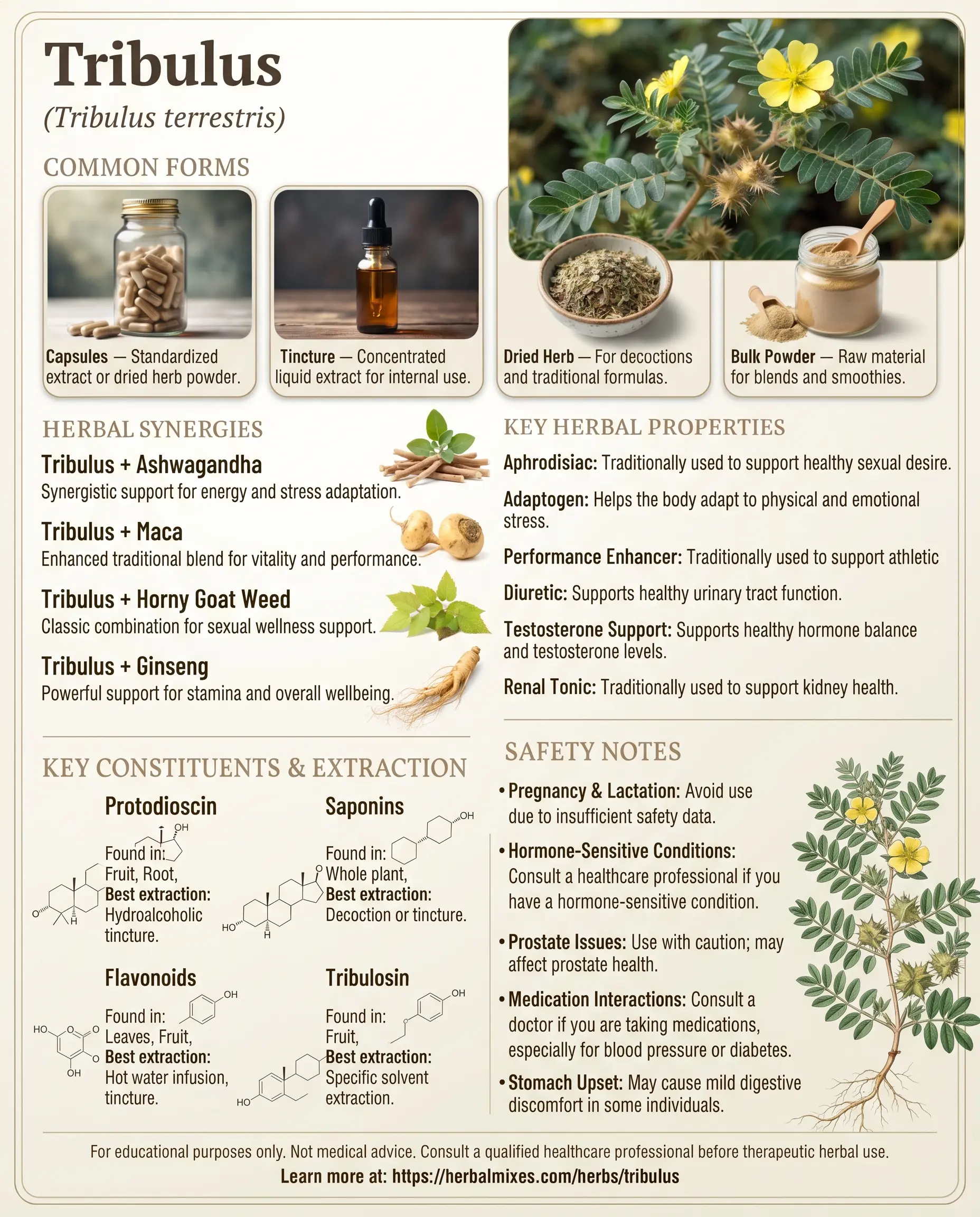
What Tribulus Is Good For
Libido & sexual well-being — Tribulus has a long traditional reputation as an aphrodisiac and reproductive tonic. Human trials suggest possible improvements in sexual desire and function in some men and women, although the evidence is still limited and preparation-dependent.
Mild erectile dysfunction — A randomized double-blind placebo-controlled trial involving men with mild-to-moderate erectile dysfunction found significant improvements in erectile function, sexual desire, orgasmic function, and satisfaction after 12 weeks of a standardized tribulus extract. Other trials have been less positive, so the evidence is mixed. PubMed
Female sexual function — A systematic review found that women receiving tribulus for one to three months generally showed improved sexual-function scores, but the certainty of evidence was rated very low. PubMed
Traditional urinary support — In Ayurvedic and other traditional systems, tribulus fruit has been used for urinary discomfort, fluid balance, and kidney-related complaints. Modern evidence for these uses is mostly preclinical and should not be interpreted as treatment for kidney stones or urinary disease.
General vitality — Tribulus is widely marketed for energy, virility, and physical performance. However, evidence does not convincingly show that it improves testosterone or muscle-building outcomes in healthy people.
Testosterone claims — This is where marketing most often outruns evidence. A systematic review concluded that tribulus is generally ineffective for increasing testosterone in humans, and a 2025 review likewise found inconsistent testosterone effects despite some evidence for sexual-function improvement. PubMed PubMed
Available Herbal Products
Buying Guides for Available Tribulus Products
Tribulus 1,000 mg – Standardized fruit and aerial-parts extract containing at least 45% saponins. Currently available directly from the manufacturer. Seller: NOW Foods – View NOW Tribulus 1,000 mg →
Tribulus 500 mg – Standardized tribulus capsules currently available directly from the manufacturer as a lower-strength option. Seller: NOW Foods – View NOW Tribulus Products →
Tribulus Extract 750 mg – Fruit extract standardized to 45% saponins, providing 1,500 mg per two-capsule serving. Currently in stock. Seller: Nutricost / Vitacost – View Nutricost Tribulus →
Tribulus Terrestris Extract 500 mg – Whole-plant extract standardized to 45% steroidal saponins. Currently available. Seller: Swanson / Vitacost – View Swanson Tribulus Extract →
Tribulus Terrestris 500 mg – Fruit extract standardized to 20% saponins and currently available. Seller: Nature’s Truth / Vitacost – View Nature’s Truth Tribulus →
When comparing products, prioritize clearly identified Tribulus terrestris, plant part, extract amount, and standardized saponin content. Total milligrams alone do not tell you how similar a product is to one used in clinical research.
Herbal Synergies
Tribulus pairs especially well with maca, ginseng, ashwagandha, saw palmetto, and ginger depending on whether the goal is libido, vitality, stress-related sexual dysfunction, or urinary support.
Tribulus + Maca
Best for: Libido and sexual well-being
Tribulus has emerging evidence for sexual function, while maca has human research supporting libido without reliably increasing testosterone.
Best extraction: Standardized tribulus extract combined with maca powder or extract.
Tribulus + Asian Ginseng
Best for: Erectile function and fatigue
Tribulus contributes steroidal saponins, while Panax ginseng has a more established clinical record for erectile function and fatigue.
Best extraction: Standardized extracts.
Tribulus + Ashwagandha
Best for: Stress-related low libido
Tribulus emphasizes sexual function, while ashwagandha adds adaptogenic support and may help when stress, fatigue, or poor sleep contribute to reduced libido.
Best extraction: Standardized extracts or powders.
Tribulus + Saw Palmetto
Best for: Traditional male urinary and reproductive support
Tribulus contributes traditional urinary and reproductive use, while saw palmetto has more specific research related to lower urinary tract symptoms associated with benign prostate enlargement.
Best extraction: Standardized extracts.
Tribulus + Ginger
Best for: Vitality with sluggish digestion
Tribulus provides reproductive-tonic chemistry while ginger adds warming digestive and circulatory support.
Best extraction: Tribulus extract combined with ginger tea or powder.
Key Herbal Properties
Aphrodisiac supportive — Clinical studies suggest possible improvements in libido and sexual-function scores in men and women.
Erectile-function supportive — emerging evidence — Some randomized trials report benefit, but findings are inconsistent.
Androgen-modulating — uncertain — Tribulus is heavily marketed as a testosterone enhancer, but clinical evidence generally does not support meaningful testosterone increases in healthy men.
Diuretic — traditional / experimental — The fruit has longstanding traditional use for urinary and fluid-balance support.
Anti-inflammatory — experimental — Steroidal saponins and flavonoids influence inflammatory pathways in laboratory and animal research.
Antioxidant — Polyphenols, flavonoids, and saponins contribute antioxidant activity.
Glucose supportive — experimental — Some preclinical studies suggest effects on glucose metabolism, but this is not a well-established clinical indication.




Active Compounds
Tribulus is especially rich in steroidal saponins, along with flavonoids, tannins, alkaloids, terpenoids, phenolic acids, and glycosides. Its phytochemistry varies substantially according to geography and plant part. PubMed
Protodioscin
Found mainly in: Aerial parts and fruit
Protodioscin is one of the best-known furostanol steroidal saponins in tribulus and is frequently proposed as a marker of biological activity.
Its concentration varies dramatically among products from different geographic origins.
Best extraction: Hydroalcoholic extraction. Saponins are amphiphilic and are efficiently recovered with water-alcohol mixtures.
Protogracillin
Found mainly in: Fruit and aerial tissues
Protogracillin is another furostanol saponin associated with tribulus’s reproductive and metabolic research.
Best extraction: Hydroalcoholic extraction.
Dioscin
Found mainly in: Fruit and aerial parts
Dioscin is a steroidal saponin investigated experimentally for anti-inflammatory and metabolic effects.
Best extraction: Alcohol-water extraction.
Diosgenin
Found mainly in: Primarily as part of saponin structures or after hydrolysis
Diosgenin is a plant steroidal sapogenin.
It is important to understand that diosgenin does not turn into testosterone inside the human body, despite its steroid-like chemical structure.
Best extraction: Alcohol-rich extraction after release from glycosides.
Tigogenin
Found mainly in: Fruit and aerial tissues
Tigogenin is another steroidal sapogenin occurring within the broader saponin fraction.
Best extraction: Alcohol-rich or hydroalcoholic extraction.
Terrestrosins
Found mainly in: Fruit and aerial tissues
Terrestrosin-type steroidal saponins are characteristic tribulus constituents and contribute to its chemically diverse saponin profile.
Best extraction: Water-alcohol extraction.
Quercetin Glycosides
Found mainly in: Leaves and aerial parts
Quercetin-related flavonoids contribute antioxidant and inflammatory-modulating effects.
Best extraction: Hot water or diluted alcohol.
Kaempferol Derivatives
Found mainly in: Aerial parts
Kaempferol-related flavonoids add to tribulus’s antioxidant profile.
Best extraction: Hot water or hydroalcoholic extraction.
-
FAQ
What is tribulus best used for?
Tribulus is best described as a sexual-function and libido-support herb with traditional urinary and vitality uses.
Its strongest modern interest is sexual function rather than testosterone enhancement.
Does tribulus increase testosterone?
Usually not in a meaningful or reliable way.
A systematic review found that human trials do not support tribulus as an effective testosterone booster, even though many supplements are marketed that way. PubMed
Can tribulus help erectile dysfunction?
Possibly.
One relatively large randomized controlled trial found improvement in men with mild-to-moderate erectile dysfunction, but another smaller placebo-controlled study found no meaningful benefit. Overall evidence is promising but inconsistent. PubMed PubMed
Does tribulus build muscle?
There is no convincing human evidence that tribulus increases muscle mass or athletic performance through testosterone elevation.
It should not be considered a substitute for resistance training, adequate protein intake, sleep, or evidence-based sports nutrition.
Are all tribulus extracts the same?
No.
Saponin concentrations and specific compounds such as protodioscin vary greatly by plant part, geographic origin, and extraction method. Standardization is especially important with this herb. PubMed
Safety & Precautions
Tribulus appears to be reasonably tolerated in many short-term clinical trials, but its long-term safety is not well established.
Commonly reported adverse effects include stomach discomfort, nausea, diarrhea, and other gastrointestinal symptoms.
Kidney & Liver Safety
Rare but serious cases of liver and kidney injury have been reported after tribulus supplement use.
A 2024 case report described a 46-year-old man who developed severe jaundice and acute kidney dysfunction after taking tribulus daily for two months. Liver biopsy findings were consistent with drug-induced liver injury. PubMed
Earlier and more recent case reports have also described acute kidney injury associated with tribulus use. PubMed PubMed
These reports are rare and do not prove that typical doses routinely cause organ damage, but they justify caution—particularly with high-dose, poorly characterized, or multi-ingredient products.
People with existing kidney or liver disease should avoid self-prescribing concentrated tribulus.
Stop use and seek medical care for:
- yellowing of the skin or eyes;
- dark urine;
- markedly reduced urination;
- severe fatigue;
- persistent vomiting;
- severe abdominal pain.
Pregnancy & Breastfeeding
Tribulus should generally be avoided during pregnancy because adequate human safety studies are lacking and reproductive effects have been reported experimentally.
Commercial tribulus products commonly advise against use during pregnancy and breastfeeding.
Safety during lactation is also insufficiently established.
Hormone-Sensitive Conditions
Tribulus can influence reproductive and endocrine markers in some studies, even though it does not consistently raise testosterone.
People with prostate cancer, breast cancer, ovarian cancer, endometriosis, uterine fibroids, or other hormone-sensitive conditions should discuss concentrated tribulus extracts with their healthcare professional.
Blood Pressure & Blood Sugar
Experimental research suggests tribulus may influence blood glucose and blood pressure.
Use caution with:
- insulin;
- sulfonylureas;
- other diabetes medications;
- antihypertensive medication.
Monitor for unexpectedly low blood glucose or blood pressure if using concentrated extracts alongside these medicines.
Diuretic Effects
Because tribulus has traditional and experimental diuretic activity, caution is appropriate in people taking prescription diuretics or managing kidney, heart, or electrolyte disorders.
Sexual Symptoms Need Evaluation
Do not use tribulus to delay evaluation of persistent erectile dysfunction or major loss of libido.
Erectile dysfunction can be an early sign of:
- cardiovascular disease;
- diabetes;
- hypertension;
- hormonal disorders;
- medication side effects;
- neurological disease.
Persistent sexual dysfunction deserves medical assessment rather than simply adding a “testosterone booster.”
Anyone who is pregnant, breastfeeding, taking diabetes or blood-pressure medication, or managing significant liver, kidney, cardiovascular, or hormone-sensitive disease should discuss therapeutic tribulus use with an appropriate healthcare professional.
References
- Kew Plants of the World Online — Tribulus terrestris
- PubMed — Tribulus, Erectile Dysfunction & Testosterone: 2025 Systematic Review
- PubMed — Tribulus and Testosterone: Systematic Review
- PubMed — Tribulus for Male Sexual Dysfunction: Randomized Controlled Trial
- PubMed — Tribulus for Female Sexual Dysfunction: Systematic Review
- PubMed — Comprehensive Phytochemistry & Toxicology Review
- PubMed — Traditional Uses and Phytochemistry of Tribulus terrestris
- PubMed — Severe Liver and Renal Injury From Tribulus
- NCBI LiverTox — Tribulus
- NOW Foods — Tribulus 1,000 mg
- Nutricost / Vitacost — Tribulus
- Swanson / Vitacost — Tribulus Extract
Disclaimer
Disclaimer: This article is for educational purposes only and is not intended to diagnose, treat, cure, or prevent any disease. Herbal products can cause side effects and interact with medications. Consult a qualified healthcare professional before using herbs therapeutically, especially if you are pregnant, breastfeeding, taking prescription medications, or managing a medical condition.