

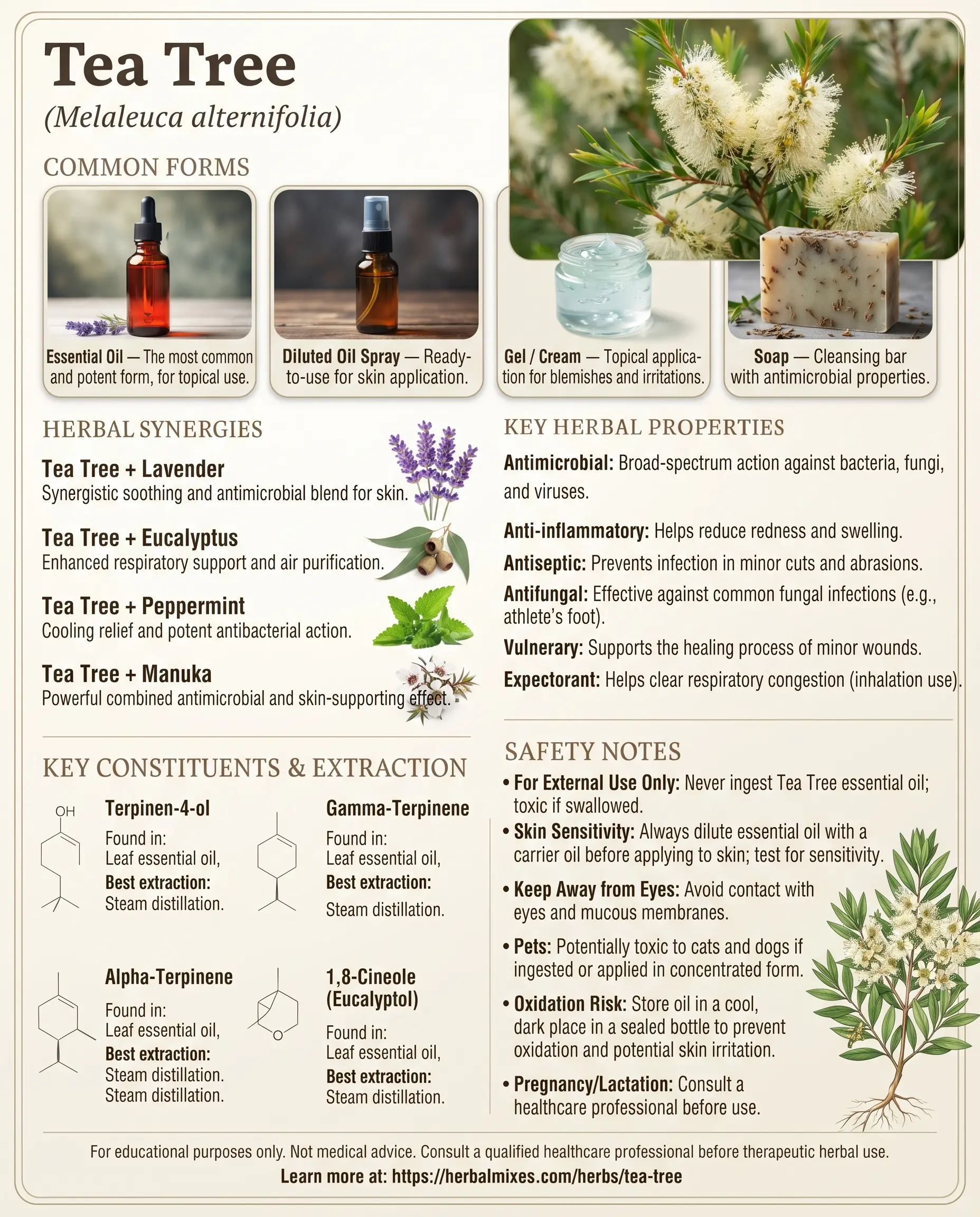
What Tea Tree Is Good For
Mild acne — Tea tree oil has one of its better-supported uses in acne. A 2026 systematic review and meta-analysis of seven studies involving 445 people found a modest reduction in acne severity with generally mild local adverse effects. A randomized trial of 5% tea tree oil gel also found significantly greater improvement than placebo. PubMed
Dandruff — A randomized trial involving 126 people found that a 5% tea tree oil shampoo improved dandruff severity by about 41% over four weeks compared with 11% with placebo. PubMed
Athlete’s foot — EMA recognizes traditional tea tree oil use for itching and irritation associated with mild athlete’s foot. In one clinical trial, 25% and 50% tea tree oil solutions produced clinical improvement, although conventional antifungal treatments remain better established. PubMed
Small boils and superficial wounds — The European Medicines Agency recognizes traditional topical tea tree oil use for small superficial wounds, insect bites, small boils, and mild acne. EMA
Minor mouth inflammation — EMA also recognizes appropriately formulated tea tree oil preparations for minor inflammation of the lining of the mouth. This does not mean swallowing essential oil is safe.
Antimicrobial skin support — Tea tree oil has broad antibacterial and antifungal activity in laboratory studies, especially against organisms associated with acne, superficial fungal infections, and some scalp conditions.
Available Herbal Products
Tea Tree Oil – 100% pure Melaleuca alternifolia leaf essential oil, steam distilled and currently available in several bottle sizes. The manufacturer provides access to a certificate of analysis. Seller: NOW Foods – View NOW Tea Tree Oil →
Organic Tea Tree Oil – Certified-organic 100% pure Melaleuca alternifolia leaf oil, steam distilled and currently available directly from the manufacturer. Seller: NOW Foods – View NOW Organic Tea Tree Oil →
100% Australian Tea Tree Oil – Pure Australian Melaleuca alternifolia oil, steam distilled and currently available in multiple bottle sizes. Seller: Desert Essence – View Desert Essence Tea Tree Oil →
Tea Tree Essential Oil – Pure Melaleuca alternifolia essential oil from Australia, currently listed in stock and accompanied by GC/MS quality documentation. Seller: Aura Cacia – View Aura Cacia Tea Tree Essential Oil →
Tea Tree Essential Oil – Steam-distilled Melaleuca alternifolia oil with published third-party GC/MS testing and manufacturer guidance for topical dilution. Seller: Plant Therapy – View Plant Therapy Tea Tree Essential Oil →
For skin treatment, a finished 2–5% topical product or appropriately diluted essential oil is generally easier to use safely than repeatedly applying undiluted tea tree oil.
Herbal Synergies
Tea tree pairs especially well with aloe vera, calendula, witch hazel, lavender, and thyme depending on whether the goal is acne, scalp care, irritated skin, or antimicrobial support.
Tea Tree + Aloe Vera
Best for: Acne-prone or irritated skin
Tea tree contributes antimicrobial activity, while aloe vera provides cooling, hydrating, and skin-soothing effects.
Best extraction: Diluted tea tree oil incorporated into aloe gel or a properly formulated topical product.
Tea Tree + Calendula
Best for: Minor superficial skin irritation
Tea tree provides antimicrobial activity while calendula adds soothing and tissue-supportive properties.
Best extraction: Diluted essential oil combined with calendula-infused oil or cream.
Tea Tree + Witch Hazel
Best for: Oily, acne-prone skin
Tea tree adds antimicrobial action while witch hazel contributes mild astringency.
Best extraction: Use a professionally formulated toner or diluted topical preparation rather than adding large amounts of neat essential oil directly to witch hazel.
Tea Tree + Lavender
Best for: Minor skin irritation and blemishes
Both essential oils demonstrate experimental antimicrobial activity, while lavender contributes a gentler aromatic and soothing component.
Best extraction: Diluted topical essential-oil blend.
Tea Tree + Thyme
Best for: Experimental antimicrobial skin formulations
Tea tree and thyme essential oils have complementary antimicrobial chemistry.
Best extraction: Professionally diluted topical formulation.
Thyme essential oil can be strongly irritating, so this is not a good combination for casual undiluted DIY use.
Key Herbal Properties
Antibacterial — Tea tree oil inhibits a broad range of bacteria in laboratory studies, including organisms associated with acne and superficial skin infections.
Antifungal — It shows activity against dermatophytes and yeasts and has clinical research in athlete’s foot and dandruff.
Anti-inflammatory — Terpinen-4-ol and other compounds influence inflammatory signaling and may contribute to reductions in redness and irritation.
Anti-acne supportive — Clinical trials and a 2026 meta-analysis support modest benefit for mild-to-moderate acne.
Antipruritic supportive — EMA recognizes traditional use for itching and irritation associated with mild athlete’s foot.
Antiseptic — traditional — Tea tree oil has longstanding topical use for small superficial wounds and minor skin infections.
Contact sensitizer potential — Tea tree oil can also provoke allergic contact dermatitis, especially after oxidation.





Active Compounds
Tea tree oil is composed primarily of monoterpenes and monoterpene alcohols. Its exact composition varies with cultivation, storage, chemotype, and oxidation.
Terpinen-4-ol
Found mainly in: Essential oil
Terpinen-4-ol is the major characteristic constituent of standard tea tree oil and is strongly associated with its antimicrobial and anti-inflammatory properties.
Best extraction: Steam distillation of fresh leaves and terminal branchlets.
Gamma-Terpinene
Found mainly in: Essential oil
Gamma-terpinene is one of tea tree oil’s major monoterpenes.
It contributes to the aromatic profile but is also prone to oxidation during prolonged exposure to air.
Best extraction: Steam distillation.
Alpha-Terpinene
Found mainly in: Essential oil
Alpha-terpinene contributes antimicrobial and aromatic effects.
Oxidation products derived from it can increase the risk of allergic contact dermatitis.
Best extraction: Steam distillation.
1,8-Cineole
Found mainly in: Essential oil
Also known as eucalyptol, 1,8-cineole contributes to tea tree oil’s penetrating aroma.
Modern standardized tea tree oils typically keep cineole within defined limits because excessive amounts may increase irritation.
Best extraction: Steam distillation.
Alpha-Terpineol
Found mainly in: Essential oil
Alpha-terpineol is a monoterpene alcohol with experimental antimicrobial activity.
Best extraction: Steam distillation.
P-Cymene
Found mainly in: Essential oil, increasing with oxidation
P-cymene occurs naturally and can increase as certain terpenes oxidize during storage.
Best extraction: Steam distillation.
Alpha-Pinene
Found mainly in: Essential oil
Alpha-pinene contributes pine-like aroma and experimental antimicrobial activity.
Best extraction: Steam distillation.
Oxidation Products
Found mainly in: Old or poorly stored oil
Oxidation can generate compounds such as ascaridole and oxidized terpene derivatives that make tea tree oil significantly more allergenic. PubMed
Best extraction: Not applicable—these are unwanted degradation products.
St. John’s wort contains several pharmacologically important groups, especially phloroglucinols, naphthodianthrones, flavonoids, biflavones, phenolic acids, and volatile compounds.
Hyperforin
Found mainly in: Flowering aerial parts, especially fresh flowering tops
Hyperforin is one of the most pharmacologically important compounds in St. John’s wort.
It contributes to antidepressant activity but is also largely responsible for the herb’s ability to induce CYP3A4 and P-glycoprotein, creating many clinically significant interactions. PubMed
Best extraction: Hydroalcoholic extraction.
Hyperforin is relatively unstable and sensitive to light, oxygen, and storage conditions, so standardized commercial extracts may differ greatly.
Adhyperforin
Found mainly in: Flowering aerial parts
Adhyperforin is structurally related to hyperforin and contributes to the phloroglucinol fraction.
Best extraction: Alcohol-rich extraction.
Hypericin
Found mainly in: Flowers and aerial tissues
Hypericin is a red naphthodianthrone and one of the traditional standardization markers for St. John’s wort products.
It contributes to photosensitizing activity at high exposure but is not considered the sole antidepressant constituent.
Best extraction: Hydroalcoholic extraction.
Pseudohypericin
Found mainly in: Flowering aerial parts
Pseudohypericin is closely related to hypericin and contributes to the plant’s characteristic red pigment chemistry.
Best extraction: Hydroalcoholic extraction.
Rutin
Found mainly in: Aerial parts
Rutin is a flavonoid glycoside contributing antioxidant activity.
Best extraction: Hot water or diluted alcohol.
Hyperoside
Found mainly in: Leaves and flowers
Hyperoside, a quercetin glycoside, contributes antioxidant and inflammatory-modulating activity.
Best extraction: Water or hydroalcoholic extraction.
Quercetin Derivatives
Found mainly in: Aerial herb
Multiple quercetin-related flavonoids contribute to the herb’s broader antioxidant profile.
Best extraction: Hot water or diluted alcohol.
Amentoflavone
Found mainly in: Aerial parts
Amentoflavone is a biflavonoid investigated for nervous-system and inflammatory activity.
Best extraction: Alcohol-containing extraction.