

What Skullcap Is Good For
Nervous tension — American skullcap is traditionally used as a relaxing nervine for people who feel tense, overstimulated, or mentally unable to settle.
Mild anxiousness — Human evidence is limited but promising. A randomized double-blind crossover trial in 43 healthy adults found improvements in overall mood, although anxiety scores did not differ significantly from placebo. An earlier small controlled trial also reported anxiolytic effects. PubMed
Sleep support — A 2025 randomized double-blind crossover trial involving 66 adults with mild-to-moderate insomnia found that a chemically characterized Scutellaria lateriflora extract improved sleep-quality and sleep-wake measures compared with placebo. PubMed
Restlessness — Skullcap is traditionally used when fatigue is accompanied by nervous agitation rather than simple physical exhaustion.
Stress-related muscle tension — Herbalists often include skullcap in calming formulas when stress presents with physical tension, twitchiness, jaw clenching, or difficulty relaxing. Direct clinical evidence for muscle symptoms is limited.
Available Herbal Products
Buying Guides for Available Skullcap Products
Skullcap Liquid Herbal Extract – Fresh certified-organic flowering aerial parts of Scutellaria lateriflora at a 1:1.5 fresh-herb extraction ratio. Currently available directly from the manufacturer. Seller: Herb Pharm – View Herb Pharm Skullcap →
Organic Skullcap Herb Cut & Sifted – Loose Scutellaria lateriflora aerial herb suitable for tea and custom herbal blends. Currently available through iHerb. Seller: Starwest Botanicals / iHerb – View Organic Skullcap Herb →
Skullcap 350 mg – Freeze-dried organic flower and leaf capsules using Scutellaria lateriflora. Currently available through iHerb. Seller: Eclectic Herb / iHerb – View Eclectic Herb Skullcap →
Blue Skullcap 425 mg – Whole aerial-parts capsules containing Scutellaria lateriflora. Currently available through iHerb. Seller: Solaray / iHerb – View Solaray Blue Skullcap →
Skullcap Alcohol-Free Extract – Glycerin-based Scutellaria lateriflora liquid extract providing a concentrated herb equivalent without alcohol. Currently available through iHerb. Seller: Nature’s Answer / iHerb – View Nature’s Answer Skullcap →
For skullcap, species verification matters unusually much. Choose products explicitly labeled Scutellaria lateriflora from manufacturers that perform botanical identity testing.
Herbal Synergies
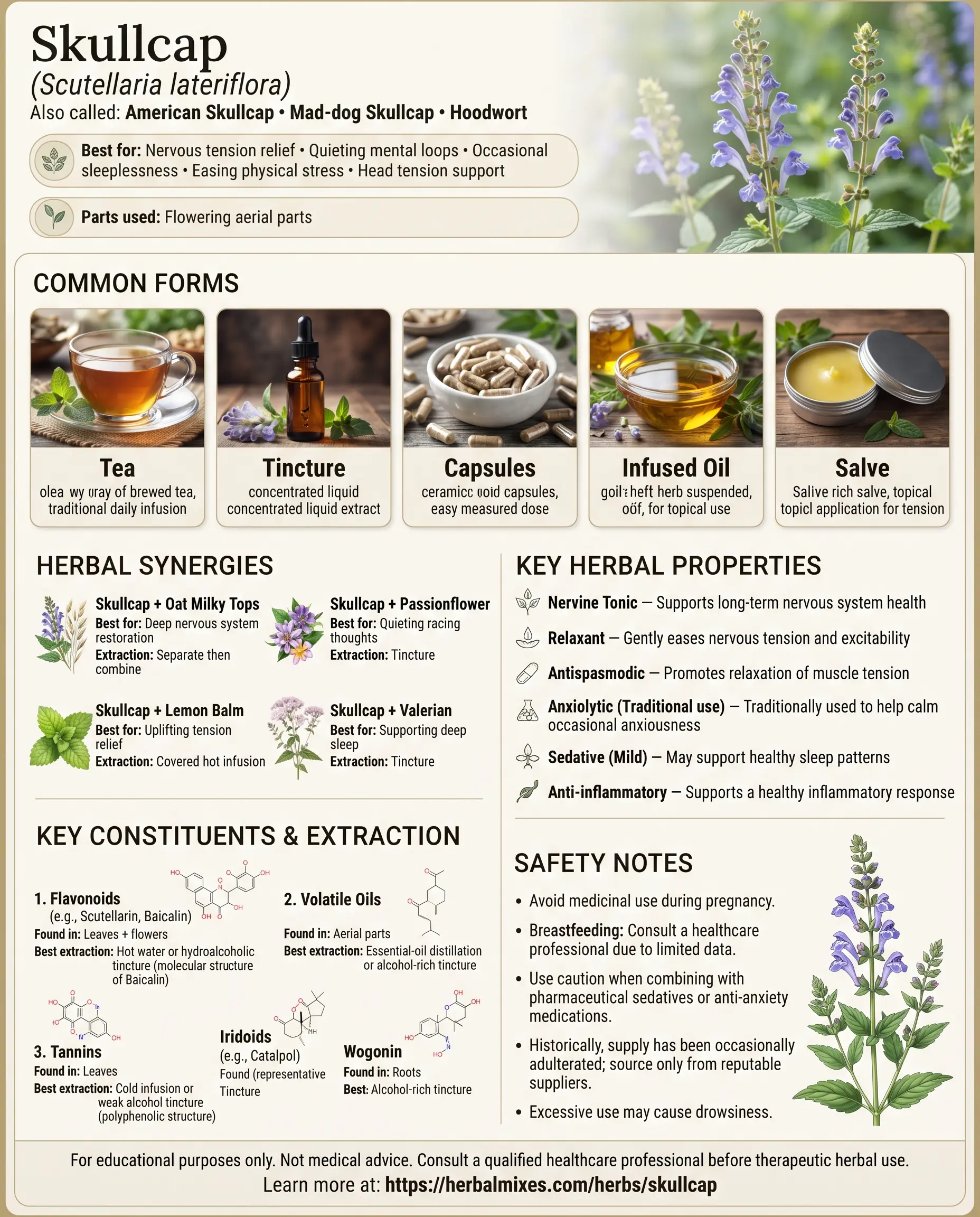
Skullcap pairs especially well with lemon balm, passionflower, valerian, chamomile, and milky oats depending on whether the goal is daytime calm, sleep, nervous exhaustion, or physical tension.
Skullcap + Lemon Balm
Best for: Daytime stress and nervous tension
Skullcap provides stronger relaxing nervine support, while lemon balm contributes gentler calming and digestive activity.
Best extraction: Covered hot infusion or hydroalcoholic tincture.
Skullcap + Passionflower
Best for: Racing thoughts and difficulty settling at night
Both herbs have calming traditions, with passionflower particularly useful when mental overactivity interferes with sleep.
Best extraction: Tea or tincture.
Skullcap + Valerian
Best for: More pronounced nighttime restlessness
Skullcap contributes nervous-system relaxation, while valerian provides stronger sedative and antispasmodic activity.
Best extraction: Tincture is useful because valerian’s volatile and less-polar compounds are incompletely extracted by water alone.
This combination may cause substantial drowsiness.
Skullcap + Chamomile
Best for: Mild anxiety with digestive or muscle tension
Chamomile adds gentle antispasmodic and digestive support to skullcap’s nervine action.
Best extraction: Covered hot infusion.
Skullcap + Milky Oats
Best for: Nervous exhaustion and prolonged stress
Skullcap is more immediately relaxing, while milky oats are traditionally used as a restorative nervine for depleted, overworked nervous systems.
Best extraction: Skullcap tincture combined with fresh milky-oat tincture.
Key Herbal Properties
Nervine — Skullcap is primarily used as a relaxing nervous-system herb.
Anxiolytic supportive — Small human trials and preclinical research suggest possible anxiety-reducing activity.
Sleep supportive — A recent controlled clinical trial found improved sleep parameters with a standardized skullcap preparation. PubMed
Mild sedative — Traditional use and pharmacological studies support calming central-nervous-system activity.
Antispasmodic — traditional / experimental — Skullcap is traditionally used when nervous tension is accompanied by muscular restlessness or spasm.
Antioxidant — Flavonoids including baicalin and baicalein contribute antioxidant activity.
Anti-inflammatory — experimental — Skullcap flavonoids influence inflammatory pathways in laboratory research.






Active Compounds
American skullcap contains a range of flavonoids, flavone glycosides, amino acids, phenolic compounds, and other secondary metabolites.
Its chemistry should not be assumed identical to Chinese skullcap (Scutellaria baicalensis), which has a different phytochemical profile and medicinal tradition.
Baicalin
Found mainly in: Aerial parts
Baicalin is one of the better-characterized flavonoid glycosides in American skullcap.
A phytochemical study measured substantial baicalin levels in a 50% ethanol extract and proposed that it may contribute to calming effects through GABA-related pathways. PubMed
Best extraction: Water-alcohol mixtures.
Baicalein
Found mainly in: Aerial parts
Baicalein is the aglycone related to baicalin.
It is less water soluble and was found at higher levels in stronger alcohol extracts in analytical research.
Best extraction: Alcohol-rich or hydroalcoholic extraction.
GABA
Found mainly in: Aerial herb
Researchers have identified measurable amounts of gamma-aminobutyric acid (GABA) in both water and alcohol extracts of American skullcap.
Whether orally consumed plant GABA directly explains skullcap’s clinical effects remains uncertain.
Best extraction: Water or hydroalcoholic extraction.
Glutamine
Found mainly in: Aerial parts
Glutamine was identified in relatively high concentrations in aqueous skullcap extracts.
Its specific contribution to skullcap’s relaxing effects is unclear.
Best extraction: Water.
Scutellarin-Type Flavonoids
Found mainly in: Aerial tissues
American skullcap contains several flavone glycosides belonging to the broader Scutellaria phytochemical pattern.
These contribute antioxidant and possibly nervous-system-modulating activity.
Best extraction: Hot water or hydroalcoholic tincture.
Wogonin-Related Flavones
Found mainly in: Variable amounts depending on plant material and extract
Related Scutellaria flavones have demonstrated GABA-A-related and anti-inflammatory effects experimentally, but their abundance in American skullcap is generally lower and more variable than in Chinese skullcap.
Best extraction: Alcohol-containing preparations.
-
FAQ
What is skullcap best used for?
American skullcap is best suited to nervous tension, restlessness, mild anxiousness, and difficulty relaxing at bedtime.
Its modern human evidence is still limited, but a recent randomized trial strengthens the case for sleep support.
Does skullcap make you sleepy?
It can.
Some people experience only relaxation, while others become noticeably drowsy, especially when it is combined with valerian, passionflower, alcohol, or sedating medications.
Can skullcap help insomnia?
Possibly.
A 2025 randomized controlled crossover trial found significant improvements in sleep-quality and sleep-wake measures with a characterized Scutellaria lateriflora extract. More independent studies would strengthen confidence in the finding. PubMed
Is American skullcap the same as Chinese skullcap?
No.
American skullcap is Scutellaria lateriflora and is primarily used as a calming nervine.
Chinese skullcap is Scutellaria baicalensis and is used very differently, especially in traditional Chinese medicine for inflammatory and infectious-pattern formulas.
Why does product identity matter so much with skullcap?
Historical commercial skullcap supplies have occasionally been adulterated with germander (Teucrium species).
Some germanders contain potentially hepatotoxic diterpenes, so reputable botanical identification is particularly important. PubMed
Safety & Precautions
American skullcap appears to be reasonably well tolerated in short-term studies, but the clinical safety database remains relatively small.
Possible adverse effects include drowsiness, dizziness, impaired coordination, or gastrointestinal upset.
Avoid driving, operating machinery, or performing hazardous activities until you know how skullcap affects you.
Skullcap may have additive sedative effects when combined with:
- benzodiazepines;
- prescription sleep medicines;
- sedating antihistamines;
- opioids;
- anticonvulsants with sedative effects;
- alcohol;
- other strongly calming herbs such as valerian or kava.
Do not deliberately combine multiple sedatives without professional guidance.
Pregnancy and breastfeeding safety have not been adequately established. Concentrated medicinal skullcap should generally be avoided during pregnancy and lactation unless specifically recommended by a qualified healthcare professional.
Use in children should be professionally guided.
Liver Safety and Germander Adulteration
Older reports of liver injury attributed to “skullcap” are complicated by a significant historical problem: substitution or contamination with germander, especially Teucrium chamaedrys or related species.
Analytical research has demonstrated that germander and American skullcap can be clearly distinguished chemically and confirmed that germander contains potentially hepatotoxic constituents. PubMed
This makes supplier quality and botanical identity testing especially important.
Choose products clearly labeled Scutellaria lateriflora rather than simply “skullcap.”
People with existing liver disease should discuss concentrated skullcap products with a healthcare professional, particularly if taking multiple medications or supplements.
Stop use and seek medical evaluation for symptoms suggesting liver injury, including yellowing of the skin or eyes, dark urine, severe unexplained fatigue, persistent nausea, or right-upper-abdominal pain.
Skullcap should not replace evidence-based treatment for generalized anxiety disorder, panic disorder, severe insomnia, depression, seizures, or other neurological conditions.
Persistent insomnia lasting several weeks, severe anxiety, worsening depression, or substantial daytime impairment warrants medical evaluation.
Anyone who is pregnant, breastfeeding, taking sedatives or anticonvulsants, managing liver disease, or using multiple prescription medications should discuss therapeutic skullcap use with an appropriate healthcare professional.
References
- Kew Plants of the World Online — Scutellaria lateriflora
- PubMed — American Skullcap and Mood: Randomized Double-Blind Crossover Trial
- PubMed — Skullcap in Healthy Volunteers: Controlled Anxiety Trial
- PubMed — Skullcap for Insomnia: Randomized Double-Blind Crossover Trial
- PubMed — Phytochemistry and Anxiolytic Activity of Scutellaria lateriflora
- PubMed — Skullcap vs. Germander: Identification of a Hepatotoxic Adulterant
- Herb Pharm — Skullcap Liquid Herbal Extract
- Starwest Botanicals / iHerb — Organic Skullcap Herb
- Eclectic Herb / iHerb — Skullcap Capsules
- Solaray / iHerb — Blue Skullcap
- Nature’s Answer / iHerb — Skullcap Alcohol-Free Extract
Disclaimer
Disclaimer: This article is for educational purposes only and is not intended to diagnose, treat, cure, or prevent any disease. Herbal products can cause side effects and interact with medications. Consult a qualified healthcare professional before using herbs therapeutically, especially if you are pregnant, breastfeeding, taking prescription medications, or managing a medical condition.