

What Shepherd’s Purse Is Good For
Heavy menstrual bleeding — This is shepherd’s purse’s best-supported traditional use. The European Medicines Agency recognizes the aerial herb for traditional use in reducing heavy menstrual bleeding in women with regular cycles after serious conditions have been excluded.
Menstrual flow regulation — A randomized clinical trial found that women receiving Capsella bursa-pastoris alongside mefenamic acid had a significantly greater reduction in menstrual blood loss than women receiving mefenamic acid plus placebo. The study is encouraging but does not establish shepherd’s purse as a stand-alone treatment for abnormal uterine bleeding.
Traditional bleeding control — Shepherd’s purse has historically been considered an antihemorrhagic or hemostatic herb, particularly for uterine bleeding. Modern research supports this traditional direction, although mechanisms and clinical effectiveness remain incompletely defined.
Postpartum bleeding research — A randomized trial involving 100 women examined shepherd’s-purse hydroalcoholic extract as an adjunct to standard oxytocin treatment immediately after vaginal birth and reported reduced postpartum blood loss. This was a hospital-based intervention and should never be interpreted as support for self-treating postpartum hemorrhage.
Antioxidant and inflammatory balance — Flavonoids, phenolic acids, sterols, and sulfur-containing compounds demonstrate antioxidant and anti-inflammatory activity experimentally.
Available Herbal Products
Buying Guides for Available Shepherd’s Purse Products
Shepherd’s Purse Liquid Herbal Extract – Fresh flowering-aerial-parts tincture. Made from certified-organic Capsella bursa-pastoris at a 1:1.5 fresh-herb extraction ratio and currently available directly from the manufacturer. Seller: Herb Pharm – View Herb Pharm Shepherd’s Purse →
Shepherd’s Purse Tincture – Dried-herb liquid extract. A Capsella bursa-pastoris tincture currently listed in stock in several bottle sizes. Seller: HawaiiPharm – View HawaiiPharm Shepherd’s Purse Tincture →
Shepherd’s Purse Alcohol-Free Extract – Glycerite made from Capsella bursa-pastoris with vegetable glycerin and water. Currently available for people who prefer an alcohol-free liquid preparation. Seller: HawaiiPharm – View HawaiiPharm Alcohol-Free Shepherd’s Purse →
Fresh Organic Shepherd’s Purse Tincture – Fresh-plant Capsella bursa-pastoris tincture from a small herbal producer, currently listed for purchase. Seller: My Herbs For You / Etsy – View Fresh Shepherd’s Purse Tincture →
For menstrual bleeding, tinctures and liquid extracts are the most common modern commercial forms. Persistent or unusually heavy bleeding should be medically evaluated rather than managed only with herbs.
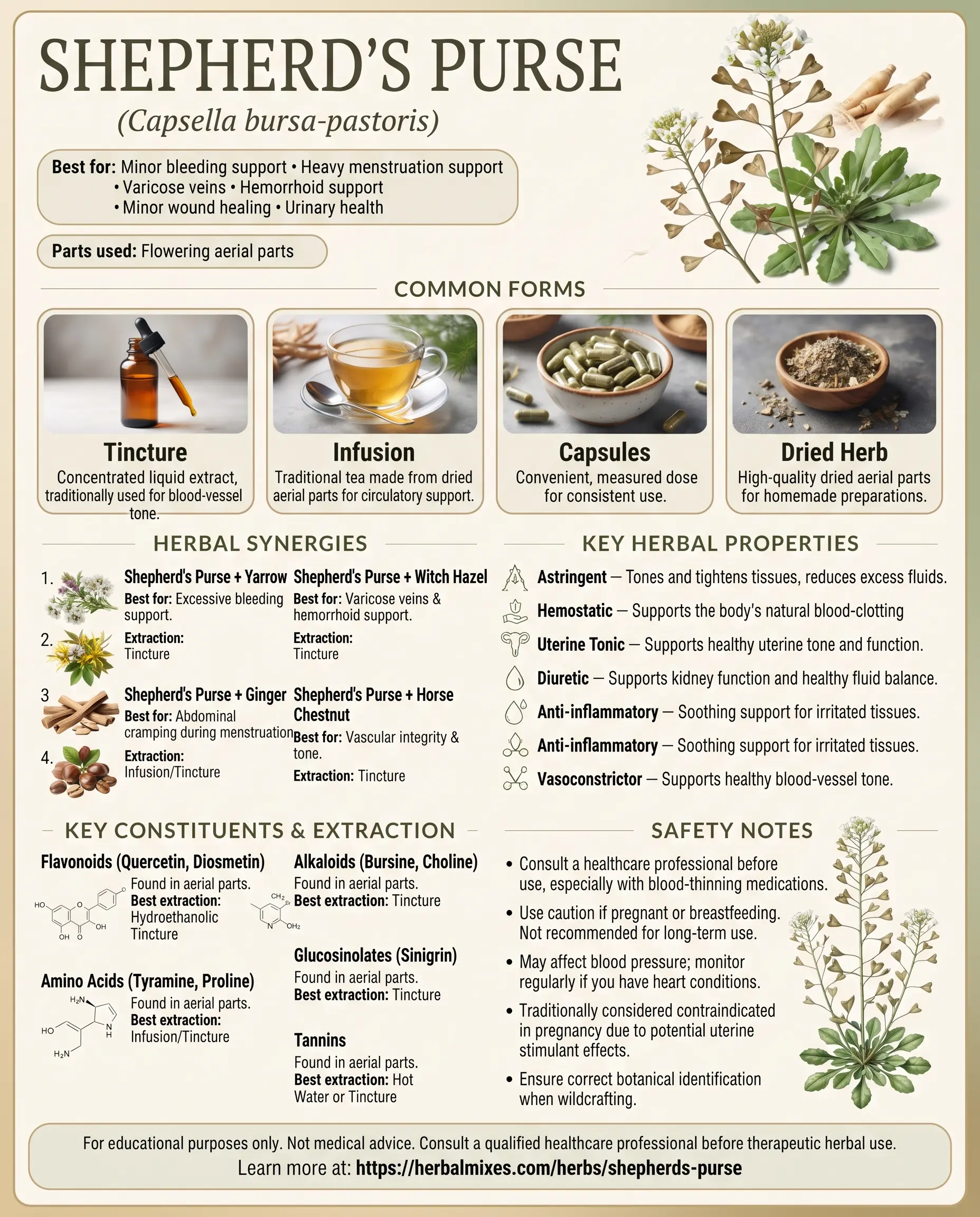
Herbal Synergies
Shepherd’s purse pairs especially well with yarrow, raspberry leaf, nettle, cramp bark, and ginger depending on whether the goal is menstrual bleeding, pelvic tone, cramping, or restorative support.
Shepherd’s Purse + Yarrow
Best for: Traditional heavy menstrual bleeding support
Both herbs have longstanding reputations as astringent and hemostatic botanicals.
Yarrow contributes tannins, flavonoids, and traditional styptic activity, while shepherd’s purse has more specific European recognition for heavy menstrual bleeding.
Best extraction: Hydroalcoholic tincture or strong infusion.
Shepherd’s Purse + Raspberry Leaf
Best for: Heavy menstrual flow with pelvic weakness
Shepherd’s purse provides traditional bleeding-control activity, while raspberry leaf contributes tannin-rich astringency and traditional uterine support.
Best extraction: Shepherd’s-purse tincture combined with raspberry-leaf tea.
Shepherd’s Purse + Nettle
Best for: Menstrual support with nutritional depletion
Shepherd’s purse addresses excessive flow traditionally, while nettle leaf contributes iron-associated minerals, chlorophyll, and nutritive support.
Best extraction: Shepherd’s-purse tincture alongside a long nettle infusion.
Shepherd’s Purse + Cramp Bark
Best for: Heavy flow with menstrual cramping
Shepherd’s purse contributes traditional hemostatic support, while cramp bark provides antispasmodic smooth-muscle support.
Best extraction: Combined tinctures or shepherd’s-purse infusion with cramp-bark decoction.
Shepherd’s Purse + Ginger
Best for: Menstrual discomfort with nausea or digestive tension
Shepherd’s purse addresses excessive flow traditionally, while ginger contributes warming digestive and antispasmodic effects.
Best extraction: Shepherd’s-purse tincture with ginger tea.
People taking anticoagulants or with unexplained heavy bleeding should not experiment with concentrated combinations without professional guidance.
Key Herbal Properties
Hemostatic / antihemorrhagic — traditional and emerging clinical evidence — Shepherd’s purse is best known for reducing excessive bleeding, particularly menstrual bleeding.
Astringent — Phenolics and related compounds contribute tissue-tightening effects.
Uterine active — Traditional use and pharmacological observations suggest effects on uterine tissue, which is important both therapeutically and from a pregnancy-safety standpoint.
Anti-inflammatory — experimental — Phenolic glycosides and sulfur compounds suppress inflammatory mediators in laboratory models.
Antioxidant — Flavonoids, phenolics, sterols, and sulfur compounds contribute antioxidant activity.
Mild diuretic — traditional — Shepherd’s purse has also been traditionally used for mild urinary support.
Digestive supportive — traditional — Ethnomedicinal use includes digestive-system support, though this is much less clinically developed than its gynecological use.





Active Compounds
Shepherd’s purse contains a diverse mixture of flavonoids, phenolic acids, amino acids, phytosterols, sulfur-containing compounds, vitamins, minerals, and biogenic amines.
Rutin
Found mainly in: Flowering aerial parts
Rutin is a flavonoid glycoside that contributes antioxidant and vascular-supportive activity.
It may help support capillary integrity, although it has not been established as the sole compound responsible for shepherd’s purse’s bleeding-related effects.
Best extraction: Hot water or hydroalcoholic extraction.
Quercetin Derivatives
Found mainly in: Aerial parts
Quercetin-related flavonoids contribute antioxidant and inflammatory-modulating activity.
Best extraction: Hot-water infusion or diluted alcohol.
Kaempferol Derivatives
Found mainly in: Aerial parts
Kaempferol glycosides are among the flavonoids identified in the herb and contribute antioxidant activity.
Best extraction: Hot water or hydroalcoholic tincture.
Phenolic Glycosides
Found mainly in: Aerial herb
Several phenolic glycosides have been isolated from shepherd’s purse and have demonstrated anti-inflammatory activity experimentally.
Best extraction: Water or hydroalcoholic extraction.
Organosulfur Compounds
Found mainly in: Seeds and other tissues
As a member of the Brassicaceae family, shepherd’s purse contains distinctive sulfur-containing compounds.
Several organosulfur compounds isolated from the seeds reduced inflammatory mediators in laboratory cells.
Best extraction: Hydroalcoholic extraction provides broad recovery; individual sulfur compounds vary in polarity.
Phytosterols
Found mainly in: Seeds and aerial tissues
Shepherd’s purse contains several plant sterols that contribute to its broader phytochemical profile.
Best extraction: Alcohol-rich or lipid-compatible extraction.
Choline
Found mainly in: Aerial parts
Choline has historically been identified among shepherd’s-purse constituents.
It plays many physiological roles in the human body, but its contribution to the herb’s hemostatic activity remains unclear.
Best extraction: Water.
Tyramine and Related Biogenic Amines
Found mainly in: Aerial parts
Older phytochemical analyses report tyramine, histamine, acetylcholine, and related biologically active amines.
These compounds have been proposed as contributors to cardiovascular or smooth-muscle effects, but their actual clinical significance in modern preparations remains uncertain.
Best extraction: Water or hydroalcoholic preparations.
FAQ
What is shepherd’s purse best used for?
Its best-established traditional medicinal role is heavy menstrual bleeding in women with regular cycles after serious underlying causes have been excluded.
Does shepherd’s purse really reduce heavy periods?
Possibly.
A randomized trial found that adding Capsella bursa-pastoris to mefenamic acid reduced menstrual blood loss more than mefenamic acid plus placebo. More independent research is needed.
How quickly does shepherd’s purse work?
Traditional use often focuses on taking it during active menstrual bleeding, but there is no universally established onset time or standardized dose across commercial products.
Can shepherd’s purse stop postpartum hemorrhage?
It should never be used as a home treatment for postpartum hemorrhage.
One clinical trial studied it in a hospital together with oxytocin, not instead of standard treatment. Postpartum hemorrhage can become life-threatening within minutes.
Is tea or tincture better?
Both are traditional preparations.
Tea extracts flavonoids, phenolics, minerals, and other polar compounds, while a hydroalcoholic tincture offers broader extraction and is the most common commercial format.
Safety & Precautions
Do not use shepherd’s purse during pregnancy without direct professional supervision.
The herb has traditional uterine activity, and current commercial manufacturers specifically advise seeking medical guidance or avoiding pregnancy use. Herb Pharm instructs users to seek expert medical advice before taking its shepherd’s-purse extract during pregnancy.
Safety during breastfeeding has not been adequately established for concentrated medicinal preparations.
The herb may influence uterine contraction, blood pressure, heart rate, and bleeding, although modern interaction data remain incomplete.
Use caution with blood-pressure medications or drugs affecting cardiovascular function.
People taking anticoagulant or antiplatelet medications should discuss medicinal shepherd’s-purse use with a healthcare professional. Heavy bleeding while taking these medicines may indicate excessive anticoagulation and requires evaluation rather than simple herbal suppression.
Because shepherd’s purse has historically been reported to contain tyramine and other biologically active amines, extra caution is reasonable with medications that strongly affect monoamine metabolism, although clinically proven interactions are poorly documented.
Do not use shepherd’s purse to hide or repeatedly suppress unexplained abnormal uterine bleeding.
Heavy periods can result from uterine fibroids, adenomyosis, endometriosis, bleeding disorders, thyroid disease, medication effects, pregnancy complications, polyps, or cancer.
Seek medical evaluation if menstrual bleeding:
- suddenly becomes much heavier than usual;
- repeatedly soaks a pad or tampon every hour;
- lasts longer than about a week;
- causes dizziness, fainting, shortness of breath, or marked weakness;
- occurs after menopause;
- occurs during pregnancy;
- is accompanied by severe pelvic pain.
Postpartum hemorrhage is a medical emergency. Do not delay emergency obstetric treatment while attempting herbal remedies.
Anyone who is pregnant, breastfeeding, taking cardiovascular or blood-thinning medication, or experiencing recurrent heavy bleeding should discuss therapeutic shepherd’s-purse use with an appropriate healthcare professional.
References
- European Medicines Agency — Shepherd’s Purse (Bursae pastoris herba)
- PubMed — Shepherd’s Purse for Heavy Menstrual Bleeding: Randomized Clinical Trial
- PubMed — Shepherd’s Purse Extract and Early Postpartum Hemorrhage
- PubMed — Shepherd’s Purse: Traditional Uses, Bioactive Compounds and Pharmacology
- PubMed — Phenolic Glycosides from Capsella bursa-pastoris
- PubMed — Organosulfur Compounds from Shepherd’s Purse
- PubMed — Antioxidant Constituents of Shepherd’s Purse Seeds
- Herb Pharm — Shepherd’s Purse Liquid Herbal Extract
- HawaiiPharm — Shepherd’s Purse Tincture
- HawaiiPharm — Shepherd’s Purse Alcohol-Free Extract
Disclaimer
Disclaimer: This article is for educational purposes only and is not intended to diagnose, treat, cure, or prevent any disease. Herbal products can cause side effects and interact with medications. Consult a qualified healthcare professional before using herbs therapeutically, especially if you are pregnant, breastfeeding, taking prescription medications, or managing a medical condition.